|
Article: Home PI/PIF Scanning |
Introduction
CDFreaks is the world's largest online source of information on optical storage technology. Our members are very serious about their optical drives, and therefore strongly encouraged to contribute to the knowledge base. The size of this repository of information is largely due to their valuable contributions in our Media and Optical hardware forums on Club CDFreaks.
Credits:
Thank you to the CD Freaks staff team for their help in completing this article.
The purpose of this article:
To assist our members in contributing information, we would like to give them some guidance in the choice of drives for assessing the quality of their recordable DVD discs. Hence, in this article, we will attempt to compare the reading abilities of some of the most popular DVD drives which are used on our forums for Disc Quality Scanning.
The main criteria used to assess the quality of a DVD burn here are the total count of 'Parity Inner Errors' (PIE) and Parity Inner Failures (PIF) that the drive reports as errors as it reads the imperfections distributed across the disc surface. Whilst these are by no means the only factors which determine a good quality burn, they are useful surrogate markers which can be straightforwardly obtained by home users. As with all surrogate markers (for example, blood pressure as an indicator of general human health), their usefulness is limited, but we believe that there is a proportional and reliable relationship between the number of PIE and PIF counts and the general 'health' of a recorded DVD. Therefore, for completeness you should be advised that Disc Quality Scanning which reports PIE/PIF on a burned media is neither an exhaustive nor completely objective measurement but will show us an important part of the full picture. Other factors also have to be considered that can't be assessed by a PI/PIF scan alone: for more information on this you may like to read our explanation in the next section of this article.
You must also take account of the fact that these drives use different scanning speeds and reading methods to report errors in a Disc Quality Scan, which unfortunately makes comparing the drives difficult. Nevertheless, the speeds we have chosen for this article are the same ones chosen as the accepted standards for our forums, except in the case of the Lite-On drive where we use the 4x scanning speed we always use in our reviews here on CDFreaks.
What are the criteria for a good scanning drive?
Read accuracy
Reading the information burned on the disc is of primary importance. Yet as described above we must take into consideration that the scanning drives used in this test are all machines aimed at the home market and that our surrogate marker for such reading accuracy is the PIE/PIF count and distribution. There will inevitably be variations (perhaps introduced by manufacturing differences) between drives of the same brand and even drives of the same model. Without access to professional analyzing hardware such as CATS or Datarius, it is not possible to say with complete certainty that any of these drives report PI/PIF errors in the same way.
Unbiased reading
The scanning drive should be as 'neutral' as possible. By this we mean the scanning drive should be able to scan media which has been burned on any of our test drives equally well. In other words, the drive should not show a bias towards burns made on the scanning drive itself.
Consistency
Our third important factor; a good scanning drive should be able to give broadly similar results with multiple scans of the same disc.
PI/PIF Scanning
For our explanation we will use KProbe and a Lite-On branded drive. In this article 3 of our 4 scanning drives use PI sum 8 and PIF sum 1 to derive a result, the exception being our BenQ drive which uses PI sum 8 and PIF sum 8 to derive its results. For comparability with our other drives which derive their PIF results with Sum 1, one can divide the PIF total by 4 with our BenQ scanning drive to compare the results, although this is an approximate value and not an absolute value. We have taken this calculation into account in the summary of each of our test discs.
Please note: the NEC ND-4570A is capable of scanning using PIF sum 8 or sum 1 and many other combinations. We choose Sum 1 for our tests.
Lite-On with KProbe:
You should first notice that this is not a scientific or professional way to test the discs. But according to our testing done in recent months, we would conclude that there is a clear link between the quality reported when scanning the disc and the playability of the disc in different devices. Also notice that different drives report different amounts of errors. K-Probe was designed to work with Lite-On DVD-Writers, so we recommend using a DVD-Writer from Lite-On. In this test we use a Lite-On SHW-16H5S DVD-Writer, as already said; remember that scans done with a Lite-On DVD-ROM or Lite-On combo drive can't be compared with the results obtained with a Lite-On DVD-Writer. Also remember that different PI/PO ECC sum settings along with different reading speeds in K-Probe will affect the result. We use these settings. PI (Parity Inner) set to summarize 8 ECC blocks, PIF (Parity Inner Failures) set to summarize 1 ECC block, reading speed: 4X CLV (Constant Linear Velocity). Setting the PI sum to 8 and the PIF sum to 1 will give a result that we may compare to the standards for DVD+R/RW and DVD-R/RW.
But what is a good scan? That is a discussion that we don't think will end soon, as different drives report different amounts of errors, some players are pickier about media than others, and so on. But as a comparison we present you with a scan from two pressed DVD discs:
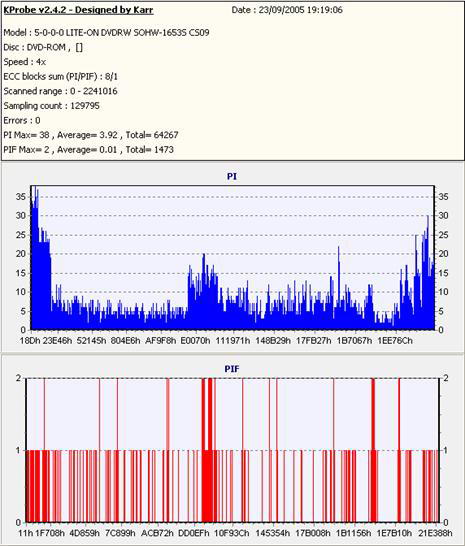
This scan shows the results from a pressed DVD-Video disc (GoldenEye).
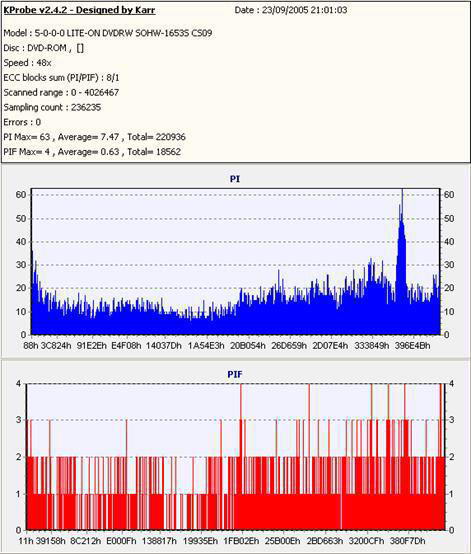
This scan shows the result from a pressed DVD-Video disk (The Green Mile). Notice the error jump when shifting to the second layer (the error level actually drops from the end of the first layer to the beginning of the second layer).
If you read below, you will see that both the pressed DVD-discs are well within the standards.
Download the ECMA 267 Standard for DVD-ROM, the ECMA 337 Standard for DVD+R/RW and the ECMA 338 Standard for DVD-R/RW at http://www.ecma-international.org if you want to look at the standards for yourself. Here is some data from the ECMA standards (same for DVD-ROM, DVD-R/RW and DVD+R/RW):
Random errors:
A row of an ECC Block that has at least 1 byte in error constitutes a PI error. In any 8
consecutive ECC Blocks the total number of PI errors before correction shall not exceed 280.
Here we see that a PI error is defined as a row in an ECC block having 1 byte or more containing errors and that the sum of PI errors in 8 ECC blocks after each other should not exceed 280 PI errors.
But what is a row and what is an ECC block? Again we refer to the ECMA standards. We do not copy and paste everything, but if you're interested, look in the ECMA standards. A row is 182 bytes long where the last 10 bytes contain PI (Parity Inner) information. An ECC block is 208 rows long where the last 16 rows contain the PO (Parity Outer) information. This gives us a maximum possible PI error amount of 208 errors per block and for 8 blocks after each other this sum is of course 8 times higher, giving a maximum possible amount of 1664 PI-8 errors. In practical use, a disc with 1664 PI-8 errors is unreadable.
According to our tests the specified max PI-8 sum of 280 for good discs seems to be a good guideline, as some readers have problems reading discs when the PI-8 errors is over 300 and most players starts to have problems when the PI-8 error level reaches 600 or more.
But what are the PIF errors that K-Probe reports? They are Parity Inner Failures, meaning errors left after PI correction. Only the ECMA 337 standard describes the Parity Inner Failures. So how is a Parity Inner Failure defined? Here is what the ECMA 337 states:
'If a row of an ECC Block as defined in 13.3 contains more than 5 erroneous bytes, the row is said to be 'PI-uncorrectable"."
In theory, an ECC block may in the worst case have 208 PIF since every ECC block is 208 rows long. But the ECMA 337 standard goes further and specifies the max amount of accepted PI Failures (uncorrectable errors) allowed on a good disc:
'In any ECC Block the number of PI - uncorrectable rows should not exceed 4."
This means that when the PIF sum is set to 1, the maximum error value should not exceed 4. The theoretical maximum value for PIF is 208 errors.
But what makes a disc unreadable? A POF (Parity Outer Failure) error will make the disc unreadable, but K-Probe does not display the POF's.
Notice that there are other aspects such as disc reflectivity, jitter, tracking errors and so on that also will affect the readability of a DVD disc '� but for this we do not have measuring equipment available.
Also, another note is that we have scanned the discs at 4X CLV speed, by lowering the speed to 2X(DVD-R/RW)/2.4X(DVD+R/RW) or 1X the amount of reported errors may drop on some discs. We scanned at 4X CLV due to lower speeds taking too much time.
To see if there is a connection between the reported amount of errors and readability of the discs we also include the reading curve from a NEC ND-4570A DVD-Writer. The reason why we have changed the reader is that some companies disliked that we used a modified firmware to obtain 16x reading speed. So to please them, we are now using a drive that reads DVD+R/-R media at 16x as default. A small speed reduction near the end is still accepted on good discs, but serious reading problems or reading failures is a bad sign.
Easier explanation on how to read the test results.
Maybe this has got too technical, and you are wondering what to look for in KProbe reports?
Use this as a guideline for good discs:
- PI (Parity Inner): No larger areas on the disc should exceed 280 PI-8 errors, do not worry too much about high single spikes that exceed 280.
- PIF (Parity Inner Failures): No larger areas on the disc should exceed 4 PIF-1 errors, do not worry too much about high single spikes that exceed 4.
And as always; lower is better 
Now let's head on to the next page where we will take a look at our scanning and burning drives.
Test machine:
For this article we will be using a computer with the following configuration:
Hardware:
- Motherboard: ASUSTeK A8N-SLI DELUXE (nForce 4 SLI chipset)
- Processor: AMD Athlon 64 X2 4400+ (Toledo) Dual Core
- RAM: 2 GB Corsair TWINX 2CL DDR
- GFX: Leadtek Winfast 6600 TD (PCI Express nVidia)
- Sound: SoundBlaster Audigy 2
- Hard disk: 2X 250GB Seagate Barracuda (SATA 2)
Installed Software:
Windows XP Professional is installed on the computer along with Service Pack 2 for Windows XP. We will be using the following software in this article:
Burning Drives:
We used 6 burning DVD-RW drives from 6 different manufacturers to burn our test media
- BenQ DW1640 (firmware BSQB)
- LG GSA-H10N (firmware JJ11)
- Lite-On SHW-16H5S (firmware LS0W)
- NEC ND-4570A (firmware 1.02)
- Pioneer DVR-111 (firmware 1.23)
- Plextor PX-760A (firmware 1.03)
Scanning Drives:
We used 4 scanning drives to test our burned media. Each test media was scanned in each of our scanning drives.
- BenQ DW1640 '� 8x CAV scanning method (firmware BSQB)
- Lite-On SHW-16H5S - 4x CLV scanning method (firmware LS0W)
- NEC ND-4570A - 5x CAV scanning method (firmware 1.02)
- Plextor PX-760A - 2x CLV scanning method (firmware 1.03)
Testing Methods:
Burning the media:
We selected 4 different media for our tests. We selected 2 DVD+R media rated at 8x and 16x respectively, and 2 DVD-R media rated at 8x and 16x respectively. In all cases the media used for the tests came from the same tub of media.
We then burned the media at random on our 6 DVD burners at the media's rated speed.
Scanning the media:
Each scan was done at random and we used (brand in-house software) if available.
The NEC and BenQ scans were conducted using CD-Speed. For our Lite-On drive we used KProbe, and we used PlexTools Professional XL with our Plextor drive. For the Plextor tests, we used the 'Good Accuracy" setting when running our scans.
The Plextor and BenQ drives are capable of testing for Jitter values. Where Jitter tests were available on a drive we also tested this as well. As this article is dealing with PI/PIF scanning and not all of our scanning drives can test Jitter. The Jitter tests are there for reference only. We also note that DVDScan is available as a beta and will report Jitter on some Lite-On models. However, we were unable to make the application work properly on our review PC.
We also used the NEC drive along with CD-Speed to read back our test media using the Transfer Rate Test option on CD-Speed.
Test Media:
Now let's take a look at the media we used for our tests.
DVD+R:


For our 8x DVD+R media we selected Verbatim branded Taiyo Yuden 000T02 (thanks to SVP UK for sending us this media).


For our 16x DVD+R media we selected Verbatim branded MCC004 (thanks to SVP UK for sending us this media).
DVD-R:

For our 8x DVD-R media we selected Ricoh branded CMC MAG AE1 (thanks to Ricoh Europe for sending us this media).


For our 16x DVD-R media we selected Verbatim branded MCC03RG20 (thanks to Verbatim UK for sending us this media).

Now let's head on to the next page were we will look at our first test results……
Verbatim branded - YUDEN000T02:
We created our test data discs using CD-Speed's 'create data disc" function.
Burning drive '� BenQ DW1640:

Burn speed 8x

Transfer Rate Test
Scanning drive '� BenQ DW1640:

Scanning drive '� NEC ND-4570A:

Scanning drive '� Lite-ON SHW-16H5S

Scanning drive '� Plextor PX-760A:


|
Scanning |
PI |
PIF |
|
BenQ |
2.38 |
0.05 |
|
NEC |
3.65 |
0.03 |
|
Lite-On |
0.72 |
0.01 |
|
Plextor |
0.98 |
0.00 |
All our scanning drives show a similar trend, PI levels are however higher with our BenQ and NEC scans.
Burning drive - LG GSA-H10N:

Burn speed 8x

Transfer rate test
Scanning drive '� BenQ DW1640:

Scanning drive '� NEC ND-4570A:

Scanning drive '� Lite-ON SHW-16H5S

Scanning drive '� Plextor PX-760A:


|
Scanning |
PI |
PIF |
|
BenQ |
5.46 |
0.84 |
|
NEC |
3.64 |
0.03 |
|
Lite-On |
0.66 |
0.07 |
|
Plextor |
0.76 |
0.00 |
On this occasion the BenQ and NEC drives show elevated PI errors and a PI spike at roughly the same area of the disc where the writing speed jumped from 6x to 8x. The Lite-On and Plextor drives don't show this.
Burning drive '� Lite-On SHW-16H5S:

Burn speed 8x

Transfer rate test
Scanning drive '� BenQ DW1640:

Scanning drive '� NEC ND-4570A:

Scanning drive '� Lite-ON SHW-16H5S

Scanning drive '� Plextor PX-760A:


|
Scanning |
PI |
PIF |
|
BenQ |
5.93 |
0.05 |
|
NEC |
6.87 |
0.01 |
|
Lite-On |
1.35 |
0.00 |
|
Plextor |
2.57 |
0.00 |
Although none of our drives had any problems in scanning this test disc, the Plextor and Lite-On drives reported the most similar error levels.
Burning drive '� NEC ND-4570A:

Burn speed 8x

Transfer rate test
Scanning drive '� BenQ DW1640:

Scanning drive '� NEC ND-4570A:

Scanning drive '� Lite-On SHW-16H5S:

Scanning drive '� Plextor PX-760A:


|
Scanning |
PI |
PIF |
|
BenQ |
3.49 |
0.02 |
|
NEC |
4.02 |
0.01 |
|
Lite-On |
0.69 |
0.01 |
|
Plextor |
1.01 |
0.00 |
All our scanning drives show a fairly similar trend on this test disc, although the BenQ and NEC drives show higher average PI levels.
Burning drive '� Pioneer DVR-111:

Burn speed 8x

Transfer rate test
Scanning drive '� BenQ DW1640:

Scanning drive '� NEC ND-4570A:

Scanning drive '� Lite-On SHW-16H5S:

Scanning drive '� Plextor PX-760A:


|
Scanning |
PI |
PIF |
|
BenQ |
1.97 |
0.02 |
|
NEC |
2.79 |
0.01 |
|
Lite-On |
0.73 |
0.01 |
|
Plextor |
0.94 |
0.00 |
Once again our scanning drives broadly agreed with each other with this test disc.
Burning drive '� Plextor PX-760A:

Burn speed 8x

Transfer rate test
Scanning drive '� BenQ DW1640:

Scanning drive '� NEC ND-4570A:

Scanning drive '� Lite-On SHW-16H5S:

Scanning drive '� Plextor PX-760A:


|
Scanning |
PI |
PIF |
|
BenQ |
1.75 |
0.01 |
|
NEC |
3.13 |
0.01 |
|
Lite-On |
0.66 |
0.00 |
|
Plextor |
0.97 |
0.00 |
Again all our scanning drives showed a similar trend on this test disc, although the NEC drive in particular showed a higher average level of PI errors .
Summary:
With our Taiyo Yuden YUDEN000T02 8x DVD+R media, all our scanning drives showed a very similar trend with our test media. The exception being, the BenQ DW1640 and NEC ND-4570A which showed elevated PI errors on a couple of our test discs.
Now let's head onto the next page where we will test Verbatim MCC004 16x media…..
Verbatim branded - MCC004:
We created our test data discs using CD-Speed's 'create data disc" function.
Burning drive '� BenQ DW1640:

Burn speed 16x

Transfer rate test
Scanning drive '� BenQ DW1640:

Scanning drive '� NEC ND-4570A:

Scanning drive '� Lite-On SHW-16H5S:

Scanning drive '� Plextor PX-760A:


|
Scanning |
PI |
PIF |
|
BenQ |
1.03 |
0.16 |
|
NEC |
1.67 |
0.06 |
|
Lite-On |
0.31 |
0.01 |
|
Plextor |
0.45 |
0.00 |
All our drives showed a broadly similar trend, although the NEC drive showed some PIF spikes which knocked down the quality score and the BenQ and NEC drives showed higher average PI errors than our Lite-On and Plextor drives.
Burning drive - LG GSA-H10N:

Burn speed 16x

Transfer rate test
Scanning drive '� BenQ DW1640:

Scanning drive '� NEC ND-4570A:

Scanning drive '� Lite-On SHW-16H5S:

Scanning drive '� Plextor PX-760A:


|
Scanning |
PI |
PIF |
|
BenQ |
2.93 |
0.03 |
|
NEC |
1.77 |
0.01 |
|
Lite-On |
0.38 |
0.01 |
|
Plextor |
0.37 |
0.00 |
All our scanning drives showed a broadly similar trend. The NEC and BenQ drives once again showing slightly elevated PI errors.
Burning drive '� Lite-On SHW-16H5S:

Burn speed 16x

Transfer rate test
Scanning drive '� BenQ DW1640:

Scanning drive '� NEC ND-4570A:

Scanning drive '� Lite-On SHW-16H5S:

Scanning drive '� Plextor PX-760A:


|
Scanning |
PI |
PIF |
|
BenQ |
70.55 |
0.91 |
|
NEC |
299.80 |
1.75 |
|
Lite-On |
1.06 |
0.01 |
|
Plextor |
9.39 |
0.00 |
This disc produced very interesting variations in results. Let's first look at the NEC drives result. The cluster of PIF errors at 3.5gig (well out of specification) if correct should render the disc unreadable. Yet the NEC drive itself manages a perfect Transfer Rate Test.
Next let's look at the BenQ result. At the recalibration point. According to the BenQ drive, Jitter rises as does PI and PIF errors. Yet our other drives show no problem at this point of the test disc. Our Plextor and Lite-On scans show no problems with this disc, although the Plextor scan shows elevated PI errors at about half way through the disc.
Burning drive '� NEC ND-4570A:

Burn speed 16x

Transfer rate test
Scanning drive '� BenQ DW1640:

Scanning drive '� NEC ND-4570A:

Scanning drive '� Lite-On SHW-16H5S:

Scanning drive '� Plextor PX-760A:


|
Scanning |
PI |
PIF |
|
BenQ |
5.21 |
0.08 |
|
NEC |
3.98 |
0.03 |
|
Lite-On |
0.84 |
0.03 |
|
Plextor |
1.11 |
0.01 |
The BenQ drive in this instance shows elevated PI and PIF errors compared to our other drives at the end of our test disc. This is most likely caused by its faster scanning speed. However, all our drives show a broadly similar trend.
Burning drive '� Pioneer DVR-111:

Burn speed 16x

Transfer rate test
Scanning drive '� BenQ DW1640:

Scanning drive '� NEC ND-4570A:

Scanning drive '� Lite-On SHW-16H5S:

Scanning drive '� Plextor PX-760A:


|
Scanning |
PI |
PIF |
|
BenQ |
2.12 |
0.05 |
|
NEC |
19.52 |
0.04 |
|
Lite-On |
0.99 |
0.02 |
|
Plextor |
1.71 |
0.01 |
The NEC drive on this occasion shows elevated PI errors, if we can ignore the PIF spike, the NEC drive reports similar PIF errors to the rest of our scanning drives.
Burning drive '� Plextor PX-760A:

Burn speed 16x

Transfer rate test
Scanning drive '� BenQ DW1640:

Scanning drive '� NEC ND-4570A:

Scanning drive '� Lite-On SHW-16H5S:

Scanning drive '� Plextor PX-760A:


|
Scanning |
PI |
PIF |
|
BenQ |
9.81 |
0.04 |
|
NEC |
3.44 |
0.02 |
|
Lite-On |
0.59 |
0.02 |
|
Plextor |
1.71 |
0.00 |
The single PIF spike in the NEC scan spoils what is essentially a good scan. The BenQ and Plextor drives report slightly elevated PI errors near the end of the disc compared to our Lite-On drive. All our drives report fairly similar PIF error averages.
Summary:
With our MCC004 test discs and burning speed now at 16x, the variations in results have become more pronounced. However, our Lite-On and Plextor scanning drives still manage to report broadly similar results.
Now let's head to the next page where we take a look at the first of our DVD-R test results…..
Ricoh branded - CMC MAG AE1:
We created our test data discs using CD-Speed's 'create data disc" function.
Burning drive '� BenQ DW1640:

Burn speed 8x

Transfer rate test
Scanning drive '� BenQ DW1640:

Scanning drive '� NEC ND-4570A:

Scanning drive '� Lite-On SHW-16H5S:

Scanning drive '� Plextor PX-760A:


|
Scanning |
PI |
PIF |
|
BenQ |
28.73 |
0.05 |
|
NEC |
40.33 |
0.04 |
|
Lite-On |
18.71 |
0.02 |
|
Plextor |
24.23 |
0.00 |
Our CAV scanning drives (BenQ and NEC) show fairly comparable results, but what is striking about this test disc, is how our two CLV scanning drives the (Lite-On and Plextor) PI patterns appear to almost identically match, all be it with slightly different overall error rates.
Burning drive '� LG GSA-H10N:

Burn speed 8x

Transfer rate test
Scanning drive '� BenQ DW1640:

Scanning drive '� NEC ND-4570A:

Scanning drive '� Lite-On SHW-16H5S:

Scanning drive '� Plextor PX-760A:


|
Scanning |
PI |
PIF |
|
BenQ |
9.88 |
0.57 |
|
NEC |
72.08 |
0.04 |
|
Lite-On |
2.34 |
0.01 |
|
Plextor |
4.71 |
0.00 |
Once again our two CAV scanning drives (NEC and BenQ) are out of step with each other and with our two CLV scanning drives (Lite-On and Plextor). The BenQ drive showing elevated PIF errors and the NEC showing elevated PI errors. It is also worth noting that this disc was also written by our LG drive. It would appear the BenQ drive has problems scanning some discs written on the LG drive.
Burning drive '� Lite-On SHW-16H5S:

Burn speed 8x

Transfer rate test
Scanning drive '� BenQ DW1640:

Scanning drive '� NEC ND-4570A:

Scanning drive '� Lite-On SHW-16H5S:

Scanning drive '� Plextor PX-760A:


|
Scanning |
PI |
PIF |
|
BenQ |
45.20 |
0.04 |
|
NEC |
19.90 |
0.12 |
|
Lite-On |
37.22 |
0.02 |
|
Plextor |
17.45 |
0.00 |
This time the BenQ and Lite-On drives show elevated PI errors compared to the NEC and Plextor drives. The NEC drive does report more PIF errors compared to our other scanning drives.
Burning drive '� NEC ND-4570A:

Burn speed 8x

Transfer rate test
Scanning drive '� BenQ DW1640:

Scanning drive '� NEC ND-4570A:

Scanning drive '� Lite-On SHW-16H5S:

Scanning drive '� Plextor PX-760A:


|
Scanning |
PI |
PIF |
|
BenQ |
13.09 |
0.23 |
|
NEC |
24.77 |
0.08 |
|
Lite-On |
22.50 |
0.03 |
|
Plextor |
11.87 |
0.01 |
All our scanning drives on this occasion show a broadly similar trend, although the NEC and Lite-On drives report elevated levels of average PI errors.
Burning drive '� Pioneer DVR-111:

Burn speed 8x
Transfer rate test
Scanning drive '� BenQ DW1640:

Scanning drive '� NEC ND-4570A:

Scanning drive '� Lite-On SHW-16H5S:

Scanning drive '� Plextor PX-760A:


|
Scanning |
PI |
PIF |
|
BenQ |
2.60 |
0.06 |
|
NEC |
26.04 |
0.04 |
|
Lite-On |
1.34 |
0.03 |
|
Plextor |
1.71 |
0.01 |
All our drives show broadly the same trend with this test disc, although the NEC PI average errors levels are elevated compared to our other drives
Burning drive '� Plextor PX-760A:

Burn speed 8x

Transfer rate test
Scanning drive '� BenQ DW1640:

Scanning drive '� NEC ND-4570A:

Scanning drive '� Lite-On SHW-16H5S:

Scanning drive '� Plextor PX-760A:


|
Scanning |
PI |
PIF |
|
BenQ |
2.89 |
0.04 |
|
NEC |
27.54 |
0.04 |
|
Lite-On |
3.96 |
0.01 |
|
Plextor |
1.71 |
0.01 |
On this test disc the NEC drive shows elevated PI errors; PIF errors on all our scanning drives are broadly similar.
Summary:
Our Ricoh branded CMC MAG AE1 test discs, once again we have shown the Lite-On and Plextor drives give the most similar results. Although with the writing speed at 8x except on a couple of occasions, the difference is reduced.
Let's head on to the next page and our final set of media tests……
Verbatim branded - MCC03RG20:
We created our test data discs using CD-Speed's 'create data disc" function.
Burning drive '� BenQ DW1640:

Burn speed 16x

Transfer rate test
Scanning drive '� BenQ DW1640:

Scanning drive '� NEC ND-4570A:

Scanning drive '� Lite-On SHW-16H5S:

Scanning drive '� Plextor PX-760A:


|
Scanning |
PI |
PIF |
|
BenQ |
4.89 |
0.04 |
|
NEC |
26.82 |
0.04 |
|
Lite-On |
7.76 |
0.02 |
|
Plextor |
4.07 |
0.01 |
All our scanning drives show broadly similar PIF errors, the NEC drive however shows elevated PI errors on this test disc compared to our other drives.
Burning drive '� LG GSA-H10N:

Burn speed 16x
Transfer rate test
Scanning drive '� BenQ DW1640:

Scanning drive '� NEC ND-4570A:

Scanning drive '� Lite-On SHW-16H5S:

Scanning drive '� Plextor PX-760A:


|
Scanning |
PI |
PIF |
|
BenQ |
23.91 |
0.05 |
|
NEC |
64.12 |
0.07 |
|
Lite-On |
2.84 |
0.02 |
|
Plextor |
1.24 |
0.00 |
The BenQ and NEC drives show higher average PI error levels compared to the Lite-On and Plextor drives. Again our two CLV scanning drives (Lite-On and Plextor) prove to give the most similar results.
Burning drive '� Lite-On SHW-16H5S:

Burn speed 16x

Transfer rate test
Scanning drive '� BenQ DW1640:

Scanning drive '� NEC ND-4570A:

Scanning drive '� Lite-On SHW-16H5S:

Scanning drive '� Plextor PX-760A:


|
Scanning |
PI |
PIF |
|
BenQ |
40.69 |
0.07 |
|
NEC |
72.46 |
0.26 |
|
Lite-On |
15.27 |
0.02 |
|
Plextor |
18.73 |
0.01 |
The NEC scan is very much out of step with the other drives, and once again the BenQ drive has problems at the recalibration point and shows higher average levels of PI errors. The Lite-On and Plextor drives once again appear to show us the more comparable results.
Burning drive '� NEC ND-4570A:

Burn speed 16x

Transfer rate test
Scanning drive '� BenQ DW1640:

Scanning drive '� NEC ND-4570A:

Scanning drive '� Lite-On SHW-16H5S:

Scanning drive '� Plextor PX-760A:


|
Scanning |
PI |
PIF |
|
BenQ |
7.15 |
0.08 |
|
NEC |
26.56 |
0.11 |
|
Lite-On |
3.75 |
0.01 |
|
Plextor |
1.27 |
0.00 |
Our NEC scanning drive shows elevated PI errors on this test disc. The BenQ scanning drive shows POF errors on the disc. We have to question this as the Plextor drive is also capable of reporting POF and does not report any. The Transfer Rate Test of the disc is also perfect. Once again it appears that the Lite-On and Plextor drives show the most consistency with their results.
Because the BenQ drive had reported POF errors on this test disc. We decided to also run a Transfer Rate Test on the BenQ drive. As we can see from the screenshot below, we can see no reason why the BenQ drive reported POF errors on this disc.

Burning drive '� Pioneer DVR-111:

Burn speed 8x

Transfer rate test
Scanning drive '� BenQ DW1640:

Scanning drive '� NEC ND-4570A:

Scanning drive '� Lite-On SHW-16H5S:

Scanning drive '� Plextor PX-760A:


|
Scanning |
PI |
PIF |
|
BenQ |
4.69 |
0.14 |
|
NEC |
38.08 |
0.08 |
|
Lite-On |
0.86 |
0.02 |
|
Plextor |
1.32 |
0.00 |
This time our NEC reports elevated errors on our test disc compared to our other drives.
Burning drive '� Plextor PX-760A:

Burn speed 16x

Transfer rate test
Scanning drive '� BenQ DW1640:

Scanning drive '� NEC ND-4570A:

Scanning drive '� Lite-On SHW-16H5S:

Scanning drive '� Plextor PX-760A:


|
Scanning |
PI |
PIF |
|
BenQ |
4.94 |
0.04 |
|
NEC |
18.49 |
0.05 |
|
Lite-On |
5.33 |
0.03 |
|
Plextor |
3.74 |
0.00 |
Once again our NEC scanning drive is out of step with our other scanning drives. Our other drives show broadly similar results.
Summary:
With our Verbatim branded MCC03RG20 test discs, our results once again show the Lite-On and Plextor drives to report broadly similar results. The NEC and BenQ drives have problems with some discs burned on a few of our burning drives.
On the next page we will run basic scanning consistency tests on our scanning drives.....
Basic scanning consistency test:
The purpose of this test is to test out the scanning consistency of our scanning drives. The aim of the test is to scan the same piece of media 5 times on each of our scanning drives. We should point out that we don't expect any of these drives to scan with 100% consistency.
Testing method:
We chose one piece of Taiyo Yuden YUDEN000T02 media and burned the disc at its rated speed of 8x on the Sony AW-G170A (firmware 1.71)

Our next task was to scan the prewritten media on each of our scanning drives 5 times in succession. After each scan, the disc was ejected then reloaded before continuing to the next scan. In the case of our Plextor drive which requires two passes to complete a PI/PIF test. The disc was not ejected after the SUM8 test, the SUM1 test was run then the disc was ejected and reloaded before starting the next scan.
The obtained results can be seen below.
BenQ DW1640:
Scan 1

Scan 2

Scan 3

Scan 4

Scan 5

|
BenQ |
PI |
PIF |
|
Scan |
38164 |
133 |
|
Scan |
41120 |
130 |
|
Scan |
40287 |
140 |
|
Scan |
87993 |
146 |
|
Scan |
46107 |
141 |
Scan 4 let the drive down badly, had the drive not reported a much higher PI total in this scan, the BenQ DW1640 result would have been reasonable.
Lite-On SHW-16H5S:
Scan1

Scan 2

Scan 3

Scan 4

Scan 5

|
Lite-On |
PI |
PIF |
|
Scan |
12637 |
107 |
|
Scan |
12992 |
115 |
|
Scan |
13252 |
111 |
|
Scan |
12405 |
111 |
|
Scan |
12890 |
114 |
The Lite-On SHW-16H5S did well in our consistency tests; the PI totals are all pretty similar as are the PIF totals.
NEC ND-4570A:
Scan 1

Scan 2

Scan 3

Scan 4

Scan 5

|
NEC |
PI |
PIF |
|
Scan |
20874 |
210 |
|
Scan |
22294 |
213 |
|
Scan |
22367 |
259 |
|
Scan |
22039 |
129 |
|
Scan |
22008 |
146 |
The NEC ND-4570A did well in the PI ratings, but was let down badly with apparently random PIF spikes.
Plextor PX-760A:
Scan 1


Scan 2


Scan 3


Scan 4


Scan 5


|
Plextor |
PI |
PIF |
|
Scan |
18010 |
358 |
|
Scan |
17456 |
364 |
|
Scan |
17250 |
352 |
|
Scan |
17214 |
346 |
|
Scan |
17568 |
350 |
The Plextor PX-760A did well with our consistency tests. The totals are all pretty similar, a good result.
Summary:
Once again the drives from Plextor and Lite-On came out the winners in our scanning consistency tests. We would however like to point out that the number of samples taken were low (5 scans on each drive) and this could in some way account for the widely varying results with the BenQ and NEC drives.
This concludes our tests. Let's head over to the last page where you can read our conclusion….
Scanning drive summary
BenQ DW1640:
Our BenQ DW1640 scanned the media it burned fairly well. It is also a fairly fast scanning drive; PI/PIF and Jitter are all reported in a single pass.
The main problem with the BenQ DW1640 was scanning media burned on other drives, where it did not seem to scan the test discs in a neutral manner.
Positive:
- Completes the scan quickly.
- Inexpensive to buy.
- Is able to scan its own recordings fairly well.
- Reports Jitter and POF.
- Can use a CLV scanning method
Negative:
- Does not provide neutral scans on some media burned on other drives.
- Uses sum 8 for deriving its PIF results.
- Did not do well in our consistency tests.
Lite-On SHW-16H5S:
Our Lite-On SHW-16H5S proved very reliable with our scanning tests. The drive is also capable of using a CLV scanning method which we believe is a must for reliable PI/PIF scanning. PI and PIF are reported in a single pass.
The Lite-On SHW-16H5S didn't seem to mind on which drive the media had been burned and remained neutral throughout our tests. This is also important for reliable Disc Quality Scanning.
Positive:
- Neutral scanning behaviour (does not mind which drive the media was burned on).
- Good scanning consistency
- Completes the scan fairly quickly.
- Can use a CLV scanning method.
- Inexpensive to buy.
Negative:
- Does not currently report Jitter with the current version of KProbe.
NEC ND-4570A:
The NEC ND-4570A displayed many problems during our tests. It nearly always displayed elevated PI errors and in some cases was totally out of step compared to our other scanning drives.
It did however manage to scan its own burned media fairly well, and reports PI and PIF in a single pass.
Positive:
- Can use sum 1 to derive its PIF results.
- Inexpensive to buy.
- Is able to scan its own recordings fairly well.
Negative:
- Does not provide neutral scans on some media burned on other drives.
- Slow 5x CAV scanning method.
- Does not support Jitter tests.
- Did not do well in our scanning consistency tests.
Plextor PX-760A:
The Plextor PX-760A is by some margin the most expensive drive and the slowest scanning drive in our tests. It does however produce very neutral scans, regardless of the drive used for burning the disc.
With the PlexTools Professional/XL suite of test applications, it also supports an amazing amount of media tests. The biggest problem with the Plextor is the amount of time needed for running the tests. The drive requires a separate pass for scanning PI, PIF, and Jitter.
Positive:
- Neutral scanning behaviour (does not mind which drive the media was burned on).
- Good scanning consistency
- Can report Jitter and POF.
- Uses a CLV scanning method.
- Advanced tests via PlexTools Professional/XL
Negative:
- Expensive to buy
- Very slow scanning speeds
- Requires a separate pass for each test.
Conclusion
While the NEC ND-4570 and BenQ DW1640 drives could prove useful for scanning their own burned media, in a system where only one drive space is available and the user particularly wanted one of these drives. These two drives proved not to be neutral when scanning media burned on other drives.
There is also the matter of scanning drives following the criteria for Disc Quality Scanning according to the ECMA standard. One of the requirements of this standard is for the scan to be done using a CLV reading method. The NEC drive is not able to perform this task at a reasonable scanning speed, (by reasonable we mean 2x '� 4x scanning speed).
While 4x CLV is an option in CD-Speed when using the BenQ drive, this option is fairly recent and the forum standard is 8x using a CAV reading method. We therefore find it difficult to recommend these two drives for serious home PI/PIF scanning.
This now leaves us with the Lite-On SHW-16H5S and Plextor PX-760A drives. Both these drives scan media in a very neutral fashion and proved this with all our tested media, time after time reporting fairly similar results. These two drives also did well with our scanning consistency tests.
We would also like to note, that both these drive manufacturers show great faith in their drives ability to do PI/PIF testing, by making available specialised software specifically for this task.
The Plextor drive probably has the most complete set of diagnostic features of any DVD writer aimed at the home user. But this feature set does not come cheap. There is also the matter of the time the Plextor PX-760A drive takes to complete its results.
The Lite-On SHW-16H5S drive by contrast is very inexpensive and completes a Disc Quality Scan in a very reasonable amount of time using a 4x CLV reading method, and does a PI/PIF scan in a single pass. And as we have seen from our tests, the Lite-On SHW-16H5S scanned our test media in a very neutral manner and did not mind which drive had burned the media.
To sum up, this is what we would say. We conclude that the drives from Lite-On and Plextor performed the most reliably in our tests. If we consider the price of these drives and the time taken to complete the tests, the Lite-On drive has to be the logical choice.
You may comment on this article below or in this forum thread
Thanks to:
 SVP Communications '� The United Kingdom for providing the media used in this review.
 Verbatim - Germany and United Kingdom for providing the media used in this review.
 Ricoh Europe '� For providing the media used in this review.