
 |
Review: ASUS DRW-2014L1T |
ASUS USA was kind enough to send us their latest LightScribe DVD Burner: the Asus DRW-2014L1T internal SATA drive. The newest DVD burner from ASUS incorporates DVD-RAM recording, creating a true DVD Multi drive. Single layer 4.7GB DVD burning is supported at 20X max. Double Layer and Dual Layer Recording speed is 8X max. DVD Rewriteable speeds are 8X max for DVD+RW and 6X max for DVD-RW respectively. DVD-RAM recording is supported at 14X max. Very fast 48X max CD-R burning and 32X max CD-RW.
We invite you to have a look at the “Press Release” announcing this drive.
In this review we will show the performance of the DRW-2014L1T by running the drive through many tests on a considerable amount of various CD/DVD media.
Company Information

ASUS, a technology-oriented company blessed with one of the world’s top R&D teams, is well known for high-quality and innovative technology. As a leading provider of 3C (computers, communications and consumer electronics) total solutions, ASUS offers a complete product portfolio to complete in the new millennium.
In 2006, the company shipped 55 million motherboards, which means one in three desktop PCs sold last year was powered by an ASUS motherboard. Our 2006 revenues reached US$16.5 billion, and are expected to garner US$23 billion in 2007.
ASUS product’s top quality stems from product development. It’s like learning Chinese Kung-Fu; one must begin with cultivating the “Chi” and inner strength. Besides innovating cutting-edge features, ASUS engineers also pay special attention to EMI (electromagnetic interference), thermal, acoustics and details that usually go unnoticed to achieve complete customer satisfaction. ASUS notebooks are the first TCO’99- certified notebooks worldwide. The requirements for this honor include radiation emission control, energy (batter consumption), ecology (environment friendly) and ergonomics.
To succeed in this ultra-competitive industry, great products need to be complimented by speed-to-market, cost and service. That’s why all 100,000 over employees of ASUS strive for the “ASUS Way of Total Quality Management” to offer the best quality without compromising cost and time-to-market while providing maximum value to all customers through world-class services.
With unyielding commitment to innovation and quality, ASUS won 2,168 awards in 2006, meaning on average, the company received over 5 awards everyday last year. BusinessWeek ranked ASUS amongst its “InfoTech 100” for the 9th straight year. The readers of Tom’s Hardware Guide, the world’s largest IT website, selected ASUS as the best maker of motherboards and graphics cards. Furthermore, the company is ranked as No.1 in quality products and services by the Wall Street Journal.

Drive Specifications

Multi Function: (X MULTI+LightScribe)
Max Write: 20X DVD+R/8X DVD+RW/6X DVD-RW/8X DVD+R (DL)
Max Write: 48X CD-R/32X CD-RW
Max Read: 16X DVD-ROM/48X CD-ROM/12X DVD-RAM
Max Write: 14X DVD-RAM

Over-Speed Burning
Burn 2.4X DVD+R (Double Layer) Disc at 8X Speed
FlextraLink™ Buffer Under-run Errors Prevention Technology
Built-in FlextraLink prevents users from buffer under-run problems and eliminates the creation of unusable discs. Throughout the recording process, FlextraLink consistently monitors the data buffer status to ensure best recording quality under high-speed operation.

FlextraSpeed™
Built-in FlextraSpeed and AI Auto Speed Adjustment Tech. enhance accuracy and reliability when reading/writing/re-writing across a broad range of certified media in different formats. FlextraSpeed continuously monitors the recording media and sets the optimal writing speeds to ensure best recording quality. The ASUS proprietary FlextraSpeed occupies minimal system resources so the PC remains full operational and available for other applications even during recording process.
Auto Vibration Reducing System (AVRS)
The DDSSII technology is designed to minimize the vibration caused by the spindle motor and resonance between components as well as the drive and PC cases. AVRS is designed to reduce vibration and noise induced by unbalanced mass of rotating machinery. With AVRS, the ASUS DRW-2014L1T provides high readability and playability

-
Compatible with Wide Range of Disc Formats
-
Operates on Horizontal or Vertical Mounting
-
ASUS Unique Live Firmware Update Tool
-
Bundle Burning Software
-
Windows XP/NT/2000/Vista Supported
LightScribe
The ASUS DRW-2014L1T as a LightScribe drive enables images to be burned onto LightScribe Discs, both CD and DVD. Make a label whenever and wherever you want with your PC and burner. It is Simple, Compatible and Flexible.


What’s inside the box?
The drive we received was a retail package that comes with all you need for an easy and quick installation. The retail package includes the following:
-
Internal SATA Drive ASUS DRW-2014L1T
-
Nero 7 Essentials CD Version V7.5.14.4
-
Quick installation guide

Retail Package Contents
Moving right along, let’s take a closer look at the Package Details.

Box Front

Box Rear


Box Left and Right


Box Top and Bottom
Now let’s take a closer look at the drive itself:

Drive Front

Drive Rear

Drive Left

Drive Right

Drive Bottom

Drive Top

Drive Sticker


Drive Insides
Test machine
For this review we are testing the ASUS DRW-2014L1T mounted inside of our Intel based system with the following components:
-
Motherboard: ASUSTek, P5K Deluxe
-
Processor: Intel Core 2 Duo E6600, 2.4GHz
-
Memory: 4GB G-SKILL DDR2-800
-
Video: GeForce 8600 GTS
-
Sound: SoundMAX integrated Digital HD Audio, onboard
-
Hard Disks: 250GB Seagate SATA-II, X2
-
Optical Drives: Lite-On DVDRW LH-20A1H, Lite-On DH20A3P, LG GSA-H62L , ASUS BC-1205PT, Optiarc DVD RW AD 7170A, BenQ DW1650, Lite-On CD-RW SOHR-5239V, and the ASUS DRW-2014L1T
System set-up:

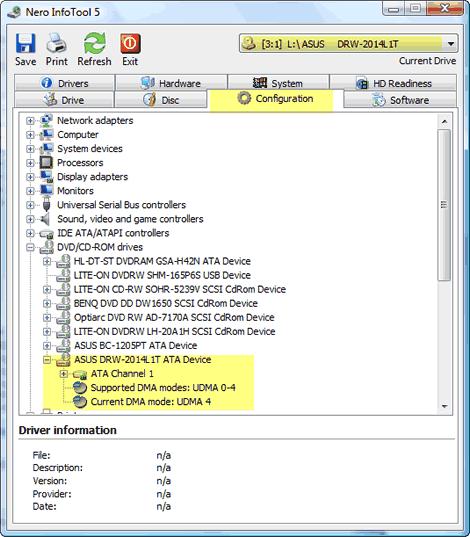
The drive identifies itself as: ASUS DRW-2014L1T and is installed SATA, with firmware 1.00 with a 2MB buffer.
Software
Windows Vista Business 32bit installed on our test system; we will also be using the following software for this review:
-
Nero Burning Rom 8 Ultra Enhanced
-
Nero CD-DVD Speed
-
Nero InfoTool
-
Slysoft CloneCD
-
K-Probe 2.5.2
Included Software with the Drive

The ASUS DVD Software CD will install the powerful ASUS Nero 7 Essentials; ASUS version number D071 V7.5.14.4. This suite of software will allow you to create and copy digital audio, data, photo, and video programs on both CD’s and DVD’s. The package includes:
-
Nero StartSmart
-
Nero Burning Rom 7SE and Nero Express 7
-
Nero VisionExpress 4
-
Nero InCD 5
-
Nero ShowTime
-
Nero PhotoSnap/PhotoSnap Viewer
-
Nero MediaHome
-
Nero Recode
-
Nero BackItUp
-
Nero MediaPlayer/Wave Editor
-
Nero Cover Designer
-
Nero Toolkit
-
ASUS Update
Book type (bitsetting):
Automatic bitsetting is supported by the ASUS DRW-2014L1T. DVD+R, DVD+RW and DVD+R DL will burn at DVD-ROM booktype; the Drive will remember these settings so once you have it set you won’t need to change it unless you want to make future changes.
To support our findings we burned an ISO to both a Single Layer and a Double Layer DVD+R media with Nero Burning Rom and then checked it with Nero DiscSpeed; here are the results:

Details from the SL burn with Nero Burning Rom

Details from the DL burn with Nero Burning Rom
Once we finished burning our Image to both the SL and DL media we checked the “Book Type” from within Nero DiscSpeed:

Single Layer

DL Layer
Writing technique
Now it’s time to take a closer look at the write technology used by the ASUS DRW-2014L1T:
For these tests we used CD-Speed and wrote a full disc at the drives maximum speed.
CD Recordable:
According to the specifications of the ASUS DRW-2014L1T, it should be able to write CD-R media at a maximum speed of 48X on supported media.

The ASUS DRW-2014L1T used CAV, (Constant Angular Velocity), to write at its maximum speed of 48X. This gives an average speed of 35.67X with a total write time of 2 minutes and 52 seconds.
For comparison we have made the following table:

CD-Rewritable

The ASUS DRW-2014L1T uses Z-CLV (Zone-Constant Linear Velocity) to write CD-RW media at its maximum speed of 32x, with an average write speed of 23.95x and writing time of 3 minutes 51 seconds.
For comparison we have made the following table:

20x DVD+R/-R writing speed
According to the specification of the ASUS DRW-2014L1T, it is able to write supported DVD+R/-R media at a maximum speed of 20X.
The ASUS engineers have advised us that current media that is certified at 16X may be written at 20X, however in some cases should the drive sense a potential problem it will on its own reduce the speed to affect the best possible write.
Below you will see the initial write curve is on a 20X path and you can see where the drive slowed itself to an ending speed of 15.99X on the DVD+R and to 16.06X on the DVD-R test discs.
20x DVD+R

The ASUS DRW-2014L1T uses P-CAV (Partial Constant Angular Velocity) to write DVD+R at the maximum supported speed of 20x according to CDSpeed, however it should be writing in CAV (Constant Angular Velocity). This results in an average write speed of 13.65x and a writing time of just 5 minutes and 15 seconds.
20x DVD-R

The ASUS DRW-2014L1T uses CAV (Constant Angular Velocity) to write DVD-R at the maximum supported speed of 20x according to CDSpeed. This results in an average write speed of 14.36x and a writing time of just 4 minutes and 55 seconds.
Here we have prepared a table to show how the ASUS DRW-2014L1T compares with other 18X and 20X burners:

As you can see the ASUS DRW-2014L1T performs on average looking at write times when compared with our other tested burners.
Let’s take a look at how it handles burning at 16X.
16x DVD+R and DVD-R

DVD+R

DVD-R
The ASUS DRW-2014L1T uses CAV (Constant Angular Velocity) strategy to write to both our Verbatim and Sony 16X test media (DVD+R and DVD-R) and is able to burn them at 16X. The +R was writen in 6 minutes and 01 seconds while the –R media was completed in 6 minutes and 13 seconds.
8x DVD+RW

The ASUS DRW-2014L1T uses Z-CLV (Zone-Constant Linear Velocity) to write DVD+RW at 8x. The average speed is 7.48x and total writing time is 7 minutes and 45 seconds.
For comparison we have made the following table:

6x DVD-RW

The ASUS DRW-2014L1T uses CLV (Constant Linear Velocity) to write DVD-RW at 6x. The average speed is 5.94x and total writing time is 10 minutes and 33 seconds.
For comparison we have made the following table:

As you can see the ASUS DRW-2014L1T was the slowest when compared with the other drives we have tested.
Let’s take a look at DVD+R/-R writing techniques……
8x DVD+R DL
According to the specifications of the ASUS DRW-2014L1T, it should be able to write DVD+R DL at a maximum speed of 8X. Here are our results.

The ASUS DRW-2014L1T uses Z-CLV, (Zoned Constant Linear Velocity), to write at its maximum speed of 8X. This gives an average speed of 6.55X and a total writing time of 19 minutes and 01 seconds.
8x DVD-R DL
According to the specifications of the ASUS DRW-2014L1T, it should be able to write DVD-R DL at a maximum speed of 8X. At this time your review team is not able to obtain any high speed DVD-R DL media to test for this review. We will show you a 4X burn using RiDATA DVD-R DL media.

The ASUS DRW-2014L1T uses Z-CLV, (Zoned Constant Linear Velocity), to write at 4X with this media with an average speed of 3.88X and a total write time of 28 minutes and 14 seconds.
DVD-RAM
The specifications for the ASUS DRW-2014L1T state that the drive is capable of writing DVD-RAM at 14X. Let’s take a look at the write strategy for this media.
14X DVD-RAM Writing

The ASUS DRW-2014L1T uses CAV (Constant Angular Velocity), to write at is maximum speed of 12X. This gives an average speed of 10.31X and a total writing time of 6 minutes and 00 seconds.
Summary
The ASUS DRW-2014L1T performed well with our writing tests. We regret that we do not have some of the high speed rated media to test with at this time; when the media is available to us we will post scans of further burning tests in the appropriate threat here at CDFreaks. We would also like to see this drive be able to burn more media at its 20X rated speed.
Let’s move on ahead and check out the reading performance on the next page…..
Reading performance
We will using Nero CD/DVD-Speed to read various CD and DVD Discs; both burned and pressed for the Reading Performance section of the review.
Pressed CD-ROM discs
We used an original pressed CD-ROM disc containing 72.39.55 minutes of data.

The ASUS DRW-2014L1T reached 45.99X, so how does that compare with other newer drives, let’s take a look here:

The ASUS DRW-2014L1T reads on average with the other drives in speed and seek times.
CD-Recordable Discs
For this test we used a Data CD-R that we created with Nero CD-DVD Speed in “create data disc” mode. The disc was a Maxell 48X certified disc manufactured by Ritek. (Thanks to Maxell for sending us this media.)

The ASUS DRW-2014L1T reached the speed of 40.98X when reading a full CD-R disc. Let’s take a look on how that compares with other drives.

With our CD-Recordable Disc the ASUS DRW-2014L1T is one of the slowest of our other tested drives.
CD-Rewritable discs
For the CD-Rewritable tests we created a Data CD using Nero CD-DVD Speeds’ “create data disc”. We used a Verbatim 32X CD-RW. (We thank Verbatim USA for sending us this media)

The ASUS DRW-2014L1T reaches a read speed of 41.00X; let’s compare this with our other tested drives:

The ASUS DRW-2014L1T performed on average while reading our CD-Rewritable disc.
Audio – Digital Audio Extraction
To test digital audio extraction performance with the ASUS DRW-2014L1T we used Nero CD-DVD Speed to measure the transfer rate; the audio disc we used is 74:00:00 in length.

The ASUS DRW-2014L1T reached the speed of 39.73X when reading our Audio-CD; let’s take a look on how that compares with our other tested drives below:

The ASUS DRW-2014L1T was the slowest in regards to speed, however, the seek times were very good.
Advanced audio – DAE quality test
For the Advanced Audio DAE test we used the “Advanced DAE Quality Test” feature of Nero CD-DVD Speed. The CD-R media used is a 40X certified Memorex Music CD-R manufactured by Ritek. (Thanks to Memorex USA for sending us this media.)


The ASUS DRW-2014L1T will permit “On-The-Fly” copying at all tested speeds through 16X; the drive does not support reading data form the Lead-in or Lead-Out.
DVD reading performance
We utilized Nero CD-DVD Speed to measure the reading performance. We will to the reading performance testing on various types of DVD discs. To start off with we will test the ASUS DRW-2014L1T at reading “Pressed” DVD-Video discs both Single Layer and Double Layer.

DVD-Video Single Layer

DVD-Video Double Layer
The ASUS DRW-2014L1T read the SL DVD-Video disc at 16.18X and the DL DVD-Video disc at 8.25X. The specifications for the ASUS DRW-2014L1T state that the drive should read DVD-ROM SL Video at 16X speed and DVD-ROM DL Video at 8X; let’s take a look below to see how this drive compared with other we have tested:

DVD+R/RW
For testing the read speed of DVD+R and DVD+RW discs we used Verbatim 16X DVD+R and 8X DVD+RW. Both Discs were written with 4.38GB of data using Nero CD-DVD Speed. (Thanks to Verbatim USA for sending us this media.) See the results below:

DVD+R

DVD+RW
We have prepared this table to show you how the ASUS DRW-2014L1T reads DVD+R/RW media as compared with other drives:

The ASUS DRW-2015L1T is among the slowest of our drives at reading DVD+R/RW media.
DVD-R/RW
For testing the DVD-R and DVD-RW reading performance we used Verbatim discs we used Verbatim 16X DVD-R and 6X DVD-RW. (Thanks to Verbatim USA for sending us this media.) Below you will find our test results.

DVD-R

DVD-RW
We have also provided this table to show how the ASUS DRW-2014L1T compares with other drives for reading these media:

Here again the ASUS DRW-2014L1T is among the slowest of our tested drives at reading DVD-R/RW media.
DVD±R DL
For this test we used a Verbatim 8X DVD+R DL disc and a Verbatim 4X DVD–R DL disc filled with 7.96GB of data. (Thanks to Verbatim USA for sending us this media.)

DVD+R DL

DVD-R DL
The ASUS DRW-2014L1T reads both media at 8X.
DVD-RAM
For this part of our test we are using a Maxell 12x DVD-RAM filled with 4.27GB of data. Our test results are found below:

The ASUS DRW-2014L1T will read DVD-RAM at 12X; reading this disc in 5 minutes and 37 seconds.
Writing Quality with CD-R/RW discs
Now we are going to test CD-R discs from different CD-R manufacturers. To measure the write speed we will use the “Create Data CD” function from within Nero DiscSpeed. We wrote these discs at the maximum speed that the drive supports. For the quality test, we also used Nero DiscSpeed. DiscSpeed runs under Windows and supports several drives. Also note that different drives and different reading speeds may affect the results obtained when scanning the discs. We used a BenQ DVD DW1650 with firmware BCDC and scanned these discs at 48X speed.
Disc Quality Scanning - C1/C2 (and CU); here is an explanation in more detail:
CDs use an error detection and correction system (CIRC) which is for the most part not seen by the user when reading the disc. We can get a working idea of the quality of the media in question by performing Disc Quality Scanning that will show us the amount of errors the drive is detecting and correcting while reading the media.
There is more than one way to handle C1 and C2 error detection/correction, but a simple and common way is to detect and correct up to two errors per frame in each stage and detect three or more errors:
-
E11: 1 error detected and corrected by C1 layer
-
E21: 2 errors detected and corrected by C1 layer
-
E31: 3 or more errors detected but not corrected by C1 layer
The sum of these (per second) is called the BLock Error Rate: BLER=E11+E21+E31
-
E12: 1 error detected and corrected by C2 layer
-
E22: 2 errors detected and corrected by C2 layer
-
E32: 3 or more errors detected but not corrected by C2 layer
Any E31 is uncorrectable by the C1 layer and will result in the bytes in that frame being redistributed into multiple frames which are passed to the C2 layer.
Any E32 is uncorrectable by the C2 layer and will result in interpolation being used for Audio CDs or will result in third layer error correction being use for Data CDs.
Different drives have different ways of reporting these errors in a Disc Quality scan. For example the following drives will report C1 and C2 errors this way:
BenQ DW1650 Disc Quality:
-
C1=BLER=E11+E21+E31
-
C2=E32
BenQ DW1650 Advanced Disc Quality:
-
All errors are reported separately as well as BLER=E11+E21+E31
Lite-On SOHR-5239V:
-
C1=BLER=E11+E21+E31
-
C2=E32
Here is a little easier way to look at Disc Quality Scanning:
A written CD-R disc will always have some C1 errors; C1 errors are easily corrected by the drive's error correction capabilities. The next level of errors is C2, while C2 errors could also be corrected by most drive's error correction capabilities; multiple C2 errors in the same frame are not wanted on a good quality disc. A good disc should not contain any C2 errors of the E22 or E32 kind, and preferably have an average C1 error amount of below 2.0 for the best quality discs, or at least below 10.0 averages for good quality discs. After C2 errors, there are only un-correctable errors that will make a disc unusable.
So, in short, our analysis will be based on these guidelines to determine the quality of the burned discs which will be Quality Scanned on our BenQ DW1650:
CD-R/RW quality scans guideline

Below you will see our obtained results:
Writing Data CD-R discs
For our data writing tests, we simply set up a new compilation of 703Mb using Nero Burning ROM software. Writing method used is DAO (Disc At Once), and the disc is set up as a non-multisession disc with “finalize disc” enabled. The screenshot below shows how long it takes to write a disc at the highest speed. (48x):

The ASUS DRW-2014L1T completed this burn in 3 minutes and 20 seconds.
Now let’s take a closer look at writing quality using CD-R media with the ASUS DRW-2014L1T.


Advanced Disc Quality Scan with Stats at 16X CLV

Disc Quality Scan at 48X

An excellent result to start our CD-R quality tests, no C2 errors reported from the Lite-On drive and no E22 or E32 errors reported from the BenQ scan.


Advanced Disc Quality Scan with Stats at 16X CLV

Disc Quality Scan at 48X

The ASUS DRW-2014L1T burned this media with very good results.


Advanced Disc Quality Scan with Stats at 16X CLV

Disc Quality Scan at 48X

The ASUS DRW-2014L1T did not fare as well with this media with the existence of E22 errors.


Advanced Disc Quality Scan with Stats at 16X CLV

Disc Quality Scan at 48X

This ASUS DRW-2014L1T handled this media with very good results also.


Advanced Disc Quality Scan with Stats at 16X CLV

Disc Quality Scan at 48X

Overall these results reflect some E22 errors on our ADQT with our BenQ drive suggesting this is not as good a quality burn as we would like to see; even though the LiteOn with Kprobe shows the burn to be of good quality.


Advanced Disc Quality Scan with Stats at 16X CLV

Disc Quality Scan at 48X

Here we see very excellent results with this media.


Advanced Disc Quality Scan with Stats at 16X CLV

Disc Quality Scan at 48X

The ASUS DRW-2014L1T writes to this media with excellent results.
Now we will see how the ASUS DRW-2014L1T performs with our CD-RW media…..
Writing Quality with Re-Writable discs


Advanced Disc Quality Scan with Stats at 16X CLV

Disc Quality Scan at 48X

The ASUS DRW-2014L1T did not do well with this media which can be problematic with some burners.
We will also test the ASUS DRW-2014L1T with the Memorex 12X CD-RW disc:


Advanced Disc Quality Scan with Stats at 16X CLV

Disc Quality Scan at 48X

The ASUS DRW-2014L1T was able to write to this media with excellent results.
Summary
Overall the disc quality scans on our Lite-On 5239V with KProbe show very good results, however, from our Advanced Disc Quality test with our BenQ drive we can see some E22 errors on Daxon and Ritek CD-Rs and Verbatim CD-RW which we would like to see improved.
Since this is a DVD-Writer, let’s head on to next page and read about DVD-Writing performance and DVD media compatibility…
On the next page let’s take a look at the DVD+R/RW Writing Performance…
DVD-Writing performance
In this test we will measure the time for writing to DVD±R discs. We used Nero Burning Rom to burn an ISO compilation containing 4482Mb of data. We used the Disc-At-Once write method.

DVD+R

DVD-R

Disc Quality Scanning - PI/PO:
DVDs use an error detection and correction system (ECC) which is usually transparent to the end-user, but we can get an idea of the "quality" of a disc by performing Disc Quality Scanning, which shows how many errors the drive is detecting and correcting behind the scenes.
There are two layers or stages of error detection and correction on all DVD media; these are called Parity Inner (PI) and Parity Outer (PO). Data is arranged in ECC blocks containing rows and columns of user data with additional columns of PI error correction and rows of PO error correction.
An ECC block contains 32 kByte of user data with some added control data, scrambled and arranged in 192 rows and 172 columns with an additional 10 columns of PI error correction and 16 rows of PO error correction.
The Parity Inner stage is performed first, and up to 5 bytes in a row can be corrected. Any row with one or more errors is counted as a Parity Inner Error (PIE). Any row with more than 5 errors is considered uncorrectable and is counted as a Parity Inner Failure (PIF).
The Parity Outer stage is performed next and will detect and attempt to correct any errors that are still left after the PI stage. Any column that has errors is counted as a Parity Outer Error (POE), and any column that has uncorrectable errors is counted as a Parity Outer Failure (POF). If a POF occurs the drive can sometimes re-read the problematic spot and correct the problem; this happens only during normal reading and not during scanning, however.
Disc Quality scanning is influenced by the drive performing the test, and that's why different drives report different results and even the same drive will report (slightly) different results when scanning the same disc again. Please note that PI/PO and Jitter scans only test some aspects of disc quality and that other important aspects are not revealed.
But what is a good scan? That is a discussion that we don’t think will end soon, as different drives report different amount of errors, some players are more picky about media than others, and so on. But as a comparison we present you with scans from two pressed DVD discs:


This scan above shows the results from a pressed, Single Layer DVD-Video disc (Flicka).


This above scan shows the result from a pressed Double Layer DVD-Video disc (MI3).
The Lite-On DVD burners used in this review report errors as follows.
-
PIE per 8 ECC blocks (rows with 1 or more bytes in error)
-
PIF per 1 ECC block (rows with 6 or more bytes in error)
We want to see as low error numbers as possible.
PIE per 8 ECC blocks should be no higher than 280.
PIF per 1 ECC block should be no higher than 4.
Both the pressed DVD-discs above are well within the standards.
If you want to look at the standards for yourself, download the ECMA 267 Standard for DVD-ROM, the ECMA 337 Standard for DVD+R/RW and the ECMA 338 Standard for DVD-R/RW at http://www.ecma-international.org.
Notice that there are other aspects such as disc reflectivity, tracking errors and so on that also will affect the readability of a DVD disc – but for this we do not have measuring equipment available.
Also, another note is that we have scanned the discs at 4X speed, by lowering the speed to 2X (DVD-R/RW)/2.4X (DVD+R/RW) or 1X the amount of reported errors may drop on some discs. We scanned at 4X CLV due to lower speeds taking too much time.
To see if there is a connection between the reported amount of errors and readability of the discs we also include the reading curve from a BenQ DW1650 DVD-Writer which by default is able to read DVD±R media at 16x speed. A small speed reduction near the end is still accepted on good discs, but serious reading problems or reading failures is a bad sign.
Here is an easier explanation on how to read the test results
Maybe this got too technical, and you are wondering what to look for in your Nero DiscSpeed Quality Scans?
Use this as a guideline for good discs:
-
PI (Parity Inner): No larger areas on the disc should exceed 280 PI-8 errors, do not worry too much about high single spikes that exceed 280.
-
PIF (Parity Inner Failures): No larger areas on the disc should exceed 4 PIF-1 errors, do not worry too much about high single spikes that exceed 4.
And as always: the lower is better. 
DVD+R media compatibility and write quality
In these tests we will be using either a Lite-On DVDRW LH-20A1H or the Lite-On DH20A3P drives along with Nero CD-DVD Speed and DiscSpeed to measure the disc quality. We will provide you with an image of the Quality Scan, TRT, and a Table which gives the pertinent details for the burn and quality scan to include the number of samples taken in the Quality Scan. We will also be using the BenQ DW1650 along with Nero CD-DVD Speed for our read-back tests.
Here is what we discovered:


Disc Quality Scan at 4X with Lite-on Drive

TRT with BenQ DW-1650

The ASUS DRW-2014L1T writes to this media with very good results.


Disc Quality Scan at 4X with Lite-on Drive

TRT with BenQ DW-1650

PIF errors are higher than we would like to see; however TRT is smooth.


Disc Quality Scan at 4X with Lite-on Drive

TRT with BenQ DW-1650

The ASUS DRW-2014L1T performs very nicely with this media.


Disc Quality Scan at 4X with Lite-on Drive

TRT with BenQ DW-1650

Higher PIE than we would like to see but read back test is smooth


Disc Quality Scan at 4X with Lite-on Drive

TRT with BenQ DW-1650

PIF max of 4 but still overall good results with this Sony media.
Here again we have a media that allows writing at 20X with the ASUS DRW-2014L1T; we will again provide you with the data for both 16X and 20X writing:


Disc Quality Scan at 4X for our 20X write

TRT with our BenQ for our 20X write test

The writing speed dropped at the end of the disc but the ASUS DRW-2014L1T did a good job with burning this media.

Disc Quality Scan of our 16X writing test

TRT with our BenQ on our 16X test

The ASUS DRW-2014L1T performs very nicely with this media from Verbatim at both 16X and 20X (speed dropped at the end).


Disc Quality Scan at 4X with Lite-on Drive

TRT with BenQ DW-1650

As expected the ASUS DRW-2014L1T does a good job with our Taiyo Yuden test disc.
DVD+RW media compatibility and write quality
We used the same test procedures as in our DVD+R tests.
Here are our results.


Disc Quality Scan at 4X with Lite-on Drive

TRT with BenQ DW-1650

Very good results with this 8X Memorex DVD+RW test disc.


Disc Quality Scan at 4X with Lite-on Drive

TRT with BenQ DW-1650

The ASUS DRW-2014L1T did a very nice job with our RiDATA DVD+RW test disc.
Summary
The ASUS DRW-2014L1T writes DVD+R/RW media with overall good results on our tested media.
Now let’s look at DVD-R/RW performance and quality on the next page…..
DVD-R media compatibility and write quality
As with the +R media, for these tests we will be using either a Lite-On DVDRW LH-20A1H or the Lite-On DH20A3P drives along with Nero’s CD-DVDspeed to measure the disc quality. We will also be using the BenQ DW1650 along with Nero CD-DVDSpeed for our read-back tests.
Here is what we discovered:


Disc Quality Scan at 4X with Lite-on Drive

TRT with BenQ DW-1650

The ASUS DRW-2014L1T did not do well with this media when burning at 20X as show with the high PIF in our quality scan.


Disc Quality Scan at 4X with Lite-on Drive

TRT with BenQ DW-1650

The ASUS DRW-2014L1T burned this 16X with good results.

Disc Quality Scan at 4X with Lite-on Drive

TRT with BenQ DW-1650

This media showed a dip in the TRT but scanned with acceptable results.


Disc Quality Scan at 4X with Lite-on Drive

TRT with BenQ DW-1650

Smooth TRT and overall good quality for this media with the ASUS DRW-2014L1T


Disc Quality Scan at 4X with Lite-on Drive

TRT with BenQ DW-1650

Good results with this Philips media.


Disc Quality Scan at 4X with Lite-on Drive

TRT with BenQ DW-1650

The higher levels of PIE and PIF suggest problems with the quality on this media.


Disc Quality Scan at 4X with Lite-on Drive

TRT with BenQ DW-1650

Despite the smooth TRT, the higher PIF at the end of the disc suggest that there might be questionable quality.
Our tests revealed that this media from Taiyo Yuden will permit writing at 20X with the ASUS DRW-2014L1T; we will show you the graphs and tables for both 16X and 20X writing:


Quality Scan at 4X for the high speed burn

TRT on our 20X write test

The quality scan shows this media with high PIF spikes at several positions on this media, this coupled with the TRT suggest that the DRW-2014L1T might have problems burning at 20X to this TY media. Here again we see the speed drop just before reaching a full 20X.
Let’s see how the drive handles this TY media when writing at 16X:

Disc Quality Scan at 4X with Lite-on Drive

TRT with BenQ DW-1650

As we can see there were still some spikes in PIF, however, they were lower and fewer in number. The TRT reflects a smooth read back curve when burned at 16X.


Disc Quality Scan at 4X with Lite-on Drive

TRT with BenQ DW-1650

The ASUS DRW-2014L1T performed very well with this media from Verbatim.
DVD-RW media compatibility and write quality
We used the same test procedures as in our DVD-R tests.
Here are our results.


Disc Quality Scan at 4X with Lite-on Drive

TRT with BenQ DW-1650

The ASUS DRW-2014L1T did an excellent job with the RiDATA media.


Disc Quality Scan at 4X with Lite-on Drive

TRT with BenQ DW-1650

The ASUS DRW-2014L1T did OK with this media from Verbatim.
Summary
Overall, the ASUS DRW-2014L1T did a good job with our DVD-R/RW test media; we would have like to have seen lower PIE/PIF values on our dash media.
Let’s head on to the next page where we will test DVD R DL writing performance and quality……
DVD+R/-R Double Layer writing performance and quality
The ASUS DRW-2014L1T supports the DVD+R DL/-R DL standard for writing Double Layer/Dual Layer discs with a size around 8.5 GB at a writing speed of 8X on supported media. At this time your review team has 8X +R DL and 4X –R DL media available for testing.
Testing procedure:
We created an ISO Image from a pre-authored DVD-Video compliant file set, with a total on-disc size of nearly 8.5GB. We then wrote this image file using Nero Burning ROM 7. Below are the results:
DVD+R DL


Disc Quality Scan at 4X with Lite-on Drive

TRT with BenQ DW-1650

The ASUS DRW-2014L1T performed nicely with this media.
DVD-R DL
As we mentioned above the ASUS DRW-2014L1T is capable of writing DVD-R DL discs at 8X, however we do not have any of the high speed DL dash media for testing at this time. We did use a 4X Verbatim DVD-R DL disc for our test. You will see those results below:


Disc Quality Scan at 4X with Lite-on Drive

TRT with BenQ DW-1650

Result is good with this verbatim media.
Standalone DVD-Player compatibility
We only have 2 standalone DVD-Players available to test the DVD+R DL media (Book Type: DVD-ROM) and the DVD-R DL media (Book Type: DVD-R); a Panasonic DMR-EZ475V and an Insignia TV/DVD combo player.
Compatibility results:

The Verbatim DVD-R DL freezes at the layer break in Insignia Unit. We would like to mention, that the compatibility issue with standalone DVD Players and the DVD-R DL media format is also caused by incompatibilities with the standalone devices used in this review, as we know the DVD-R DL format has inferior compatibility compared to DVD+R DL especially with older standalone players.
Summary
The ASUS DRW-2014L1T burns DVD+R/-R DL with good results.
Let’s head on to the next page and our DVD-RAM writing tests....
DVD-RAM writing performance
The ASUS DRW-2014L1T is a so-called Multi DVD Drive; meaning is also supports writing and reading the DVD-RAM format. Writing at 14X and reading at 12X.
This drive is one of few drives that also supports the DVD-RAM format, lets us look at the recording side of the disc, and as you can see it has differences from the other DVD+R/W/R9 DL and DVD-R/W discs.

We can see a very fascinating pattern of darker spots. These tick marks are "address information" ("Pre-mastered Pit Header Field") which is embedded onto the disc. This is header information in front of data sector area, and is the same format as HDD and MO.
A DVD-RAM disc can be formatted in the following formats:
-
FAT32
-
UDF 1.02
-
UDF 1.50
-
UDF 2.00
-
UDF 2.01
-
UDF 2.50

By formatting a DVD-RAM disc with FAT32 it will act like a removable hard drive and all writing will be done as “background processes”. Meaning you do not have to wait for it to finish, you can start or work with other applications while the DVD-RAM is working without noticing any “hangs” or CPU slowdowns.
DVD-RAM has error correction, but also has error replacement to spare sectors as a "defect management" function. This gives higher reliability than other DVD format.
Another advantage with DVD-RAM is that the discs can be formatted/erased/written at over 100.000 times before it will/can cause/report any errors. Let’s try to read back the 2 discs that we wrote:
Lets us take a look how the drive performs:

Writing the Maxell 14X without verification

Writing the Maxell 14X with verification
Transfer Rate Test
For those of you who are not familiar with DVD-RAM, you may probably think that something went wrong during the write process with the verification turned on, since the 12X media was written at 5X. But don’t worry, that is pretty normal for DVD-RAM discs. The reason for the lower writing speed is the drive constantly reads back the data after writing it to verify that it’s written correctly. We can also call it a “bullet proof” writing/verify technique, with no data loss/errors.
Summary
The ASUS DRW-2014L1T was able to read and write our tested media without any problems.
Advanced testing
To round off this review, we will run some advanced tests on the ASUS DRW-2014L1T.
External Enclosure Performance
Here we installed the ASUS DRW-2014L1T into a Galaxy External Enclosure, model number 5202ASUAS, supporting USB2.0 and eSTATA, here are those results:

20X write using Nero CD-Speed

Burst Rate Test

Disc Quality Scan at 4X

TRT
The ASUS DRW-2014L1T performs nicely when used with this enclosure. Still we did find the same drop in speed just before reaching 20X as we did while the drive was installed internally.
Burning LightScribe Labels
The ASUS DRW-2014L1T as a LightScribe drive enables images to be burned onto LightScribe Discs, both CD and DVD. Make a label whenever and wherever you want with your PC and burner. It is Simple, Compatible and Flexible.
You may use the included Nero 7 essentials software to create and burn your LightScribe labels to your LightScribe media. Make sure you have the latest LS system software which is required to enable LightScribe functionality. You may download this free software from www.lightscribe.com in the download section.
We burned our LS label using LS system software version 1.10.19.1 which now includes the LightScribe Control Panel application to easily configure and monitor the installed LightScribe functions. The “Extended Label Contrast Utility” is now included in the Control Panel of this latest software.
Below is a Verbatim LS DVD+R 16X disc with our Review Team label burned to it:

The “Sheep Test”
 For this test, we will use the Sheep tests made by Alexander Noé. Why is it called sheep test? That’s because the logo of the first 1 to 1 copy program called CloneCD is a sheep. When looking at supported writers, you will notice that the feature list has sheep to indicate if a feature is supported or not. In this case we are interested in the writer’s ability to backup/write weak sectors. Also called: “Correct EFM encoding of regular bit-patterns.”
- No sheep: Can’t backup any Safedisc 2 versions without the help of software tricks
- 1 Sheep: Can backup Safedisc 2 up to version 2.4x without software tricks
- 2 Sheep: Can backup Safedisc 2, including version 2.5x
- 3 Sheep: Can write all possible weak sectors, few if any writers could do this.
One of our forum moderators Womble, has written a guide concerning the “Sheep Test” that can be found here.
In the screenshot below taken from CloneCD, we see the ASUS DRW-2014L1T supports everything.

We created our “Sheep Test” disc according to “Womble’s” instructions; using the copy method, our results follow.


As you can see, when we tried to copy the files on the written disc in the ASUS DRW-2014L1T to our Hard Drive; SD2OLD, SD251 and SD290 being able to copy. However, SHEEP3 failed, resulting in the determination that this drive is rated “2 sheep”.


Over burning:
700MB (80 minute) over-burn test

From the above screenshot, the ASUS DRW-2014L1T failed to over burn this disc to 83:28.04; we then set CD-Speed to over burn to 82:00.00. This burn is shown below:

As you can see the ASUS DRW20-14L1T had no problem burning our 80 minute disc to 81 minutes and 16 seconds.
We then decided to see if the ASUS DRW-2014L1T is able to read the same over burned disc.

As we can see from the above screenshot, the ASUS DRW-2014L1T had no problems when reading our test disc.
DVD+R over-burn test

The ASUS DRW-2014L1T does not support over-burning this type of media.
DVD-R over-burn test

Here also, the ASUS DRW-2014L1T does not support over-burning to the DVD-R media.
MINI DVD discs
For our final test we would like to see how the ASUS DRW-2014L1T works with one of our mini-DVD test discs.
Here we are testing the ability of the DRW-2014L1T to write and read a mini DVD-RW disc with the capacity of 30 minutes/1.37GB.

This Memorex media is made by Verbatim. Thanks to Memorex USA for providing this media.

The ASUS DRW-2014L1T had no problems in writing our test Mini-Disc. Let’s take a look to see if the drive can also read the disc.

The ASUS DRW-2014L1T read our test mini-DVD without any problems.
This concludes our ASUS DRW-2014L1T review. To read the conclusion, click on the link below.
Positive
Quiet operation
-
Fast pressed CD-ROM as well as Audio-CD Extraction
-
Burns DVD+R DL 2.4X discs (Verbatim) at 8X
-
Writes DVD-RAM at 14X
-
Reads DVD-RAM at 12X
-
Exceptional CD-R writer with overall very good results
-
Supports Bitsetting (booktype DVD-ROM) for DVD+R, DVD+RW and DVD+R DL media
-
Writes to LightScribe Discs
-
SATA connection
-
Nero OEM Suite 7
Negative
-
Reads DL pressed DVD-Video at only 8X
-
DVD+R writing at 20X (with a drop in speed at the end) is currently limited to only a few select media
-
Slow CD-R reading
Let us summarize the most important positive and negative points below:
The main positive points: Following our tests we found that this drive is a good LightScribe DVD burner. The ASUS DRW-2014L1T is a Multi DVD Burner since it supports recording on all available media formats including CD-R/RW, DVD±R/±RW, DVD±R Double/Dual Layer, and DVD-RAM. It is packed with a comprehensive software suite from Nero Burning ROM 7 which is worth the extra retail price.
The 16x DVD+R writing on our media produced very good quality burns. DVD-RAM writing at 14X is a positive feature for those who use this format of media. The ability to read DVD-RAM at 12X must be recognized as a positive feature.
The drives operation is very quiet; this is a big plus for us or anyone who appreciates a quite computer.
The sleek SATA cables are so much more amenable to twists and turns while taking up less space in the chassis; and the days of setting jumpers with these SATA drives are over.
The main negative points: There are few issues that we would like to mention with hopes of them being improved. The inabilities to over-speed all but a select few 16X DVD±R media; as mentioned in the body of this review, we hope this will be corrected with future firmware updates.
The ASUS DRW-2014L1T reads DVD-R DL video discs at 8X while other competitors can read them at faster times.
So to sum it all up, this is what we would say:
If you are building a new system, with most new motherboards having SATA by default and usually only one IDE port in most cases, the ASUS DRW-2014L1T should fit the bill.
Here in the US we have found the drive listed at www.newegg.com for $30.99; November 2007.
You may discuss/comment this review below or in this thread.
Thanks to
 |
Verbatim USA – For providing the media used in this review. |
 |
Maxell USA – For providing the media used in this review. |
 |
Memorex USA – For providing the media used in this review. |
|
|
ExtremeMhz – For providing the Maxell 12x DVD-RAM media used in this review |
 |
Rima.com USA – For providing Taiyo Yuden media used in this review. |
 |
Advanced Media/Ritek-USA – For providing the media used in this review. |