
 |
Review: BenQ DW1625A Lighscribe dual format writer Reviewer: OC-Freak Provided by: BenQ Firmware: BBGA Manufactured: February 2004 |
It has been a while since the last time we looked at a BenQ drive. The drive they sent us was their LightScribe capable drive; the BenQ DW1625A. This drive supports both DVD-R and DVD+R as well as the new LightScribe standard.
Some BenQ history:
We took a quick look at the company information found at BenQ Europe¡¦s web pages:
The BenQ Group, formerly known as Acer Communications & Multimedia Group, is a global operation, employing over 14,760 people worldwide and with an annual turnover (2003) of US$ 3.6 billion. Its expertise encompasses: Communications, Imaging, Display technology, Digital media and Electro-optics products. As home, office, and entertainment merge with each other, BenQ will use these competencies to create networked digital lifestyle devices that will increasingly become part of our world.
BenQ is in a unique position to serve this newly emerging world. It owns more than 1,382 global patents. In addition to this, R&D is carried out in the Hsinchu Lab in Taiwan, the Suzhou Software Development Center in China, and the Wireless Technology Center in San Diego, USA. BenQ currently employs some 2,000 R&D specialists worldwide. It spends about 4% of its income on R&D.
For production, BenQ has facilities in Malaysia, Mexico, China, and Taiwan. BenQ Suzhou is the flagship facility covering 600,000 sq. meters and employing over 6,000 people. Today that centre boasts an annual output capacity of 4 million colour monitors, 8 million keyboards, and 4 million scanners.
As you could see it¡¦s a large company with long history. But it¡¦s time to look at the specifications of the drive.
Drive specifications:
These are the specifications of this drive, found at the BenQ Global webpage:
|
Model |
DW1625 |
|
Performance |
[DVD+R DL] [DVD+R/+RW] [DVD-R/-RW] [DVD ROM] [CD] |
|
Interface |
E-IDE/ATAPI |
|
Supported IDE Mode |
PIO mode 0/1/2/3/4 |
|
Buffer Size |
2MB |
|
Firmware Upgrade |
Flash memory upgradable |
|
Writing Mode |
[DVD] [CD] |
|
Disc Size |
[DVD] 120 mm disc |
|
Disc Formats |
[DVD] [CD] |
|
Power Requirement |
+5V Â¡é“ 5%, ripple: 100mVpp |
|
Environment Conditions |
Operating temperature: 5¢XC~50¢XC at humidity of 8~80% RH |
|
Reliability Characteristics |
MTBF: 125,000 POH (20%) |
|
Physical Characteristics |
Dimension: 146 X 42 X 198 mm (W x H x D) |
|
OS Compatibility |
Windows XP / 2000 / ME / 98SE |
|
Minimum System |
¡E IBM PC compatible |
Not the best specifications with only 8x DVD-R and 2.4x DVD+R double layer. Also; CD-Writing and reading is limited to 40x.
What's inside the box?
The drive we received was a pre-release drive that came in a white box. The bundle is not complete either. But this is what we got:
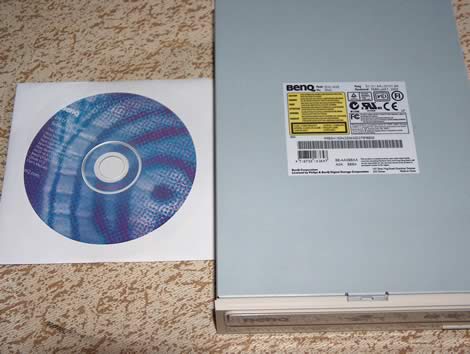
Yes, we only got the installation CD and the drive.
We also got a LightScribe CD-R and Lightscribe DVD+R for use in this review.
Now it¡¦s time to take a look at the drive itself:
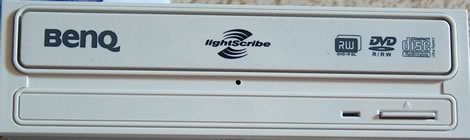
Nothing new under the sun here, it uses the same front as the DW1620.
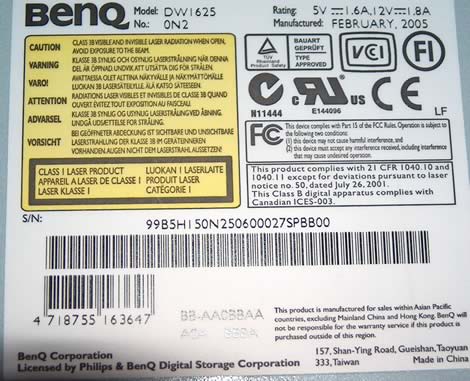
Our sample was produced in China and has a production date of February 2005.
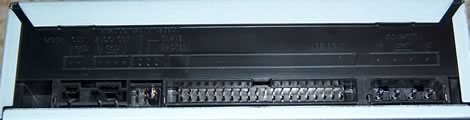
Still no changes on the back either; from the left: digital audio connector; analogue audio connector; pins and jumper to set the drive to cable select, slave or master; IDE connector and finally the power connector.
Now, let us connect the drive and check out the features and program bundle of this drive on the next page¡K
Test machine:
For this
review we will be using a computer with the following configuration:
Hardware:
⋅
Motherboard: Abit IC-7 MAX3
i875P
⋅
Processor:
Intel Pentium 4 3,2GHz 800MHz FSB Prescott with Hyper
Threading support.
⋅
RAM: 1Gb PC4300 DDR
⋅
GFX: Asus GeForce 6800
⋅
Sound: SB
Audigy 2
⋅
Hard
disks: 400Gb Seagate Barracuda 7200.8 S-ATA connected to the Intel i875P S-ATA
controller.
System
set-up:

The BenQ DW1625 was connected as secondary Master and identified
itself as BENQ DVD DD DW1625. DMA (Direct
Memory Access) was enabled for all devices where it was
possible.
Software:
Windows XP
Professional is installed on the computer along with Service Pack 2 for Windows
XP. We will be using the following software in this review:
⋅
Nero Burning ROM version
6.6.0.13
⋅
Nero CD/DVD Speed v3.80
⋅
Nero InfoTool
v3.10
⋅
DVD-Identifier
3.6.3.1
⋅
K-Probe v2.4.3
Installation and supported features:
We quickly
installed the drive without any problems and here is a screenshot from Nero
InfoTool:

Our drive came
shipped with firmware BBAA, we updated the firmware to version BBFA and later on
to BBGA. The only drawbacks we could see are the inability to read and write
DVD-RAM discs as well as missing Mt. Rainier support along with a slightly small
buffer. A larger buffer would at least smooth up the data transfer to the drive
a bit on stressed systems. It also looks like this drive doesn't support
reporting C2 errors.
Qsuite:
BenQ DW1625 ships
with the QSuite application, let us take a look at the different features of
Q-Suite:

The first tab tells
you information about the drive and about the media in the drive.

The second tab is
for booktype changing, the BenQ DW1625 sets all DVD+R/RW/DL discs to DVD-ROM
booktype as default, and we can't see why anyone would want to change
this, but you have the opportunity to do it at least.
Let us see if the
discs are correctly identified with DVD-ROM booktype:

No problems, the
discs are identified as having DVD-ROM booktype.


The third tab is the
QScan feature which checks if the media you have in the drive is suitable for
the selected speed. According to QScan our MCC004 disc is NOT suitable for 16x
writing. This could vary from disc to disc though.

The fourth tab is
for disabling the OPC function of the drive. We disabled the OPC function and
tried three different 16x DVD+R discs. Take a look later in this review for
results with WOPC enabled.


Verbatim 16x DVD+R,
MCC004 works fine with WOPC off, not a big difference compared to having the
WOPC technology enabled. But on the other side there are only 3-4 seconds
saved.


Traxdata 16x DVD+R,
Ritek.R04: Compared to the result with WOPC enabled later in this review, this
result is very good. First it writes at 16x compared to 8x with WOPC enabled,
second the error levels is much better! But for 16x writing a result of 6
minutes and 4 seconds is not really stunning '“ we expected it to be faster with
WOPC disabled.


That's Write 16x
DVD+R, Philips.C16: Compared to the result with WOPC enabled later in this
review this result is pretty good. First it writes at 16x compared to 8x with
WOPC enabled and the error level is not significantly higher. But for 16x
writing a result of 6 minutes and 15 seconds is not really stunning either '“ we
expected it to be faster with WOPC disabled.
Overall: Disabling
the WOPC technology seems to improve the writing quality with some media and
prevents the OPC technology to limit the speed. But it doesn't save you any time
in most cases it seems. Opposite of what we expected you may say; we expected
lower writing times at the cost of quality '“ but that is not the
case.

The fifth and last
tab is to enable/disable test writing on DVD+R/RW/DL. By enabling it, the drive
will first try to simulate a write and if that succeeds write the actual data to
the disc.
Problems
encountered: BenQ QSuite doesn't work on all computers. Computer containing
extra PCI add-on IDE controllers with optical drives connected will cause the
program to crash. The same with BenQ firmware upgrades, they will also crash.
BenQ programming team should look into these issues.
Error scanning
of written discs:
The BenQ
DW1625 supports error scanning of written discs by using Nero CD/DVD
speed.

Nero CD-Speed
gives you an indication of the quality by giving a score. Higher score is
better; a good result should at least be over 80 in quality score.
Other
features:
Here are the other
features that BenQ promotes with this drive:
| LightScribe Technology: Create Professional-Looking DVD Labels |
|
Together with LightScribe and BenQ's leading DVDRW
1. Hardware: The BenQ DW1625
|
 |
| Write Right Technology - Best Quality in DVD |
|
WOPC + BLER
Tilt
|


Included recording software:
Now it's time to
look at the included software, and comment it if needed. Notice that we may not
use the included software in our performance testing part of the
review.
Nero 6 OEM
Suite:

The well-known Nero
suite is also included and covers all tasks from creating the movie to writing
it to the disc. This is one of our favourite programs.
BenQ QVideo
2.0:

This is how BenQ
presents their QVideo 2.0 program:
Instant DV
to DVD - QVideo 2.0
With
BenQ's exclusive QVideo 2.0 you can instantly transfer your digital video
footage into a DVD disc without spending hours completing capturing, rendering,
authoring and burning processes.

As you see QVideo is
used to transfer data from capturing devices directly to DVD-Discs with almost
no delays, this of course saves some time.
Now that we have
finished examining the drive and bundled programs '“ let us head on to the next
page, which is reading performance test…
Reading performance:
For these
tests we will use Nero CD/DVD-Speed to read various CD and DVD's, including
audio discs and DVD-media. As already mentioned in the introduction, this drive
sports a specified read speed of 16X for DVD's and 40X for CD's.
Pressed
discs:
For this test
we used a pressed CD-ROM disc containing PlexTools
v1.08 that is exactly 74 minutes long. Below you will see the produced
result:

The BenQ DW1625 did reach 40x without any
problems. To see how this compares to other drives, look
below:
|
Pressed |
Average |
Start |
End |
Seek |
Seek |
Seek |
|
BenQ |
30.78x |
17.52x |
40.39x |
99ms |
116ms |
167ms |
|
Samsung |
35.65x |
20.40x |
47.22x |
96ms |
102ms |
172ms |
|
Mad |
34.10x |
19.54x |
45.17x |
109ms |
127ms |
187ms |
|
Philips |
35.69x |
20.59x |
47.25x |
118ms |
130ms |
206ms |
|
Memorex |
34.94x |
20.05x |
46.33x |
122ms |
130ms |
221ms |
|
AOpen |
37.34x |
21.29x |
49.42x |
105ms |
118ms |
196ms |
|
LG |
31.10x |
17.91x |
40.93x |
102ms |
123ms |
192ms |
|
LG |
30.73x |
16.88x |
40.47x |
108ms |
105ms |
128ms |
|
Lite-On |
36.44x |
21.36x |
48.13x |
118ms |
133ms |
207ms |
|
Pioneer |
30.77x |
18.18x |
24.51x |
96ms |
110ms |
182ms |
|
BenQ |
30.74x |
15.39x |
38.87x |
99ms |
112ms |
161ms |
Not the
fastest drive due to the low reading speed of only 40x. But the seek times are
pretty good.
CD-Recordable
Discs:
For this test
we made a copy of the original PlexTools v1.08 CD. The
disc we used was a Verbatim 48X certified CD-R disc manufactured by Mitsubishi
Chemicals Corporation.

No big
differences compared to reading the original pressed disc, but let us compare
the result to some other drives:
|
CD-R |
Average |
Start |
End |
Seek |
Seek |
Seek |
|
BenQ |
30.76x |
17.60x |
40.41x |
96ms |
106ms |
157ms |
|
Samsung |
36.49x |
21.20x |
48.13x |
91ms |
96ms |
165ms |
|
Mad |
35.49x |
20.74x |
46.78x |
125ms |
131ms |
189ms |
|
Philips |
36.54x |
21.46x |
48.14x |
124ms |
151ms |
230ms |
|
Memorex |
36.39x |
21.63x |
47.96x |
127ms |
155ms |
231ms |
|
AOpen |
36.49x |
21.20x |
48.11x |
99ms |
115ms |
185ms |
|
LG |
30.63x |
17.62x |
40.14x |
105ms |
129ms |
183ms |
|
LG |
30.71x |
16.90x |
40.37x |
121ms |
110ms |
110ms |
|
Lite-On |
36.53x |
21.42x |
48.20x |
124ms |
153ms |
231ms |
|
Pioneer |
31.41x |
18.45x |
41.16x |
101ms |
114ms |
188ms |
|
BenQ |
30.74x |
17.41x |
39.04x |
104ms |
107ms |
157ms |
Still not
beating the drives that supports 48x reading of course, but the seek times is
pretty good.
CD-ReWritable discs:
Again we made
a copy of the original PlexTools v1.08 disc, this time
we used a Verbatim High Speed (10X) CD-RW disc made by Mitsubishi Chemicals
Corporation.

The drive
reads CD-RW discs at full 40x speed. Check how this compares to other drives
below.
|
CD-RW |
Average |
Start |
End |
Seek |
Seek |
Seek |
|
BenQ |
31.36x |
17.55x |
41.44x |
109ms |
113ms |
194ms |
|
Samsung |
24.07x |
14.02x |
31.15x |
88ms |
97ms |
166ms |
|
Mad |
25.92x |
14.93x |
34.33x |
126ms |
135ms |
200ms |
|
Philips |
23.81x |
13.97x |
31.39x |
122ms |
156ms |
232ms |
|
Memorex |
24.15x |
14.02x |
31.97x |
128ms |
158ms |
238ms |
|
Aopen |
36.55x |
21.31x |
48.22x |
102ms |
114ms |
185ms |
|
LG |
30.64x |
17.69x |
40.56x |
105ms |
127ms |
180ms |
|
LG GSA-5163D |
31.30x |
16.85x |
41.35x |
127ms |
127ms |
133ms |
|
Lite-On |
24.26x |
13.97x |
32.20x |
127ms |
163ms |
229ms |
|
Pioneer |
25.43x |
14.55x |
33.77x |
102ms |
113ms |
189ms |
|
BenQ |
31.35x |
17.44x |
39.69x |
98ms |
114ms |
230ms |
Pretty good,
since most other drives limits the CD-RW reading speed to 32x.
Audio '“
Digital Audio Extraction:
To test the
digital audio extraction performance of the BenQ
DW1625, we again used Nero CD/DVD-Speed to measure the transfer rate. The
audio disc we used is slightly larger than the disc used for the other tests, to
be exact it's about 78 minutes long (77:56:57).

The drive had
no problems with reading the audio disc at full speed; let us compare the result
with other drives:
|
Audio |
Average |
Start |
End |
Seek |
Seek |
Seek |
|
BenQ |
31.25x |
17.59x |
41.34x |
96ms |
108ms |
161ms |
|
Samsung |
37.30x |
21.21x |
49.43x |
94ms |
110ms |
189ms |
|
Mad |
25.71x |
14.82x |
34.09x |
120ms |
140ms |
194ms |
|
Philips |
37.40x |
21.06x |
49.59x |
117ms |
127ms |
204ms |
|
Memorex |
36.76x |
20.54x |
47.69x |
117ms |
138ms |
239ms |
|
AOpen |
37.50x |
21.38x |
49.72x |
115ms |
120ms |
206ms |
|
LG |
31.37x |
17.57x |
41.39x |
95ms |
121ms |
211ms |
|
LG |
31.17x |
16.68x |
41.05x |
128ms |
136ms |
128ms |
|
Lite-On |
37.09x |
21.22x |
49.12x |
125ms |
155ms |
233ms |
|
Pioneer DVR-109D |
31.16x |
18.05x |
42.04x |
99ms |
113ms |
191ms |
|
BenQ |
31.22x |
17.39x |
41.36x |
96ms |
124ms |
180ms |
Again, this is
slower than some of the fastest, due to the reading speed of only
40x.
Advanced
audio '“ DAE quality test:
Before we move
on to testing DVD read speeds, we will take a last audio test. This time we used
the 'Advanced DAE Quality Test" feature in CD-Speed.

The extracting
quality should be excellent, but it doesn't support reading data from the
lead-out. This could affect the ability to extract audio from certain protected
audio discs.
DVD reading performance:
Again, we will use
Nero CD-Speed to measure the reading performance, this time for various types of
DVD discs. The drive should read pressed single layer DVD-discs at
16X.
DVD '“
DVD-Video:
For our DVD
reading performance tests we are going to start with single and dual layered DVD
video discs. While only 1X speed is required to watch DVD movies, it's useful to
be able to read the discs at higher speeds if you're going to extract (rip) the
content of the disc to your hard drive.


This drive has
no riplock and does nearly reach 16x with the single layer disc. The double
layer disc is only read at 8x.
|
DVD |
Average |
Start |
End |
Average |
Start |
End |
|
BenQ |
11.87x |
6.60x |
15.79x |
6.01x |
3.36x |
8.00x |
|
Samsung |
12.08x |
6.76x |
16.11x |
6.42x |
3.58x |
8.53x |
|
Mad |
3.74x |
2.06x |
5.00x |
3.43x |
1.90x |
4.58x |
|
Philips |
9.62x |
6.77x |
6.52x |
6.19x |
3.45x |
8.22x |
|
Memorex |
12.16x |
6.78x |
16.27x |
6.19x |
3.44x |
8.25x |
|
AOpen |
12.04x |
6.71x |
16.05x |
6.61x |
3.68x |
8.79x |
|
LG |
7.62x |
4.26x |
10.16x |
6.16x |
3.44x |
8.18x |
|
LG |
8.03x |
3.32x |
8.03x |
6.13x |
3.40x |
8.18x |
|
Lite-On |
11.94x |
6.76x |
15.91x |
6.15x |
3.46x |
8.20x |
|
Pioneer |
3.85x |
2.18x |
5.13x |
3.87x |
2.21x |
5.20x |
|
BenQ |
11.85x |
6.53x |
15.79x |
6.01x |
3.36x |
8.00x |
Pretty good,
but we would like to see 12x reading speed for the double layer disc.
DVD+R(W):
For this test
we used a Taiyo Yuden 4X DVD+R and a Ricoh 4X DVD+RW with about 4,4Gb of data. Below are the
results:


The reading
speed was locked to 8x for DVD+R/RW.
|
DVD+R |
Average |
Start |
End |
Average |
Start |
End |
|
BenQ |
6.25x |
3.42x |
8.36x |
6.25x |
3.43x |
8.36x |
|
Samsung |
6.22x |
3.44x |
8.31x |
6.23x |
3.44x |
8.32x |
|
Mad |
11.94x |
6.56x |
15.96x |
5.98x |
3.29x |
7.99x |
|
Philips |
6.23x |
3.44x |
8.33x |
6.23x |
3.47x |
8.33x |
|
Memorex |
6.21x |
3.46x |
8.30x |
6.22x |
3.45x |
8.31x |
|
AOpen |
8.79x |
4.83x |
11.73x |
5.83x |
3.20x |
7.79x |
|
LG |
7.69x |
4.25x |
10.29 |
6.15x |
3.41x |
8.22x |
|
LG |
7.69x |
4.10x |
10.28x |
6.16x |
3.32x |
8.24x |
|
Lite-On |
6.21x |
3.42x |
8.31x |
6.21x |
3.44x |
8.30x |
|
Pioneer |
9.36x |
5.15x |
12.55x |
6.25x |
3.46x |
8.36x |
|
BenQ |
6.24x |
3.42x |
8.34x |
6.25x |
3.43x |
8.36x |
Slow due to
the reading speed of only 8x, we would like to see 12x or 16x reading speeds for
the DVD+R disc at least.
DVD '“ DVD-R/RW:
For this test
we used a Taiyo Yuden 4X DVD-R disc and a Verbatim 2X DVD-RW disc filled with about 4.4Gb of data. Our test results
are found below:


There are
hardly any differences compared to reading the DVD+R/RW discs.
|
DVD-R |
Average |
Start |
End |
Average |
Start |
End |
|
BenQ |
6.24x |
3.40x |
8.35x |
6.23x |
3.40x |
8.33x |
|
Samsung |
6.22x |
3.43x |
8.32x |
6.22x |
3.43x |
8.31x |
|
Mad |
11.96x |
6.56x |
15.98x |
5.98x |
3.29x |
7.99x |
|
Philips |
6.10x |
3.39x |
8.16x |
6.11x |
3.39x |
8.17x |
|
Memorex |
6.09x |
3.38x |
8.13x |
6.10x |
3.39x |
8.15x |
|
AOpen |
8.80x |
4.83x |
11.76x |
5.88x |
3.23x |
7.84x |
|
LG |
7.68x |
4.26x |
10.26x |
6.16x |
3.41x |
8.23x |
|
LG |
7.69x |
4.13x |
10.27x |
6.13x |
3.30x |
8.08x |
|
Lite-On |
6.09x |
3.39x |
8.14x |
6.08x |
3.37x |
8.13x |
|
Pioneer DVR-109D |
9.39x |
5.19x |
12.58x |
6.23x |
3.45x |
8.34x |
|
BenQ |
6.23x |
3.03x |
8.35x |
6.23x |
3.42x |
8.33x |
Nothing
changes here, but we would like to see 12x/16x reading speed of DVD-R
media.
Overall
thoughts:
Not the
fastest drive around, but the seek times is good. It also seems to be a very
stable reader that doesn't easily slow down or fail. Another plus is that it
does not have a riplock.
But now
it's time to head on to a more interesting part: Writing CD-R and CD-RW
discs…
The specifications of the BenQ DW1625 state that the drive is able to write CD-R discs at 40x. Let us find out how the drive really performs in speed and quality.
Writing Data CD-R discs:
Let us first take a look at the CD-R write technology used by the BenQ DW1625:

As we could see, the BenQ DW1625 uses CAV (Constant Angular Velocity) to write at its rated speed of 40x, this gives an average speed of 29.22x. This seems to be slightly lower than average for a 40x CD-Writer.

The Mad Dog MD-16XDVD9 uses CAV (Constant Angular Velocity) to write at its rated speed of 48x. This gives an average speed of 36.38x.

As we could see the Plextor PX-712A uses CAV (Constant Angular Velocity) writing strategy to reach it rated speed of 48X. This gives an average speed of 36.43x.
And as a last test we wrote a disc containing 700Mb using Nero Burning ROM software. Writing method used is DAO (Disc At Once), and the disc is set up as a non multi-session disc with 'finalize disc" enabled.

The BenQ DW1625 used 3 minutes and 24 seconds to write the disc at 40x. Let us see how this compares to other drives:
|
CD-R |
Supported |
Write |
Start |
End |
Average |
Write |
Write |
|
BenQ |
40x |
CAV |
17.75x |
40.61x |
29.37x |
3m:24s |
3m:23s |
|
Samsung |
40x |
P-CAV |
20.91x |
39.55x |
34.27x |
2m:47s |
2m:49s |
|
Mad Dog |
48x |
CAV |
21.41x |
48.16x |
36.38x |
2m:56s |
2m:58s |
|
Philips |
48x |
CAV |
18.98x |
42.88x |
32.47x |
3m:01s |
3m:03s |
|
Memorex |
48x |
CAV |
21.74x |
49.42x |
37.23x |
2m:37s |
3m:11s |
|
AOpen |
48x |
CAV |
22.07x |
49.66x |
37.69x |
2m:44s |
2m:47s |
|
LG |
40x |
Z-CLV |
16.01x |
40.48x |
31.76x |
3m:15s |
3m:15s |
|
LG |
40x |
Z-CLV |
16.00x |
40.91x |
31.74x |
3m:23s |
3m:17s |
|
Lite-On |
48x |
CAV |
21.86x |
49.31x |
37.38x |
2m:39s |
2m:47s |
|
Pioneer |
40x |
CAV |
17.10x |
40.87x |
30.39x |
3m:21s |
3m:31s |
|
BenQ |
40x |
CAV |
17.75x |
39,86x |
29.22x |
3m:19s |
3m:24s |
It's among
the slower drives due to the writing speed of only 40x; we would like to see 48x
like the majority of other drives offer.
Write Quality:
We will test
CD-R discs from a total of 8 different CD-R manufacturers. To really measure the
write speed, we used the 'create data CD" function in Nero CD-Speed. The discs
were written at the maximum speed that the drive supports. For the quality test,
we used K-Probe 2 which is a tool developed by a Lite-On employee. It runs under Windows and works
with drives made by Lite-On. Also
note that different drives and different reading speeds may affect the results
obtained when scanning the discs. We used a Lite-On LTR-52246S drive with firmware 6S0F and
scanned the discs at 48X speed.
A written
CD-R disc will always have some C1 errors; C1 errors are easily corrected by the
drive's error correction capabilities. The next level of errors is C2, while C2
errors could also be corrected by most drive's error correction capabilities;
they are not wanted on a good quality disc. A good disc should not contain any
C2 errors, and preferably have an average C1 error amount of below 2.0 for the
best discs, or at least below 10.0 average for good quality discs. After C2 errors
there are only un-correctable errors that will make a disc unusable.
Why wait any
longer? Below are the obtained results:

| Brand: | Infiniti, thanks to Medea EU for providing it. |
| Manufacturer: | CMC Magnetics |
| Code: | 97m26s66f |
| Disc Type: |
CD-R |
| Recording Layer: | Dye Type 6: Short Strategy (Phthalocyanine) |
| Capacity: | 79:59.71 (703MB) |
| Certified Speed: | 52x |
| Write Speed: |
40x |
| Write Time: |
3m:24s |
| C1 Average/Sec: |
0.61 |
| C2 Average/Sec: |
0.0 |
The CMC
Magnetics discs seem to be pretty good, they work fine with the BenQ DW1625
drive at least.

| Brand: | MAM-E '“ thanks to MAM-E for providing it. |
| Manufacturer: | MAM-E (Mitsui) |
| Code: | 97m27s58f |
| Disc Type: |
CD-R |
| Recording Layer: | Dye Type 8: Short Strategy (Phthalocyanine) |
| Capacity: | 79:59.74 (703MB) |
| Certified Speed: | 52x |
| Write Speed: |
40x |
| Write Time: |
3m:27s |
| C1 Average/Sec: |
0.55 |
| C2 Average/Sec: |
0.0 |
No problems
with this media.

| Brand: | Verbatim Data Life Plus |
| Manufacturer: | Moser Baer India for Mitsubishi. |
| Code: | 97m34s23f |
| Disc Type: |
CD-R |
| Recording Layer: | Dye Type 3: Long Strategy (Cyanine or AZO) |
| Capacity: | 79:59.73 (703MB) |
| Certified Speed: | 52x |
| Write Speed: |
40x |
| Write Time: |
3m:20s |
| C1 Average/Sec: |
0.30 |
| C2 Average/Sec: |
0.0 |
Good quality
with Mitsubishi/Verbatim media, highly recommended.

| Brand: | Traxdata '“ thanks to conrexx for providing it |
| Manufacturer: | Ritek |
| Code: | 97m15s17f |
| Disc Type: |
CD-R |
| Recording Layer: | Dye Type 7: Short Strategy (Phthalocyanine) |
| Capacity: | 79:59.70 (703MB) |
| Certified Speed: | 52x |
| Write Speed: |
40x |
| Write Time: |
3m:25s |
| C1 Average/Sec: |
2.81 |
| C2 Average/Sec: |
0.24 |
This was not
so good, but since we have another brand of Ritek CD-R, let's do a second
test.

| Brand: | That's Write '“ thanks to That's Write for providing it. |
| Manufacturer: | Ritek |
| Code: | 97m15s17f |
| Disc Type: |
CD-R |
| Recording Layer: | Dye Type 7: Short Strategy (Phthalocyanine) |
| Capacity: | 79:59.70 (703MB) |
| Certified Speed: | 52x |
| Write Speed: |
40x |
| Write Time: |
3m:22s |
| C1 Average/Sec: |
0.32 |
| C2 Average/Sec: |
0.0 |
Simply
excellent, looks like the problem with the first disc is due to a disc quality
issue with the Traxdata media.

| Brand: | Miflop Extreme '“ Thanks to Miflop for providing it |
| Manufacturer: | Taiyo Yuden |
| Code: | 97m24s01f |
| Disc Type: |
CD-R |
| Recording Layer: | Dye Type 1: Long Strategy (Cyanine or AZO) |
| Capacity: | 79:59.72 (703MB) |
| Certified Speed: | 52x |
| Write Speed: |
40x |
| Write Time: |
3m:22s |
| C1 Average/Sec: |
0.08 |
| C2 Average/Sec: |
0.00 |
Simply blows
away the competition, this scan is one of the better we have ever
had!

| Brand: | Infiniti '“ thanks to Medea EU for providing it. |
| Manufacturer: | SKC Co Ltd. |
| Code: | 97m26s26f |
| Disc Type: |
CD-R |
| Recording Layer: | Dye Type 6: Short Strategy (Phthalocyanine) |
| Capacity: | 79:59.73 (703MB) |
| Certified Speed: | 48x |
| Write Speed: |
40x |
| Write Time: |
3m:26s |
| C1 Average/Sec: |
0.32 |
| C2 Average/Sec: |
0.00 |
Another good
result with these rather rare CD-R discs.

| Brand: | Miflop Lite '“ thanks to Miflop for providing it. |
| Manufacturer: | Digital Data Storage (using generic plasmon ID) |
| Code: | 97m27s18f |
| Disc Type: |
CD-R |
| Recording Layer: | Dye Type 8: Short Strategy (Phthalocyanine) |
| Capacity: | 79:59.74 (703MB) |
| Certified Speed: | 52x |
| Write Speed: |
40x |
| Write Time: |
3m:28s |
| C1 Average/Sec: |
3.84 |
| C2 Average/Sec: |
0.00 |
Not the
highest quality media, but the result is still acceptable.

| Brand: | BenQ, thanks to Daxon for providing it |
| Manufacturer: | Daxon (but with Hitachi Maxell ATIP) |
| Code: | 97m25s29f |
| Disc Type: |
CD-R |
| Recording Layer: | Dye Type 9: Short Strategy (Phthalocyanine) |
| Capacity: | 79:59.74 (703MB) |
| Certified Speed: | 52x |
| Write Speed: |
40 |
| Write Time: |
3m:21s |
| C1 Average/Sec: |
1.84 |
| C2 Average/Sec: |
0.0 |
No problems
with this media.
CD-ReWritable:
The BenQ DW1625
supports a CD-ReWriting
speed of 24x; let us see how this
compares to other writers. Let us start with taking a look at the writing
strategy it uses:

The BenQ DW1625 uses P-CAV (Partial-Constant Angular Velocity), to write at its rated speed of 24x, this gives an average speed of
23.12x. This seems to be about average compared to other drives, but let
us include some other results for comparison.

The Pioneer DVR-107D uses Z-CLV, (Zone-Constant Linear Velocity), to write at its rated speed of
24x, this gives an average speed
of 22.47x.

The Plextor PX-712A, with its P-CAV (Partial-Constant Angular Velocity) write
speed of 24X for Ultra Speed CD-RW discs is among the faster writers due to its
high starting speed of 21.12x.
And we did
also write a disc in Nero Burning ROM, the compilation we made was 650Mb large
and we wrote the disc with the Disc At Once write method.

The BenQ DW1625 used 3 minutes and 36
seconds for writing the disc at 24x; let us compare this to some other writers:
|
CD-RW |
Supported |
Write |
Start |
End |
Average |
Write |
Write |
|
Plextor |
24x |
P-CAV |
21.12x |
24.00x |
23.89x |
3m:40s |
3m:34s |
|
Philips |
24x |
P-CAV |
17.74x |
25.20x |
23.13x |
3m:56s |
3m:41s |
|
BenQ |
24x |
P-CAV |
17.73x |
24.54x |
23.14x |
3m:54s |
3m:40s |
|
Samsung |
32x |
P-CAV |
20.94x |
31.85x |
30.21x |
3m:10s |
- |
|
Mad Dog |
24x |
Z-CLV |
20.08x |
24.01x |
23.68x |
3m:52s* |
3m:53s |
|
Philips |
24x |
Z-CLV |
16.04x |
24.07x |
22.63x |
4m:10s |
- |
|
AOpen |
24x |
Z-CLV |
16.01x |
24.03x |
22.06x |
4m:17s |
- |
|
LG |
24x |
Z-CLV |
16.01x |
23.80x |
23.35x |
3m:54s |
- |
|
LG |
24x |
Z-CLV |
16.00x |
24.00x |
23.33x |
3m:57s |
3m:34s |
|
Lite-On |
24x |
Z-CLV |
16.00x |
24.04x |
22.58x |
4m:24s |
4m:06s |
|
Pioneer |
24x |
Z-ZLV |
15.99x |
24.03x |
22.45x |
4m:08s |
4m:14s |
|
BenQ |
24x |
P-CAV |
17.76x |
24.47x |
23.12x |
3m:55s |
3m:36s |
Among the
faster drives due to the fast P-CAV writing strategy. But let us take a look at
the writing quality with two CD-RW discs.

| Brand: | Verbatim Data Life Plus |
| Manufacturer: | CMC Magnetics, but with Mitsubishi dye and ATIP |
| Code: | 97m34s24f |
| Disc Type: |
US CD-RW |
| Recording Layer: | Dye Type 4: Long Strategy (Phase Change) |
| Capacity: | 79:59.74 (703MB) |
| Certified Speed: | 24x |
| Write Speed: |
24x |
| Write Time: |
3m:55s |
| C1 Average/Sec: |
548.60 |
| C2 Average/Sec: |
0.02 |
One of the worst results we have ever had with CD-RW media,
BenQ should look into improving the writing quality with this media.

| Brand: | That's Write |
| Manufacturer: | Plasmon data systems |
| Code: | 97m27s12f |
| Disc Type: |
US CD-RW |
| Recording Layer: | Dye Type 2: Long Strategy (Phase Change) |
| Capacity: | 74:41.00 (656MB) |
| Certified Speed: | 24x |
| Write Speed: |
24x |
| Write Time: |
3m:36s |
| C1 Average/Sec: |
1138.00 |
| C2 Average/Sec: |
0.28 |
Low quality discs, and as we could see the result is
horrible.
Summary:
I really kicks ass for CD-R writing quality, but on the
other hand it gets its ass kicked by most other writers for CD-RW writing
quality. Plus point for CD-R writing quality noted down along with a minus point
for CD-RW writing quality.
But after
all, it's a DVD-Writer, so head on to next page and read about DVD-Writing
performance and DVD media compatibility…
The
specifications of this drive tell us that it should write DVD+R discs at 16x and DVD-R discs at 8X speed. In this part
we will measure the write time for various types of DVD+/-R(W) discs. We do also focus on write quality and media
compatibility.
DVD-Writing performance:
We will start with
taking a look at the writing strategy used and compare it to other
drives;

The BenQ
DW1625 uses CAV (Constant Angular Velocity) to write at 16x
speed. This gives an average speed of 11.61x and a total writing time of 5m:56s. Let us also take a look at writing a DVD-R
disc:

As we could
see it uses P-CAV (Partial-Constant Angular
Velocity) to write DVD-R at 8x. this gives an average speed of about
7.74x and a writing time of 8 minutes and 15 seconds.

The BenQ DW1620 uses CAV
(Constant Angular Velocity) to write at 16x. This gives an average writing speed of 11.51x and the lowest time we have obtained are 5 minutes and
47 seconds. The drive uses a bit longer time than ideally since it uses running
OPC technology when writing (shown as small dips in
the transfer curve above).

The LG
GSA-5163D uses P-CAV (Partial-Constant
Angular Velocity) to write at 16x. The
average speed for the LG GSA-5163D is 12.82x and total
writing time is 5 minutes and 19 seconds. This is the fastest result we have got
with all tested writers so far, and is thus the record to beat for other
drives.
Let us see how
long of a time it needs to create a disc with Nero. We used Nero burning Rom to
set up a new UDF/ISO compilation containing 4483Mb of
data, and started the write process. We used the Disc-At-Once write
method.

DVD+R

DVD-R
The DVD+R disc was finished in 6 minutes and 8 seconds, while
the DVD-R disc was finished in 8 minutes and 21 seconds.
|
16x |
Write |
Supported |
Start |
End |
Average |
Write |
Write |
|
NEC |
CAV |
16x +R |
6.75x |
15.96x |
11.70x |
6m:04s |
6m:08s |
|
BenQ |
CAV |
16x +R |
5.37x |
16.00x |
11.51x |
5m:47s |
5m:50s |
|
Samsung |
CAV |
16x +R |
6.74x |
12.09x |
12.03x |
5m:58s |
6m:33s |
|
Mad |
CAV |
16x +R |
6.64x |
15.96x |
11.69x |
6m:05s |
6m:12s |
|
Memorex |
CAV |
16x +R |
6.65x |
15.97x |
11.95x |
5m:59s |
5m:56s |
|
Aopen |
CAV |
16x +R |
6.69x |
15.90x |
11.90x |
6m:51s |
6m:49s |
|
LG |
P-CAV |
16x +R |
7.30x |
16.01x |
12.87x |
5m:34s |
5m:35s |
|
LG |
P-CAV |
16x +R |
7.30x |
15.94x |
12.75x |
5m:30s |
5m:32s |
|
Lite-On |
CAV |
16x +R |
6.66x |
15.95x |
11.92x |
5m:54s |
6m:02s |
|
Pioneer |
CAV |
16x +R |
6.27x |
15.95x |
11.64x |
5m:51s |
5m:43s |
|
BenQ |
CAV |
16x +R |
5.61x |
16.06x |
11.61x |
5m:56s |
6m:08s |
The BenQ
DW1625 is about average at 16x DVD+R, but lags behind for DVD-R due to the
writing speed of only 8x. But it may show its strengths at media compatibility
and writing quality? Let us find out!
Write quality:
You should first
notice that this is not a scientific and professional way to test the discs. But
according to our testing done in recent months, we would conclude that there is
a clear link between the quality reported when scanning the disc and the
playability of the disc in different devices. Also notice that different drives
report different amounts of errors. K-Probe was designed to work with Lite-On DVD-Writers. So we recommend using a DVD-Writer
from Lite-On, in this test we use a Lite-On SOHW-832S DVD-Writer, as already said; remember that
scans done with a Lite-On DVD-ROM or Lite-On combo drive can't be compared with the results
obtained with a Lite-On DVD-Writer. Also remember
that different PI/PO ECC sum settings along with
different reading speeds in K-Probe will affect the result, we use these
settings; PI (Parity Inner) set to summarize 8 ECC blocks, PIF
(Parity Inner Failures) set to summarize 1 ECC
block, reading speed: 4X CLV (Constant
Linear Velocity). Setting the PI sum to 8 and the PIF sum to 1 will give a result that we may compare to the
standards for DVD+R/RW and DVD-R/RW.
But what is a good
scan? That is a discussion that we don't think will end soon, as different
drives report different amount of errors, some players is more picky about media
than others, and so on. But as a comparison we present you with a scan from two
pressed DVD discs:

This scan shows the results from a pressed DVD-ROM disc (Baldurs Gate DVD-ROM).

This scan shows the
result from a pressed DVD-Video disk (Indiana Jones and the Last Crusade).
Notice the error jump when shifting to the second layer (the error level
actually drops from the end of the first layer to the beginning of the second
layer).
If you read below
you will see that both the pressed DVD-discs are well within the
standards.
Download the ECMA 267 Standard for DVD-ROM, the ECMA 337 Standard for DVD+R/RW and
the ECMA 338 Standard for DVD-R/RW at http://www.ecma-international.org if you
want to look at the standards for yourself. Here is some data from the ECMA standards (same for DVD-ROM, DVD-R/RW and DVD+R/RW):
Random
errors:
A row of an
ECC Block that has at least 1 byte in error
constitutes a PI error. In any 8
consecutive ECC
Blocks the total number of PI errors before correction shall not exceed
280.
Here we see what a
PI error is defined as a row in an ECC block having 1
byte or more containing errors. And that the sum of PI errors in 8 ECC blocks after each other should not exceed 280 PI
errors.
But what is a row
and what is an ECC block? Again we refer to the ECMA standards. We do not copy and paste everything but if
interested look in the ECMA standards. A row is 182
bytes long where the last 10 bytes contain PI (Parity Inner)
information. An ECC block is 208 rows long where the
last 16 rows contain the PO (Parity Outer) information. This gives
us a maximum possible PI error amount of 208 errors per block and for 8 blocks
after each other this sum is of course 8 times higher giving a maximum possible
amount of 1664 PIE-8 errors. In practical use a disc with 1664 PIE-8 errors is
unreadable.
According to our
tests the specified max PI-8 sum of 280 for good discs seems to be a good
guideline, as some readers have problems reading discs when the PI-8 errors is
over 300 and most players starts to have problems when the PI-8 error level
reaches 600 or more.
But what are the
PIF errors that K-Probe reports? They are Parity Inner
Failures, meaning errors left after PI correction. Only the ECMA 337 standard describes the Parity Inner Failures. So
how is a Parity Inner Failure defined? Here are what ECMA 337 states:
'If a row
of an ECC Block as defined in 13.3 contains more than
5 erroneous bytes, the row is said to be 'PI-uncorrectable"."
In theory an
ECC block may in the worst case have 208 PIF since every ECC block is 208
rows long. But the ECMA 337 standard goes further and
specifies the max amount of accepted PI Failures (uncorrectable errors) allowed on a good disc:
'- In any ECC Block the number of PI-uncorrectable rows should not exceed
4."
This means that when
the PIF sum is set to 1 the maximum error value should
not exceed 4. The theoretical maximum value for PIF is
208 errors.
But what makes a
disc unreadable? A POF (Parity Outer
Failure) error will make the disc unreadable, but K-Probe does not
display the POF's.
Notice that there
are other aspects such as disc reflectivity, jitter, tracking errors and so on
that also will affect the readability of a DVD disc '“ but for this we do not
have measuring equipment available.
And another note is
that we have scanned the discs at 4X CLV speed, by
lowering the speed to 2X(DVD-R/RW)/2.4X(DVD+R/RW) or 1X the amount of reported errors may drop on
some discs. We scanned at 4X CLV due to lower speeds
taking to much time.
To see if there is a
connection between the reported amount of errors and readability of the discs we
also include the reading curve from a NEC ND-3540A DVD-Writer. A small speed
reduction near the end is still accepted on good discs, but serious reading
problems or reading failures is a bad sign.
Easier explanation on how to
read the test results.
Maybe this got too
technical, and you are wondering what to look for in KProbe reports?
Use this as a
guideline for good discs:
PI(Parity
Inner): No larger areas on
the disc should exceed 280 PI-8 errors, do not worry too much about high single
spikes that exceed 280.
PIF(Parity
Inner Failures): No larger areas on the disc should exceed 4
PIF-1 errors, do not worry too much about high single spikes that exceed
4.
And as always; lower
is better 😉
And look at the
reading curve; does it look clean with no dips? Then it should be good, a small
slowdown near the end is acceptable.
DVD+R media
compatibility and write quality:


| Brand: | BenQ '“ thanks to Daxon for providing it. |
| Manufacturer: | Daxon |
| Code: | DAXON.AZ3 |
| Disc Type: | DVD+R |
| Capacity: | 4483MB |
| Certified Speed: |
16x |
| Write Speed: |
16x |
| Write Time: |
6m:05s |
| PI-8 errors Average/Sec: |
2.78 |
| PI-8 uncorrectable errors(PO) Avg/Sec: |
0.05 |
No problems with
this media, it would have been strange if there were problems, after all the
media is BenQ branded.

| Brand: | Verbatim '“ thanks to Verbatim UK for providing this media. |
| Manufacturer: | CMC Magnetics with Mitsubishi technology |
| Code: | MCC004 |
| Disc Type: | DVD+R |
| Capacity: | 4483MB |
| Certified Speed: |
16x |
| Write Speed: |
16x |
| Write Time: |
5m:56s |
| PI-8 errors Average/Sec: |
0.44 |
| PI-8 uncorrectable errors(PO) Avg/Sec: |
0.00 |
There are no
problems with this media.


| Brand: | Infiniti '“ thanks to Medea EU for providing it |
| Manufacturer: | CMC Magnetics with Mitsubishi technology. |
| Code: | MCC004 |
| Disc Type: | DVD+R |
| Capacity: | 4483MB |
| Certified Speed: |
16x |
| Write Speed: |
16x |
| Write Time: |
5m:58s |
| PI-8 errors Average/Sec: |
0.42 |
| PI-8 uncorrectable errors(PO) Avg/Sec: |
0.08 |
No problems
with this media either and the result seems to be almost identical.


| Brand: | That's Write '“ thanks to That's Write for providing it. |
| Manufacturer: | CMC Magnetics |
| Code: | CMC.MAG.M01 |
| Disc Type: | DVD+R |
| Capacity: | 4483MB |
| Certified Speed: |
16x |
| Write Speed: |
4x (16x selectable, but OPC control forced it to write at 4x) |
| Write Time: |
15m:40s |
| PI-8 errors Average/Sec: |
9.56 |
| PI-8 uncorrectable errors(PO) Avg/Sec: |
0.07 |
The OPC
control of the drive limited the writing speed to 4x; we tried two discs from
different spindles '“ but the result were the same. But otherwise the result is
good.


| Brand: | Traxdata '“ thanks to Conrexx for providing it. |
| Manufacturer: | Ritek |
| Code: | RITEK R04 |
| Disc Type: |
DVD+R |
| Capacity: | 4483MB |
| Certified Speed: |
16x |
| Write Speed: |
8x (16x selectable, but OPC control forced it to write at 8x) |
| Write Time: |
9m:11s |
| PI-8 errors Average/Sec: |
69.42 |
| PI-8 uncorrectable errors(PO) Avg/Sec: |
0.06 |
The PI error
level stays a bit high, but still within the specifications and the reading
curve shows no problems. But we would like to see 16x writing speed with these.
Yes, we did try two discs, both wrote at 8x speed.

| Brand: | Traxdata '“ thanks to Conrexx for providing it. |
| Manufacturer: | Ritek |
| Code: | RITEK.P16 |
| Disc Type: | DVD+R |
| Capacity: | 4483MB |
| Certified Speed: |
16x |
| Write Speed: |
Failed |
| Write Time: |
- |
| PI-8 errors Average/Sec: |
- |
| PI-8 uncorrectable errors(PO) Avg/Sec: |
- |
We tried two
discs, but it failed during the lead in with both discs. BenQ should look into
this problem.


| Brand: | That's Write |
| Manufacturer: | Philips/CMC Magnetics |
| Code: | Philips.C16 (Revision 001) |
| Disc Type: |
DVD+R |
| Capacity: | 4483MB |
| Certified Speed: |
16x |
| Write Speed: |
8x (16x selectable, but OPC control forced it to write at 8x) |
| Write Time: |
9m:15s |
| PI-8 errors Average/Sec: |
1.21 |
| PI-8 uncorrectable errors(PO) Avg/Sec: |
0.09 |
Good writing
quality, but it looks like the OPC control of the DW1625 is too sensitive as the
writing speed was limited to only 8x. Again, we tried two discs with the same
result.


| Brand: | TDK |
| Manufacturer: | TDK |
| Code: | TDK 003 |
| Disc Type: |
DVD+R |
| Capacity: | 4483MB |
| Certified Speed: |
16x |
| Write Speed: |
16x |
| Write Time: |
6m:05s |
| PI-8 errors Average/Sec: |
0.80 |
| PI-8 uncorrectable errors(PO) Avg/Sec: |
0.02 |
No problem at
all with this media.


| Brand: | RiData '“ thanks to RiData for providing it. |
| Manufacturer: | Ritek |
| Code: | RITEK R03 (Revision 001) |
| Disc Type: | DVD+R |
| Capacity: | 4483MB |
| Certified Speed: |
8x |
| Write Speed: |
8x |
| Write Time: |
9m:02s |
| PI-8 errors Average/Sec: |
4.49 |
| PI-8 uncorrectable errors(PO) Avg/Sec: |
0.03 |
No problems at
all.

| Brand: | Datawrite '“ thanks to E-net distribution for providing it. |
| Manufacturer: | CMC Magnetics |
| Code: | MCC003 |
| Disc Type: |
DVD+R |
| Capacity: | 4483MB |
| Certified Speed: |
8x |
| Write Speed: |
8x |
| Write Time: |
9m:09s |
| PI-8 errors Average/Sec: |
0.98 |
| PI-8 uncorrectable errors(PO) Avg/Sec: |
0.02 |
No problems
with this media, it's also one of the better results we have had with this
media.


| Brand: | UNIVERSAL |
| Manufacturer: | Prodisc |
| Code: | PRODISC.R03 |
| Disc Type: |
DVD+R |
| Capacity: | 4483MB |
| Certified Speed: |
8x |
| Write Speed: |
8x |
| Write Time: |
9m:10s |
| PI-8 errors Average/Sec: |
0.93 |
| PI-8 uncorrectable errors(PO) Avg/Sec: |
0.09 |
The drive
performed very well with the Prodisc media and we have no problems recommending this
media.


| Brand: | Miflop extreme '“ thanks to Miflop media for providing it. |
| Manufacturer: | Taiyo Yuden |
| Code: | YUDEN000T02 |
| Disc Type: |
DVD+R |
| Capacity: | 4483MB |
| Certified Speed: |
8x |
| Write Speed: |
8x |
| Write Time: |
9m:09s |
| PI-8 errors Average/Sec: |
0.73 |
| PI-8 uncorrectable errors(PO) Avg/Sec: |
0.01 |
And Taiyo
Yuden does of course fine.

| Brand: | BenQ, thanks to Daxon for providing this media! |
| Manufacturer: | Daxon |
| Code: | DAXON.AZ2 |
| Disc Type: |
DVD+R |
| Capacity: | 4483MB |
| Certified Speed: |
8x |
| Write Speed: |
8x |
| Write Time: |
9m:00s |
| PI-8 errors Average/Sec: |
1.06 |
| PI-8 uncorrectable errors(PO) Avg/Sec: |
0.02 |
One of the
best results we have ever had with this media.


| Brand: | That's Write '“ thanks to That's Write for providing it |
| Manufacturer: | Opto Disc |
| Code: | OPTODISC.OR8 |
| Disc Type: |
DVD+R |
| Capacity: | 4483MB |
| Certified Speed: |
8x |
| Write Speed: |
8x |
| Write Time: |
9m:12s |
| PI-8 errors Average/Sec: |
0.36 |
| PI-8 uncorrectable errors(PO) Avg/Sec: |
0.01 |
Excellent,
considering this is very cheap media. The slight speed drop at the end is normal
with Optodisc media, probably too low reflectivity or too high jitter at the
end.


| Brand: | Prodye Video |
| Manufacturer: | Unknown |
| Code: | Plasmon1C01 |
| Disc Type: |
DVD+R |
| Capacity: | 4483MB |
| Certified Speed: |
8x |
| Write Speed: |
8x |
| Write Time: |
9m:11s |
| PI-8 errors Average/Sec: |
1.81 |
| PI-8 uncorrectable errors(PO) Avg/Sec: |
0.13 |
Good quality
and readability.


| Brand: | ProDVD |
| Manufacturer: | UME Disc '“ Hong Kong. |
| Code: | AML 002 |
| Disc Type: | DVD+R |
| Capacity: | 4483MB |
| Certified Speed: |
8x |
| Write Speed: |
8x |
| Write Time: |
10m:02s |
| PI-8 errors Average/Sec: |
2.16 |
| PI-8 uncorrectable errors(PO) Avg/Sec: |
0.07 |
Low quality media and the results
reflect this. There is even a dye issue as we could see 3 dark spots close to
the edge. This is probably why it failed to read the disc back.


| Brand: | Commodore |
| Manufacturer: | Interaxia AG |
| Code: | VDSPMSAB002 |
| Disc Type: | DVD+R |
| Capacity: | 4483MB |
| Certified Speed: |
8x |
| Write Speed: |
8x |
| Write Time: |
9m:21s |
| PI-8 errors Average/Sec: |
3.74 |
| PI-8 uncorrectable errors(PO) Avg/Sec: |
0.15 |
Another very
low quality media type and the results are not good near the end.
Head on to
next page and read about DVD-R compatibility and write quality as well as
DVD+/-RW writing quality and
speed...
DVD-R media compatibility and write quality:

| Brand: | BenQ '“ thanks to Daxon for providing it. |
| Manufacturer: | Daxon |
| Code: | DAXON016S |
| Disc Type: |
DVD-R |
| Capacity: | 4489MB |
| Certified Speed: |
16x |
| Write Speed: |
8x |
| Write Time: |
8m:18s |
| PI-8 errors Average/Sec: |
8.20 |
| PI-8 uncorrectable errors(PO) Avg/Sec: |
0.19 |
No problems
with this media.


| Brand: | Traxdata '“ thanks to Conrexx for providing this media |
| Manufacturer: | Ritek |
| Code: | RitekF1 |
| Disc Type: |
DVD-R |
| Capacity: | 4489MB |
| Certified Speed: |
16x |
| Write Speed: |
8x |
| Write Time: |
8m:18s |
| PI-8 errors Average/Sec: |
32.16 |
| PI-8 uncorrectable errors(PO) Avg/Sec: |
0.07 |
A bit high PI
error level, but nothing to worry about.


| Brand: | Verbatim Data Life Plus |
| Manufacturer: | CMC Magnetics |
| Code: | MCC03RG20 |
| Disc Type: |
DVD-R |
| Capacity: | 4489MB |
| Certified Speed: |
16x |
| Write Speed: |
8x |
| Write Time: |
8m:19s |
| PI-8 errors Average/Sec: |
57.29 |
| PI-8 uncorrectable errors(PO) Avg/Sec: |
0.03 |
The amount of
PI errors remains a bit high, but still within specs and should not cause any
problems.


| Brand: | Miflop Extreme '“ thanks to Miflop media for providing it. |
| Manufacturer: | Taiyo Yuden |
| Code: | TYG03 |
| Disc Type: |
DVD-R |
| Capacity: | 4489MB |
| Certified Speed: |
16x |
| Write Speed: |
8x |
| Write Time: |
8m:22s |
| PI-8 errors Average/Sec: |
6.29 |
| PI-8 uncorrectable errors(PO) Avg/Sec: |
0.03 |
As expected
with Taiyo Yuden, very good!


| Brand: | BenQ '“ thanks to Daxon for providing it. |
| Manufacturer: | Daxon |
| Code: | DAXON008S |
| Disc Type: |
DVD-R |
| Capacity: | 4489MB |
| Certified Speed: |
8x |
| Write Speed: |
8x |
| Write Time: |
8m:15s |
| PI-8 errors Average/Sec: |
6.44 |
| PI-8 uncorrectable errors(PO) Avg/Sec: |
0.00 |
Again, a good
result.


| Brand: | Ridisc '“ thanks to E-Net distribution for providing this media. |
| Manufacturer: | Ritek |
| Code: | RITEKG05 |
| Disc Type: |
DVD-R |
| Capacity: | 4489MB |
| Certified Speed: |
8x |
| Write Speed: |
8x |
| Write Time: |
8m:27s |
| PI-8 errors Average/Sec: |
23.20 |
| PI-8 uncorrectable errors(PO) Avg/Sec: |
0.06 |
The KProbe
result is good, but the reading curve shows some slight problems. This could be
due to various reasons; one reason is that we have seen that NEC drives have
some slight compatibility problems with Ritek +/-R media for reading. Other
reasons could be jitter or reflectivity issues. But in practical use there
should not be any problems.

| Brand: | RiData '“ thanks to Advanced media USA for sending this media |
| Manufacturer: | Ritek |
| Code: | RITEKG05 |
| Disc Type: |
DVD-R |
| Capacity: | 4489MB |
| Certified Speed: |
8x |
| Write Speed: |
8x |
| Write Time: |
8m:19s |
| PI-8 errors Average/Sec: |
2.33 |
| PI-8 uncorrectable errors(PO) Avg/Sec: |
0.04 |
Excellent, and
this time the reading curve is completely fine as well.


| Brand: | MiFlop Extreme '“ thanks to MiFlop for providing it. |
| Manufacturer: | Taiyo Yuden |
| Code: | TYG02 |
| Disc Type: |
DVD-R |
| Capacity: | 4489MB |
| Certified Speed: |
8x |
| Write Speed: |
8x |
| Write Time: |
8m:27s |
| PI-8 errors Average/Sec: |
11.30 |
| PI-8 uncorrectable errors(PO) Avg/Sec: |
0.00 |
Excellent '“ as
expected with Taiyo Yuden.


| Brand: | UNIVERSAL |
| Manufacturer: | Prodisc |
| Code: | ProdiscF01 |
| Disc Type: |
DVD-R |
| Capacity: | 4489MB |
| Certified Speed: |
8x |
| Write Speed: |
8x |
| Write Time: |
8m:21s |
| PI-8 errors Average/Sec: |
47.29 |
| PI-8 uncorrectable errors(PO) Avg/Sec: |
0.05 |
A bit high
amount of PI Errors in the first half of the disc, but still within
specifications and should not cause any problems in practical
use.


| Brand: | Samsung |
| Manufacturer: | Opto disc |
| Code: | OPTODISCR008 |
| Disc Type: |
DVD-R |
| Capacity: | 4489MB |
| Certified Speed: |
8x |
| Write Speed: |
8x |
| Write Time: |
8m:22s |
| PI-8 errors Average/Sec: |
8.39 |
| PI-8 uncorrectable errors(PO) Avg/Sec: |
0.02 |
Very good,
considering this is very cheap media.


| Brand: | Unbranded |
| Manufacturer: | Gigastorage |
| Code: | GSC003 |
| Disc Type: |
DVD-R |
| Capacity: | 4489MB |
| Certified Speed: |
8x |
| Write Speed: |
8x |
| Write Time: |
8m:27s |
| PI-8 errors Average/Sec: |
7.05 |
| PI-8 uncorrectable errors(PO) Avg/Sec: |
0.16 |
Not bad,
considering this is a pretty low quality disc.


| Brand: | Princo |
| Manufacturer: | Princo |
| Code: | PRINCO8X02 |
| Disc Type: |
DVD-R |
| Capacity: | 4489MB |
| Certified Speed: |
8x |
| Write Speed: |
8x |
| Write Time: |
9m:01s |
| PI-8 errors Average/Sec: |
966.00 |
| PI-8 uncorrectable errors(PO) Avg/Sec: |
39.00 |
Poor quality
discs, and the result is horrible as well. You should really steer clear of
these.


| Brand: | Datawrite titanium '“ thanks to E-Net distribution for providing this media. |
| Manufacturer: | CMC Magnetics |
| Code: | CMC.MAG.AE1 |
| Disc Type: |
DVD-R |
| Capacity: | 4489MB |
| Certified Speed: |
8x |
| Write Speed: |
8x |
| Write Time: |
9m:25s |
| PI-8 errors Average/Sec: |
9.04 |
| PI-8 uncorrectable errors(PO) Avg/Sec: |
0.04 |
No problems
with this media.
Overall
thoughts: The writing quality is for the
most part very good, and the media compatibility is good as well. But the OPC
function seems to be over sensitive and several 16x discs did not write at 16x.
And it's a bit disappointing that the drive only supports 8x DVD-R when all
other new drives support 16x DVD-R.
Re-Writing data:
The BenQ DW1525 supports rewriting DVD-RW at 4x and DVD+RW at 4x speed; let us write two discs in Nero CD/DVD speed and Nero
Burning ROM to see how fast it is.
Here are the
writing results for writing the 4x DVD-RW disc:

BenQ DW1625
uses CLV writing technology to write the DVD-RW disc at 4x. Total recording time
is around 15 minutes.
And here is
the result with 4x DVD+RW writing:

BenQ DW1625
uses CLV writing technology to write the DVD+RW disc at 4x as well. Total
recording time is around 15 minutes.
Writing Quality with DVD Re-Writable discs:
Due to request from
our readers we will add a few write quality tests with ReWritable media.
Settings and testing procedures are the same as used earlier in this review so
you may want to go back and read them if unsure. All discs used for these tests
have been written to before, but none have been written to more than 25
times.
DVD+ReWritable
media:


| Brand: | Ridata '“ thanks to Advanced Media USA for providing it. |
| Manufacturer: | Ritek |
| Code: | RITEK004 |
| Disc Type: |
DVD+RW |
| Capacity: | 4483MB |
| Certified Speed: |
4x |
| Write Speed: |
4x |
| Write Time: |
14m:27s |
| PI-8 errors Average/Sec: |
89.04 |
| PI-8 uncorrectable errors(PO) Avg/Sec: |
70.21 '“ incorrect due to K-Probe bug!!! |
The result
with this media is quite disappointing; BenQ needs to improve writing quality
with this media.


| Brand: | Daxon '“ thanks to Daxon for providing it. |
| Manufacturer: | Daxon |
| Code: | Daxon.D42 |
| Disc Type: |
DVD+RW |
| Capacity: | 4483MB |
| Certified Speed: |
4x |
| Write Speed: |
4x |
| Write Time: |
14m:43s |
| PI-8 errors Average/Sec: |
6.78 |
| PI-8 uncorrectable errors(PO) Avg/Sec: |
0.11 |
A slight
slowdown at the end, but overall good.


| Brand: | Infiniti '“ thanks to Medea EU for providing it. |
| Manufacturer: | Unsure '“ Daxon or CMC Magnetics. |
| Code: | Philips041 |
| Disc Type: |
DVD+RW |
| Capacity: | 4483MB |
| Certified Speed: |
4x |
| Write Speed: |
4x |
| Write Time: |
14m:49s |
| PI-8 errors Average/Sec: |
13.46 |
| PI-8 uncorrectable errors(PO) Avg/Sec: |
0.41 |
Acceptable,
but that's about it. The result is not very good at the end.
DVD-ReWritable media:


| Brand: | Verbatim. |
| Manufacturer: | Mitsubishi |
| Code: | MCC01RW4X01 |
| Disc Type: |
DVD-RW |
| Capacity: | 4489MB |
| Certified Speed: |
4x |
| Write Speed: |
4x |
| Write Time: |
15m:06s |
| PI-8 errors Average/Sec: |
13.77 |
| PI-8 uncorrectable errors(PO) Avg/Sec: |
0.50 |
The result is
acceptable, but there is another issue with the DVD-RW discs; Most drives can't
detect the discs! Our default reading curve drives Plextor PX-712A and NEC
ND-3540A could not see the DVD-RW discs written by the BenQ DW1625.


| Brand: | Ridata '“ thanks to Advanced Media USA for providing it. |
| Manufacturer: | Ritek |
| Code: | RITEKW04 |
| Disc Type: |
DVD-RW |
| Capacity: | 4489MB |
| Certified Speed: |
4x |
| Write Speed: |
4x |
| Write Time: |
9m:52s |
| PI-8 errors Average/Sec: |
24.61 |
| PI-8 uncorrectable errors(PO) Avg/Sec: |
8.01 |
First '“ the
result is not very good, but there is another issue with the DVD-RW discs; most
drives can't detect the discs! Our default reading curve drives Plextor PX-712A
and NEC ND-3540A could not see the DVD-RW discs written by the BenQ
DW1625.
To sum it
up:
The DVD+/-RW writing quality is not good at all, and BenQ need to fix the
compatibility issues with DVD-RW discs.
But let us
now look at another aspect of this drive; double layer DVD+R writing…
DVD+R Dual Layer
writing speed and compatibility:
The BenQ DW1625 supports 2.4x DVD+R DL writing, which is slower than
most other drives on the market now.
Testing
procedure: We created a new compilation
using Nero 6 and wrote it using the Disc-at-once writing
method:


Verbatim DVD+R9 double layer 2.4x failed, so we tried another MKM001 disc we got from
Philips some time ago, but it failed as well. Then we flashed the BBGA firmware
onto a HP DVD 640i which is an OEM DW1625 and tried again:

Now it finished successfully in 46
minutes and 28 seconds. Maybe it's an issue with our DW1625 sample? We decided
to waste even one more Verbatim DVD+R DL disc just to make sure:

Nope, back to the same old problem
again. In total we tried 10 MKM001 double layer discs, with two different drives
(One DW1625 and one HP DVD 640i) on 3 different computers. They all failed
except the one shown above here. Let's at least see how the quality of the
successfully created disc is.


| Brand: | Verbatim '“ Thanks to verbatim UK for providing it. |
| Manufacturer: | Mitsubishi (Singapore) |
| Code: | MKM 001 |
| Disc Type: |
DVD+R DL |
| Capacity: | 8152MB |
| Certified Speed: |
2.4x |
| Write Speed: |
2.4x |
| Write Time: |
46m:28s |
| PI-8 errors Average/Sec: |
57.28 |
| PI-8 uncorrectable errors(PO) Avg/Sec: |
0.13 |
Looks like
BenQ messed up badly here; they should REALLY look into getting Verbatim double
layer discs to work correctly. The one (out of ten) that completed successfully
is not perfect quality wise either. Firmware used for this test is BBGA and
BBHA.

Brand: |
Traxdata '“ thanks to Traxdata for providing it. |
| Manufacturer: | Ritek |
| Code: | Ritek.D01 |
| Disc Type: | DVD+R DL |
| Capacity: | 8152MB |
| Certified Speed: |
2.4x |
| Write Speed: |
Failed |
| Write Time: |
- |
| PI-8 errors Average/Sec: |
- |
| PI-8 uncorrectable errors(PO) Avg/Sec: |
- |
And Ritek.D01
media from Traxdata failed as well 🙁 But, we decided to try one more
Ritek media '“ of another brand:


Brand: |
That's Write '“ thanks to That's Write for providing it. |
| Manufacturer: | Ritek |
| Code: | Ritek.D01 |
| Disc Type: | DVD+R DL |
| Capacity: | 8152MB |
| Certified Speed: |
2.4x |
| Write Speed: |
2.4x |
| Write Time: |
45m:41s |
| PI-8 errors Average/Sec: |
48.50 |
| PI-8 uncorrectable errors(PO) Avg/Sec: |
2.89 |
The result is
not good, but the drive did not fail this time at least.

| Brand: | Imation |
| Manufacturer: | Ritek/Ricoh |
| Code: | RICOHJPND00 |
| Disc Type: | DVD+R DL |
| Capacity: | 8152MB |
| Certified Speed: |
2.4x |
| Write Speed: |
Unsupported |
| Write Time: |
- |
| PI-8 errors Average/Sec: |
- |
| PI-8 uncorrectable errors(PO) Avg/Sec: |
- |
And Ricoh
JPND00 double layer media is not supported at all, it failed immediately without
writing anything to the disc. Firmware used is BBGA.

| Brand: | eProformance |
| Manufacturer: | Prodisc |
| Code: | PRODISC.D01 |
| Disc Type: |
DVD+R DL |
| Capacity: | 8152MB |
| Certified Speed: |
2.4x |
| Write Speed: |
Failed |
| Write Time: |
- |
| PI-8 errors Average/Sec: |
- |
| PI-8 uncorrectable errors(PO) Avg/Sec: |
- |
And it failed
with the Prodisc media, we tried two discs '“ but it failed with both.

| Brand: | That's Write '“ thanks to That's Write for providing it. |
| Manufacturer: | CMC Magnetics |
| Code: | Philips.CD2 |
| Disc Type: |
DVD+R DL |
| Capacity: | 8152MB |
| Certified Speed: |
2.4x |
| Write Speed: |
Failed |
| Write Time: |
- |
| PI-8 errors Average/Sec: |
- |
| PI-8 uncorrectable errors(PO) Avg/Sec: |
- |
No luck with
this double layer media either, firmware used with this media is
BBGA.
Here are some
comparison results against other drives:
|
Drive |
Size |
Writing Speed |
Writing |
Book |
Kprobe |
Kprobe |
|
BenQ |
8152MB |
4x |
27m:26s |
DVD-ROM |
2.21 |
0.17 |
|
Pioneer |
8152Mb |
4x |
27m:02s |
DVD-ROM |
2.42 |
0.11 |
|
Samsung |
8103 MB |
2.4x |
43m:46s |
DVD+DL |
8.26 |
0.01 |
|
Philips |
8103 MB |
2.4x |
44m:08s |
DVD-ROM |
3.31 |
0.01 |
|
Mad |
8131 MB |
4x |
26m:44s |
DVD-ROM |
2.74 |
0.12 |
|
Memorex |
8131 MB |
2.4x |
43m:48s |
DVD-ROM |
2.82 |
0.03 |
|
Aopen |
8103 MB |
2.4x |
44m:01s |
DVD-ROM |
4.12 |
0.12 |
|
LG |
8103 MB |
4x |
26m:55s |
DVD-ROM |
1.81 |
0.01 |
|
Lite-On |
8152Mb |
4x |
27m:09s |
DVD-ROM |
2.61 |
0.15 |
|
LG |
8152Mb |
4x |
27m:06s |
DVD-ROM |
2.23 |
0.02 |
|
Lite-On |
8152Mb |
4x |
27m:45s |
DVD-ROM |
2.05 |
0.10 |
|
Pioneer |
8152Mb |
6x |
19m:11s |
DVD-ROM |
1.19 |
0.10 |
|
BenQ |
8152Mb |
2.4x |
45m:41s |
DVD-ROM |
- |
- |
None of the
discs were playable in our standalone player; the only successfully written disc
froze at the layer change.
Summary: BenQ have created a
mess here, none of the double layer discs work satisfactorily. Combine this with
a speed of only 2.4x '“ should it be that hard to get good media like Verbatim to
work? We are honestly disappointed with the drive in this area and can't
recommend the drive to anyone if double layer writing is a priority.
Head on to
next page to read about the lightscribe feature of this
drive…
LightScribe:
 On
On
January 4, 2004, HP announced an innovative new technology to address the
problem of labelling CD's and DVD's. LightScribe technology allows consumers to
create silk-screen quality labels on their CDs or DVDs by burning text and
graphics directly onto a disc, eliminating the need for adhesive
labels.
But, before we
continue - Let us first take a look at some information found at the LightScribe site:

CREATE SILKSCREEN-QUALITY LABELS
FOR ALL YOUR CDS AND DVDS, RIGHT FROM YOUR COMPUTER.
Until now
there hasn't been much choice when it comes to creating labels for your CDs and
DVDs. Messy markers or sticky adhesive labels were pretty much the only
affordable option. But imagine creating professional-looking labels using the
same laser that burns your data-right inside your CD/DVD drive! Well, now it's
easy with LightScribe Direct Disc Labelling technology.
LABEL-MAKING REDEFINED.
LightScribe
technology is an integrated system that combines the CD or DVD drive of your
LightScribe-enabled computer with specially coated discs and enhanced
disc-burning software to produce precise, laser-etched labels. You can design
and produce labels to express your creativity and personality-the sky's the
limit!
With
LightScribe, the disc is the label. This amazing technology is the no-hassle way
to create elegant labels for all your CDs and DVDs. Simply burn your music mix,
digital-video/photo archives, or business application. Then flip the disc and
burn your own unique label.
LightScribe
Direct Disc Labeling technology is now available in PCs, external USB optical
DVD writers, labelling software, and a variety of brand name discs. Remember,
the LightScribe logo indicates a LightScribe-enabled product, so be sure to look
for it at your favourite retail locations. Also check out the Looking for
LightScribe page for a list of companies that make LightScribe-enabled
products

A RADICAL REVOLUTION IN DISC
LABELING.
Once you've
burned your first LightScribe label and experienced the amazing result, you'll
never want to use a permanent marker or sticky label again. LightScribe makes it
easy. It truly is a revolution in disc labelling.
JUST HOW DOES IT WORK?
How can you
burn a label onto your disc right from your computer? Suppose you have just
created a music CD of your favourite songs. Now you want to make a label that
contains the song titles, artists' names, and some personal information and
design elements to make it special.
Burn your tracks onto the data side of
the disc. Flip the disc over to the label side and put it back in the
drive. Burn your label by opening your favourite LightScribe-enabled
label-making software and going to the CD template work area. Now you do all of
your creative design work-imported pictures, copy, and artwork. When you are
satisfied with what you have done, click "print." It really is that simple! No
ink, no messy markers, no clumpy adhesive labels, just an amazingly beautiful
label right before your eyes.
LIKE TO KNOW MORE?
Your
LightScribe-enabled CD/DVD disc drive contains a special laser that pumps light
energy into a thin dye coating on the label side of the disc. The light from the
laser causes a chemical change in the dye coating that shows up as a visible
point on the disc. With laser precision, LightScribe delivers closely controlled
light energy to multiple points on the disc as it spins in the drive. The result
is a high-resolution reproduction of the artwork, text, or photos you composed
in the software application. Seeing is believing!
The
LightScribe Media:
The surface of
the LightScribe media is Gold-brown also referred to as sepia coloured.


If we take a
closer look at the inner ring of the LightScribe media we can see a bar code
indexing system, which the drive's laser use to recognize the LightScribe
surface but also for the indexing (for later re-burns).
In this review
we will use one LightScribe media from Verbatim, thanks to BenQ and Verbatim UK
for providing it.

Designing
and burning with SureThing Labeler:
While we were
browsing the LightScribe site, we came across a free version of SureThing CD/DVD
Labeller SE LightScribe Edition, which we downloaded and installed.


The SureThing
program tends to be more professional and easier to work with. We created a
layout here to test out the LightScribe feature. After we were satisfied with
the layout we pressed Print Label (LightScribe).

We selected
'Best quality" and OK to print the label in the Print Dialog windows.

The program
gave us a notice 'Please ensure that you have a LightScribe disc inserted in the
drive with the label side down". (As you can see you can choose '“ Don't show me
this message in the future." We went on with OK to print the
label.

The SureThing
program estimated a time of 28 minutes and 49 seconds for writing the LS disc,
but our stopwatch clocked it to be around 32 minutes. All lightscribe tests we
did needed around 32 minutes for the best quality setting.

Writing
process finished; let us take a look at the result.

Verbatim Lightscribe CD-R,
first write at best quality setting.

Verbatim Lightscribe 8x DVD+R,
first write at best quality setting.
As you may see
there is a big difference in quality between the CD-R and DVD+R disc, the DVD+R
disc is less sharp and almost 'holographic". That is due to the nature of DVD
media '“ which is two plastic layers glued together. According to verbatim, this
causes the holographic / blurry effects. Let us try to write the same discs once
more:

Verbatim Lightscribe CD-R,
second write at best quality setting.

Verbatim LightScribe 8x DVD+R,
second write at best quality setting. Ignore the text and image to the left,
SureThing crashed before we had saved the compilation '“ and thus we misplaced
the text and image.
This time we
could see that the images are a lot sharper, but the CD-R disc is still much
better than the DVD+R disc.
We hope that
you have gotten some more insight in the LightScribe feature/technique now,
after reading this section. And according to the LightScribe site, it looks like
there will be an interesting update coming soon.
- Will I
need to purchase a new LightScribe DVD drive when the new media with the speed
enhancement is available in the market?
LightScribe
has just announced a 50% speed enhancement to be available in the next quarter.
The enhancement comes from changes made to the discs themselves, and these new
media will be compatible with the existing drive. So if you were to buy a drive
now, you would be able to take advantage of the faster discs when they are
available.
Sounds like an
interesting update indeed, but at the time being we have to wait for it though.
If you wish to
read more in-detail about lightscribe, please read our Philips LightScribe
review.
Before we
complete this review, let us run the drive through some advanced tests at next
page…
To round off
this review we will run some advanced tests on the BenQ
DW1625.
The 'Sheep test":
For this test,
we will use the Sheep tests made by Alexander Noé. Why is it called Sheep Test?
That is because the symbol of the first 1 to 1 copy program called CloneCD is a sheep. When looking at
supported writers, you will notice that the feature list has sheep to indicate
if a feature is supported or not. In this case we are interested in the
writer's ability to backup/write weak sectors. Also called: 'Correct EFM encoding of regular bit-patterns".
- No sheep: Can't backup any
Safedisc 2
versions without the help of software tricks - 1 Sheep:
Can backup Safedisc 2 up to version 2.4x without software tricks - 2 Sheep:
Can backup Safedisc 2, including version 2.5x
- 3 Sheep:
Can write all possible weak sectors, few if any writers could do this.
One of our
forum moderators, Womble, has written a guide concerning
the 'Sheep Test" that could be found here.
In the
screenshot below we see that the BenQ DW1625 supports all available write and
read features in CloneCD:

The BenQ
DW1625 supports DAO-RAW96 recording mode. This means that it can write
uncorrected data and subchannel data.
Below are our
results from the 'Sheep Tests":
|
Sheep |
Reader: |
|
One Sheep |
Yes |
|
Two Sheep |
Yes |
|
Safedisc |
No |
|
Three Sheep |
No |


The BenQ
DW1625 qualifies as a two sheep writer and is thus an average writer for backing
up protected games.
Copy protected Audio:
For our
protected audio test we used the Exact Audio Copy program. We inserted the
protected audio discs and if the drive was able to recognize the disc we tried
to extract the music tracks to the hard drive. First let us look at the discs we
had available for this test:

Westlife: World of our own is
protected with Cactus data shield 100.

Natalie Imbruglias White Lilies
Island.
This disc is protected with Cactus Datashield
200

Shakira: Laundry Service,
which is protected with Key2Audio version 2.

And finally
Celine Dion: A New Day Has
Come, which is protected with Key2audio version 3
Results:
|
Protected Audio |
Protection |
Exact Audio |
|
Westlife: World of our own |
Cactus data shield |
Reads the disc |
|
Natalie Imbruglia: |
Cactus data shield |
Reads the disc |
|
Shakira: Laundry Service |
Key2Audio version |
Reads the disc |
|
Celine |
Key2Audio version |
Reads the disc |
The BenQ
DW1625 did well and reads all the protected audio discs without any
problems.
Overburning:
To test the CD
overburning capabilities of the BenQ DW1625 we used
the overburning test in Nero CD/DVD-Speed. According
to Nero CD/DVD speed the drive can overburn to more
than 99 minutes.

Media used is
Ritek 99-minute media. And we also tried to write a disc in Nero, but it locked
up the whole computer while writing the lead-out. We then tried a 99-minute
image with Alcohol 120%:

There are no
problems with Alcohol 120%. We are not sure if the problem with Nero is with
Nero or with the BenQ DW1625. But since it works with Alcohol 120% we think it
is a Nero issue.

There are no
problems with reading the 99-minute disc.
Now, that
concludes our BenQ DW1625 review, head on to the last
page to read our conclusion…
Positive:
- Supports 16x
DVD+R - Supports
Lightscribe - Many
features in QSuite. - Supports
disc quality checking - Supports
bitsetting for DVD+R/RW/R9 DL - Excellent
CD-Writing quality - Very good
DVD+/-R Writing quality. - Supports
writing/reading 99 minutes CD-R media - Drive has
no riplock. - Stable
reader that rarely slows down when hitting scratches.
Negative:
- Specifications are not on par
with the fastest drives nowadays (only 2.4x DVD+R DL, 8x DVD-R and 40x
CD-R). - Low reading
speed for DVD+/-R/RW media. - Huge
problems with writing DVD+R double layer media - Over
sensitive OPC function prevented some 16x media to be recorded at 16x. - Poor CD-RW
writing quality - Poor
DVD+/-RW writing quality - DVD-RW
discs written by the BenQ DW1625 has compatibility issues with other
drives. - Poorly
programmed tools and firmware updates '“ doesn't work on some systems with
extra PCI IDE controllers. - Does not
support Mt. Rainier.
Conclusion:
How does this BenQ drive perform? We were pretty pleased with the BenQ
DW1620 some time ago '“ but this drive failed to impress us as it has some really
noticeable problems. But let us try to summarize it.
The main
positive points: As with the DW1620;
The writing quality with DVD+/-R and CD-R is very good. And it also supports the
LightScribe technology. Beside that it offers lots of possibilities with QSuite;
bitsetting, disable/enable WOPC and QScan as the most interesting features. But
it also offers disc quality checking with Nero CD/DVD speed.
The main
negative points: The worst thing is
that it fails badly in our double layer writing tests; BenQ should really focus
on fixing this issue. At the same time, they should look at improving the CD-RW
and DVD+/-RW writing quality and compatibility. In addition, their software team
should look into all their programs to find the bug that prevents all their
programs, including the firmware updater, to work on some systems with
extra PCI IDE controllers. The OPC function seems to be a bit over sensitive as
well - and the specifications of this drive are not the hottest.
To sum it all
up, this is the best we could say: 'Very
good in many areas and has lots of features, but problems in some areas like
double layer writing causes this drive to be less attractive than the Philips
DVDR16LS" BenQ needs to iron out the
issues pointed out here before this drive will be a good
choice.
You
may discuss/comment this review below or in this
forum thread. This forum thread may also be used to ask questions around
this drive or request additional tests.
Thanks
to:
 Conrexx for providing the Traxdata media used in
this review. Conrexx technology is the supplier of Traxdata media as well as other Ritek media brands for whole Europe, Africa and Middle
East.
 For providing some of the That's Write
media used in this review. That's Write
focus on providing quality media at reduced prices in Europe.
 For providing some of the Memorex media used in this review.
Memorex is one of the largest
providers of all types of media for larger parts of the world.
 For providing us with Miflop Extreme and Lite media. Miflop media aims at
providing both chea and expensive (Taiyo Yuden) quality media.
 For providing the RiData media used in this
review. RiData is
a Ritek brand and thus you are sure to get Ritek manufactured discs when buying RiData media.
 For providing the Daxon and BenQ media used in this review. Daxon manufacture high quality
media for many large OEM customers lke BenQ and Sony.
 For providing the Verbatim DVD+R9 double layer media used in this
review. Verbatim
provides high quality media almost over the whole world.
 For providing the Infiniti media used in this review. Medea is a long time player in the optical
disc market.
 E-Net Distribution '“ United
Kingdom for providing the DVD+R 8x and DVD-R 8x media used in this review. E-Net Distribution is currently
Europe's largest supplier of CD and DVD media.
Looking for CD and
DVD-Media in Norway? Visit www.norwaydisc.no the Norwegian specialist
on CD and DVD Media!