
 |
Review: LG GSA-H22N |
LG Electronics USA was kind enough to send us their new Super Multi DVD Rewriter, the LG GSA-H22N.
LG's latest and fastest Super Multi drive reads and writes all DVD and CD formats: DVD+R/RW/DL, DVD-R/RW/DL, DVD-RAM, and CD-R/RW. Single-layer DVD+R and DVD-R are burned at up to 18x, double-layer DVD+R DL and dual-layer DVD-R DL at up to 8x, DVD-RAM at up to 12x, CD-R at up to 48x, and CD-RW at up to 32x.
LG dubbed GSA-H22N the "World's Fastest 18x DVD Rewriter." In this article we will see if this claim is true by testing LG GSA-H22N's reading and writing performance with a variety of DVD and CD media.
Corporate information:
LG is a South Korean industrial group. The name LG comes from an abbreviation of "Lucky-Goldstar", the company's name until 1995.
LG Electronics was established in 1958. Today, LG Electronics is one of the world's leading electronics manufacturers.
The LG Electronics U.S.A., Inc. Information Systems Products division (LGE ISP) markets LG-brand LCD displays, as well as optical storage CD and DVD readers and writers, to reseller and retail distribution channels.
As the world's largest manufacturer of CD/DVD drives, LG CD and DVD readers and writers include such models and CD-Re-Writers (CD-RW), Combo CD-RW/DVD, DVD-ROM readers and DVD writers. LG is frequently first to market with the newest technology and fastest recording speeds.
In the fast-growing area of DVD writers, LG takes the lead with the LG Super-Multi DVD writers, featuring triple DVD format compatibility (DVD+, DVD- and DVD-RAM). LG Super-Multi drives eliminate the issue of which format discs can be read, or to which format you have to write.
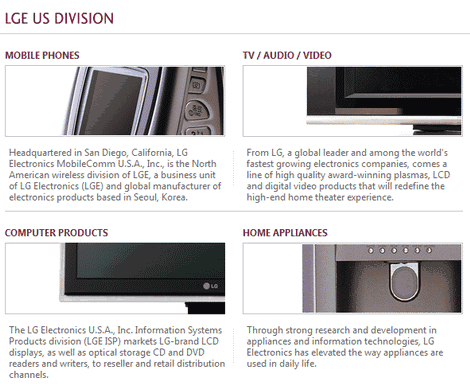
LG's stated goal is to enhance customer's life with intelligent features, intuitive functionality, and exceptional performance.

Learn more about LG Electronics U.S.A. by visiting the company website: http://us.lge.com/
Drive overview:
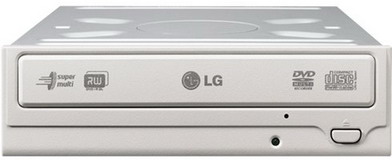
The LG GSA-H22N is a Super Multi DVD burner capable of reading and writing DVD+R/RW/DL, DVD-R/RW/DL, DVD-RAM, and CD-R/RW formats.
"Super Multi" was coined by LG in 2003 and is an informal term describing DVD burners compatible with all existing DVD and CD formats.
Prior to 2003, DVD-RAM and DVD+R/DVD-R drives were separate devices. LG Electronics was the first company to release a drive that supported all three DVD formats. Several companies have since followed this strategy, making "multi" and "super multi" commonly used terms.
Drive specifications:
LG GSA-H22N specifications on LG Electronics website list the following:
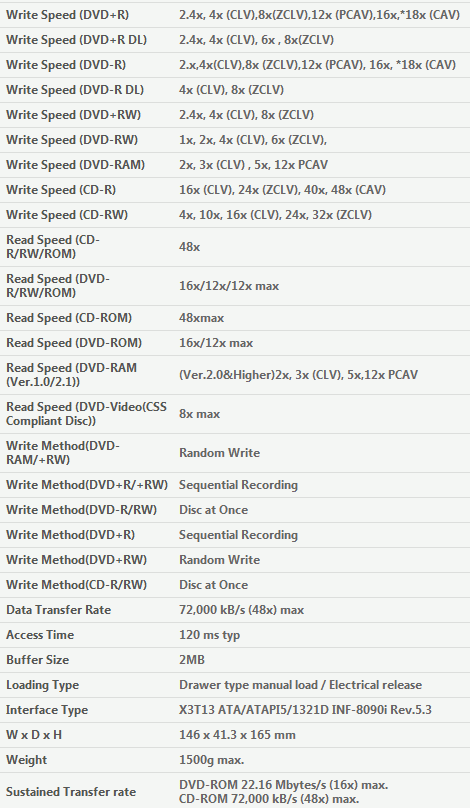
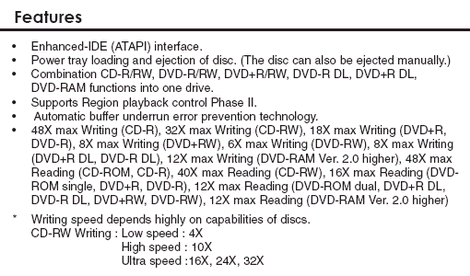
LG GSA-H22N supports a 66.7 MB/s ATAPI-5 interface, also known as Ultra ATA/66 or Ultra DMA Mode 4.
This high-speed ATA mode requires the use of an 80-wire EIDE cable in order to work reliably at full 18x speed. Although 80-wire EIDE cables have 40-pin connectors, they can be easily recognized by higher wire density in the cable and differently colored (blue, grey, and black) connectors.
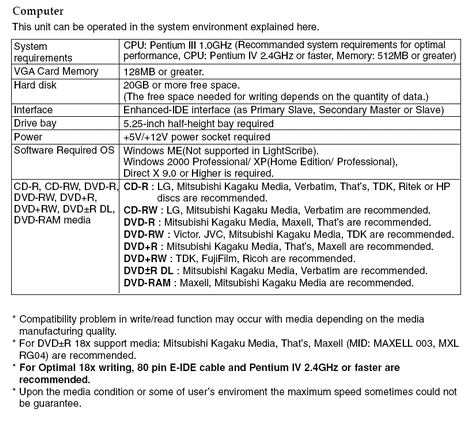
LG GSA-H22N requires high-quality 16x media in order to reliably achieve 18x DVD burn speeds, and the list of approved media provided in the second footnote to the table above is quite short.
Only Mitsubishi/Verbatim, That's/Taiyo Yuden and Maxell media made in Japan are listed as capable of 18x burns.
Fortunately, 16x Mitsubishi/Verbatim and Taiyo Yuden media is widely available in many countries.
What's inside the box?
The drive we received was a retail package. It included everything needed for an easy installation:
- Internal Super Multi 5.25" GSA-H22N drive
- Recording and authoring software disc
- Quick Set-up Guide
- Two-device, three-connector, 80-wire EIDE ribbon cable
- Audio cable
- Four mounting screws
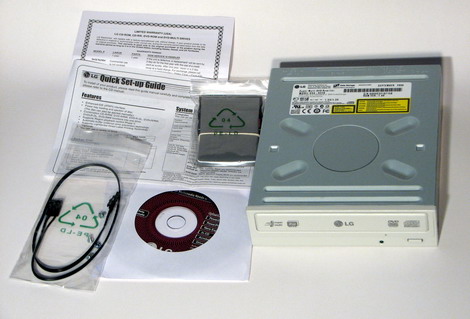
The North American retail package contains a beige drive.
The OEM, or bulk, version of the drive comes in either beige or black color.
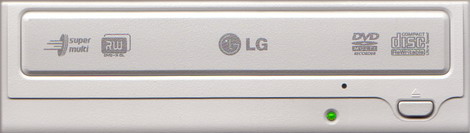
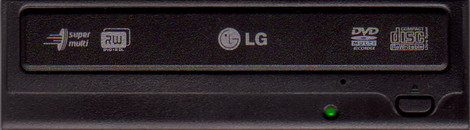
Front panel
The front panel has a distinctive LG look with a slightly protruding, contoured tray, common to all recent LG drives. The silver-colored company logo and various DVD, CD, and Super Multi logos indicating drive functionality are symmetrically arranged on the tray. The rest of the panel houses an eject button, an emergency eject hole, and a brighter than usual, round, green activity LED.
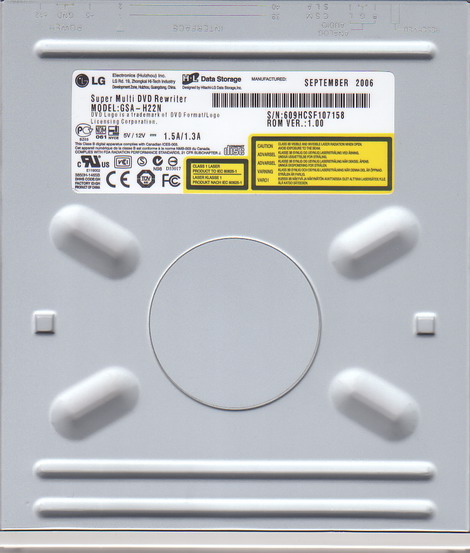
Top View
The top cover of the drive has four indentations that redirect airflow generated by fast disc rotation and also help reduce disc resonance and chassis noise at high speeds.
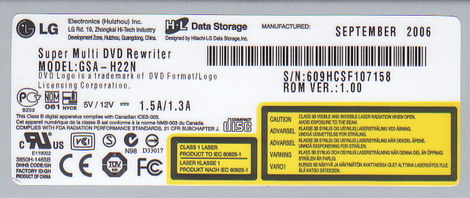
Drive Sticker
The sticker lists the drive model (GSA-H22N), serial number, firmware revision (1.00), manufacture date (September 2006) and country (China), power ratings, and various regulatory compliance logos and notices.
The 12V rating is a low 1.3 A, quite impressive for an 18x drive with a fast motor.
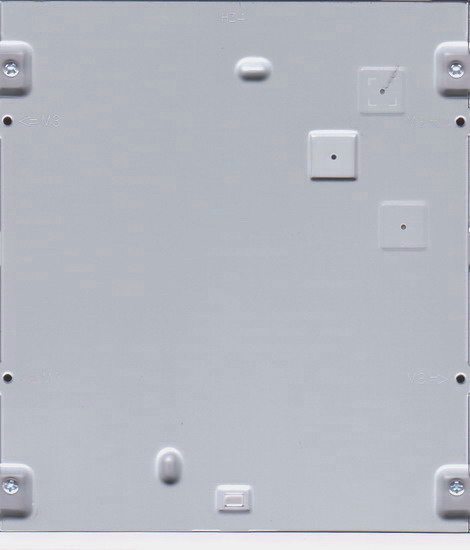
Bottom View
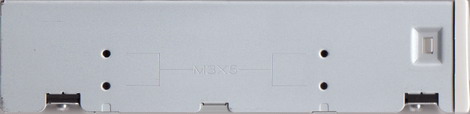
Left-side view
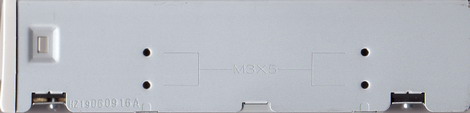
Right-side view
Left, right, and bottom sides of the drive provide standard mounting holes for case or rail screws and attachment points for the removable front panel.
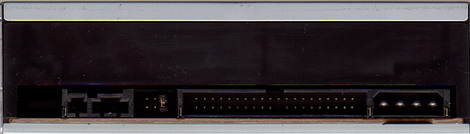
Rear view
The rear side houses the standard 4-pin DC power connector, a 40-pin EIDE/ATA connector, jumper pins that set the drive to IDE master, slave, or cable-select mode, and a four-pin analog audio connector.
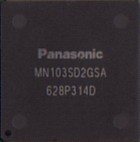
Panasonic MN103SD2GSA chip
The drive's electronics is built around a Panasonic chipset.
Test machine:
In this review we will be using a computer with the following configuration:
Hardware:
- CPU: Intel Core 2 Extreme X6800
- Motherboard: Asus P5W DH Deluxe
- Motherboard Chipset: Intel Glenwood-DG i975X
- System Memory: 4096 MB DDR2-800 SDRAM
- Video Adapter: NVIDIA GeForce 7950 GT
- Monitor: Dell 3007WFP
- Audio Adapter: Realtek ALC882
- Disk Drive: Two SATA Seagate Barracuda 7200.10 ST3320620AS drives in RAID0 configuration (640 GB)
- Disk Drive: One SATA Seagate Barracuda 7200.10 ST3750640AS drive (750 GB)
Controller and optical drive set-up:
- IDE Controller: Intel(R) 82801G (ICH7 Family) Ultra ATA Storage Controller
- IDE Controller: Intel(R) 82801GB/GR/GH (ICH7 Family) Serial ATA Storage Controller
- IDE Controller: Jmicron JMB363 Dual Channel PCI IDE Controller
- Optical Drive: HL-DT-ST DVD-RAM GSA-H22N (DVD+R9:8x, DVD-R9:8x, DVD+RW:18x/8x, DVD-RW:18x/6x, DVD-RAM:12x, DVD-ROM:16x, CD:48x/32x/48x DVD+RW/DVD-RW/DVD-RAM)
- Optical Drive: _NEC DVD_RW ND-3540A (DVD+R9:8x, DVD-R9:4x, DVD+RW:16x/8x, DVD-RW:16x/6x, DVD-ROM:16x, CD:48x/32x/48x DVD+RW/DVD-RW)
- Optical Drive: LITE-ON DVDRW LH-18A1P (DVD+R9:8x, DVD-R9:8x, DVD+RW:18x/8x, DVD-RW:18x/6x, DVD-RAM:12x, DVD-ROM:16x, CD:48x/32x/48x DVD+RW/DVD-RW/DVD-RAM)
- Optical Drive: BENQ DVD DD DW1640 (DVD+R9:8x, DVD-R9:4x, DVD+RW:16x/8x, DVD-RW:16x/6x, DVD-ROM:16x, CD:48x/32x/48x DVD+RW/DVD-RW)
The LG GSA-H22N is connected to the primary channel on the motherboard's ICH7 south bridge Parallel ATA port.
It identifies itself as "HL-DT-ST DVD-RAM GSA-H22N."

DMA (Direct Memory Access) is enabled, and connection mode is properly reported as Ultra DMA Mode 4.
CD-DVD Speed reports the burst rate of 38 MB/s, confirming that Ultra DMA Mode 4 is in effect:

When the LG GSA-H22N is installed in an external enclosure, the burst rate is reported as 27 MB/s, which should allow full speed, trouble free 16x burns:

Later, we will perform 16x and 18x test burns with the LG GSA-H22N in an external enclosure.
Software:
The computer is running Windows Vista Ultimate RC2 (build 6.0.5744). We will be using the following software in this review:
- Nero CD/DVD Speed version 4.7.0.0
- K-Probe version 2.5.2
- Nero Info Tool version 4.03
- Nero Burning ROM version 7.5.9.0
- Slysoft CloneCD 5.2.9.1
Installation and supported features:
Drive installation was uneventful. We set the jumper to "cable select" and let the two drives sharing an ATA cable pick master and slave modes automatically.
Nero InfoTool reports the following configuration and drive features:

The drive's firmware revision is listed as 1.00.
The hardware memory buffer used to ensure uninterrupted recording is the now standard 2 MB.
Included software:
The software CD provided with the retail version of the drive includes the Owner's Manual in 15 languages: Traditional Chinese, Simplified Chinese, Czech, German, Greek, English, Spanish, French, Hungarian, Italian, Japanese, Dutch, Polish, Portuguese, and Russian.
The following software is included on the CD:
- Cyberlink PowerDVD version 6
- CyberLink PowerProducer version 3
- Nero Burning ROM version 6.6
- Nero InCD version 3.4
- LG ODD Auto Firmware Update
LG ODD Auto Firmware Update is a utility similar to Windows Update. It runs in the background and can be configured to notify the user about firmware updates, or automatically download and install them.
Disc writing technology:
Now we will take a closer look at the writing technology used by the LG GSA-H22N.
CD-R:

The LG GSA-H22N uses CAV (Constant Angular Velocity) to write CD-R media at its maximum speed of 48x. This results in an average speed of 37.03x and full-disc burn time of 2 minutes and 37 seconds.
For comparison, we have made the following table:

When it comes to writing 48x CD-Rs, the LG GSA-H22N is among the fastest of all drives we have reviewed so far.
CD-RW:

The LG GSA-H22N uses Z-CLV (Zone-Constant Linear Velocity) to write CD-RW media at its maximum speed of 32x. This results in an average speed of 25.92x and full-disc burn time of 3 minutes and 29 seconds.
For comparison, we have made the following table:

When it comes to writing CD-RW media, the LG GSA-H22N is about average among the drives we have reviewed so far.

With 16x and lower rated CD-RW media, the LG GSA-H22N uses CLV (Constant Linear Velocity). At 16x, this results in an average speed of 16.09x and full-disc burn time of 5 minutes and 29 seconds.
18x DVD+R:

The LG GSA-H22N uses CAV (Constant Angular Velocity) to write DVD+R at the maximum supported speed of 18x. This results in an average write speed of 13.53x and a writing time of just 5 minutes and 13 seconds.
18x DVD-R:

The LG GSA-H22N uses CAV (Constant Angular Velocity) to write DVD-R at the maximum supported speed of 18x. This results in an average write speed of 13.55x and a writing time of just 5 minutes and 2 seconds.
For comparison, we have made the following table:

When it comes to writing DVD+R and DVD-R media, the LG GSA-H22N is currently the fastest among all 18x drives. It is at least 10 seconds and sometimes as much as 40 seconds faster than other 18x drives.
LG GSA-H22N's shorter burn times are due to two factors: fewer power calibration stops during burns and shorter than usual lead-in and lead-out times.
LG appears to be well justified in calling the GSA-H22N the "World's Fastest 18x DVD Rewriter."
16x DVD+R and DVD-R:


The LG GSA-H22N uses CAV (Constant Angular Velocity) to write DVD+R and DVD-R at 16x. This results in average write speeds of 11.94 - 11.97x and writing times of just 5 minutes 36 seconds to 5 minutes 38 seconds.
8x DVD+R and DVD-R:


The LG GSA-H22N uses an unusual 4x-8x two-zone Z-CLV (Zone-Constant Linear Velocity) strategy to write DVD+R and DVD-R at 8x. This results in average write speed of 7.42x and writing times around 9 minutes, a good minute longer compared to more common 6x-8x Z-CLV strategies.
8x DVD+RW:

The LG GSA-H22N uses Z-CLV (Zone-Constant Linear Velocity) to write DVD+RW at 8x. The average speed is 7.48x and total writing time is 9 minutes and 45 seconds.
6x DVD-RW:

The LG GSA-H22N uses Z-CLV (Zone-Constant Linear Velocity) to write DVD-RW at 6x. The average speed is 5.63x and total writing time is 10 minutes and 54 seconds.
8x DVD+R DL:
The LG GSA-H22N supports 8x writing speed on DVD+R DL media.

The LG GSA-H22N uses three-zone, 4x-6x-8x Z-CLV (Zone-Constant Linear Velocity) to write DVD+R DL at 8x. The average speed is 6.31x and total writing time is 19 minutes and 16 seconds.
8x DVD-R DL:
The LG GSA-H22N supports 8x writing speed on DVD-R DL media.

The LG GSA-H22N uses three-zone, 4x-6x-8x Z-CLV (Zone-Constant Linear Velocity) DVD-R DL at 8x. The average speed is 6.30x and total writing time is 19 minutes and 4 seconds.
12x DVD-RAM:
The LG GSA-H22N supports 12x writing speed on DVD-RAM media.

The LG GSA-H22N uses P-CAV (Partial Constant Angular Velocity) to write DVD-RAM at its maximum speed of 12x.
Without verification, the average speed is 10.11x and total writing time is 5 minutes and 42 seconds.

With verification, the average speed drops to 3.88x and total writing time increases to 14 minutes and 36 seconds.
Book type (Bitsetting):

The LG GSA-H22N supports bitsetting, and is capable of writing DVD+R and DVD+R DL media with the DVD-ROM book type.
Setting DVD+RW book type is not supported.
For more information about book types and bitsetting, see Increased compatibility: DVD bitsetting.
Reading performance:
For these tests we will use Nero CD-DVD Speed to read various CDs and DVDs, including audio and video discs. The LG GSA-H22N supports up to 16x DVD-R/-ROM reading and up to 48x CD-R/-ROM reading.
Pressed discs:
For this test we used a pressed CD-ROM data disc, about 73 minutes in length.

The LG GSA-H22N reached 44.60x, and would reach approximately 47x-48x on a full 80-minute disc. Let's compare the result with other drives performance in the table below:

The LG GSA-H22N is about average when reading pressed CD-ROMs.
CD-R:
For this test we used a Data CD-R that was made using Nero CD-DVD Speed. The disc was a Memorex 48x CD-R manufactured by CMC Magnetics Corporation.

The LG GSA-H22N reached almost 43x when reading a full CD-R disc. Now let us compare the result to some other drives:

The LG GSA-H22N is about average when reading CD-R discs.
CD-RW:
Again, we made a Data CD with Nero CD-DVD Speed. This time we used a Memorex Ultra Speed (24x) CD-RW manufactured by Infodisc Technology Co., Ltd.

The drive reads CD-RW discs at the same speed as CD-R discs, approximately 43x. Check how this compares to other drives below:

The LG GSA-H22N is one of the fastest drives when reading CD-RW media.
Audio - digital audio extraction:
To test the digital audio extraction performance of the LG GSA-H22N, we used Nero CD-DVD Speed to measure the transfer rate. The audio disc we used was 76 minutes long.

The LG GSA-H22N reached 42x reading the Audio-CD.

The LG GSA-H22N audio extraction speed was in line with other drives, with relatively slow seek times but perfect 10/10 quality and accuracy.
Advanced audio - DAE quality test:
For this test we used the "Advanced DAE Quality Test" feature of Nero CD-DVD Speed.
The CD-R media was a 40x certified Memorex Music CD-R made by CMC. (Thanks to Memorex USA for providing this media.)
The LG GSA-H22N showed 48x as an available speed with this media, and we created the test disc at 48x.


The test shows that audio extraction quality is perfect, with a quality score of 100, and that the drive supports reading CD text, subchannel data and the lead-in.
On the downside, the speed of on-the-fly copying appears to be limited to 8x.
DVD reading performance:
Again, we will use Nero CD-DVD Speed to measure reading performance, this time for various types of DVD discs.
DVD - DVD-Video:
For our DVD reading performance tests we are going to start with single- and double-layer DVD video discs.
While only 1x speed is required to watch DVD movies, it is useful to be able to read the discs at higher speeds when extracting the content of the disc to a hard drive.

DVD-Video Single Layer

DVD-Video Double Layer
The LG GSA-H22N reads pressed single- and double-layer DVD-Video discs at 8x CAV (Constant Angular Velocity).
In our test, a nearly full single-layer DVD-Video disc was read in 9 minutes and 41 seconds, and a nearly full double-layer DVD-Video disc in 17 minutes and 37 seconds.

As you can see, the LG GSA-H22N turns out to have the slowest double-layer and (especially) single-layer DVD-Video extraction speed among all recently tested drives.
DVD - DVD+R/RW:
For this test we used a Verbatim 16x DVD+R and a Verbatim 4x DVD+RW with 4.38 GB of data each. (Thanks to Verbatim USA for providing this media.)

DVD+R

DVD+RW

The LG GSA-H22N is a fast reader of DVD+R and DVD+RW discs, maxing out just above 16x and 12x, respectively.
DVD - DVD-R/RW:
For this test we used a Verbatim 16x DVD-R disc and a Ritek 6x DVD-RW disc filled with 4.38 GB of data each. (Thanks to Verbatim USA and Advanced Media/Ritek USA for providing this media.)

DVD-R

DVD-RW

The LG GSA-H22N is a fast reader of DVD-R and DVD-RW discs, again maxing out just above 16x and 12x, respectively.
DVD - DVD±R DL:
For this test we used a Verbatim 8x DVD+R DL disc and a Verbatim 8x DVD-R DL disc filled with 7.96 GB of data each. (Thanks to Verbatim USA for providing this media.)

DVD+R DL

DVD-R DL
The LG GSA-H22N is a fast reader of DVD+R DL and DVD-R DL discs, maxing out at 12x.
Curiously, it reads recordable DVDs with data faster than pressed DVD-Video discs.
DVD - DVD-RAM:
For this test we used a Maxell 12x DVD-RAM filled with 4.27GB of data. (Thanks to ExtremeMhz for providing this media.)

DVD-RAM
The LG GSA-H22N reads DVD-RAM at 12x using P-CAV (Partial Constant Angular Velocity) in 5 minutes and 34 seconds.
The specifications of LG GSA-H22N state that the drive is able to write CD-R discs at up to 48x and CD-RW discs at up to 32x. In this part of the review we will find out how the drive performs in terms of speed and quality.
Writing speed with CD-R discs:
For our data writing tests, we created a new compilation of 703 MB using Nero Burning ROM software. The writing method used is DAO (Disc At Once), and the disc is set up as a non-multisession disc with "finalize disc" enabled. The screenshot below shows how long it took to write a disc at the highest speed (48x):

The drive took 2 minutes and 43 seconds to write the disc at 48x. The LG GSA-H22N is the fastest of all recently tested drives:

Writing quality:
We test writing quality using CD-R discs from different manufacturers.
To measure the writing speed, we used the "create data CD" function of Nero CD-DVD Speed. The discs were written at the maximum speed supported by the drive.
For the quality test, we used KProbe 2, a tool developed by a Lite-On employee. It runs under Windows and works with drives made by Lite-On. We used a Lite-On LTR-24102B drive with firmware 5S5A and scanned the discs at 48x. (Note that different scanning drives and different scanning speeds may affect the results obtained during quality tests.)
In practice, a recorded CD-R disc will always have some C1 errors; C1 errors are easily corrected by the drive's error correction capabilities.
The next level of errors is C2. While C2 errors are corrected by computer drive's error correction mechanisms, they are not wanted on a good quality disc. A good disc should not contain any C2 errors, and preferably have an average C1 error amount of below 2.0 for the best quality discs, or at least below 10.0 C1 average for good quality discs. After C2 errors, there are only un-correctable errors that will make a disc unusable.
In short, our analysis will be based on these guidelines to determine the quality of the burned disc:
CD-R/RW quality scan guideline


Verbatim DataLifePlus CD-R media has no C2 errors and the average C1 error rate of 1.47, indicating that the LG GSA-H22N produces excellent quality burns with this media, and in record time too.


This Verbatim-branded media, manufactured by CMC Magnetics Corporation has no C2 errors and the average C1 error rate of 1.36, just as good as the DataLifePlus media. Again, the burn time of 2 minutes and 37 seconds is as short as it gets at 48x, and the LG GSA-H22N produces excellent quality burns with this media.


There is an increase in the C1 error rate in the last 10 minutes of the disc, but not enough to significantly raise the average error rate. The LG GSA-H22N burns this media very well, and the 48x CD-R burn is fast.


This Memorex-branded media manufactured by Ritek was burned by the LG GSA-H22N at 40x, taking 30 seconds longer than 48x burns. Burn quality is very good with an average C1 error rate of 3.41.
Writing quality with CD-RW discs:
We have performed a few write quality tests with rewritable media. The settings and the testing procedures are the same as with CD-R media. All discs used for these tests are new and have not been written to before.


The ultra-speed CD-RW has frequently been difficult for DVD drives to handle, and the LG GSA-H22N is no exception. C1 error rate is very high, and there are many C2 errors. This media appears to be unsuitable for audio recording.
However, our data disc is readable and exhibits only minor slowdowns when read by another drive, a BenQ DW1640.


This media was burned at 16x but it shows slightly better, but still far from good quality. Again, the BenQ DW1640 has no trouble reading the disc.
Summary:
The LG GSA-H22N is a very fast CD-R writer creating high quality CD-R discs.
CD-RW burns appear problematic when we look at quality scans, but all recorded discs are read back fine.
The specifications of LG GSA-H22N state that the drive is able to write DVD±R at 18x, DVD+RW at 8x, and DVD-RW at 6x. In this part of the review, we will measure writing time for various types of DVD+R/RW and DVD-R/RW discs. We will also focus on writing quality and media compatibility.
DVD writing performance:
First, let us see how long the drive needs to create a disc using Nero Burning ROM. We have created a UDF/ISO compilation containing 4482Mb (4.38GB) of data, and started the write process. We used the Disc-At-Once writing method.

DVD+R

DVD-R
The DVD+R disc was completed in 5 minutes and 20 seconds, while the DVD-R disc was completed in 5 minutes and 13 seconds.

The LG GSA-H22N is at least as fast as any other 18x drive we have tested to date. Now let us see how good the writing quality is.
Writing quality:
You should first notice that this is not a scientific and professional way to test the discs. But according to our testing done in recent months, we would conclude that there is a clear link between the quality reported when scanning the disc and the playability of the disc in different devices. Also notice that different drives report different amounts of errors. K-Probe was designed to work with Lite-On DVD-Writers. So we recommend using a DVD-Writer from Lite-On, in this test we use a Lite-On LH-18A1P DVD-Writer, as already said; remember that scans done with a Lite-On DVD-ROM or Lite-On combo drive can't be compared with the results obtained with a Lite-On DVD-Writer. Also remember that different PI/PO ECC sum settings along with different reading speeds in K-Probe will affect the result, we use these settings; PI (Parity Inner) set to summarize 8 ECC blocks, PIF (Parity Inner Failures) set to summarize 1 ECC block, reading speed: 4x CLV (Constant Linear Velocity). Setting the PI sum to 8 and the PIF sum to 1 will give a result that we may compare to the standards for DVD+R/RW and DVD-R/RW.
But what is a good scan? That is a discussion that we don't think will end soon, as different drives report different amount of errors, some players are more picky about media than others, and so on. But as a comparison we present you with a scan from two pressed DVD discs:

This scan above shows the results from a pressed, Single Layer DVD-Video disc (Widow on the Hill).

This next scan shows the result from a pressed Double Layer DVD-Video disc (Monster in Law). Notice the error jump when shifting to the second layer (the error levels jump from the end of the first layer to the beginning of the second layer).
If you read below you will see that both the pressed DVD-discs above are well within the standards.
If you want to look at the standards for yourself, download the ECMA 267 Standard for DVD-ROM, the ECMA 337 Standard for DVD+R/RW and the ECMA 338 Standard for DVD-R/RW at http://www.ecma-international.org. Here is some data from the ECMA standards (same for DVD-ROM, DVD-R/RW and DVD+R/RW):
Random errors:
A row of an ECC Block that has at least 1 byte in error constitutes a PI error. In any 8 consecutive ECC Blocks the total number of PI errors before correction shall not exceed 280.
Here we see that a PI error is defined as a row in an ECC block having 1 byte or more containing errors and that the sum of PI errors in 8 ECC blocks after each other should not exceed 280 PI errors.
But what is a row and what is an ECC block? Again we refer to the ECMA standards. We do not copy and paste everything, but if you're interested, look in the ECMA standards. A row is 182 bytes long where the last 10 bytes contain PI (Parity Inner) information. An ECC block is 208 rows long where the last 16 rows contain the PO (Parity Outer) information. This gives us a maximum possible PI error amount of 208 errors per block and for 8 blocks after each other this sum is of course 8 times higher, giving a maximum possible amount of 1664 PI-8 errors. In practical use, a disc with 1664 PI-8 errors is unreadable.
According to our tests the specified max PI-8 sum of 280 for good discs seems to be a good guideline, as some readers have problems reading discs when the PI-8 errors is over 300 and most players starts to have problems when the PI-8 error level reaches 600 or more.
But what are the PIF errors that K-Probe reports? They are Parity Inner Failures, meaning errors left after PI correction. Only the ECMA 337 standard describes the Parity Inner Failures. So how is a Parity Inner Failure defined? Here is what the ECMA 337 states:
"If a row of an ECC Block as defined in 13.3 contains more than 5 erroneous bytes, the row is said to be "PI-uncorrectable"."
In theory, an ECC block may in the worst case have 208 PIF since every ECC block is 208 rows long. But the ECMA 337 standard goes further and specifies the max amount of accepted PI Failures (uncorrectable errors) allowed on a good disc:
"In any ECC Block the number of PI-uncorrectable rows should not exceed 4."
This means that when the PIF sum is set to 1, the maximum error value should not exceed 4. The theoretical maximum value for PIF is 208 errors.
But what makes a disc unreadable? A POF (Parity Outer Failure) error will make the disc unreadable, but K-Probe does not display the POF's.
Notice that there are other aspects such as disc reflectivity, tracking errors and so on that also will affect the readability of a DVD disc - but for this we do not have measuring equipment available.
Also, another note is that we have scanned the discs at 4x CLV speed, by lowering the speed to 2x(DVD-R/RW)/2.4x(DVD+R/RW) or 1x the amount of reported errors may drop on some discs. We scanned at 4x CLV due to lower speeds taking too much time.
To see if there is a connection between the reported amount of errors and readability of the discs we also include the reading curve from a NEC ND-4570A or BenQ DW1655 DVD-Writers which by default are able to read DVD±R media at 16x speed. A small speed reduction near the end is still accepted on good discs, but serious reading problems or reading failures is a bad sign.
Easier explanation on how to read the test results.
Maybe this got too technical, and you are wondering what to look for in KProbe reports?
Use this as a guideline for good discs:
- PI (Parity Inner): No larger areas on the disc should exceed 280 PI-8 errors, do not worry too much about high single spikes that exceed 280.
- PIF (Parity Inner Failures): No larger areas on the disc should exceed 4 PIF-1 errors, do not worry too much about high single spikes that exceed 4.
And as always: lower is better.
Also look at the reading curve; if it looks clean with no dips it should be good, a small slowdown near the end is accepted.
DVD+R media compatibility and writing quality:
In these tests we will be using a Lite-On LH-18A1P drive along with KProbe 2 to measure disc quality. We will also be using a BenQ DW1640 and Nero CD-DVD Speed for our transfer rate tests.


Verbatim/Mitsubishi media is so good, very few drives have problems burning it. But this is no average drive.
The LG GSA-H22N sets a new burn time record, 5 minutes and 10 seconds, burning this DVD+R disc faster than any other drive we have seen so far.
Disc quality is amazing, considering the speed at which it was created.


This disc burned in 5 minutes and 15 seconds, with outstanding quality as well. Another 18x success.


CMC media sometimes gets undeserved criticism, in our opinion. The LG GSA-H22N handled this 16x DVD+R disc very well, producing a good quality burn.


This is another example of outsourced media. The scan shows excellent burn quality.


Another 16x CMC DVD+R disc under a different brand, same good burn quality.


This 16x burn was completed in 5 minutes and 40 seconds. Burn quality is outstanding.


Another 16x burn, completed in 5 minutes and 40 seconds. A wonderful result with Optodisc 16x DVD+R media.


An excellent-quality Taiyo Yuden burn, as expected.
However, the drive's Z-CLV writing strategy begins 8x DVD burns at 4x, spending two full minutes burning at 4x, which results in total burn time close to 9 minutes. This 4x-8x Z-CLV strategy seems to be carried over from earlier LG models.
DVD+RW media:
The LG GSA-H22N supports writing to DVD+RW discs at up to 8x speed.


Quality-wise, this is a very good result, similar to write-once media results, but 8x DVD+RW media is burned a little slower than it could have been, due to the 4x-8x Z-CLV burning strategy we earlier observed with DVD+R media.


This is an unusual result with thousands of PIFs forming a nearly solid red area. However, because PIF levels are so low, the burn should be considered very good. The smooth reading curve confirms this.


Extremely high PIE and PIF levels in the 4x area suggest that a laser power adjustment may be needed for this media, but it's hard to argue with a perfectly readable result.


A very good burn with a slower, 4x DVD+RW media.
Summary:
Writing quality is excellent with DVD+R and, with one exception, appears to be good with DVD+RW too.
DVD-R media writing quality:
In these tests we will be using a Lite-On LH-18A1P drive along with KProbe 2 to measure disc quality. We will also be using a BenQ DW1640 and Nero CD-DVD Speed for our transfer rate tests.


A very fast 18x burn, only 5 minutes and 2 seconds. Outstanding quality, too.
This media is well suited for 18x burns.


An excellent quality burn, as expected with Taiyo Yuden media.


A very fast 16x burn, only 5 minutes and 36 seconds. Quality is good, and a transfer rate test shows no issues.


This burn looks very good. Achieving a good quality burn with the media that has often been a challenge to other drives.


A very fast 18x burn with excellent quality. TYG03 is one of the best 18x media, and LG GSA-H22N handles it extremely well.


The LG GSA-H22N lacks a 16x strategy for this 16x-certified media. The burn took almost 15 minutes with the default 4x strategy. Burn quality is good.


Burn time of 9 minutes is a little on the slow side, but we can't argue with the result. The total PIF number of 32 indicates near-perfect media, near-perfectly burned at its rated speed. DVD burns don't get much better than this.
DVD-ReWritable media:


This Verbatim media produces an acceptable but far from stellar quality burn.


PIF numbers are out of the normal range, indicating potential reading problems in some devices, but a transfer rate test shows no problems when the disc is read in another drive.


This is about as good as it gets with DVD-RW media.
Summary:
The LG GSA-H22N produced excellent results on most of our DVD-R media but was only acceptable with DVD-RW media.
DVD+R Double Layer writing speed and quality:
The LG GSA-H22N supports the DVD+R DL standard for writing 8.5 GB Double Layer media at a writing speed of 8x.


The scan shows questionable quality at the beginning of the second layer but the transfer rate test shows no problem whatsoever during a read test. (The disc later played fine in a standalone DVD player, too.)


LG GSA-H22N burned this 8x certified media at 4x in under 28 minutes. Burn quality is good, and a transfer rate test shows a perfect reading curve.


Verbatim 2.4x DVD+R DL has a well-deserved reputation for high quality. This media can be burned at 4x, 6x, and even 8x speed. The LG GSA-H22N overspeeds this media to 6x, with excellent burn quality, as expected.


This new 8x DVD+R DL media was burned at the default 4x speed. The result is very good and shows no problems during a transfer rate test at 12x speed.


This 2.4x DVD+R DL media has been difficult for many drives, but the LG GSA-H22N handles it quite well.
The LG GSA-H22N burns RITEK D01 at 4x, which is faster than the rated speed. 4x appears to be the minimum speed for any DL media with this drive.
The quality scan shows acceptable results, confirmed by a smooth transfer rate test at 12x speed.
DVD-R Dual Layer writing speed and quality:
The LG GSA-H22N supports the DVD-R DL standard for writing 8.5 GB Dual Layer media at a writing speed of 8x.


A 4x-6x-8x Z-CLV writing strategy keeps rotational speed under 6000 RPM, taking 19 minutes to burn a full 8.5 GB disc. This is only 2 minutes faster than a 4x-6x Z-CLV burn, but PIE and PIF levels are good, and a transfer rate test shows no reading problems.
Good performance with this new, high-speed DVD-R DL media.


The result is excellent and shows how reliable 4x DVD-R DL burning is with Verbatim media.


The quality scan shows significantly elevated PIE and PIF error rates but there are no problems during a transfer rate test at 12x speed.
Standalone DVD player compatibility:
We used LG GSA-H22N to create DVD video discs on DVD+R DL media (Book Type: DVD-ROM) and DVD-R DL media (Book Type: DVD-R) and tested their playback on a standalone DVD player: Sony DVP-S560D.
Compatibility results:

Both brands of DVD+R DL played correctly in the standalone player.
However, the DVD-R DL disc froze at the layer break. This was likely caused by a known compatibility issue between the DVD-R DL format and older standalone players, and is not an indication of a problem with either the LG GSA-H22N drive or Verbatim media quality.
Summary:
The LG GSA-H22N burns DVD+R/-R DL well, with good results all around, especially with Ritek media that has been problematic for many burners in the past. Although some Ritek media exhibits elevated levels of PI errors and PI failures in quality scans, smooth transfer rate tests indicate that the discs are reliably readable.
There were no problems with reading any of the DL media burned by the LG GSA-H22N at 12x speed. This suggests that no standalone DVD players or computer drives should have difficulty playing DL discs burned by the LG GSA-H22N at slower playback speeds.
DVD-RAM:
The LG GSA-H22N is a Super Multi DVD Rewriter, meaning that is fully supports reading and writing the DVD-RAM format.
DVD-RAM is a veteran among the three DVD formats. It is a ten-year old format, and it predates the DVD-R format by one year.
LG's Super Multi drives have played a significant role in spreading the use of the DVD-RAM format from camcorders and standalone devices to computers, by combining DVD-RAM support with DVD+R and DVD-R support, thus making DVD-RAM use possible without having a separate drive.
The DVD-RAM format is inherently more reliable than other DVD rewritable formats due to its superior error control, defect management, and the option of hardware-based data verification during writing.
DVD-RAM defect management provides data structures, stored on each disc, that allow unusable sectors to be relocated. It also allows the number of relocated sectors to grow over time, effectively reversing the negative effect of gradual media deterioration.
While DVD+R and DVD-R data track is spiral, DVD-RAM track layout is concentric, similar to that of a hard drive platter.
Looking at the recording side of a DVD-RAM disc, it is easy to notice that the data surface is very different from DVD+R and DVD-R discs. It has a fascinating pattern of small rectangles:

A DVD-RAM disc can be formatted in any of the following formats: FAT32, UDF 1.02, UDF 1.50, UDF 2.00, UDF 2.01, and UDF 2.50.


Many operating systems (Mac OS X, Windows XP, Windows Vista) support DVD-RAM formatting, reading and writing directly, without the need to install any additional drivers or software. Once a DVD-RAM disc is formatted, it acts like a removable hard drive and all writing is done in the background. This means that you do not have to wait for the drive to finish writing and can continue working with applications while the DVD-RAM drive is doing the burning.
Lets us take a look how the LG GSA-H22N works with DVD-RAM:


Maxell 12x DVD-RAM media, manufactured by Maxell
(Thanks to ExtremeMhz for providing this media)

Writing Maxell 12x DVD-RAM without verification

Writing Maxell 12x DVD-RAM with verification

Reading Maxell 12x DVD-RAM (transfer rate test)
As we can see, the LG GSA-H22N writes 12x DVD-RAM in 5 minutes and 42 seconds without verification, and reads back at 12x speed in 5 minutes and 34 seconds.
With verification, writing a full 4.27 GB DVD-RAM disc takes 14 minutes and 36 seconds.
Please note how turning on data verification has slowed writing speed from an average of 10.11x to 3.88x. This is due to the drive constantly reading back the data after writing it, to verify that it has been correctly stored. It is a slow writing technique but in combination with the defect management mechanism of DVD-RAM it is as close to "bullet proof", in terms of preventing data loss, as one can get with optical media.


Maxell5x DVD-RAM media, manufactured by Maxell
(Thanks to Maxell USA for providing this media)

Writing Maxell 5x DVD-RAM

Reading Maxell 5x DVD-RAM
As we can see, the LG GSA-H22N reads and writes a full 4.27 GB 5x DVD-RAM disc in approximately 12 minutes.
Before we complete this review, we will run some advanced tests on the LG GSA-H22N.
The "Sheep Test":
 For this test, we will use the sheep tests made by Alexander Noé. Why is it called sheep test? That's because the logo of the first 1 to 1 copy program called CloneCD is a sheep. When looking at supported writers, you will notice that the feature list has sheep to indicate if a feature is supported or not.
In this case we are interested in the writer's ability to backup/write weak sectors. Also called: "Correct EFM encoding of regular bit-patterns."
- No sheep: Can't backup any Safedisc 2 versions without the help of software tricks
- 1 Sheep: Can backup Safedisc 2 up to version 2.4x without software tricks
- 2 Sheep: Can backup Safedisc 2, including version 2.5x
- 3 Sheep: Can write all possible weak sectors, few if any writers could do this.
One of our forum moderators, Womble, has written a guide concerning the "Sheep Test" that can be found here.
In the screenshot below taken from CloneCD, we see the LG GSA-H22N supports all features CloneCD tests for.


The LG GSA-H22N is a "Two Sheep Burner" that can successfully write Safedisc up to V2.51.
16x and 18x DVD writing in an external enclosure:
We have placed the LG GSA-H22N in an external FireWire enclosure built around the Prolific PL3507 chipset for the following test burns.

A 16x DVD+R burn completed in 5 minutes and 42 seconds, the same time as it would have taken in an internal setup.
The drive's buffer level is stable all the way to the end of the burn, demonstrating the drive's ability to communicate at 22 MB/s necessary to achieve the full 16x speed.

An 18x burn shows signs of exceeding the maximum data transfer rate possible in our setup, but the LG GSA-H22N manages to complete the 18x burn without a significant slowdown, in 5 minutes and 17 seconds. This is about 15 seconds longer than it would have taken in an internal setup, but still quite impressive for a drive in an external enclosure.

The quality of the burned disc is nothing short of excellent, even in the final area where the drive was forced to repeatedly suspend and resume burning. We can observe some additional PI failures near the end, but their number is minimal, a testament to the drive's good implementation of buffer underrun protection.
Conclusion
Positive:
- Record-breaking 18x single-layer DVD burn times of just over five minutes
- Excellent 16x single-layer DVD burn times, on par with other drives' 18x burn times
- Solid writing quality on nearly all media we tested
- Bitsetting support for DVD+R and DVD+R DL media (booktype DVD-ROM) improves readability of discs
- Complete DVD-RAM support, up to full 12x speed
- Short lead-in and lead-out times, resulting in faster burns
- Very fast 48x CD-R and 32x CD-RW writing
- Fast 16x reading of recorded DVD+R and DVD-R discs
- Fast 12x reading of recorded DVD+RW, DVD-RW, DVD+R DL and DVD-R DL discs
- A "two sheep" writer
Negative:
- Disc quality (C1/C2, PI/PO) scanning is not supported
- No bitsetting support for DVD+RW media
- Slow 8x reading of single- and double-layer DVD-Video discs
- Somewhat slow 4x-8x Z-CLV DVD strategy leads to nine-minute burn times with 8x-rated media
- Many rewritable media (CD-RW and DVD±RW) burns are of questionable quality
Conclusion:

We are quite happy with this drive's performance. LG GSA-H22N's positives outweigh its negatives.
Let us summarize the most important positive and negative points below:
The main positive points: The LG GSA-H22N is a Super Multi DVD burner supporting nine types of DVD and CD media: DVD+R/RW/DL, DVD-R/RW/DL, DVD-RAM, and CD-R/RW.
High-speed 16x and 18x DVD+R and DVD-R writing works very well and produces discs of very good quality, in record time.
48x CD-R writing is equally fast, with very good disc quality as well.
Ultra DMA Mode 4 allows the LG GSA-H22N to reach data transfer speeds needed to reliably work at 18x speed. Thanks to Ultra DMA Mode 4, this drive is well suited for external enclosures, where it easily reaches 16x DVD burning speed.
The main negative points: There are some areas where we would like to see improvements.
DVD-Video extraction at 8x speed is slow compared to other drives.
Burn quality needs to be improved for rewritable media, both CD-RW and DVD±RW.
It would be good to have a black front panel included in the retail package for customers with black computer cases.
The absence of disc quality (C1/C1, PI/PO) scanning is typical for LG drives, but, frankly, it may not be an important feature with the LG GSA-H22N as the drive hasn't produced a single coaster in any of our tests.
Final thoughts: It is easy to like the LG GSA-H22N.
18x burning is the fastest of all drives we have tested to date, easily beating the previous record set by another LG drive, the GSA-4163B, in early 2005. 18x DVD burning times are just a few seconds above the five-minute mark. 16x DVD burning is quite fast as well, at around 5 minutes and 40 seconds, and even 12x DVD burns take only six minutes.
The LG GSA-H22N is surprisingly smooth, considering that discs are rotating at 10,500 RPM (or 175 revolutions per second) during 18x burning. Vibration in our GSA-H22N drive is well contained, and the sound emitted by the drive at maximum speed - the air rushing inside and the hum of the high-speed motor - is quite subdued compared to other 18x burners.
To sum it up: "LG GSA-H22N is a solid performer and an excellent choice for reliable CD and DVD burning at record speeds. We highly recommend it."
At the time of this review (December 2006), our CD Freaks price grabber page shows that the LG GSA-H22N is available from many U.S. online stores and is priced as low as $30.99: LG GSA-H22NK (black OEM version) and LG GSA-H22NB (beige OEM version).
A search of European prices using Geizhals-Preisvergleich shows that the LG GSA-H22N is available in Europe for as little as €28,65.
And, according to a Japanese price search site, kakaku.com, the LG GSA-H22N sells for at least ¥5680 in Japan.
You may discuss/comment this review below or in this forum thread.
Thanks to:
 |
Maxell USA - For providing Maxell media used in this review. |
 |
Memorex USA - For providing Memorex media used in this review. |
 |
Rima.com USA - For providing Taiyo Yuden media used in this review. |
 |
Advanced Media/Ritek-USA - For providing RiDATA media used in this review. |
 |
Verbatim USA - For providing Verbatim media used in this review. |
 |
ExtremeMhz - For providing Maxell 12x DVD-RAM media used in this review. |