
 |
Review: Philips DVDRW885 Dual layer DVD-Writer Reviewer: OC-Freak Provided by: Philips Europe Firmware: T1.4 and P1.6 Manufactured: February 2004 |
Philips was kind enough to send us their latest DVD-Writer; the Philips DVDRW885. This drive is a very interesting drive as it supports the new Dual Layer DVD+R writing technlogy, allowing dual layer discs of 8.5Gb to be written. Philips has a long history for developing optical drives and has in the past joined up with BenQ for manufacturing and developing optical drives. This strategy alliance seems to gain both BenQ and Philips. BenQ has the production facilities, while Philips designs chipset/electronic components as well as being on of the main DVD+R/RW developers.
Company information:
We are sure that most of you know philips already as they have a lot of different industry, such as petroleum, computer parts, electronics and more. But let us take a look at some of the company information found at www.philips.com.
Royal Philips
Electronics of the Netherlands (NYSE: PHG, AEX: PHI) is one of the world's biggest electronics companies and Europe's largest, with sales of EUR 29 billion in 2003. It is a global leader in color television sets, lighting, electric shavers, medical diagnostic imaging and patient monitoring, and one-chip TV products. Its 165,300 employees in more than 60 countries are active in the areas of lighting, consumer electronics, domestic appliances, semiconductors, and medical systems.
Global Leader
Royal Philips Electronics is tenth on Fortune's list of global top electronics corporations. We are active in about 60 businesses, varying from consumer electronics to domestic appliances and from security systems to semiconductors.
 We are a world leader in digital technologies for television and displays, wireless communications, speech recognition, video compression, storage and optical products as well as the underlying semiconductor technology that makes these breakthroughs possible.
We have world class solutions in lighting, medical systems (particularly scanning and other diagnostic systems) and personal and domestic appliances where our investments in design and new materials are critical to success.
Translated into figures, we produce over 2.4 billion incandescent lamps every year, and some 30 million picture tubes.
Around 2.5 million heart procedures (scans and interventional procedures) on X-ray equipment are carried out each year using our technology.
One in seven television sets worldwide contains a Philips picture tube, and 60 percent of all telephones contain Philips products.
Thirty percent of offices around the world are lit by Philips Lighting, which also lights 65 percent of the world's top airports, 55 percent of major soccer stadium, and 30 per cent of hospitals.
The strength of Philips' global operations is reflected in its (value-based) leadership position in many of the markets in which it is active:
|
World |
Europe | |
| Lighting |
1 |
1 |
| Consumer Electronics (audio/video) |
3 |
1 |
| Monitors (units) |
4 |
3 |
| Shavers |
1 |
1 |
| Steam irons |
2 |
2 |
| Semiconductors |
9 |
4 |
| Color picture tubes |
3 |
1 |
| DVD recorders |
1 |
1 |
| Medical imaging equipment |
2 |
1 |
| Dental care (electric toothbrushes) |
2 |
2 |
Company strategy:
'BEST"
- BUSINESS EXCELLENCE THROUGH SPEED AND TEAMWORK '“
The BEST program is Philips' chosen path to achieve business excellence. It describes a set of methods and tools by which we continuously improve our efforts. Previous successful initiatives are incorporated in the program to make sure we learn as much as possible from our successes in the past.
Business Excellence
We are all committed to improving processes in-line with the company's strategic targets. To this end, Philips has adopted BEST to reach this goal. It is our ambition to be one of the best companies in the world: the best to trade with, work for, and invest in.
Our Measures:
⋅ Customers are fully satisfied by the quality of Philips' products and services
⋅ Employees develop and use their full potential
⋅ Shareholders get a premium return on their investment
⋅ Suppliers choose to work with us as this generates superior value for both
⋅ The larger community appreciates our contribution to the quality of life
Speed and Teamwork
Speed and Teamwork lie at the heart of the BEST initiative. Each and every individual within Philips knows that only by fully cooperating and working together we are able to perfect our business processes. That's why we focus on:
- Working smarter and reducing the cycle-time of processes
- Working in teams and learning from the best practices of others
The tools and approaches in the BEST initiative all are based on these two focal areas and all fit in the improvement cycle:
"Plan - Do - Check - Learn"

If you are interested in reading more company information, please visit www.philips.com.
Drive specifications:
These are the specifications of this drive, found in the pre-release documentation released under CE-Bit 2004:
Commercial Specifications
Storage Media
'¢ Access time (typical) 120ms on CD, 140ms on DVD
'¢ Disc capacity 8.5 GB DVD+R DL, 4.7 GB DVD+R
'¢ Mass storage class compliant yes
'¢ Recording format UDF and ISO 9660
'¢ Recording media 8cm CDs (only in hor. pos.), CD-R, CD-RW, DVD+R, DVD+R double layer, DVD+RW, DVD-R, DVD-RW
'¢ Supported formats 8cm discs, CD-Audio, CD-Bridge, CD-Extra, CD-I, CD-Recordable, CD-Rewritable, CD-ROM, CD-Text, DVD+R, DVD+RW, DVD-ROM, DVD/R, DVD/RW, Photo CD
'¢ Write modes Disc at once (DAO), Fixed packet, Multi Session (MS), Over-burn writing, Packet writing, Raw mode burning, Session at once (SAO), Track at once (TAO),Variable packet
'¢ Reading speeds 12x on DVD-ROM, 7x on DVD+R DL, 7x on DVD+R, 7x on DVD+RW, 7x on DVD-R, 7x on DVD-RW, 40x on CD-R, 32x on CD-RW
'¢ Recording speeds 8x on DVD+R, 2.4x on DVD+R DL, 4x on DVD-R, 24x on CD-R
'¢ Rewriting speeds 4x on DVD+RW, 2x on DVD-RW, 10x on CD-RW
Connectivity
'¢ Rear connections 12V DC in, Analog audio Left/Right out 2x, Master/Slave select jumper, IDE interface connector
Convenience
'¢ Ease of Installation Plug & Play
'¢ Ease of Use Graphical User Interface
Accessories
'¢ Included Accessories 4 mounting screws, CD-ROM with software + manual, Quick install guide, User Manual, DVD+R DL blank disc
Software
'¢ Ahead Nero Suite 6 Nero Burning Rom 6, InCD 4, Nero Vision express 2, Nero media Player 1, EasyWrite Reader 4, Nero Burning Rights 1
System Requirements
'¢ Hard disk space 500 MB
'¢ PC OS Windows 98 SE, 2000, ME, XP
'¢ Processor Pentium III 500MHz or faster
'¢ RAM memory 128 MB
Dimensions
'¢ Product dimension (WxDxH) 20x15x4 cm
'¢ Product Weight (kg) 0.95
Power
'¢ Adaptor type DC 5V/12V
'¢ Power Consumption 25 W
Technical specifications
'¢ Humidity 5 - 90% RH (no condensation)
'¢ Operating temperature range 5 - 50°C
'¢ Safety standards EN60950, EN60825, UL1950
'¢ EMC standards EN55022, EMS55024, FCC Part 15
'¢ Access time CD: <120msec (typical), DVD: <140msec (typical)
Packaging data
'¢ Type Code 7738 CARTON
'¢ 12NC 9082 100 03112
'¢ EAN 87 10895 83001 0
'¢ Quantity 1
'¢ Gross Weight (kg) 0.98
'¢ Tare Weight (kg) 0.03
'¢ Nett Weight (kg) 0.95
'¢ Length (cm) 20
'¢ Width (cm) 15
'¢ Height (cm) 4
The drive is supposed to also support DVD-R and DVD-RW as we could see out from the specifications. But it doesn't, we asked Philips about this and they told us that a firmware upgrade would be released in September that would have DVD-R and DVD-RW support. Maybe they have done this to promote the DVD+R/RW format? After all they are the heaviest supporter and developer of the DVD+R/RW format. Beside this the drive also has very low CD-R and CD-RW writing speeds, this will of course be a negative point for some potential buyers looking for a good all-round drive.
But let us continue this review and see how it really performs.
Test machine:
For this review we will be using a computer with the following configuration:
Hardware:
⋅ Motherboard: Gigabyte GA-8KNXP with Intel i875P chipset.
⋅ Processor: Intel Pentium 4 2,8GHz 800MHz FSB with Hyper Threading support.
⋅ RAM: 1Gb PC3500 DDR
⋅ GFX: ATI Radeon 9800 pro
⋅ Sound: SB Audigy 2
⋅ Hard disks: 2 x Hitachi Deskstar 7k250 160Gb S-ATA in RAID 0 on the i875P S-ATA RAID controller.
System set-up:
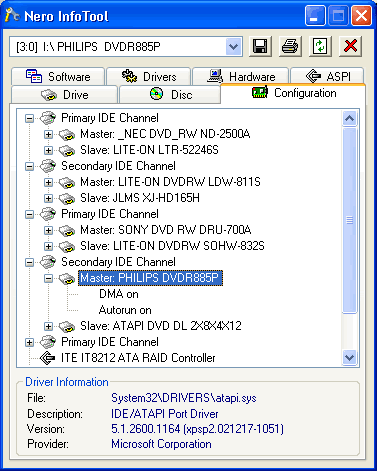
The Philips DVDRW885 was connected as Primary Master and identified itself as DVDR885P. DMA (Direct Memory Access) and autorun was enabled for all devices.
Software:
Windows XP professional is installed on the computer along with Service Pack 1 for windows XP. We will be using the following software in this review:
⋅ Ahead InCD v 4.2.9.1
⋅ Ahead Nero Burning ROM version 6.3.1.15
⋅ Ahead Nero CD/DVD Speed v3.01
⋅ Ahead Nero InfoTool v2.21
⋅ Slysoft CloneCD v4.3.2.2
⋅ VSO Blindwrite 5.1.10.136
⋅ DVD-Identifier 3.3
⋅ Exact Audio Copy v0.95 prebeta 5
⋅ K-Probe v2.1.0
Head on to the next page and find out what's inside the box…
What's inside the
box?
On this page
we will take a look at what the drive came shipped with, and take a look at the
drive and its technology.
Since our
drive is a pre-release drive it came in a white paper box that is not worth
showing, let's jump right to the content of the box:

Notice that
this is a pre-release drive, so this is what we got:
⋅
The
drive itself
⋅
Nero software installation
CD
⋅
Dual Layer 2.4x DVD+R discs (Media
code MKM001 '“ Mitsubishi Kagaku Media)
The shipping
version will of course have more content like manuals and screws etc.
Now it's time
to take a look at the drive itself:

The Philips
drive sets itself apart from most other drives we've had with a less boring
front bezel than most other drives. The most interesting feature is the LEDs,
which are both fancy and useful. There are separate LEDs for showing if there is
a CD or DVD disc in the drive, as well as a long LED for showing the operation
done. The long LED glows red while writing and blue while reading. Look below
for examples.

The Philips DVDRW885 is now
reading a DVD-Disc, the DVD light is on and the function led lights
blue.

The Philips DVDRW885 is now
writing a DVD-Disc, the DVD light is on and the function LED lights
red.


There were two
stickers on our sample drive. The production date is as early as February 2004,
this shows that Dual layer capable hardware has been ready for quite a while.
Our sample is manufactured in Malaysia.

On the back of
the drive there are from the left: two undocumented pins, digital audio
connector; analog audio connector; pins and jumper to set the drive to cable
select, slave or master; IDE connector, power connector.
We quickly
installed the drive without any problems and here is a screenshot from Nero info
tool:

Our drive came
shipped with firmware T1.4, and T1.4 is used in this review except for two
reading tests that were re-done with P1.6 due to problems with the T1.4
firmware. As we said earlier; the drive does not support writing DVD-R and
DVD-RW discs. We also miss Mt.Rainier support and a larger buffer would have
been nice.
And another
shot from Nero Burning ROM:

We do not
really find anything alarming here, but Mount Rainier, and
DVD-R/RW support and a larger buffer would have been nice.
Now it's time
to take a closer look at the write technology used by the Philips
DVDRW885:
CD-Recordable:

As we could see the
Philips DVDRW885 uses P-CAV
(Partial-Constant Angular Velocity) to write at its rated speed of 24x. This gives an average
speed of 23.05x. This low speed will for sure makes it lag behind most other
drives. Two drives for comparison is found below.

The NEC
ND-2500A uses Z-CLV, (Zone-Constant Linear
Velocity), to write at its maximum speed of 32X. The drive wrote the last
zone at 32X and this gives an average speed of 27.16x.

As we could
see the Plextor PX-708A uses P-CAV (Partial-Constant
Angular Velocity) writing strategy to reach it rated speed of 40X.
This gives an average speed of 33.38x.
For comparison
we have made the following table:
|
CD-R |
Supported |
Write |
Start |
End |
Average |
Write |
|
Plextor |
40x |
P-CAV |
20.37x |
39.90x |
33.38x |
2m:55s |
|
NEC |
32x |
Z-CLV |
16.01x |
32.05x |
27.16x |
3m:34s |
|
Pioneer |
24x |
Z-CLV |
16.05x |
24.38x |
22.47x |
4m:18s |
|
NU |
40x |
CAV |
18.20x |
41.11x |
31.15x |
3m:01s |
|
Lite-On |
40x |
CAV |
18.60x |
41.78x |
31.67x |
3m:01s |
|
BenQ |
24x |
P-CAV |
14.77x |
24.39x |
22.92x |
4m:00s |
|
BTC |
40x |
CAV |
18.86x |
42.44x |
32.16x |
3m:03s |
|
Philips |
24x |
P-CAV |
13.43x |
24.55x |
23.05x |
3m:59s |
The Philips
DVDRW885 is of course among the slower drives due to the 24x writing speed.
CD-ReWritable:

The Philips
DVDRW885 uses CLV (Constant Linear Velocity) writing
technology to write at 10X for CD-RW discs, the average speed is 9.93x. The low
speed of only 10x does for sure make the Philips slower than most other modern
DVD-Writers. Below are some other drives for comparison.

The Pioneer DVR-107D uses Z-CLV,
(Zone-Constant Linear Velocity), to write at its rated speed of 24x, this gives an
average speed of 22.47x.

The Plextor
PX-708A, with its P-CAV (Partial-Constant Angular
Velocity) write speed of 24X for Ultra Speed CD-RW discs is among the
faster writers due to its high starting speed of 20.01x. For a better overview
we present the following comparison table:
|
CD-RW |
Supported |
Write |
Start |
End |
Average |
Write |
|
Plextor |
24x |
P-CAV |
20.01x |
24.24x |
23.77x |
3m:41s |
|
Lite-On LDW-811S |
24x |
P-CAV |
18.46x |
23.94x |
23.47x |
3m:58s |
|
NEC |
16x |
CLV |
16.02x |
16.03x |
16.02x |
5m:28s |
|
Pioneer |
24x |
Z-CLV |
15.85x |
24.30x |
22.47x |
4m:11s |
|
NU |
24x |
P-CAV |
18.21x |
24.60x |
23.47x |
3m:47s |
|
Lite-On |
24x |
Z-CLV |
16.04x |
24.09x |
22.63x |
4m:00s |
|
BenQ |
10x |
CLV |
9.95x |
10.18x |
9.92x |
8m:33s |
|
BTC |
24x |
P-CAV |
18.74x |
24.02x |
23.56x |
3m:54s |
|
Philips |
10x |
CLV |
9.95x |
10.20x |
9.93x |
8m:33s |
It used
exactly the same amount of time as the BenQ DW822A, not surprising as they are
basically built on the same hardware. The drive is of course very slow due to
the low speed of only 10x.
8X DVD
Writing speed:

The Philips
DVDRW885 uses Z-CLV, (Zone-Constant Linear Velocity)
to write at 8x. It uses two zones to achieve 8x speed; The first zone from
0-0,4Gb is done at 6x speed, the last zone from 0,4Gb to 4,4Gb is done at 8x.
This gives an average speed of 7.55x. This places the drive among the faster 8x
writers we know of. The reason why there is so many bumps in the transfer rate
curve is the OPC control used by the Philips drive, which is designed to measure
the writing quality and adjust writing strategy when needed.

The NEC
ND-2500A uses Z-CLV, (Zone-Constant Linear
Velocity). The first zone from 0-0,8Gb is done at 4x speed, the next zone
from 0,8Gb to 2,2Gb is done at 6x speed and the last zone from 2,2Gb to 4,4Gb is
done at 8x. This gives an average speed of 6.80x. The speed is the same for both
DVD-R and DVD+R discs.

The Plextor
PX-708A also uses Z-CLV, (Zone-Constant Linear
Velocity). The first zone from 0-0,7Gb is done at 6x speed; the next zone
from 0,7Gb to 4,4Gb is done at 8x speed. This gives an average speed of 7.69x,
look below to see a comparison table:
|
8x |
Supported |
Write |
Start |
End |
Average |
Write |
|
Plextor |
8x +R |
Z-CLV |
6.04x |
8.11x |
7.69x |
7m:58s |
|
NEC |
8x +R |
Z-CLV |
4.14x |
8.30x |
6.80x |
9m:29s |
|
Pioneer |
8x +R |
Z-CLV |
6.03x |
8.12x |
7.72x |
8m:30s |
|
NU |
8x +R |
Z-CLV |
5.98x |
8.06x |
7.65x |
8m:00s |
|
Lite-On |
8x +R |
Z-CLV |
3.95x |
8.06x |
7.39x |
8m:36s |
|
BenQ |
8x +R |
Z-CLV |
4.61x |
8.07x |
7.44x |
8m:21s |
|
BTC |
8x +R |
Z-CLV |
3.97x |
8.42x |
6.38x |
10m:17s |
|
Philips |
8x +R |
Z-CLV |
5.16x |
8.04x |
7.55x |
8m:07s |
Very good and
it's only 9 seconds behind the fastest drive (Plextor PX-708A).
Features and techniques:
Changing book type (bitsetting).
The Philips
DVDRW885 supports bitsetting, and will as default write DVD+R, DVD+RW and DVD+R
DL media with DVD-ROM booktype. You do not need to do anything, unless you do
not want DVD-ROM booktype on your discs. If you want to write discs with their
original booktype (DVD+R, DVD+RW and DVD+R DL) you should be able to do so with
one of the generic bitsetting programs. DVDInfopro, DVDbitsetter and others
should work just fine.
Here is how
you could check if your discs are really written with DVD-ROM
booktype:
Start
DVDinfoPRO and click the Media button and you should get something like
this:

As we could
see the disc Book type is now DVD-ROM
Another quick
test is to start Nero CD-Speed and look at the disc information:

This should
also say DVD-ROM.
We recommend writing
DVD+R discs with booktype set to DVD-ROM as this improves the compatibility of
the disc.
Included software:
Now it's time
to look at the included software, and comment it if needed. Notice that we may
not use the included software in our performance testing part of the
review.
Nero OEM
suite:

We guess that
the Ahead program suite is not new to most of you; it contains programs for
creating most types of CD/DVD discs. Packet writing program, media player etc.
Our favourite writing program suite, and thus Philips gets a plus in our book
for including it.
Now that we
have finished examining the drive and its writing strategies it's time to head
on to next page, which is reading performance
test…
Reading
performance:
For these
tests we will use Nero CD/DVD-Speed to read various CD and DVD's, including
audio discs and DVD-media. As already mentioned in the introduction, this drive
sports a specified read speed of 12X for DVD's and 40X for CD's.
Pressed
discs:
For this test
we used a pressed CD-ROM disc containing PlexTools v1.08 that is exactly 74
minutes long. Below you will see the produced result:

The Philips
DVDRW885 had no problems reaching 40x and more, to see how this compares to
other drives, look below:
|
Pressed |
Average |
Start |
End |
Seek |
Seek |
Seek |
|
Plextor |
31.40x |
18.48x |
41.45x |
98ms |
116ms |
175ms |
|
NEC |
31.00x |
17.85x |
41.05x |
104ms |
114ms |
166ms |
|
Pioneer |
30.86x |
18.36x |
40.76x |
122ms |
142ms |
281ms |
|
NU |
32.36x |
18.56x |
42.70x |
114ms |
106ms |
159ms |
|
Lite-On |
30.56x |
17.92x |
40.26x |
93ms |
108ms |
183ms |
|
BenQ |
32.37x |
18.41x |
42.52x |
96ms |
112ms |
165ms |
|
BTC |
27.56x |
11.44x |
37.9x |
96ms |
110ms |
169ms |
|
Philips |
32.47x |
18.38x |
42.84x |
94ms |
112ms |
161ms |
New record!
Fastest DVD-Writer we've had so far for reading. Good seek times too.
CD-Recordable
Discs:
For this test
we made a copy of the original PlexTools v1.08 CD. The disc we used was a
Verbatim 48X certified CD-R disc manufactured by Mitsubishi Chemicals
Corporation.

Again a
perfect result, look below for a comparison table.
|
CD-R |
Average |
Start |
End |
Seek |
Seek |
Seek |
|
Plextor |
31.48x |
18.83x |
41.37x |
95ms |
111ms |
164ms |
|
NEC |
30.77x |
17.92x |
40.61x |
113ms |
115ms |
166ms |
|
Pioneer |
31.24x |
18.26x |
41.21x |
123ms |
143ms |
282ms |
|
NU |
32.34x |
18.48x |
42.65x |
93ms |
103ms |
154ms |
|
Lite-On |
30.87x |
18.16x |
40.74x |
107ms |
126ms |
207ms |
|
BenQ |
32.35x |
18.43x |
43.89x |
94ms |
105ms |
157ms |
|
BTC |
32.33x |
18.83x |
42.69x |
91ms |
100ms |
169ms |
|
Philips |
32.44x |
18.49x |
42.76x |
89ms |
100ms |
152ms |
It's the
winner again, good work Philips!
CD-ReWritable
discs:
Again we made
a copy of the original PlexTools v1.08 disc, this time we used a Verbatim High
Speed (10X) CD-RW disc made by Mitsubishi Chemicals Corporation.

The drive
reads CD-RW discs at full 40x. The result seems to be almost perfect, let us
compare it to other drives below.
|
CD-RW |
Average |
Start |
End |
Seek |
Seek |
Seek |
|
Plextor |
31.46x |
18.47x |
41.55x |
109ms |
116ms |
183ms |
|
NEC |
26.14x |
14.96x |
34.64x |
120ms |
124ms |
187ms |
|
Pioneer |
25.55x |
14.77x |
33.87x |
128ms |
149ms |
291ms |
|
NU |
32.98x |
18.57x |
43.72x |
101ms |
115ms |
172ms |
|
Lite-On |
25.40x |
14.68x |
33.66x |
106ms |
138ms |
209ms |
|
BenQ |
32.98x |
18.41x |
43.77x |
97ms |
107ms |
169ms |
|
BTC |
26.87x |
15.40x |
35.61x |
100ms |
109ms |
197ms |
|
Philips |
32.84x |
18.52x |
43.75x |
106ms |
120ms |
173ms |
It's very fast
but lags behind the NU and BenQ with a very short margin. Ok seek times as well
as great speed, what more do you want?
Audio '“
Digital Audio Extraction:
To test the
digital audio extraction performance of the Philips DVDRW885, we again used Nero
CD/DVD-Speed to measure the transfer rate. The audio disc we used is slightly
larger than the disc used for the other tests, to be exact it's about 78 minutes
long (77:56:57).

The drive had
no problems with reading the audio disc at full speed and everything seems good,
so let us compare the result with other drives:
|
Audio |
Average |
Start |
End |
Seek |
Seek |
Seek |
|
Plextor |
31.84x |
18.90x |
41.98x |
97ms |
117ms |
181ms |
|
NEC |
25.55x |
15.00x |
34.37x |
122ms |
117ms |
177ms |
|
Pioneer |
31.31x |
18.03x |
42.01x |
122ms |
148ms |
292ms |
|
NU |
32.84x |
18.49x |
43.61x |
92ms |
106ms |
158ms |
|
Lite-On |
31.02x |
17.83x |
41.09x |
108ms |
138ms |
214ms |
|
BenQ |
32.87x |
18.46x |
43.49x |
94ms |
108ms |
162ms |
|
BTC |
32.79x |
18.83x |
43.43x |
90ms |
108ms |
167ms |
|
Philips |
32.96x |
18.62x |
43.66x |
91ms |
104ms |
157ms |
Amazing '“ it
beats them all, for both speed and seek times!
And as a last test we used Exact Audio Copy (EAC) to extract the audio to our hard drive. According to EAC the Philips DVDRW885 supports caching (Which is not positive according to EAC) and Accurate Stream. But it doesn't support reporting C2 errors. |
 |
Below is the
results produced by EAC:

Burst mode

Secure mode
The drive
performed excellent as expected in the burst mode test, but it's very slow for
secure extraction and is among the slowest drives we've had for secure
extraction.
Advanced
audio '“ DAE quality test:
Before we move
on to testing DVD read speeds we will take a last audio test, this time we used
the 'Advanced DAE Quality Test" feature in CD-Speed.

The philips
DVDRW885 did pretty well in this test, but lacks support for reading data from
the lead-out.
DVD reading performance:
Again we will use Nero CD-Speed to measure the reading
performance, this time for various types of DVD discs. The drive should read
pressed single layer DVD-discs at 12X.
DVD '“
DVD-Video:
For our DVD
reading performance tests we are going to start with single and dual layered DVD
video discs. While only 1X speed is required to watch DVD movies, it's useful to
be able to read the discs at higher speeds if you're going to extract (rip) the
content of the disc to your hard drive.


As we can see,
this drive reads single layer DVD-Video discs at full 12x speed and dual layer
DVD-Video discs at 8x speed. How this compares to other drives may be seen in
the table below.
|
DVD |
Average |
Start |
End |
Average |
Start |
End |
|
Plextor |
9.01x |
5.00x |
12.04x |
6.03x |
3.37x |
8.03x |
|
NEC |
3.76x |
2.06x |
5.03x |
3.42x |
1.83x |
4.56x |
|
Pioneer |
3.87x |
2.20x |
5.16x |
3.56x |
2.21x |
5.22x |
|
NU |
4.59x |
2.57x |
6.13x |
4.24x |
2.37x |
5.65x |
|
Lite-On |
9.15x |
5.18x |
12.18x |
6.30x |
3.54x |
8.39x |
|
BenQ |
9.19x |
5.10x |
12.28x |
6.02x |
3.36x |
8.05x |
|
BTC |
4.58x |
2.59x |
6.10x |
4.80x |
2.69x |
6.40x |
|
Philips |
9.20x |
5.13x |
12.01x |
6.03x |
3.37x |
8.03x |
Very good and
it's among the fastest drives again.
DVD+R(W):
For this test
we used a Taiyo Yuden 4X DVD+R and a Ricoh 4X DVD+RW with about 4,4Gb of data.
Below are the results:


The reading
speed was locked to 8x for DVD+R and DVD+RW. Pretty normal for most new
drives.
|
DVD+R |
Average |
Start |
End |
Average |
Start |
End |
|
Plextor |
6.05x |
3.33x |
8.10x |
6.07x |
3.34x |
8.11x |
|
NEC |
5.97x |
3.27x |
7.99x |
5.98x |
3.29x |
7.99x |
|
Pioneer |
6.28x |
3.48x |
8.40x |
6.08x |
3.48x |
8.23x |
|
NU |
6.24x |
3.42x |
8.36x |
6.25x |
3.43x |
8.36x |
|
Lite-On |
6.14x |
3.39x |
8.23x |
6.18x |
3.43x |
8.26x |
|
BenQ |
6.25x |
3.41x |
8.37x |
6.25x |
3.41x |
8.35x |
|
BTC |
6.17x |
3.40x |
8.25x |
4.74x |
2.63x |
6.34x |
|
Philips |
6.26x |
3.41x |
8.39x |
6.27x |
3.43x |
8.39x |
It's among the
faster drives, but it's nothing too special.
DVD '“ DVD-R/RW:
For this test
we used a Taiyo Yuden 4X DVD-R disc and a Verbatim 2X DVD-RW disc filled with
about 4,4Gb of data. Our test results are found below:


There are
hardly any differences compared to reading the DVD+R/RW discs.
|
DVD-R |
Average |
Start |
End |
Average |
Start |
End |
|
Plextor |
6.00x |
3.37x |
8.04x |
6.06x |
3.34x |
8.11x |
|
NEC |
5.99x |
3.30x |
8.00x |
5.98x |
3.29x |
8.00x |
|
Pioneer |
6.27x |
3.51x |
8.38x |
6.25x |
3.49x |
8.23x |
|
NU |
6.27x |
3.42x |
8.65x |
6.25x |
3.40x |
8.47x |
|
Lite-On |
6.19x |
3.43x |
8.27x |
6.14x |
3.40x |
8.22x |
|
BenQ |
6.26x |
3.40x |
8.41x |
6.24x |
3.38x |
8.35x |
|
BTC |
6.27x |
3.45x |
8.38x |
4.68x |
2.58x |
6.27x |
|
Philips |
6.27x |
3.43x |
8.38x |
6.26x |
3.41x |
8.36x |
Again it's
among the faster drives, very good!
Overall
thoughts:
The drive is
very good for all reading operations, except for secure reading in EAC. But
overall Philips has done a good job when fine tuning the reading
abilities.
But now
it's time to head on to a more interesting part: Writing CD-R
discs…
The
specifications of the Philips DVDRW885 state that the drive is able to write
CD-R discs at 24x. Let us find out how the drive really performs in speed and
quality.
Writing Data CD-R discs:
For our data
writing tests, we simply set up a new compilation of 700Mb using Nero Burning
ROM software. Writing method used is DAO (Disc At Once),
and the disc is set up as a non-multisession disc with 'finalize disc" enabled.
The screenshot below shows how long it takes to write a disc at the highest
speed. (24x):

The drive used
4 minutes and 1 second to write the disc at 24x. Let us see how this compares to
other drives; the NU DDW-082 used 3 minutes and 2 seconds for the same writing
operation at 40x speed, and the Plextor PX-708A used 2 minutes and 58 seconds at
40x. the low writing speed of only 24x makes this drive noticeably slower than
most other drives.
Write Quality:
We will test
CD-R discs from a total of 11 different CD-R manufacturers. To really measure
the write speed, we used the 'create data CD" function in Nero CD-Speed. The
discs were written at the maximum speed that the drive supports. For the quality
test, we used K-Probe 2 which is a tool developed by a Lite-On Employee. It runs
under Windows and works with drives made by Lite-On. Also note that different
drives and different reading speeds may affect the results obtained when
scanning the discs. We used a Lite-On LTR-52246S drive with firmware 6S0F and
scanned the discs at 48X speed.
A written CD-R
disc will always have some C1 errors; C1 errors are easily corrected by the
drive's error correction capabilities. The next level of errors is C2, while C2
errors could also be corrected by most drive's error correction capabilities;
they are not wanted on a good quality disc. A good disc should not contain any
C2 errors, and preferably have an average C1 error amount of below 2.0 for the
best discs, or at least below 10.0 average for good quality discs. After C2
errors there are only un-correctable errors that will make a disc unusable.
Why wait any
longer? Below are the obtained results:

| Brand: | Memorex, thanks to Memorex for providing it. |
| Manufacturer: | CMC Magnetics |
| Code: | 97m26s66f |
| Disc Type: |
CD-R |
| Recording Layer: |
Dye Type 6: Short Strategy (Phthalocyanine) |
| Capacity: | 79:59.73 (703MB) |
| Certified Speed: |
48x |
| Write Speed: |
24x |
| Write Time: |
3m:59s |
| C1 Average/Sec: |
1.82 |
| C2 Average/Sec: |
0.0 |
CMC Magnetics
is not known for making the best CD-R discs but the Philips DVDRW885 did okay
with this media and should not cause you any problems.

| Brand: | MMORE |
| Manufacturer: | Moser Baer India |
| Code: | 97m17s06f |
| Disc Type: |
CD-R |
| Recording Layer: |
Dye Type 6: Short Strategy (Phthalocyanine) |
| Capacity: | 79:59.74 (703MB) |
| Certified Speed: |
52x |
| Write Speed: |
24x |
| Write Time: |
4m:00s |
| C1 Average/Sec: |
1.01 |
| C2 Average/Sec: |
0.0 |
Very good,
should not cause you any trouble.

| Brand: | Verbatim Data Life Plus |
| Manufacturer: | Mitsubishi by Moser Baer India. |
| Code: | 97m34s23f |
| Disc Type: |
CD-R |
| Recording Layer: |
Dye Type 3: Long Strategy (Cyanine or AZO) |
| Capacity: | 79:59.73 (703MB) |
| Certified Speed: |
48x |
| Write Speed: |
24x |
| Write Time: |
4m:00s |
| C1 Average/Sec: |
2.34 |
| C2 Average/Sec: |
0.0 |
As we could
see it starts out with incorrect writing strategy but quickly adjusts it. But
there is room for improvements as most other drives works pretty good with this
media type.

| Brand: | That's Write - Thanks to That's Write for providing it. |
| Manufacturer: | Ritek (JS Dye) |
| Code: | 97m15s17f |
| Disc Type: |
CD-R |
| Recording Layer: |
Dye Type 7: Short Strategy (Phthalocyanine) |
| Capacity: | 79:59.70 (703MB) |
| Certified Speed: |
48x |
| Write Speed: |
24x |
| Write Time: |
3m:59s |
| C1 Average/Sec: |
0.53 |
| C2 Average/Sec: |
0.0 |
Very good and
you should not have any problems with this media type either.

| Brand: | Plextor |
| Manufacturer: | Taiyo Yuden |
| Code: | 97m24s01f |
| Disc Type: |
CD-R |
| Recording Layer: |
Dye Type 1: Long Strategy (Cyanine or AZO) |
| Capacity: | 79:59.72 (703MB) |
| Certified Speed: |
48x |
| Write Speed: |
24x |
| Write Time: |
4m:00s |
| C1 Average/Sec: |
0.22 |
| C2 Average/Sec: |
0.0 |
Perfect, just
like it should be with Taiyo Yuden CD-R media.

| Brand: | Memorex |
| Manufacturer: | Prodisc |
| Code: | 97m32s19f |
| Disc Type: |
CD-R |
| Recording Layer: |
Dye Type 9: Short Strategy (Phthalocyanine) |
| Capacity: | 79:59.72 (703MB) |
| Certified Speed: |
48x |
| Write Speed: |
24x |
| Write Time: |
4m:01s |
| C1 Average/Sec: |
0.72 |
| C2 Average/Sec: |
0.0 |
While some
other writers have problems with these CD-R discs, the Philips DVDRW885 did not
have any problems at all.

| Brand: | Samsung |
| Manufacturer: | Plasmon Data Systems, Ltd. |
| Code: | 97m27s18f |
| Disc Type: |
CD-R |
| Recording Layer: |
Dye Type 8: Short Strategy (Phthalocyanine) |
| Capacity: | 79:59.74 (703MB) |
| Certified Speed: |
48x |
| Write Speed: |
24x |
| Write Time: |
4m:01s |
| C1 Average/Sec: |
4.08 |
| C2 Average/Sec: |
0.0 |
We have found
these Samsung CD-R discs, manufactured by Plasmon, to be of very low quality.
And as we could see their C1 error count is a bit higher than for most other
discs, but far from worryingly high, and there were no C2 errors. So all in all
there should not be any problems in practical use.

| Brand: | Sony |
| Manufacturer: | Acer Media Technology / Daxon Inc |
| Code: | 97m22s67f |
| Disc Type: |
CD-R |
| Recording Layer: |
Dye Type 7: Short Strategy (Phthalocyanine) |
| Capacity: | 79:59.74 (703MB) |
| Certified Speed: |
48x |
| Write Speed: |
24x |
| Write Time: |
4m:00s |
| C1 Average/Sec: |
0.42 |
| C2 Average/Sec: |
0.0 |
Again a
perfect result, highly recommended.

| Brand: | Princo |
| Manufacturer: | Princo |
| Code: | 97m27s28f |
| Disc Type: |
CD-R |
| Recording Layer: |
Dye Type 8: Short Strategy (Phthalocyanine) |
| Capacity: | 79:59.74 (703MB) |
| Certified Speed: |
48x |
| Write Speed: |
24x |
| Write Time: |
4m:01s |
| C1 Average/Sec: |
10.71 |
| C2 Average/Sec: |
0.0 |
Princo is not
known for making the best quality discs, and as we could see there are problems
in the beginning as the Philips DVDRW885 starts out with wrong writing strategy.
The Philips DVDRW is able to adjust the writing strategy while writing, but we
would still like to see a correctly tuned writing strategy from the start of the
disc.

| Brand: | Fujifilm |
| Manufacturer: | Fuji Photo Film Co. |
| Code: | 97m26s45f |
| Disc Type: |
CD-R |
| Recording Layer: |
Dye Type 5: Short Strategy (Phthalocyanine) |
| Capacity: | 79:59.73 (703MB) |
| Certified Speed: |
52x |
| Write Speed: |
24x |
| Write Time: |
4m:00s |
| C1 Average/Sec: |
0.24 |
| C2 Average/Sec: |
0.0 |
Perfect '“ just
like it should be with these high quality Fujifilm CD-R discs manufactured in
Germany.
This media is just as good as or better than Taiyo Yuden in our
opinion.

| Brand: | TDK Speed-X |
| Manufacturer: | TDK Corp |
| Code: | 97m15s05f |
| Disc Type: |
CD-R |
| Recording Layer: |
Dye Type 5: Short Strategy (Phthalocyanine) |
| Capacity: | 79:59.74 (703MB) |
| Certified Speed: |
48x |
| Write Speed: |
24x |
| Write Time: |
4m:01s |
| C1 Average/Sec: |
9.63 |
| C2 Average/Sec: |
0.0 |
While TDK is a
well-known brand in larger parts of the world, their own manufactured CD-R discs
may not be so well known, as they are mostly only available in Europe. As we could see the C1 amount is a bit higher than for most
other discs.
Summary:
Overall it does the
job, but nothing more. It's not the best writer we have had, especially
considering the low writing speed of only 24x.
But after
all, it's a DVD-Writer, so head on to next page and read about DVD-Writing
performance and DVD media
compatibility…
The
specifications of this drive tell us that it should write DVD+R discs at 8x and
DVD-R discs at 4X speed, but Philips have released it without DVD-R support.
DVD-R support will be added by a firmware upgrade in September this year. In
this part we will measure the write time for various types of DVD+R discs. We do
also focus on write quality and media compatibility.
DVD-Writing performance:
In this test
we will measure the time for writing to a DVD+R disc. We used Nero burning Rom
to set up a new UDF/ISO compilation containing 4483Mb of data, and started the
write process. We used the Disc-At-Once write method.

DVD+R
Look below for
the results.
|
Write DVD data |
DVD+R |
DVD-R |
|
Plextor PX-708A |
8m:01s |
14m:57s |
|
NEC ND-2500A |
9m:34s |
9m:30s |
|
Lite-On LDW-811S |
8m:43s |
15m:07s |
|
Pioneer DVR-107D |
8m:45s |
8m:27s |
|
NU DDW-082 |
8m:02s |
14m:26s |
|
Lite-On |
8m:40s |
9m:29s |
|
BenQ |
8m:26s |
16m:13s |
|
BTC |
10m:34s |
10m:03s |
|
Philips |
8m:20s |
Not |
As we
could see the Philips DVDRW885 is pretty fast but still lagging some seconds
behind the NU DDW-082 and the Plextor PX-708A. But speed is not everything; let
us see how the writing quality is. Do the dynamic OPC really improve writing
quality?
Write quality:
You should first
notice that this is not a scientific and professional way to test the discs. But
according to our testing done in recent months, we would conclude that there is
a clear link between the quality reported when scanning the disc and the
playability of the disc in different devices. Also notice that different drives
report different amounts of errors. K-Probe was designed to work with Lite-On
DVD-Writers. So we recommend using a DVD-Writer from Lite-On, in this test
we use a Lite-On SOHW-832S DVD-Writer, as already said; remember that scans
done with a Lite-On DVD-ROM or Lite-On combo drive can't be compared with the
results obtained with a Lite-On DVD-Writer. Also remember that different
PI/PO ECC sum settings along with different reading speeds in K-Probe will
affect the result, we use these settings; PI (Parity
Inner) set to summarize 8 ECC blocks, PO (Parity
Outer) set to summarize 1 ECC block, reading speed: 4X CLV
(Constant Linear Velocity). Setting the PI sum to 8 and the
PO sum to 1 will give a result that we may compare to the
standards for DVD+R/RW and DVD-R/RW.
But what is a good
scan? That is a discussion that we don't think will end soon, as different
drives report different amount of errors, some players is more picky about media
than others, and so on. But as a comparison we present you with a scan from two
pressed DVD discs:

This scan shows the results from a pressed DVD-ROM disc (Baldurs
Gate DVD-ROM).

This scan shows the
result from a pressed DVD-Video disk (Indiana Jones and the last crusade).
Notice the error jump when shifting to the second layer (the error level
actually drops from the end of the first layer to the beginning of the second
layer).
If you read below
you will see that both the pressed DVD-discs are well within the
standards.
Download the ECMA
267 Standard for DVD-ROM, the ECMA 337 Standard for DVD+R/RW and the ECMA 338
Standard for DVD-R/RW at http://www.ecma-international.org if you
want to look at the standards for yourself. Here is some data from the ECMA
standards (same for DVD-ROM, DVD-R/RW and DVD+R/RW):
Random
errors:
A row of an
ECC Block that has at least 1 byte in error constitutes a PI error. In any
8
consecutive ECC Blocks the total number of PI errors before correction
shall not exceed 280.
Here we see what a
PI error is defined as a row in an ECC block having 1 byte or more containing
errors. And that the sum of PI errors in 8 ECC blocks after each other should
not exceed 280 PI errors.
But what is a row
and what is an ECC block? Again we refer to the ECMA standards. We do not copy
and paste everything but if interested look in the ECMA standards. A row is 182
bytes long where the last 10 bytes contain PI (Parity Inner)
information. An ECC block is 208 rows long where the last 16 rows contain the
PO (Parity Outer) information. This gives us
a maximum possible PI error amount of 208 errors per block and for 8 blocks
after each other this sum is of course 8 times higher giving a maximum possible
amount of 1664 PI-8 errors. In practical use a disc with 1664 PI-8 errors is
unreadable.
According to our
tests the specified max PI-8 sum of 280 for good discs seems to be a good
guideline, as some readers have problems reading discs when the PI-8 errors is
over 300 and most players starts to have problems when the PI-8 error level
reaches 600 or more.
But what are the
PO errors that K-Probe reports? Actually the PO errors that K-Probe reports is the Parity Inner uncorrectable
errors, meaning errors left after PI correction. Only the ECMA 337 standard
describes the Parity Inner uncorrectable errors. So how is a Parity Inner
uncorrectable error defined? Here are what ECMA 337 states:
'If a row
of an ECC Block as defined in 13.3 contains more than 5 erroneous bytes, the row
is said to be 'PI-uncorrectable"."
In theory an
ECC block may in the worst case have 208 PI uncorrectable errors since every ECC
block is 208 rows long. But the ECMA 337 standard goes further and specifies the
max amount of accepted PI uncorrectable errors allowed on a good
disc:
'- In any ECC Block
the number of PI-uncorrectable rows should not exceed 4."
This means that when
the PO sum is set to 1 the maximum error value should not
exceed 4. The theoretical maximum value for PO errors is
208 errors.
But what makes a
disc unreadable? A PO uncorrectable error will make the disc unreadable, but
K-Probe does not display the PO uncorrectable
errors.
Notice that there
are other aspects such as disc reflectivity, jitter, tracking errors and so on
that also will affect the readability of a DVD disc '“ but for this we do not
have measuring equipment available.
And another note is
that we have scanned the discs at 4X CLV speed, by lowering the speed to
2X(DVD-R/RW)/2.4X(DVD+R/RW) or 1X the amount of reported errors may drop on some
discs. We scanned at 4X CLV due to lower speeds taking to much time.
To see if there is a
connection between the reported amount of errors and readability of the discs we
also include the reading curve from a JLMS XJ-HD165H DVD-ROM that is using a
modified firmware and thus tries to read the discs at full 16x
speed. Reading the discs
at full 16x speed could almost be considered a 'torture" test and most discs
will slow down near the end. Only the best of the best discs will be able to
get a perfect reading curve, so our limit for good discs will be:
A speed drop at
the end is accepted, but the reading speed should not drop below 6x for longer
periods (small dips below 6x is accepted).
Easier
explanation on how to read the test results.
Maybe this got too
technical, and you are wondering what to look for in Kprobe reports?
Use this as a
guideline for good discs:
PI(Parity
Inner): No larger areas on
the disc should exceed 280 PI-8 errors, do not worry too much about high single
spikes that exceed 280.
PO(Parity Outer): No larger areas on
the disc should exceed 4 PO-1 (actually PI uncorrectable) errors, do not worry
too much about high single spikes that exceed 4.
And as always; lower
is better 😉
And look at the
reading curve, some slowdowns is expected with most media, but the reading speed
should not drop below 6x for longer periods (small dips below 6x is
accepted).
DVD+R media compatibility and write quality:


| Brand: | SKS Claudia |
| Manufacturer: | Ritek |
| Code: | RITEK R03 (Revision 001) |
| Disc Type: |
DVD+R |
| Capacity: | 4483MB |
| Certified Speed: |
8x |
| Write Speed: |
8x |
| Write Time: |
8m:13s |
| PI-8 errors Average/Sec: |
15.03 |
| PI-8 uncorrectable errors(PO) Avg/Sec: |
0.01 |
A perfect
reading curve along with a good K-Probe result shows that this media should not
cause you any trouble at all.


| Brand: | Traxdata - Thanks to Conrexx for providing it. |
| Manufacturer: | Ritek |
| Code: | RITEK R03 (Revision 002) |
| Disc Type: |
DVD+R |
| Capacity: | 4483MB |
| Certified Speed: |
8x |
| Write Speed: |
8x |
| Write Time: |
8m:11s |
| PI-8 errors Average/Sec: |
10.09 |
| PI-8 uncorrectable errors(PO) Avg/Sec: |
0.01 |
The reading
curve shows that there is some minor problems, but nothing to worry
about.


| Brand: | Verbatim DataLifePlus |
| Manufacturer: | Mitsubishi (Real Mitsubishi disc from Singapore ) |
| Code: | MCC 003 |
| Disc Type: |
DVD+R |
| Capacity: | 4483MB |
| Certified Speed: |
8x |
| Write Speed: |
8x |
| Write Time: |
8m:17s |
| PI-8 errors Average/Sec: |
0.98 |
| PI-8 uncorrectable errors(PO) Avg/Sec: |
0.00 |
Perfect
K-Probe result, but the reading curve shows some problems at the end. The
reading problems at the end is normal with all Mitsubishi DVD+R media when
written at 8x, we guess the media quality is simply not good enough near the
edge.


| Brand: | Datawrite |
| Manufacturer: | Prodisc |
| Code: | PRODISC R03 |
| Disc Type: |
DVD+R |
| Capacity: | 4483MB |
| Certified Speed: |
8x |
| Write Speed: |
8x |
| Write Time: |
8m:8s |
| PI-8 errors Average/Sec: |
1.01 |
| PI-8 uncorrectable errors(PO) Avg/Sec: |
0.03 |
This Prodisc
media seems to be some of the best 8x media available as all writers we have
tried really likes this media! Highly recommended.


| Brand: | Platinum |
| Manufacturer: | Ricoh by Ritek |
| Code: | RICOHJPNR02 |
| Disc Type: |
DVD+R |
| Capacity: | 4483MB |
| Certified Speed: |
8x |
| Write Speed: |
8x |
| Write Time: |
8m:19s |
| PI-8 errors Average/Sec: |
4.93 |
| PI-8 uncorrectable errors(PO) Avg/Sec: |
0.00 |
Not perfect as
there is some reading problems near the end, but still very good and recommended
media.


| Brand: | That's Write '“ thanks to That's Write for providing it. |
| Manufacturer: | CMC Magnetics |
| Code: | CMC.MAG.E01 |
| Disc Type: |
DVD+R |
| Capacity: | 4483MB |
| Certified Speed: |
8x |
| Write Speed: |
8x |
| Write Time: |
8m:7s |
| PI-8 errors Average/Sec: |
1.671 |
| PI-8 uncorrectable errors(PO) Avg/Sec: |
0.00 |
An almost
perfect reading curve so we could highly recommend this media as
well.


| Brand: | Philips |
| Manufacturer: | Philips by CMC Magnetics |
| Code: | PHILIPS.C08 |
| Disc Type: |
DVD+R |
| Capacity: | 4483MB |
| Certified Speed: |
8x |
| Write Speed: |
8x |
| Write Time: |
8m:18s |
| PI-8 errors Average/Sec: |
2.52 |
| PI-8 uncorrectable errors(PO) Avg/Sec: |
0.13 |
Strange '“ One
of the worst results we obtained are with Philips own media. The PO level exceeds the standards at the end and the reading curve
confirms that this media is not perfect near the end.


| Brand: | Plextor |
| Manufacturer: | Taiyo Yuden |
| Code: | YUDEN000T01 (Revision 001) |
| Disc Type: |
DVD+R |
| Capacity: | 4483MB |
| Certified Speed: |
4x |
| Write Speed: |
8x |
| Write Time: |
8m:11s |
| PI-8 errors Average/Sec: |
0.90 |
| PI-8 uncorrectable errors(PO) Avg/Sec: |
0.00 |
Right where it
should be for the excellent Taiyo Yuden DVD+R media. Highly recommended
media.


| Brand: | Memorex '“ thanks to Memorex for providing it. |
| Manufacturer: | Ricoh (by Ritek) |
| Code: | RICOHJPNR01 |
| Disc Type: |
DVD+R |
| Capacity: | 4483MB |
| Certified Speed: |
4x |
| Write Speed: |
8x |
| Write Time: |
8m:9s |
| PI-8 errors Average/Sec: |
0.63 |
| PI-8 uncorrectable errors(PO) Avg/Sec: |
0.01 |
Very good and
highly recommended. Even better than the 8x Ricoh media shown higher up on this
page!


| Brand: | Memorex |
| Manufacturer: | CMC Magnetics |
| Code: | CMC.MAG.F01 (revision 000) |
| Disc Type: |
DVD+R |
| Capacity: | 4483MB |
| Certified Speed: |
4x |
| Write Speed: |
8x |
| Write Time: |
8m:17s |
| PI-8 errors Average/Sec: |
4.18 |
| PI-8 uncorrectable errors(PO) Avg/Sec: |
0.03 |
Another perfect
result and you should not have any problems with this media either.


| Brand: | BenQ |
| Manufacturer: | Daxon |
| Code: | DAXON.AZ1 |
| Disc Type: |
DVD+R |
| Capacity: | 4483MB |
| Certified Speed: |
4x |
| Write Speed: |
8x |
| Write Time: |
8m:12s |
| PI-8 errors Average/Sec: |
3.70 |
| PI-8 uncorrectable errors(PO) Avg/Sec: |
0.01 |
Another perfect
result and we could highly recommend this media.


| Brand: | BulkpaQ Generation 4 |
| Manufacturer: | Unknown |
| Code: | MEDIA ID001 |
| Disc Type: |
DVD+R |
| Capacity: | 4483MB |
| Certified Speed: |
4x |
| Write Speed: |
4x |
| Write Time: |
14m:45s |
| PI-8 errors Average/Sec: |
7.94 |
| PI-8 uncorrectable errors(PO) Avg/Sec: |
0.04 |
There is an
error spike at the beginning of the disc as usual with this media. But overall
there are no serious problems and you should not have any problems using this
media.
To see if
rather unknown media types are supported at certified speed we include the
following table:
|
DVD+R |
Manufacturer |
Media |
Certified |
Supported |
|
Sky |
Unknown |
AML 002 |
8x |
8x |
|
Fortis |
Daxon |
DAXON.AZ2 |
8x |
8x |
|
Norwaydisc.no |
Nanya |
NANYA.RJB |
8x |
8x |
|
Fortis |
Nanya |
NANYA.RJB |
4x |
4x |
|
Verbatim |
Mitsubishi |
MCC 002 |
4x |
8x |
|
BeALL |
BeALL |
BeAll000P40 |
4x |
4x |
|
Unbranded |
Unknown |
PITSEXP 002 |
4x |
4x |
|
Unbranded |
Unknown |
AML 001 |
4x |
4x |
|
Unbranded |
Unknown |
IS01001 |
4x |
4x |
|
Unbranded |
Unknown |
VDSPMSAB001 |
4x |
4x |
|
Unbranded |
Unknown |
001 |
4x |
4x |
|
MMORE |
Opto Disc |
OPTODISCOR4 |
4x |
4x |
|
MMORE |
Moser Baer |
MBIPG101.R03 |
4x |
4x |
Perfect media
compatibility and there are several 4x certified discs that are supported at 8x
as well. And the writing quality is for the most part excellent as
well.
Head on to
next page and read about DVD+R DL compatibility and write
quality...
DVD+R Dual Layer writing
speed and compatibility:
The Philips
DVDRW885 supports the new DVD+R DL standard for writing Dual Layer discs with a
size of 8.5Gb. Since we do not have many results to compare with we decided to
include results from a Sony DRU-700A (Lite-On 832S) Dual layer drive. Let us
first take a look at the media we will use:

Let's find the
manufacturer and media information too, for this we will use DVD Identifier
3.3:
--------------------------------------------------------------------------
Unique
Disc Identifier :
[DVD+R-DL:MKM-001-000]
--------------------------------------------------------------------------
Disc
Type
: [DVD+R
DL]
Manufacturer ID
: [MKM]
Manufacturer Name
: [Mitsubishi Kagaku Media]
Media Type ID
: [001]
Product
Revision : [Not Specified]
Disc
Application Code : [General Purpose]
Recording Speeds
: [1x , 2.4x]
Blank Disc Capacity
: [4,173,824 Sectors = 8,152.0 MB = 7.96
GB]
--------------------------------------------------------------------------
[DVD
Identifier - http://DVD.Identifier.CDfreaks.com]
--------------------------------------------------------------------------
Full
media code:
0000 : 00 00 00 00 e0 0f 32 10 00 03 00 00 00 fc
ff ff ......2.........
0010 : 00 22 d7 ff 00 00 00
4d 4b 4d 00 00 00 00 00 30 .".....MKM.....0
0020 : 30
31 00 3c 25 25 37 13 02 4d 69 02 4d 69 1f 1f
01.<%7..Mi.Mi..
0030 : 0a 0a 12 12 02 01 01 1f 1f 0a 0a 12 12
02 01 01 ................
The media is made by Mitsubishi
Kagaku Media and is to our knowledge the only available (shipping) Dual Layer
media.
Testing
procedure: We created an ISO Image of the largest DVD-Video disc we had (Three
Kings, 7.83Gb) using DVD-Decrypter. Then we wrote this image file using Nero
Burning ROM 6. Below are the results:

Philips
DVDRW85 used 45 minutes and 5 seconds for writing the disc at 2.4x.

The Sony
DRU-700A used 44 minutes and 37 seconds for writing the disc at 2.4x.
As we could
see the Sony has a slight lead for writing the disc as it used 28 seconds less
time for writing it. But the difference is pretty minor, let us take a look at
the K-Probe result of the created discs:

The above
picture shows the result of the DVD+R DL discs written by the Philips DVDRW885
and overall the amount of errors is very low. There is a small error spike at
the layer change, but hopefully not enough to cause any problems.

And this
picture shows the K-Probe result of the Sony DRU-700A written disc. And as we
could easily see the amount of errors is much higher at the second
layer.
Summary: The
Philips took a clear victory over the Sony for writing quality measured with
K-Probe.
Now it's time
to take a look at some real life reading tests with various DVD-Writers and
DVD-ROM drives.
First we will
try to read the discs back in the Philips DVDRW885:

Reading the Philips written Dual
Layer disc.

Reading the Sony written dual
layer disc.
As we could
see the Philips DVDRW885 had no problems reading any of the discs, let us see if
the Sony DRU-700A has any problems reading the Dual Layer discs:

Reading the Philips written dual
layer disc.

Reading the Sony written dual
layer disc.
The Sony
DRU-700A did not have any problems with reading the dual layer discs either, but
the reading speed is limited to 6x. Time to try some other readers, first out is
the Plextor PX-712A:

Reading the philips written dual
layer disc.

Reading the Sony written dual
layer disc.
As we could
see none of the discs could be read back without problems. There were some
problems in the middle of the Philips written disc, while there were problems
with the second layer of the Sony written disc. Let's try reading the discs in a
JLMS XJ-HD165H DVD-ROM:

Reading the Philips written dual
layer disc.

Reading the Sony written dual
layer disc.
Again we could
see some of the same problems, the Philips written disc shows some problems near
the layer change, while the Sony written disc shows some problems on the second
layer of the disc. Now it's time to try with a Toshiba SD-M1612
DVD-ROM:

Reading the Philips written dual
layer disc.

Reading the Sony written dual
layer disc.
This time the
Sony written disc gave back the best result, let us take a last reading test,
this time with an Asus DVD-E616 DVD-ROM:

Reading the Philips written dual
layer disc.

Reading the Sony written dual
layer disc.
This time the
Sony written disc also gave back the best result. The Asus slowed down near the
layer change and never speeded up again when reading the Philips written
disc.
Standalone DVD-Player compatibility:
Unfortunately
we do only have one standalone DVD-Player available to test with; a cheap
Denver DVD-188DivX. Compatibility
results:
Philips
DVDRW885 Dual Layer disc written with DVD+R DL booktype: Disc not
recognized
Philips DVDRW885 Dual Layer disc written with DVD-ROM booktype:
Plays perfect.
Sony DRU-700A Dual Layer disc written with DVD+R DL booktype:
Disc not recognized
Sony DRU-700A Dual Layer disc written with DVD-ROM
booktype: Plays perfect.
With our
player it's at least required to have DVD-ROM booktype. And for reference here
is some compatibility information provided by BenQ:
|
Standalone |
DVD+R DL Booktype |
DVD-ROM Booktype |
|
Cyberhome |
Failed |
Pass |
|
Elta 8882 |
Pass |
Pass |
|
Grundig |
Failed |
Failed |
|
JVC |
Pass |
Failed |
|
Kiss |
Failed |
Pass |
|
LiteON |
Failed |
Pass |
|
Metz DH |
Failed |
Pass |
|
Panasonic |
Failed |
Pass |
|
Panasonic |
Failed |
Pass |
|
Panasonic |
Failed |
Pass |
|
Philips DVD |
Pass |
Pass |
|
Philips DVDR |
Failed |
Failed |
|
Pioneer |
Failed |
Pass |
|
Pioneer |
Failed |
Pass |
|
Roadstar |
Failed |
Pass |
|
Sony |
Failed |
Pass |
|
Teac |
Failed |
Failed |
|
Tevion |
Failed |
Pass |
|
Waitec |
Pass |
Pass |
Notice that
those results is provided by BenQ and not verified by us.
As we could
see there is a big difference in compatibility between discs with DVD+R DL
booktype and DVD-ROM booktype. And we think and hope that this difference will
force all manufacturers to add bitsetting support for their Dual Layer writers.
Releasing a Dual Layer writer without bitsetting support will not be very wise
in our opinion.
Summary: There is no clear winner as it
appears that different readers has different preferences, some got problems due
to the error spike near the layer change on the Philips written disc, while
others got more problems with the Sony disc due to the increased amount of
errors on the second layer. But all in all both works as they should and the
discs worked in all players we tested them in '“ as long as the booktype was set
to DVD-ROM.
This
concludes our DVD-writing tests, so head on to next page and read about the RW
and packet writing performance of this
drive…
The Philips
DVDRW885 supports writing CD-RW discs at 10x speed only and it supports writing
DVD+RW discs at 4x.
Re-Writing data:
For this test
we set up a new compilation containing 650Mb of data in Nero Burning
ROM. We used the DAO (Disc At
Once) writing method. In the screenshot below you can see that the burn
process completed successfully.
The Philips
DVDRW used 8 minutes and 3 seconds for writing the disc at 10X, let us compare
this to some other writers; The Plextor PX-708A used 3 minutes and 39 seconds to
write the disc at 24x and the NU DDW-082 used 3 minutes and 37 seconds to write
the disc at 24x. Well, we can't expect it to keep up with the other two drives
due to the low speed of only 10x.
And here is
the writing time for writing 4.4Gb of data to a Ricoh 4X DVD+RW disc:

The Philips
DVDRW885 used 14 minutes and 46 seconds to write the disc, as a comparison the
NU DDW-082 used 14 minutes and 34 seconds and the NEC ND-2500A used 13 minutes
and 52 seconds. This makes the Philips DVDRW885 a bit slower than the two other
drives.
CD-RW Packet
writing:
Now it's time
to take a look at the packet writing performance of the Philips DVDRW885. We
used Ahead InCD to write 401 MB (421 003 264 bytes) data to the
disc.
|
Packet |
InCD |
InCD |
Average |
|
Pioneer |
4m:33s |
2m:38s |
17.76x |
|
NU |
4m:1s |
2m:29s |
18.84x |
|
Lite-ON |
6m:30s |
2m:34s |
18.23x |
|
BenQ |
9m:4s |
5m:40s |
8.25x |
|
BTC |
5m:48s |
2m:33s |
18.24x |
|
Philips |
8m:57s |
5m:44s |
8.16x |
It's slower
than most other drives due to the low speed of only 10x, but there were at least
no problems.
DVD-RW/DVD+RW
packet writing tests:
We used Ahead
InCD to format and write 2Gb (2 217 820 160 bytes) data to the
disc.
|
DVD+RW |
Quick |
Writing |
Average write speed |
|
Plextor |
0m:8s |
6m:43s |
3.97x |
|
Mediagear |
0m:4s |
6m:43s |
3.97x |
|
NEC |
0m:6s |
6m:36s |
4.04x |
|
Pioneer |
0m:19s |
6m:43s |
3.97x |
|
NU |
0m:7s |
6m:44s |
3.97x |
|
Lite-On |
3m:9s |
7m:11s |
3.72x |
|
BenQ |
0m:16s |
6m:43s |
3.97x |
|
BTC |
0m:11s |
6m:44s |
3.97x |
|
Philips |
0m:10s |
9m:9s |
2.92x |
The DVD+RW
packet writing performance is noticeably worse than for most other drives, but
we suspect this to be cause by InCD, which is a very unstable program that never
performs the same from version to version.
Writing Quality with Re-Writable discs:
Due to request from
our readers we will add a few write quality tests with Re-Writable media.
Settings and testing procedures is the same as used earlier in this review so
you may want to go back and read them if unsure. All discs used for these tests
have been written to before, but none have been written to more than 25
times.
CD-ReWritable
media:

| Brand: | Verbatim Data Life Plus |
| Manufacturer: | CMC Magnetics, but with Mitsubishi dye and ATIP |
| Code: | 97m34s24f |
| Disc Type: |
US CD-RW |
| Recording Layer: |
Dye Type 4: Long Strategy (Phase Change) |
| Capacity: | 79:59.74 (703MB) |
| Certified Speed: |
24x |
| Write Speed: |
10x |
| Write Time: |
9m:15s |
| C1 Average/Sec: |
8.08 |
| C2 Average/Sec: |
0.00 |
The result is very
good and this media should not cause any problems.

| Brand: | That's Write |
| Manufacturer: | Plasmon data systems |
| Code: | 97m27s12f |
| Disc Type: |
US CD-RW |
| Recording Layer: |
Dye Type 2: Long Strategy (Phase Change) |
| Capacity: | 74:41.00 (656MB) |
| Certified Speed: |
24x |
| Write Speed: |
10x |
| Write Time: |
8m:18s |
| C1 Average/Sec: |
157.10 |
| C2 Average/Sec: |
0.00 |
Low quality discs,
and as we could see the amount of C1 errors is pretty high, but there are at
least no C2 errors.
DVD+ReWritable
media:


| Brand: | That's Write - Thanks to That's Write for providing it. |
| Manufacturer: | Ricoh (by Ritek) |
| Code: | RICOHJPNW11 |
| Disc Type: |
DVD+RW |
| Capacity: | 4483MB |
| Certified Speed: |
4x |
| Write Speed: |
4x |
| Write Time: |
14m:37s |
| PI-8 errors Average/Sec: |
4.47 |
| PI-8 uncorrectable errors(PO) Avg/Sec: |
0.04 |
Not the best
result we have seen with these discs, so there is room for
improvements.


| Brand: | BenQ |
| Manufacturer: | Philips |
| Code: | PHILIPS 041 |
| Disc Type: |
DVD+RW |
| Capacity: | 4483MB |
| Certified Speed: |
4x |
| Write Speed: |
4x |
| Write Time: |
14m:41s |
| PI-8 errors Average/Sec: |
1.88 |
| PI-8 uncorrectable errors(PO) Avg/Sec: |
0.02 |
The result is
pretty good with this media, not that surprising as it has a Philips media
code.


| Brand: | Fortis |
| Manufacturer: | Nanya |
| Code: | NANYA.DRW |
| Disc Type: |
DVD+RW |
| Capacity: | 4483MB |
| Certified Speed: |
4x |
| Write Speed: |
4x |
| Write Time: |
14m:31s |
| PI-8 errors Average/Sec: |
13.70 |
| PI-8 uncorrectable errors(PO) Avg/Sec: |
0.59 |
Although the
amount of errors is a bit higher than for most other DVD+RW discs the reading
curve shows few problems.


| Brand: | Verbatim DataLifePlus |
| Manufacturer: | Mitsubishi Kagaku Media |
| Code: | MKM A02 |
| Disc Type: |
DVD+RW |
| Capacity: | 4483MB |
| Certified Speed: |
4x |
| Write Speed: |
4x |
| Write Time: |
14m:43s |
| PI-8 errors Average/Sec: |
1.25 |
| PI-8 uncorrectable errors(PO) Avg/Sec: |
0.03 |
Pretty good
and there is only a slight slowdown at the end of the reading curve.
To sum it
up: It
will not win a price for anything here as it's pretty average compared to most
other drives and things could be improved. For example CD-RW writing speed as
well as writing quality with ricoh DVD+RW media etc could have been
better.
Before we
round off this review, let us run the drive through some advanced tests at next
page…
To round off
this review we will run some advanced tests on the Philips DVDRW885. These tests
are: making backups of protected data and audio discs as well as some special
disc test.
Copy protected data discs:
For this test,
we will use CloneCD 4.3.2.2 and Blindwrite 5.1.10.136 to make a backup of games
containing some of the most popular copy protections. In the screenshot below we
see that the Philips DVDRW885 supports all available write and read features
except writing CD+G RAW-DAO:

Philips
DVDRW885 supports DAO-RAW96 recording mode, which basically means that it can
write uncorrected data and subchannel data. Below are our results for all the
tested games:

Motoracer 3 is
protected with Tagé¨s, a protection that uses a very special sub channel
protection. So far no drives have been able to backup this game successfully.

Flé¥klypa grand
prix is a Norwegian game that is protected with CD Cops, again a very special
protection that is added during the manufacturing process. So far no drives have
been able to make a 100% working backup, a few drives in combination with a few
media types may make a backup that works in a few drives.

Desperados:
Wanted dead or alive is protected with Laserlok, a protection that takes very
long time to read for most drives, but most drives is able to make working
backups of this game.

The Diablo 2
expansion set is protected with SecuROM version 4.62.00 0100, a widely used
protection scheme. Writers able to read and write subchannel data correctly
should be able to backup this Game.

Grand Theft
Auto: Vice city is protected with a newer version of SecuROM: namely version
4.84.69 0071. Very few (if any) writers could reliably make working backups of
this protection. There are a few tricks that advanced users may use in
combination with some writers to make a backup that will at least work in some
drives, but this is still not a perfect copy.

Max Payne 2 is
protected with one of the most recent SecuROM versions: version 4.85.04. Very
few (if any) writers could reliably make working backups of this
protection.

Max Payne is
protected with the very popular Safedisc protection; the version used on Max
Payne is version 2.30.33. If a writer supports 'Almost correct EFM encoding of
regular bit patterns" it will be able to backup this protection without
problems. If it does not support this you need to enable the 'Amplify weak
sectors" option in CloneCD. This is a software trick to make most writers able
to backup most Safedisc protected games with weak sectors.

Serious Sam is
also protected with the very popular Safedisc protection; the version used on
Serious Sam is version 2.51.21. If a writer supports 'Correct EFM encoding of
regular bit patterns" it will be able to backup this protection without
problems. If it does not support this you need to enable the 'Amplify weak
sectors" option in CloneCD. This is a software trick to make most writers able
to backup most Safedisc protected games with weak sectors.

Command and
Conquer: Generals is another game protected with the very popular Safedisc
protection, the version used on Command and Conquer: Generals is version
2.80.10. If a writer supports 'Correct EFM encoding of regular bit patterns" it
may be able to backup this protection without problems. If it does not support
this you need to enable the 'Amplify weak sectors" option in CloneCD. This is a
software trick to make most writers able to backup most Safedisc protected games
with weak sectors. Note that some writers may still have problems with this
version.

The protection
on The Sims: Superstar expansion pack is also Safedisc protected, this time it's
version 2.90.40. Very few writers are able to reliably make a working backup of
this protection. . If a writer supports 'Correct EFM encoding of regular bit
patterns" it may be able to backup this protection without problems. If it does
not support this you need to enable the 'Amplify weak sectors" option in
CloneCD. This is a software trick to make most writers able to backup most
Safedisc protected games with weak sectors. Note that some writers may still
have problems with this version.

And Vegas:
Make it BIG is yet another Safedisc protected game, this time it's version
3.10.20. Very few writers are able to reliably make a working backup of this
protection. . If a writer supports 'Correct EFM encoding of regular bit
patterns" it may be able to backup this protection without problems. If it does
not support this you need to enable the 'Amplify weak sectors" option in
CloneCD. This is a software trick to make most writers able to backup most
Safedisc protected games with weak sectors. Note that some writers may still
have problems with this version.
The table
below shows the backup capabilities of the Philips DVDRW885:
|
Game '“ protection |
CloneCD |
Backup |
|
Motoracer 3 |
1m:53s |
No |
|
Flé¥klypa |
2m:01s |
No |
|
Desperados |
21m:03s |
Yes |
|
Diablo 2 |
1m:59s |
Yes |
|
GTA |
1m:38s |
No |
|
Max Payne 2 |
1m:49s |
No |
|
Max Payne |
41m:31s |
Yes* |
|
Serious Sam |
40m:52s |
Yes* |
|
C&C: |
38m:29s |
Yes** |
|
The Sims: |
40m:12s |
Yes** |
|
VEGA$ - Make |
41m:279s |
Yes** |
*Only with
Amplify Weak sectors enabled
**Only when using Blindwrite 5 to back it up,
CloneCD backup does not work.
Settings for CloneCD: Read subchannel data
and write them uncorrected. Fast Error Skip: enabled. Intelligent bad sector
scanner: enabled and set to 100-error skip. First we tried to write with
AWS(Amplify Weak sectors) disabled, if that did not work we wrote again with AWS
enabled, as a last attempt we tried the emulate option as well.
Drives used to
verify that the backup works: Toshiba SD-M1612 and JLMS XJ-HD165H, No emulators
or ATIP hiders are running while testing the backup copy.
As we could
see the Philips DVDRW885 is not the perfect drive for backing up protected discs
as it does not support 'correct EFM encoding of regular bit patterns" and is
pretty slow at reading safedisc protected discs.
Copy protected Audio:
For our
protected audio test we used the Exact Audio Copy program. We inserted the
protected audio discs and if the drive was able to recognize the disc we tried
to extract the music tracks to the hard drive. First let us look at the discs we
had available for this test:

Westlife:
World of our own is protected with Cactus data shield 100.

Natalie Imbruglias White lilies Island. This disc is protected with
Cactus Datashield 200

Shakira:
Laundry service, which is protected with Key2Audio version 2.

And finally
Celine Dion: A new day has come, that is protected with key2audio version
3
Results:
|
Protected Audio |
Protection |
Exact Audio |
|
Westlife: World of our own |
Cactus data shield |
Must use secure mode |
|
Natalie |
Cactus data shield |
Must use secure mode |
|
Shakira: Laundry Service |
Key2Audio version |
Must use secure mode |
|
Celine Dion: A new day has come |
Key2Audio version |
Must use secure mode |
We had to use
secure mode with all discs '“or else we got a lot of timing errors, this makes
the Philips DDVRW885 one of the less good choices for backing up protected audio
discs.
Overburning:
To test the
overburning capabilities of the Philips DVDRW885 we used the overburning test in
Nero CD/DVD-Speed. According to Nero CD/DVD speed the drive can overburn to more
than 99 minutes:

To make sure
that it actually works we wrote a 99 minutes long disc in Nero Burning
ROM:

It failed
writing right before writing the lead out, but we guess this may be a bug in
Nero as it wrote up to 100 minutes using Nero CD-Speed;

No problems
here '“ it wrote fine all the way up to 100 minutes, below is the reading test
for the created disc:

Impressive! It
reads the disc at full speed, reaching over 47x near the end.
8CM CD-R and
pocket card CD-R discs:
Now we will try to
read and write 8cm CD-R discs and pocket card CD-R discs from
Memorex.
8cm CD-R
disc:

| Brand: | Memorex |
| Manufacturer: | CMC Magnetics |
| Code: | 97m26s66f |
| Disc Type: |
CD-R |
| Recording Layer: |
Dye Type 6: Short Strategy (Phthalocyanine) |
| Capacity: | 23:59.74 (210.64MB) |
| Certified Speed: |
24x |
| Write Speed: |
18-24x P-CAV |
| Write Time: |
1m:31s |

The Philips DVDRW885
did not have any problems with writing and reading the 8cm CD-R disc.
Pocket card
CD-R:

| Brand: | Memorex |
| Manufacturer: | CMC Magnetics |
| Code: | 97m26s66f |
| Disc Type: |
CD-R |
| Recording Layer: |
Dye Type 6: Short Strategy (Phthalocyanine) |
| Capacity: | 06:00.00 (52.44MB) |
| Certified Speed: |
Not specified |
| Write Speed: |
18-20x CAV |
| Write Time: |
1m:36s |

The Philips
DVDRW885 did not have any problems reading/writing the credit card disc
either.
Now, that
concludes our Philips DVDRW885 review, head on to the last page to read our
conclusion…
Positive:
- Supports 2.4x DVD+R Dual Layer writing
- Supports 8x DVD+R speed.
- Supports 4x DVD+RW speed.
- Among the faster 8x DVD-writers for writing discs.
- Very good writing quality and speed with DVD+R media.
- Supports dynamic OPC that adjusts writing strategy while writing.
- Supports DAO-RAW writing.
- Supports reading and writing of full SubChannel Data.
- Supports reading and writing 8cm CD-R discs and credit card CD-R discs.
- Good reading speed with most types of media, including DVD-Video discs.
- Good seek times.
- Fast and perfect audio extraction.
- Supports reading and writing 99 minutes CD-R discs.
- Supports bitsetting for all types of DVD+R/R DL/RW media and automatically sets booktype to DVD-ROM for all these media.
- Fancy and useful LED setup on the front.
Negative:
- Does not support DVD-R/RW out of the box (will be added through a firmware upgrade in September this year).
- Slow at CD-R and CD-RW writing.
- Does not support Mt. Rainier.
- Slow at extracting data from protected audio discs.
- Doesn't support 'Correct EFM encoding of regular bit patterns" making it harder for it to backup safedisc protected games.
Conclusion:
Overall the drive is quite decent, but feels a bit rushed to the market as it does not support DVD-R and DVD-RW out of the box. Anyway let us summarize the most important positive and negative points below
The main positive points: The first thing that comes to mind will of course be that it supports dual layer writing, a new and exciting technology. Just too bad that dual layer media is not available at reasonable prices yet, we guess it will be 6 Months or so before dual layer media will be priced somewhat decent. The next thing that comes to mind is that it is pretty fast at 8x DVD+R writing and has very good writing quality with DVD+R media, much thanks to the dynamic OPC. It does also write several types of 4x DVD+R media at 8x, and add bitsetting support to this and you have a very good drive if you are only interested in using DVD+R/RW/R DL media.
The main negative points: Although there are few serious flaws with this drive there are some points that we want to mention; First it was advertised to support DVD-R/RW but upon release Philips decided to add this later by a firmware upgrade, seems like they dropped it to rush the drive out on the market? Or maybe they did it in favour of the DVD+R/RW format that they are the main developer of? Beside this it's very slow at CD-R and CD-RW writing compared to most other new drives. And last; the drive is not the best drive for backing up protected data and audio discs, as it's slow and does not support all techniques.
The drive has a list price of € 129 EUR.
To sum it all up, this is the best we could say: 'A safe choice if your main concern is DVD+R/RW writing speed/quality as well as dual layer DVD+R support". But since it does not offer anything very special beside dual layer support as well as lacking DVD-R/RW support out of the box we do not feel that it deserves any awards. If it had been faster at CD-R/CD-RW writing and had DVD-R/RW support out of the box the situation would have been different.
You may discuss/comment this review below or in this forum thread.
Thanks to:
 For providing the
  media used in this review. Conrexx technology is the supplier of Traxdata media as well as other media for whole Europe.
 For providing the That's Write
media used in this review. That's Write focus on providing quality media at reduced prices in Europe.
 For providing some of the Memorex
media used in this review. Memorex is one of the largest providers of all types of media for larger parts of the world.