
|
|
Review: Pioneer DVR-110D Reviewed by: Dee-27 Provided by: Pioneer Europe NV. Firmware: 1.17 Manufactured: July 2005 |

Pioneer Europe NV
was kind enough to send us their latest DVD Burner, the DVR-110D for review. In
this review we will be seeing how this latest drive from one the world's most
respected optical drive manufacturers performs in our tests.
The Pioneer DVR-110D
supports 16x DVD±R, 8x
DVD+RW, 6x DVD-RW and 8x DVD±R DL writing
technology, allowing Double/Dual Layer discs of 8.5Gb to be
written. So far this is the worlds first DVD-burner to support the
DVD-R9 DL format at 8x.
Company
information:
|
1937 1938 1947 1953 1961 1962 1966 1967 1969 1975 1976 Introduction of the Supertuner, a high-sensitivity tuner 1977 1979 1980 1981 1982 |
 |
|
|
1984 1985 Introduction of the first 1986 1987 1989 1990 1992 1995 1996 1997 1998 1999 2000 2001 |















Drive
specifications:
Now let us
take a look at the specifications of the Pioneer DVR-110D, found at Pioneer's UK
website
|
DVR-110D |
|
|
Write |
⋅ ⋅ CD-R |
 |
|
|
Read |
⋅ ⋅ ⋅ ⋅ +R, ⋅ ⋅ |
|
|
|
Write Speed |
⋅ 16x ⋅ 12x ⋅ 8x ⋅ 6x ⋅ 4x ⋅ 2x ⋅ 1x |
|
|
|
Write Speed |
⋅ 8x ⋅ 6x ⋅ 4x ⋅ 2x |
|
|
|
Write Speed |
⋅ 6x ⋅ 4x ⋅ 2x ⋅ 1x |
|
|
|
Write Speed |
⋅ 2x ⋅ 1x |
|
|
|
Write Speed |
⋅ 16x ⋅ 12x ⋅ 8x ⋅ 6x ⋅ 4x ⋅ 2.4x |
|
|
|
Write Speed |
⋅ 8x ⋅ 6x ⋅ 4x ⋅ 2.4x |
|
|
|
Write Speed |
⋅ 8x ⋅ 6x ⋅ 4x ⋅ 3.3x ⋅ 2.4x |
|
|
|
Write Speed |
⋅ 40x ⋅ 32x ⋅ 24x ⋅ 16x ⋅ 10x |
|
|
|
Write Speed |
⋅ 32x ⋅ 24x ⋅ 20x ⋅ 16x ⋅ 10x ⋅ 4x |
|
|
|
Write Speed |
4x CLV |
|
|
|
Read Speed |
Max. 16x |
|
|
|
Read Speed |
Max. 12x |
|
|
|
Read Speed |
Max. 5x CAV |
|
|
|
Read Speed |
Max. 2x |
|
|
|
Read Speed |
Max. 12x |
|
|
|
Read Speed |
Max. 12x |
|
|
|
Read Speed |
Max. 3.4x |
|
|
|
Read Speed |
Max. 40x |
|
|
|
Read Speed |
Max. 40x |
|
|
|
Read Speed |
Max. 6.1x |
|
|
|
Read Speed |
Max. 9.3x |
|
|
|
Read Speed |
Max. 40x |
|
|
|
Read Speed |
Max. 9.3x |
|
|
|
Access Time |
130 msec |
|
|
|
Access Time |
120 msec |
|
|
|
Interface |
ATAPI |
|
|
|
IDE Data |
PIO Mode 4, |
|
|
|
Data Buffer |
2 MB |
|
|
|
Mounting |
Horizontal |
|
|
|
Power |
+5V 1.2A +12V 0.8A (Average during 16X DVD-R writing process) |
|
|
|
Power |
15.6 W |
|
|
|
Regulatory |
UL60950-1 |
|
|
|
Dimensions |
(Including |
|
|
|
Net Weight |
1.0 |
What's
inside the box?
On this page
we will take a look at what the drive came shipped with and take a look at the
drive and its technology.
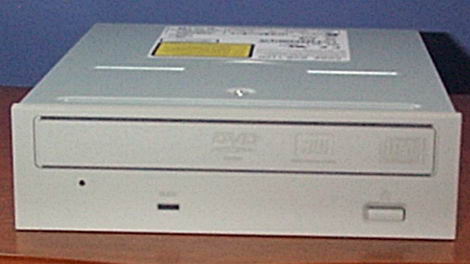
The drive
supplied was the OEM/bulk version. Meaning no cables, software or manual was
supplied.
Now it's time
to take a look at the drive itself:
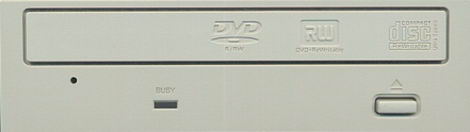
The bezel of
the Pioneer DVR-110D is quite plain looking. We can see an emergency eject hole,
a single green coloured LED and an eject button.
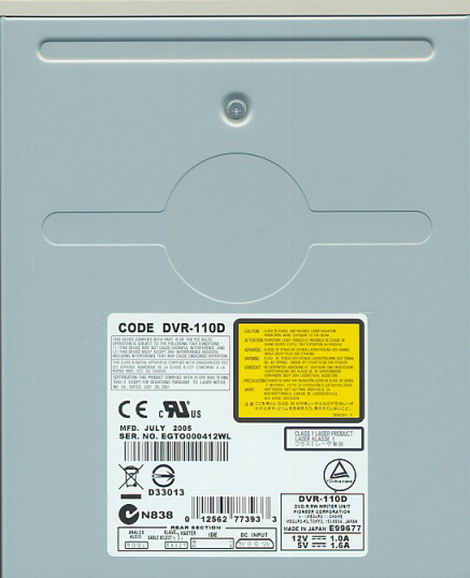
Top
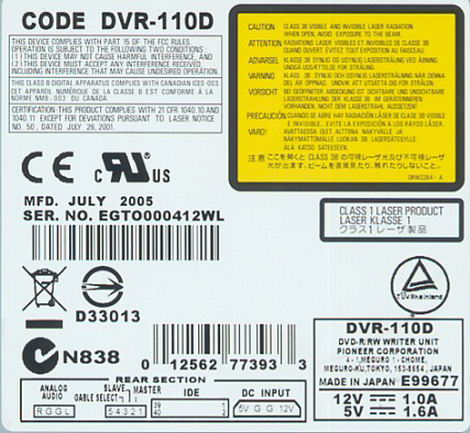
On the
top-side of the drive we found one label, and we can see that the drive was made
in Japan '“ July 2005.
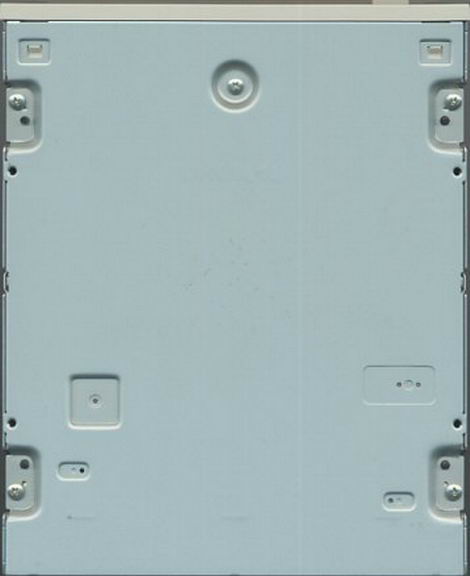
Underside
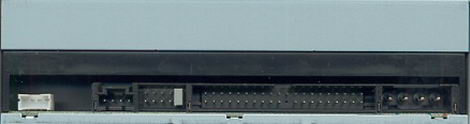
Rear
On the back of
the drive starting from the left, we can see a diagnostics connector; analogue
audio connector; pins and jumper to set the drive to cable select, slave or
master; IDE connector and finally the power connector.
We installed
the drive without any problems and here is a screenshot from Nero
InfoTool:
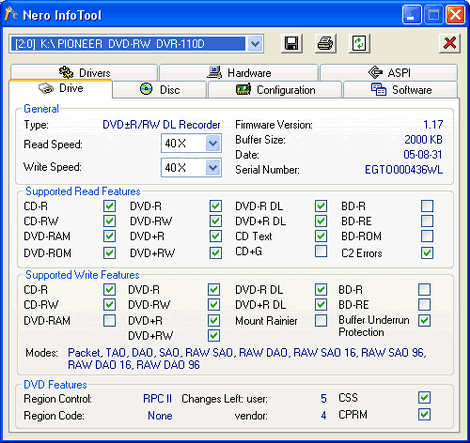
From the
screenshot of Nero InfoTool above, we miss Mt.Rainier and CD+G support and a
larger buffer size. But the drive does support DVD-RAM reading capability. Our
drive came shipped with firmware 1.17.
And another
shot from Nero Burning ROM:
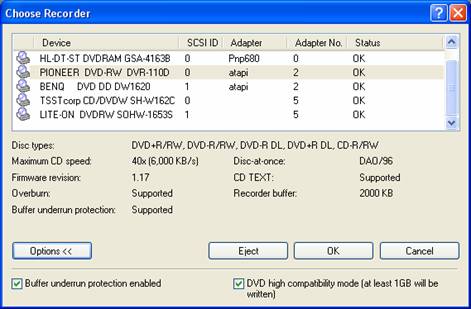
We do not
really find anything alarming here, but Mount Rainier and a larger buffer would
have been nice.
But let us continue
this review and see how it really performs.
On the next page we
will take a look at the test machine, the software, the drive
features…………
Test machine:
For this review we will be using a computer with the following configuration:
Hardware:
⋅ Motherboard: ASUSTeK A8N-SLI DELUXE (nForce 4 SLI chipset)
⋅ Processor: AMD Athlon 64 3500+ (Venice) 800 MHz FSB.
⋅ RAM: 2 GB Corsair TWINX 2CL DDR
⋅ GFX: Leadtek Winfast 6600 TD (PCI Express nVidia)
⋅ Sound: SoundBlaster Audigy 2
⋅ Hard disk: 1X 200Gb Seagate Barracuda (SATA): 1X 120Gb Maxtor (SATA).
System set-up:

The Pioneer DVR-110D was connected as Secondary Master and identified itself as PIONEER DVD-RW DVR-110D. DMA (Direct Memory Access) and autorun was enabled for all devices.
NOTE: This motherboard has 8 IDE channels; although the screenshot states the Pioneer DVR-110D is connected to a Primary IDE channel. It is in fact connected as Secondary Master
Software:
Windows XP Professional is installed on the computer along with Service Pack 2 for Windows XP. We will be using the following software in this review:
- Nero Burning ROM version 6.6.0.16
- Nero CD/DVD Speed V4.04
- Nero Info Tool v3.03
- Slysoft CloneCD v5.2.5.1
- Exact Audio Copy v0.95 beta 2
- K-Probe v2.4.2
Features and techniques:
Pioneer uses Active OPC Technology with its optical hardware. Active OPC constantly monitors the sensitivity of the media and adjusts the laser strength to achieve the best possible results. It does this by analyzing the reflection from the media's surface.
Now it's time to take a closer look at the write technology used by the Pioneer DVR-110D:
CD-Recordable:

The Pioneer uses CAV, (Constant Angular Velocity), to write at its maximum speed of 40X. This gives an average speed of 30.05x. Two drives for comparison are found below.

The Samsung TS-E552U uses P-CAV (Partial-Constant Angular Velocity) to write at its rated speed of 40x. This gives an average speed of 34.39x.

The LG GSA-5160D uses Z-CLV, (Zone-Constant Linear Velocity), to write at its maximum speed of 40X. The drive wrote the last zone at 40.41X and this gives an average speed of 31.70x.
For comparison we have made the following table:
|
CD-R |
Supported |
Write |
Start |
End |
Average |
Write |
|
Philips |
48x |
CAV |
18.98x |
42.88x |
32.47x |
3m:01s |
|
AOpen |
48x |
CAV |
22.07x |
49.66x |
37.69x |
2m:44s |
|
LG |
40x |
Z-CLV |
16.01x |
40.48x |
31.76x |
3m:15s |
|
Lite-On |
48x |
CAV |
21.90x |
49.55x |
37.49x |
2m:38s |
|
LG |
40x |
Z-CLV |
15.98x |
40.41x |
31.70 |
3m:18s |
|
Asus |
32x |
Z-CLV |
16.03x |
32.66x |
24.92x |
3m:58s |
|
Samsung |
40x |
P-CAV |
21.12x |
39.59x |
34.39x |
2m:53s |
|
Philips |
40x |
CAV |
17.80x |
40.01x |
29.51x |
3m:24s |
|
NU |
40x |
CAV |
18.60x |
41.28x |
31.23x |
3m:09s |
|
NEC |
48x |
CAV |
21.44x |
48.17x |
36.43x |
3m:0s |
|
BenQ |
48x |
CAV |
18.31x |
47.99x |
35.20x |
2m:57s |
|
Pioneer |
40x |
CAV |
17.77x |
40.28 |
30.05 |
3m:19s |
As we can see from the table, the Pioneer DVR-110D is average in speed where it comes to writing CD-R's.
CD-Rewritable:

The Pioneer DVDR-110D uses Z-CLV (Zone Constant Linear Velocity) to write CD-RW media at its maximum speed of 32x, with an average write speed of 24.88x.
Below are some other drives for comparison.

The NEC ND-3540A uses Z-CLV, (Zone-Constant Linear Velocity writing technology to write at 32X for CD-RW discs, the average speed is 29.75x.

The NU DHW-164 uses P-CAV (Partial-Constant Angular Velocity) writing technology to write at 24X for CD-RW discs, the average speed is 23.16x.

The LaCie d2 DVD±RW Double Layer uses CLV (Constant Linear Velocity) writing technology to write at 16X for CD-RW discs, the average speed is 16x. For a better overview we present the following comparison table:
|
CD-RW |
Supported |
Write |
Start |
End |
Average |
Write |
|
AOpen |
24x |
Z-CLV |
16.01x |
24.03x |
22.06x |
4m:17s |
|
LG |
24x |
Z-CLV |
16.01x |
23.80x |
23.35x |
3m:54s |
|
Lite-On |
24x |
Z-CLV |
15.98x |
23.97x |
22.57x |
4m:19s |
|
LG |
24x |
Z-CLV |
15.99x |
23.99x |
23.31x |
3m:55s |
|
ASUS |
24x |
Z-CLV |
15.96x |
24.00x |
22.46x |
4m:07s |
|
Samsung |
32x |
P-CAV |
21.07x |
31.87x |
30.26x |
3m:05s |
|
Philips |
24x |
P-CAV |
17.77x |
24.01x |
23.15x |
3m:58s |
|
NU |
24x |
P-CAV |
15.39x |
23.93x |
23.16x |
3m:49s |
|
NEC |
32x |
Z-CLV |
20.11x |
32.03x |
29.75x |
3m:32s |
|
BenQ |
32x |
P-CAV |
21.26x |
31.96x |
30.33x |
3m:10s |
|
Pioneer |
32x |
Z-CLV |
15.87x |
32.01x |
24.88x |
3m:47s |
As we can see from the table, the Pioneer DVR-110D speed wise, is once again average when writing CD-RW's.
16X DVD+R/-R Writing speed:

The Pioneer DVR-110D uses CAV (Constant Angular Velocity) to write DVD+R at the maximum supported speed of 16x. This gives an average write speed of 11.58x and a writing time of 6 minutes 9 seconds.

The Pioneer DVR-110D uses CAV (Constant Angular Velocity) to write DVD-R at its maximum speed of 16x. This gives an average write speed of 11.59x and a writing time of 6 minutes and 1 second.
Below are some write graphs from some other drives for comparison.

The NEC 3540A uses CAV (Constant Angular Velocity) to write DVD+R at 16x. This gives an average writing speed of 11.81x and a writing time of 5 minutes and 58 seconds.

The Philips DVDR16LS uses CAV, (Constant Angular Velocity) to write DVD+R at 16x. The average speed is 11.33x and total writing time is 6 minutes and 8 seconds. The average speed is lower and the writing time is higher than it could have been due to the Walking OPC generation 2 using some time to constantly adjust the writing quality, we could see this as constant dips in the speed curve.

The LG GSA-5160D uses Z-CLV, (Zone-Constant Linear Velocity) to write DVD+R at 16x. The average speed is 11.60x and total writing time is 6 minutes and 12 seconds.

The LG GSA-4163B uses P-CAV, (Partial-Constant Angular Velocity) to write DVD-R at 16x. The average speed is 12.90x and total writing time is 5 minutes and 20 seconds.

The Samsung TS-H552B uses CAV, (Constant Angular Velocity) to write DVD+R at 16x. The average speed is 12.03x and total writing time is 5 minutes and 58 seconds. Below, we made a comparison table:
|
16x |
Supported |
Write |
Start |
End |
Average |
Write |
|
Philips |
16x +R |
CAV |
6.69x |
16.00x |
11.98x |
5m:52s |
|
Aopen |
16x +R |
CAV |
6.69x |
15.90x |
11.90x |
6m:51s |
|
LG |
16x +R |
P-CAV |
7.30x |
16.01x |
12.87x |
5m:34s |
|
Lite-On |
16x +R |
CAV |
6.66x |
16.02x |
11.97x |
6m:01s |
|
LG |
16x +R |
Z-CLV |
6.00x |
15.88x |
11.60x |
6m:12s |
|
ASUS |
16x +R |
Z-CLV |
6.01x |
16.04x |
10.29x |
6m:48s |
|
Samsung |
16x +R |
CAV |
6.75x |
12.09x |
11.11x |
6m:00s*1 |
|
Philips |
16x +R |
CAV |
5.80x |
12.18x |
11.33x |
6m:08s |
|
NU |
16x +R |
CAV |
6.66x |
7.97x |
9.32x |
6m:55s*2 |
|
NEC |
16x +R |
CAV |
6.70x |
16.06x |
11.81x |
5m:58s |
|
BenQ |
16x +R |
CAV |
5.70x |
15.95x |
11.53x |
5m:44s |
|
Pioneer |
16x +R |
CAV |
6.27x |
15.87x |
11.58x |
6m:09s |
*1 - Actual writing speed was max 14x due to USB-Bridge limitations.
*2 '“ Actual writing speed was max 13x due to USB-Bridge limitations.
From the table above, we can see that the Pioneer DVR-110D is about average in speed when writing DVD+R and DVD-R.
8X DVD+R DL writing speed:
The Pioneer DVR-110D supports 8x writing speed on DVD+R DL media.

The Pioneer DVR-110D uses Z-CLV, (Zone-Constant Linear Velocity) to write DVD+R9 DL at 8x. Five zones are used to write DVD+R Double Layer discs at 8x. The average speed is 7.00x and total writing time is 18:06 minutes.
8X DVD-R DL writing speed:
The Pioneer DVR-110D is the world's first drive to support 8x writing speed on DVD-R DL media.

The Pioneer uses Z-CLV, (Zone-Constant Linear Velocity) to write DVD-R9 DL at 8x. Five zones are used to write DVD-R Double Layer discs at 8x. The average speed is 7.06x and total writing time is 17:55 minutes.
8X DVD+RW writing speed:

The Pioneer DVR-110D uses Z-CLV, (Zone-Constant Linear Velocity) to write DVD+RW at 8x. The average speed is 7.78x and total writing time is 7:36 minutes.
6X DVD-RW writing speed:

The Pioneer DVR-110D uses CLV, (Constant Linear Velocity) to write DVD-RW at 6x. The average speed is 6.00x and total writing time is 10:21 minutes.
Book type (bitsetting):
The Pioneer DVDR-110D supports bitsetting, and will as default write DVD+R DL media with DVD-ROM book type.
Here is how you could check if your discs are really written with DVD-ROM book type:
Start Nero CD-DVD Speed and click the Disc info button and you should get something like this (V3.80):

DVD+R DL with book type DVD-ROM.
By using Nero CD-DVD Speed V4.04, you will get the following screen:

DVD+R DL with book type DVD-ROM.
Another quick test is to start Nero CD-Speed and look at the disc information:

This should say DVD-ROM.
Lets continue to the next page where we will examine the reading performance..
Reading performance:
For these
tests we will use Nero CD/DVD-Speed to read various CD and DVD's, including
audio discs and DVD-media. As already mentioned in the introduction, this drive
supports:
- DVD-ROM :
16x - CD-ROM :
40x
Pressed
discs:
For this test
we used a pressed CD-ROM disc containing the Roxio Media Creator 7 install CD
that is close to 75 minutes in length. Below you will see the produced
result:

The Pioneer
DVR-110D reached 41.99x which is beyond its stated read speed of 40x, and will
reach faster speeds on a full disc. Let's compare the result in the table below:
|
Pressed |
Average |
Start |
End |
Seek |
Seek |
Seek |
|
Samsung |
35.65x |
20.40x |
47.22x |
96ms |
102ms |
172ms |
|
Philips |
35.69x |
20.59x |
47.25x |
118ms |
130ms |
206ms |
|
Memorex |
34.94x |
20.05x |
46.33x |
122ms |
130ms |
221ms |
|
AOpen |
37.34x |
21.29x |
49.42x |
105ms |
118ms |
196ms |
|
LG |
30.73x |
16.88x |
40.47x |
108ms |
105ms |
128ms |
|
Lite-On |
36.44x |
21.36x |
48.13x |
118ms |
133ms |
207ms |
|
Pioneer |
30.77x |
18.18x |
24.51x |
96ms |
110ms |
182ms |
|
BenQ |
30.74x |
15.39x |
38.87x |
99ms |
112ms |
161ms |
|
NEC |
34.82x |
19.88x |
46.09x |
122ms |
132ms |
210ms |
|
BenQ |
36.58x |
20.82x |
47.67x |
107ms |
123ms |
175ms |
|
Pioneer |
31.61 |
18.09 |
41.99 |
99ms |
111ms |
189ms |
The Pioneer
DVR-110D performed average reading pressed CD-ROM.
* Some drives
including the NU HDW-164 will simply execute the seek command without actually
moving the pickup.
CD-Recordable
Discs:
For this test
we made a copy of the original Roxio Media Creator 7 install CD. The disc we
used was a Ricoh 52X certified CD-R disc manufactured by Moser Baer
India.

|
CD-R |
Average |
Start |
End |
Seek |
Seek |
Seek |
|
Philips |
36.54x |
21.46x |
48.14x |
124ms |
151ms |
230ms |
|
AOpen |
36.49x |
21.20x |
48.11x |
99ms |
115ms |
185ms |
|
LG |
30.63x |
17.62x |
40.14x |
105ms |
129ms |
183ms |
|
Lite-On |
36.63x |
21.46x |
48.29x |
125ms |
157ms |
234ms |
|
LG |
30.53x |
16.83x |
40.27x |
116ms |
118ms |
128ms |
|
ASUS |
30.96x |
18.26x |
40.81x |
125ms |
143ms |
282ms |
|
Samsung |
36.65x |
21.28x |
48.33x |
92ms |
95ms |
163ms |
|
Philips |
30.69x |
17.68x |
40.44x |
126ms |
137ms |
175ms |
|
NU |
32.20x |
18.48x |
42.65 |
N/A* |
N/A* |
N/A* |
|
NEC |
35.68x |
20.76x |
47.06x |
128ms |
130ms |
213ms |
|
BenQ |
36.57x |
20.92x |
48.09x |
203ms |
233ms |
239ms |
|
Pioneer |
31.18x |
18.37x |
40.99 |
111ms |
121ms |
204ms |
Again the
Pioneer DVR-110D performed around average on CD-R read test.
* Some drives
including the NU HDW-164 will simply execute the seek command without actually
moving the pickup.
CD-Rewritable discs:
Again, we made
a copy of the original Roxio Media Creator 7 install CD; this time we used a
Verbatim Ultra Speed (32X) CD-RW disc made by Mitsubishi Chemicals
Corporation.

As we can see
above, the Pioneer DVR-110D is locked at 32x, reading CD-RW; now let us compare
it to other drives below.
|
CD-RW |
Average |
Start |
End |
Seek |
Seek |
Seek |
|
Philips |
23.81x |
13.97x |
31.39x |
122ms |
156ms |
232ms |
|
Aopen |
36.55x |
21.31z |
48.22x |
102ms |
114ms |
185ms |
|
LG |
30.64x |
17.69x |
40.56x |
105ms |
127ms |
180ms |
|
Lite-On |
24.25x |
14.04x |
32.15x |
129ms |
167ms |
233ms |
|
LG |
30.54x |
16.59x |
40.43x |
119ms |
116ms |
129ms |
|
ASUS |
25.32x |
14.63x |
33.52x |
129ms |
149ms |
288ms |
|
Samsung |
23.99x |
14.02x |
31.63x |
86ms |
95ms |
162ms |
|
Philips |
30.70x |
17.71x |
40.55x |
131ms |
149ms |
179ms |
|
NU |
32.20x |
18.17x |
42.53x |
N/A* |
N/A* |
N/A* |
|
NEC |
30.76x |
18.02x |
40.08x |
132ms |
128ms |
213ms |
|
BenQ |
31.36x |
17.47x |
41.46x |
105ms |
116ms |
250ms |
|
Pioneer |
24.96x |
14.60x |
33.01x |
105ms |
119ms |
195ms |
The Pioneer
DVR-110D proved fairly slow at reading CD-RW's. The seek times however, are
quite good.
* Some drives
including the NU HDW-164 will simply execute the seek command without actually
moving the pickup.
Audio '“
Digital Audio Extraction:
To test the
digital audio extraction performance of the Pioneer DVR-110D, again we used Nero
CD/DVD-Speed to measure the transfer rate. The audio disc we used is slightly
larger than the disc used for the other tests, to be exact it's was 78 minutes
in length (78:53:31).

The Pioneer
CDR-110D went beyond its maximum rated speed of 40x and actually reached 42.38x;
let us compare the result with other drives:
|
Audio |
Average |
Start |
End |
Seek |
Seek |
Seek |
|
Philips |
37.40x |
21.06x |
49.59x |
117ms |
127ms |
204ms |
|
Aopen |
37.50x |
21.38x |
49.72x |
115ms |
120ms |
206ms |
|
LG |
31.37x |
17.57x |
41.39x |
95ms |
121ms |
211ms |
|
Lite-On |
36.92x |
21.36x |
48.89x |
126ms |
157ms |
234ms |
|
LG |
31.27x |
16.81x |
41.20x |
118ms |
124ms |
115ms |
|
ASUS |
31.10x |
19.91x |
41.38x |
125ms |
146ms |
286ms |
|
Samsung |
37.53x |
19.73x |
49.76x |
85ms |
97ms |
171ms |
|
Philips |
31.44x |
17.75x |
41.69x |
107ms |
124ms |
176ms |
|
NU |
32.98x |
18.32x |
43.70x |
N/A* |
N/A* |
N/A* |
|
NEC |
31.43x |
18.00x |
40.16x |
119ms |
135ms |
217ms |
|
BenQ |
37.15x |
20.94x |
49.23x |
171ms |
200ms |
184ms |
|
Pioneer |
31.52x |
17.95x |
42.38x |
108ms |
124ms |
201ms |
The Pioneer
DVR-110D performed around average on the Audio-CD.
* Some drives
including the NU HDW-164 will simply execute the seek command without actually
moving the pickup.
For this test
we used EAC (Exact Audio Copy) to test the drives Audio extraction performance.
As we can see from the screenshot below the drive supports 'caching" which can
have an adverse effect on Audio extraction performance. Also worth noting, the
drive does not support 'C2 error info" with EAC.

Below is the
results produced by EAC:

Burst mode

Secure mode
The drive
performed well in burst mode but performed poorly in secure mode.
Advanced
audio '“ DAE quality test:
Before we move
on to testing DVD read speeds, we will take a last audio test, and this time we
used the 'Advanced DAE Quality Test" feature in CD-Speed. For this test we used
a CD-R media from RICOH (Thanks to RICOH Europe (BV) for sending us this
media).


The extracting
quality is excellent but the drive proved to slow for 'on the fly copying"
beyond 4x. Also reading of lead-in and lead-out were also not
supported.
DVD reading
performance:
Again, we will use
Nero CD-Speed to measure the reading performance, this time for various types of
DVD discs. The drive should read pressed single layer DVD-discs at
16X.
DVD '“
DVD-Video:
For our DVD
reading performance tests we are going to start with a single and Double Layered
DVD video discs. While only 1X speed is required to watch DVD movies, it's
useful to be able to read the discs at higher speeds if you're going to extract
(rip) the content of the disc to your hard drive.

DVD-Video Single Layer

DVD-Video Double Layer
The DVR-110D
is not RIPLOCKED and reads a pressed DVD-Video at up to 16x for a Single Layer
disc, and at up to 13x for a Double Layer disc. This makes the DVR-110D a fast
DVD-Video ripper.
Now let us
test a pressed DVD-ROM disc. For this test we used the Plextor PX-716 install
DVD, which is around 4.37 Gigabyte in size.

The DVR-110D
will reach 16x on DVD-ROM's.
|
DVD |
Average |
Start |
End |
Average |
Start |
End |
|
Philips |
9.62x |
6.77x |
6.52x |
6.19x |
3.45x |
8.22x |
|
AOpen |
12.04x |
6.71x |
16.05x |
6.61x |
3.68x |
8.79x |
|
LG |
7.62x |
4.26x |
10.16x |
6.16x |
3.44x |
8.18x |
|
Lite-On |
11.96x |
6.77x |
15.94x |
6.15x |
3.46x |
8.19x |
|
LG |
7.60x |
4.12x |
10.13x |
6.14x |
3.38x |
8.16x |
|
ASUS |
3.92x |
2.17x |
5.25x |
3.94x |
2.19x |
5.25x |
|
Samsung |
11.50x |
6.78x |
13.11x |
6.41x |
3.57x |
8.51x |
|
Philips |
11.97x |
6.61x |
15.97x |
6.02x |
3.35x |
8.01x |
|
NU |
6.40x |
3.54x |
8.53x |
5.87x |
3.26x |
7.81x |
|
NEC |
5.94x |
3.32x |
7.93x |
5.45x |
3.03x |
7.24x |
|
BenQ |
11.86x |
6.59x |
15.79x |
9.01x |
5.03x |
12.00x |
|
Pioneer |
11.98x |
6.42x |
15.98x |
9.34x |
5.26x |
12.41x |
The Pioneer
DVR-110D performed very well with our DVD-Video tests. It was among the fastest
drives at reading a pressed SL DVD-Video disc. And the fastest drive at reading
a DL pressed DVD-Video disc.
DVD '“ DVD+R:
For this test
we used a Maxell (Taiyo Yuden) 4X DVD+R and a Verbatim 8X DVD+RW with about
4.4Gb of data. Below are the results:

DVD+R

DVD+RW
|
DVD+R |
Average |
Start |
End |
Average |
Start |
End |
|
AOpen |
8.79x |
4.83x |
11.73x |
5.83x |
3.20x |
7.79x |
|
LG |
7.69x |
4.25x |
10.29x |
6.15x |
3.41x |
8.22x |
|
Lite-On |
6.19x |
3.42x |
8.28x |
6.23x |
3.46x |
8.33x |
|
LG |
7.66x |
4.11x |
10.23x |
6.15x |
3.32x |
8.21x |
|
ASUS |
9.35x |
5.19x |
12.52x |
6.26x |
3.48x |
8.36x |
|
Samsung |
6.23x |
3.44x |
8.32x |
6.22x |
3.43x |
8.31x |
|
Philips |
6.24x |
3.42x |
8.34x |
6.24x |
3.42x |
8.34x |
|
NU |
6.47x |
3.53x |
8.63x |
6.46x |
3.52x |
8.65x |
|
NEC |
11.99x |
6.56x |
16.05x |
9.87x |
5.45x |
13.18x |
|
BenQ |
12.10x |
6.59x |
16.22x |
9.37x |
5.12x |
12.56x |
|
Pioneer |
9.35x |
5.16x |
12.46x |
6.24x |
3.44x |
8.33x |
The Pioneer
DVR-110D performed averagely on DVD+R and DVD+RW, returning respectable results.
Now let us see how it will perform on DVD-R/RW.
DVD '“
DVD-R/RW:
For this test
we used a DAXON 16X DVD-R disc and a Verbatim 6X DVD-RW disc filled with about
4.4Gb of data. Our test results are found below:

DVD-R

DVD-RW
There are
minor differences compared to reading the DVD+R/RW discs, but they are very
marginal differences.
|
DVD-R |
Average |
Start |
End |
Average |
Start |
End |
|
Philips |
6.10x |
3.39x |
8.16x |
6.11x |
3.39x |
8.17x |
|
Aopen |
8.80x |
4.83x |
11.76x |
5.88x |
3.23x |
7.84x |
|
LG |
7.68x |
4.26x |
10.26x |
6.16x |
3.41x |
8.23x |
|
Lite-On |
6.05x |
3.34x |
8.09x |
6.05x |
3.35x |
8.09x |
|
LG |
7.67x |
4.12x |
10.25x |
6.14x |
3.31x |
8.21x |
|
ASUS |
9.37x |
5.22x |
12.52x |
6.25x |
3.46x |
8.35x |
|
Samsung |
6.19x |
3.41x |
8.27x |
6.22x |
3.43x |
8.32x |
|
Philips |
6.23x |
3.40x |
8.33x |
6.24x |
3.41x |
8.34x |
|
NU |
6.46x |
3.49x |
8.66x |
6.46x |
3.49x |
8.64x |
|
NEC |
12.01x |
6.58x |
16.06x |
9.85x |
5.42x |
13.16x |
|
BenQ |
12.09x |
6.59x |
16.17x |
9.34x |
5.11x |
12.50x |
|
Pioneer |
9.36x |
5.18x |
12.51x |
6.24x |
3.46x |
8.34x |
Once again the
Pioneer DVR-110D was average at reading DVD-R/RW.
DVD-RAM
For this test
we used a Emgeton 3x DVD-RAM disc, and below is our result:

The Pioneer
DVR-110D reads DVD-RAM media at 2x, and read our test disc without
problems.
Overall
thoughts:
The Pioneer
DVR-110D is a respectable reader, it's not the fastest reader in the world, but
during our read tests it proved reliable. Pressed DL DVD-Video read speeds were
very impressive and it does have the advantage of being able to read DVD-RAM
media.
Overall the
reading performance of the Pioneer DVR-110D should not disappoint the end
user.
But now
it's time to head on to a more interesting part: Writing CD-R and CD-RW
discs…
The
specifications of the Pioneer DVR-110D state that the drive is able to write
CD-R discs at 40x and CD-RW at 32x. Let us find out how the drive really
performs in speed and quality.
Writing Data CD-R
discs:
For our data
writing tests, we simply set up a new compilation of 700Mb using Nero Burning
ROM software. Writing method used is DAO (Disc At Once),
and the disc is set up as a non-multisession disc with 'finalize disc" enabled.
The screenshot below shows how long it takes to write a disc at the highest
speed. (40x):

The drive took
3 minutes and 34 seconds to write the disc at 40x. Let us see how this compares
to other drives:
- NU DHW-164
used 3 minutes and 12 seconds at 40x - Philips
DVDR16LS used 3 minutes and 26 seconds at 40x - Samsung
TS-E552U used 2 minutes and 52 seconds at 40x - LG
GSA-4163B used 3 minutes and 15 seconds at 40x - Philips
DVDR1640P used 3 minutes and 17 seconds at 40x - NU DDW-082
used 3 minutes and 2 seconds at 40x - Samsung
TS-H552B used exactly 3 minutes at
40x - Plextor
PX-708A used 2 minutes and 58 seconds at 40x
Write
Quality:
We will test
CD-R discs from a total of 8 different CD-R manufacturers. To really measure the
write speed, we used the 'create data CD" function in Nero CD-Speed. The discs
were written at the maximum speed that the drive supports. For the quality test,
we used K-Probe 2 which is a tool developed by a Lite-On employee. It runs under
Windows and works with drives made by Lite-On. Also note that different drives
and different reading speeds may affect the results obtained when scanning the
discs. We used a Lite-On SOHR-5238S drive with firmware 4S08 and scanned the
discs at 48X speed.
A written CD-R
disc will always have some C1 errors; C1 errors are easily corrected by the
drive's error correction capabilities. The next level of errors is C2, while C2
errors could also be corrected by most drive's error correction capabilities;
they are not wanted on a good quality disc. A good disc should not contain any
C2 errors, and preferably have an average C1 error amount of below 2.0 for the
best discs, or at least below 10.0 averages for good quality discs. After C2
errors, there are only un-correctable errors that will make a disc unusable.
Below are the
obtained results:


| Brand: | Unbranded Printable. Thanks to SVP UK for sending us this media |
| Manufacturer: | Taiyo Yuden |
| Code: | 97m24s01f |
| Disc Type: |
CD-R |
| Recording Layer: |
Dye Type 1: Long Strategy (Cyanine, AZO) |
| Capacity: | 79:59.72 (703MB) |
| Certified Speed: |
48x |
| Write Speed: |
40x (CAV) |
| Write Time: |
3m:19s |
| C1 Average/Sec: |
0.12 |
| C2 Average/Sec: |
0.0 |
Media made by
Taiyo Yuden have always had a good reputation and with the average C1 errors of
0.12 it goes into the group 'best quality discs" category.
Highly recommended!


| Brand: | Infiniti Professional White Top '“ Thanks to Medea International (UK) for sending us this media. |
| Manufacturer: | CMC Magnetics |
| Code: | 97m26s66f |
| Disc Type: |
CD-R |
| Recording Layer: |
Dye Type 6: Short Strategy (Phthalocyanine) |
| Capacity: | 79:59.71 (703 MB) |
| Certified Speed: |
52x |
| Write Speed: |
40x (CAV) |
| Write Time: |
3m:18s |
| C1 Average/Sec: |
0.43 |
| C2 Average/Sec: |
0.0 |
An excellent result
from the Infiniti Profession media. With a C1 average of 0.43 this disc goes
into our best quality category. Recommended!


| Brand: | Infiniti Samurai Lava Red '“ Thanks to Medea International (UK) for sending us this media. |
| Manufacturer: | SKC |
| Code: | 97m26s26f |
| Disc Type: |
CD-R |
| Recording Layer: |
Dye Type 6: Short Strategy (Phthalocyanine) |
| Capacity: | 79:59.09 (703 MB) |
| Certified Speed: |
52x |
| Write Speed: |
40x (CAV) |
| Write Time: |
3m:34s |
| C1 Average/Sec: |
2.73 |
| C2 Average/Sec: |
0.0 |
Another good
result.


| Brand: | RICOH '“ Thanks to RICOH Europe (BV) for sending us this media. |
| Manufacturer: | Moser Baer India Limited |
| Code: | 97m17s06f |
| Disc Type: |
CD-R |
| Recording Layer: |
Dye Type 6: Short Strategy (Phthalocyanine) |
| Capacity: | 79:59.74 (703MB) |
| Certified Speed: |
1x-52x |
| Write Speed: |
32x (P-CAV) |
| Write Time: |
3m:27s |
| C1 Average/Sec: |
3.34 |
| C2 Average/Sec: |
0.0 |
RICOH media '“
manufactured by Moser Baer India Limited and with its average of 3.34 it goes in
the 'good
discs" category. The only drawback was the disc
was only written at 32x.


| Brand: | Traxdata '“ Thanks to Conrexx (NL) for sending us this media. |
| Manufacturer: | Ritek |
| Code: | 97m15s17f |
| Disc Type: |
CD-R |
| Recording Layer: |
Dye Type 7: Short Strategy (Phthalocyanine) |
| Capacity: | 79:59.70 (703MB) |
| Certified Speed: |
52x |
| Write Speed: |
32x (Z-CLV) |
| Write Time: |
4m:12s |
| C1 Average/Sec: |
0.44 |
| C2 Average/Sec: |
0.0 |
This media goes
into the category 'best quality discs" for its C1
average of 0.44. Unfortunately the disc was only written at 32x. Recommended!


|
Brand: |
Verbatim Super AZ0+Crystal |
|
Manufacturer: |
Verbatim |
|
Code: |
97m34s23f |
|
Disc |
CD-R |
|
Recording |
Dye Type 3: Long Strategy |
|
Capacity: |
79:59.70 |
|
Certified |
52x |
|
Write |
40x |
|
Write |
3m:18s |
|
C1 |
0.19 |
|
C2 |
0.0 |
The result on
this Verbatim Super AZO+Cystal DL disc is extremely good. With a C1 error
average of 0.19, this disc goes into our 'best quality disc" category. Highly
recommended!


| Brand: | EMGETON Qauarelle '“ Thanks to Bell Technology (CZ) for sending us this media. |
| Manufacturer: | Fornet International Pte. Ltd. |
| Code: | 97m26s07f |
| Disc Type: |
CD-R |
| Recording Layer: |
Dye Type 7: Short Strategy (Phthalocyanine) |
| Capacity: | 79:59.71 (703 MB) |
| Certified Speed: |
56x |
| Write Speed: |
32x (Z-CLV) |
| Write Time: |
3m:35s |
| C1 Average/Sec: |
12.70 |
| C2 Average/Sec: |
0.19 |
This was not a good
result. C1 errors are quite high and the disc has C2 errors. The media was
written at 32x.


|
Brand: |
Traxdata |
|
Manufacturer: |
Prodisc |
|
Code: |
97m32s19f |
|
Disc |
CD-R |
|
Recording |
Dye Type 9: Short Strategy |
|
Capacity: |
79:59.73 |
|
Certified |
16x |
|
Write |
32x |
|
Write |
3m:26s |
|
C1 |
1.61 |
|
C2 |
0.0 |
An excellent
result from a disc burned at twice its rated speed. With a C1 error average of
1.61; this places this disc in our 'best quality disc" category.
Recommended!


|
Brand: |
Verbatim '“ Thanks to |
|
Manufacturer: |
CMC |
|
Code: |
97m34s23f |
|
Disc |
CD-R |
|
Recording |
Dye Type 6: Short Strategy |
|
Capacity: |
79:59.73 |
|
Certified |
52x |
|
Write |
40x |
|
Write |
3m:17s |
|
C1 |
2.73 |
|
C2 |
0.0 |
Another good
result, with a C1 error average of 2.73, this places this disc in our 'good
quality" disc category.


| Brand: | Memorex '“ Thanks to Memorex Europe for sending us this media. |
| Manufacturer: | Moser Baer India Limited |
| Code: | 97m17s06f |
| Disc Type: |
CD-R |
| Recording Layer: |
Dye Type 6: Short Strategy (Phthalocyanine) |
| Capacity: | 79:59.74 (703MB) |
| Certified Speed: |
1x-52x |
| Write Speed: |
32x (P-CAV) |
| Write Time: |
3m:26s |
| C1 Average/Sec: |
0.59 |
| C2 Average/Sec: |
0.0 |
Excellent
result from the Memorex branded Moser Baer India disc. With a C1 error average
of just 0.59; this places the disc in the 'best quality disc" category. The disc
however was only written at 32x.
Writing Quality with Re-Writable
discs:
Due to requests from
our readers, we will add a few write quality tests with re-writable media.
Settings and testing procedures is the same as used earlier in this review, so
you may want to go back and read them if you are unsure. All discs used for
these tests have been written to before, but none have been written to more than
5 times.
CD-ReWritable
media:


| Brand: | Verbatim '“ Thanks to Verbatim (D) for sending us this media. |
| Manufacturer: | Mitsubishi Chemicals Corporation |
| Code: | 97m34s25f |
| Disc Type: |
Ultra Speed CD-RW 32x |
| Recording Layer: |
Phase Change |
| Capacity: | 79:59.74 (703MB) |
| Certified Speed: |
32x |
| Write Speed: |
32x (Z-CLV) |
| Write Time: |
3m:48s |
| C1 Average/Sec: |
5.67 |
| C2 Average/Sec: |
0.0 |
The result is very
good.


|
Brand: |
Memorex '“ Thanks to Memorex Europe for sending us this media. |
| Manufacturer: | Infodisc Technology |
| Code: | 97m25s30f |
| Disc Type: |
High Speed CD-RW 12x |
| Recording Layer: |
Phase Change |
| Capacity: | 79:59.74 (703MB) |
| Certified Speed: |
12x |
| Write Speed: |
10x (CLV) |
| Write Time: |
8m:26s |
| C1 Average/Sec: |
2.53 |
| C2 Average/Sec: |
0.0 |
Another very
good result.
Summary:
The CD-R writing quality is
excellent, and the CD-RW quality is good.
So let us
head on to next page and read about DVD-Writing
performance…
The
specifications of this drive tell us that it should write DVD±R at 16x and
DVD+RW/-RW at 8x/6x. In this part, we will measure the write time for various
types of DVD+R/RW and DVD-R/RW discs. We will also focus on write quality and
media compatibility.
DVD-Writing
performance:
In this test
we will measure the time for writing to DVD±R discs. We used Nero Burning Rom to
burn an ISO compilation containing 4483Mb of data. We used the Disc-At-Once
write method.

DVD+R

DVD-R
Look below for
the results.
|
Write DVD data |
DVD+R |
DVD-R |
|
Philips |
7m:52s |
9m:55s |
|
AOpen |
6m:49s |
9m:17s |
|
LG |
5m:35s |
5m:22s |
|
Lite-On |
6m:03s |
7m:28a |
|
LG |
6m:22s |
8m:16s |
|
ASUS |
6m:33s |
6m:44s |
|
Samsung |
6m:40s |
N/A |
|
Philips |
6m:08s |
8x:21s |
|
NU |
6m:51s |
7m:23s |
|
NEC |
6m:17s |
6m:05s |
|
BenQ |
6m:01s |
6m:11s |
|
Pioneer |
6m:25s |
6m:11s |
The
results are above average on DVD+R and among the fastest drives on DVD-R, when
compared to other drives. Let us see how the writing quality is.
Write quality:
You should first
notice that this is not a scientific and professional way to test the discs. But
according to our testing done in recent months, we would conclude that there is
a clear link between the quality reported when scanning the disc and the
playability of the disc in different devices. Also notice that different drives
report different amounts of errors. K-Probe was designed to work with
Lite-On
DVD-Writers, so we recommend
using a DVD-Writer from Lite-On. In this test we
use a Lite-On SOHW-1653S
DVD-Writer, as already said; remember that scans done with a Lite-On
DVD-ROM or Lite-On combo
drive can't be compared with the results obtained with a Lite-On
DVD-Writer. Also remember that
different PI/PO ECC sum settings along
with different reading speeds in K-Probe will affect the result, we use these
settings; PI (Parity Inner) set to summarize 8
ECC blocks,
PIF
(Parity Inner Failures) set
to summarize 1 ECC block,
reading speed: 4X CLV
(Constant Linear Velocity). Setting the PI sum to 8 and the
PIF sum to 1 will give
a result that we may compare to the standards for DVD+R/RW and
DVD-R/RW.
But what is a good
scan? That is a discussion that we don't think will end soon, as different
drives report different amount of errors, some players are more picky about
media than others, and so on. But as a comparison we present you with a scan
from two pressed DVD discs:

This scan shows the results from a pressed DVD-Video disc
(GoldenEye).

This scan shows the
result from a pressed DVD-Video disk (The Green Mile). Notice the error jump
when shifting to the second layer (the error level actually drops from the end
of the first layer to the beginning of the second layer).
If you read below,
you will see that both the pressed DVD-discs are well within the
standards.
Download the
ECMA 267 Standard for
DVD-ROM, the ECMA 337 Standard for
DVD+R/RW and the
ECMA 338 Standard for
DVD-R/RW at http://www.ecma-international.org if you
want to look at the standards for yourself. Here is some data from the
ECMA standards (same for
DVD-ROM, DVD-R/RW and DVD+R/RW):
Random
errors:
A row of an
ECC Block that has at least 1 byte in error
constitutes a PI error. In any 8
consecutive ECC
Blocks the total number of PI errors before correction shall not exceed
280.
Here we see that a
PI error is defined as a row in an ECC block having 1 byte
or more containing errors and that the sum of PI errors in 8 ECC blocks after each
other should not exceed 280 PI errors.
But what is a row
and what is an ECC block? Again we
refer to the ECMA standards. We do
not copy and paste everything, but if you're interested, look in the
ECMA standards. A row is
182 bytes long where the last 10 bytes contain PI (Parity Inner)
information. An ECC block is 208 rows
long where the last 16 rows contain the PO (Parity Outer)
information. This gives us a maximum possible PI error amount of 208 errors per
block and for 8 blocks after each other this sum is of course 8 times higher,
giving a maximum possible amount of 1664 PI-8 errors. In practical use, a disc
with 1664 PI-8 errors is unreadable.
According to our
tests the specified max PI-8 sum of 280 for good discs seems to be a good
guideline, as some readers have problems reading discs when the PI-8 errors is
over 300 and most players starts to have problems when the PI-8 error level
reaches 600 or more.
But what are the
PIF errors that K-Probe
reports? They are Parity Inner Failures, meaning errors left after PI
correction. Only the ECMA 337 standard
describes the Parity Inner Failures. So how is a Parity Inner Failure defined?
Here is what the ECMA 337
states:
'If a row
of an ECC Block as defined in 13.3 contains more than
5 erroneous bytes, the row is said to be 'PI-uncorrectable"."
In theory, an
ECC block may in the worst case have 208 PIF since every ECC block is 208
rows long. But the ECMA 337 standard goes further and
specifies the max amount of accepted PI Failures (uncorrectable errors) allowed on a good disc:
'In any
ECC Block
the number of PI-uncorrectable rows
should not exceed 4."
This means that when
the PIF sum is set to 1,
the maximum error value should not exceed 4. The theoretical maximum value for
PIF is 208
errors.
But what makes a
disc unreadable? A POF (Parity
Outer Failure) error will make the disc unreadable, but K-Probe
does not display the POF's.
Notice that there
are other aspects such as disc reflectivity, jitter, tracking errors and so on
that also will affect the readability of a DVD disc '“ but for this we do not
have measuring equipment available.
Also, another note
is that we have scanned the discs at 4X CLV speed,
by lowering the speed to 2X(DVD-R/RW)/2.4X(DVD+R/RW) or 1X
the amount of reported errors may drop on some discs. We scanned at 4X
CLV due to lower speeds
taking too much time.
To see if there is a
connection between the reported amount of errors and readability of the discs we
also include the reading curve from a NEC ND-3540A DVD-Writer. The reason why we
have changed the reader is that some companies disliked that we used a modified
firmware to obtain 16x reading speed. So to please them, we are now using a
drive that reads DVD+R/-R media
at 16x as default. A small speed reduction near the end
is still accepted on good discs, but serious reading problems or reading
failures is a bad sign.
Easier
explanation on how to read the test results.
Maybe this got too
technical, and you are wondering what to look for in KProbe
reports?
Use this as a
guideline for good discs:
- PI (Parity
Inner): No larger areas
on the disc should exceed 280 PI-8 errors, do not worry too much about high
single spikes that exceed 280. - PIF (Parity Inner
Failures): No larger areas
on the disc should exceed 4 PIF-1 errors, do not worry too much about high
single spikes that exceed 4.
And as always; lower
is better 
And look at the
reading curve; if it looks clean with no dips it should be good, a small
slowdown near the end is accepted.
DVD+R media compatibility and write quality:
In these tests
we will be using a Lite-On SOHW-1653 drive with firmware CS09 along with K-Probe
to measure the disc quality. We will also be using the NEC ND-3540A with
firmware 1.01 along with CD-Speed for our read-back tests.


| Brand: | BenQ |
| Manufacturer: | Daxon Inc. |
| Code: | DAXON AZ3 |
| Disc Type: |
DVD+R |
| Capacity: | 4483MB |
| Certified Speed: |
16x |
| Write Speed: |
16x |
| Write Time: |
6m:10s |
| PI-8 errors Average/Sec: |
2.59 |
| PI-1 failures (PIF) Avg/Sec: |
0.07 |
The K-Probe
scan shows a single PIF spike of 6, but overall this is a good quality
burn.


| Brand: | Datawrite Titanium (Grey) '“ Thanks to E-Net (UK) for sending us this media. |
| Manufacturer: | Prodisc Technology |
| Code: | PRODISC R03 |
| Disc Type: |
DVD+R |
| Capacity: | 4483MB |
| Certified Speed: |
8x |
| Write Speed: |
8x |
| Write Time: |
8m 21s |
| PI-8 errors Average/Sec: |
0.83 |
| PI-1 failures (PIF) Avg/Sec: |
0.02 |
Datawrite 8x
media with Prodisc media code. The result is excellent.


| Brand: | Datawrite Titanium '“ Thanks to E-Net (UK) for sending us this media. |
| Manufacturer: | CMC Magnetics Corporation |
| Code: | CMC MAG M01 |
| Disc Type: |
DVD+R |
| Capacity: | 4483MB |
| Certified Speed: |
16x |
| Write Speed: |
8x |
| Write Time: |
8m:22s |
| PI-8 errors Average/Sec: |
2.75 |
| PI-1 failures (PIF) Avg/Sec: |
0.06 |
Datawrite 16x
media with CMC media code. This 16x media was burned at 8x. The result is ok
although not fantastic considering this media was burned at half its rated
speed.


| Brand: | RiDisc '“ Thanks to SVP (UK) for sending us this media. |
| Manufacturer: | Ricoh Company Limited |
| Code: | RICOH JPN R01 |
| Disc Type: |
DVD+R |
| Capacity: | 4483MB |
| Certified Speed: |
4x |
| Write Speed: |
4x |
| Write Time: |
14m:54s |
| PI-8 errors Average/Sec: |
0.70 |
| PI-1 failures (PIF) Avg/Sec: |
0.00 |
RiDisc 4x media
with Ricoh media code. The result is excellent. Recommended!


| Brand: | Emgeton '“ Thanks to Bell Technology (CZ) for sending us this media. |
| Manufacturer: | Infomedia Inc. |
| Code: | INFOME R20 |
| Disc Type: |
DVD+R |
| Capacity: | 4483MB |
| Certified Speed: |
8x |
| Write Speed: |
6x |
| Write Time: |
10m:14s |
| PI-8 errors Average/Sec: |
19.98 |
| PI-1 failures (PIF) Avg/Sec: |
0.07 |
The PI errors
are rising near the end of the disc, but everything is well within
specification, and the transfer rate test is good.


| Brand: | MMORE '“ Thanks to MMORE (NL) for sending us this media. |
| Manufacturer: | Moser Baer India Limited |
| Code: | MBIPG101 R05 |
| Disc Type: |
DVD+R |
| Capacity: | 4483MB |
| Certified Speed: |
16x |
| Write Speed: |
12x |
| Write Time: |
7m:29s |
| PI-8 errors Average/Sec: |
0.73 |
| PI-1 failures (PIF) Avg/Sec: |
0.04 |
A very good
result but only burned at 12x.


| Brand: | TDK '“ Thanks to SVP (UK) for sending us this media. |
| Manufacturer: | Moser Baer India Limited |
| Code: | MBIPG101 R04 |
| Disc Type: |
DVD+R |
| Capacity: | 4483MB |
| Certified Speed: |
8x |
| Write Speed: |
8x |
| Write Time: |
8m:21s |
| PI-8 errors Average/Sec: |
2.01 |
| PI-1 failures (PIF) Avg/Sec: |
0.01 |
Another
excellent result with very low PIF errors on this disc.


| Brand: | Ricoh '“ Thanks to Ricoh Europe for sending us this media. |
| Manufacturer: | Ricoh Company Limited |
| Code: | RICOH JNP R03 |
| Disc Type: |
DVD+R |
| Capacity: | 4483MB |
| Certified Speed: |
1x-16x |
| Write Speed: |
12x |
| Write Time: |
7m:28s |
| PI-8 errors Average/Sec: |
12.49 |
| PI-1 failures (PIF) Avg/Sec: |
0.23 |
It would
appear the DVR-110D does not handle this media very well. Even though the burn
speed was 12x, there are problems near the end of the disc where PIF errors are
increasing and from our 'transfer rate test" we can see there is a minor slow
down at the end of the disc.


| Brand: | Ricoh '“ Thanks to Ricoh Europe for sending us this media. |
| Manufacturer: | Ricoh Company Limited |
| Code: | RICOH JNP R02 |
| Disc Type: |
DVD+R |
| Capacity: | 4483MB |
| Certified Speed: |
1x-8x |
| Write Speed: |
8x |
| Write Time: |
8m:21s |
| PI-8 errors Average/Sec: |
3.09 |
| PI-1 failures (PIF) Avg/Sec: |
0.00 |
A very good
result.


| Brand: | Verbatim '“ Thanks to Pioneer for including this media. |
| Manufacturer: | Mitsubishi Chemicals Corporation |
| Code: | MCC 004 |
| Disc Type: |
DVD+R |
| Capacity: | 4483MB |
| Certified Speed: |
16x |
| Write Speed: |
16x |
| Write Time: |
6m:09s |
| PI-8 errors Average/Sec: |
0.79 |
| PI-1 failures (PIF) Avg/Sec: |
0.00 |
A very high
quality burn from a good quality media. Highly recommended!


| Brand: | Verbatim Thanks to SVP (UK) for sending us this media |
| Manufacturer: | Verbatim |
| Code: | MCC003 |
| Disc Type: |
DVD+R |
| Capacity: | 4483MB |
| Certified Speed: |
8x |
| Write Speed: |
12x |
| Write Time: |
7m:27s |
| PI-8 errors Average/Sec: |
1.15 |
| PI-1 failures (PIF) Avg/Sec: |
0.02 |
Another very
good result and this 8x media was burned at 12x. Recommended!


| Brand: | Traxdata - Thanks to Conrexx (NL) for sending us this media |
| Manufacturer: | RITEK |
| Code: | RITEK R04 |
| Disc Type: |
DVD+R |
| Capacity: | 4483MB |
| Certified Speed: |
16x |
| Write Speed: |
4x |
| Write Time: |
14m:53s |
| PI-8 errors Average/Sec: |
29.05 |
| PI-1 failures (PIF) Avg/Sec: |
0.07 |
The burn
quality is good on this Traxdata media, but the burn speed was only
4x.


| Brand: | FUJI |
| Manufacturer: | Taiyo Yuden |
| Code: | YUDEN000T02 |
| Disc Type: |
DVD+R |
| Capacity: | 4483MB |
| Certified Speed: |
8x |
| Write Speed: |
12x |
| Write Time: |
7m:28s |
| PI-8 errors Average/Sec: |
1.40 |
| PI-1 failures (PIF) Avg/Sec: |
0.01 |
Another very
good quality burn, this media is rated at 8x and was burned at 12x. Highly
recommended!


| Brand: | Maxell |
| Manufacturer: | Taiyo Yuden |
| Code: | YUDEN000T01 |
| Disc Type: |
DVD+R |
| Capacity: | 4483MB |
| Certified Speed: |
4x |
| Write Speed: |
4x |
| Write Time: |
14m:53s |
| PI-8 errors Average/Sec: |
1.38 |
| PI-1 failures (PIF) Avg/Sec: |
0.04 |
A good
result.
DVD+ReWritable
media:


| Brand: | Ricoh '“ Thanks to Ricoh Europe for sending us this media. |
| Manufacturer: | RICOH Company Limited |
| Code: | RICOH JPNW21 |
| Disc Type: |
DVD+RW |
| Capacity: | 4483MB |
| Certified Speed: |
8x |
| Write Speed: |
8x |
| Write Time: |
7m:36s |
| PI-8 errors Average/Sec: |
22.61 |
| PI-1 failures (PIF) Avg/Sec: |
0.11 |
The result is
good and as we can see a perfect reading curve.


| Brand: | Traxdata '“ Thanks to Conrexx Europe for sending us this media. |
| Manufacturer: | RITEK |
| Code: | RITEK 008 |
| Disc Type: |
DVD+RW |
| Capacity: | 4483MB |
| Certified Speed: |
8x |
| Write Speed: |
3.3x |
| Write Time: |
18m:26s |
| PI-8 errors Average/Sec: |
498.30 |
| PI-1 failures (PIF) Avg/Sec: |
0.76 |
The Traxdata
media is not supported in the firmware, hence the very poor write quality. A bad
result.


| Brand: | Ricoh |
| Manufacturer: | Ricoh Company Limited |
| Code: | RICOH JPNW11 |
| Disc Type: |
DVD+RW |
| Capacity: | 4483MB |
| Certified Speed: |
4x |
| Write Speed: |
4x |
| Write Time: |
14m:50s |
| PI-8 errors Average/Sec: |
2.66 |
| PI-1 failures (PIF) Avg/Sec: |
0.14 |
Another good
result.


| Brand: | Emgeton Thanks to Bell Technology (CZ) for sending us this media |
| Manufacturer: | Infodisc |
| Code: | INFODISC A10 |
| Disc Type: |
DVD+RW |
| Capacity: | 4483MB |
| Certified Speed: |
4x |
| Write Speed: |
4x |
| Write Time: |
15m:19s |
| PI-8 errors Average/Sec: |
3.07 |
| PI-1 failures (PIF) Avg/Sec: |
0.41 |
Once again we
have a good result, a small blip in the read-back curve but nothing to worry
about.
To sum it
up: So
far the Pioneer DVR-110D writes DVD+R and DVD+RW media with very good quality.
Nearly all the test discs had a perfect read-back curve. Let's find out if the
drive can do as well with DVD-R/RW media.
On the next
page you will find the DVD-R/RW writing
results...
DVD-R media compatibility and
write quality:
In these tests
we will be using a Lite-On SOHW-1653 drive with firmware CS09 along with K-Probe
to measure the disc quality. We will also be using the NEC ND-3540A with
firmware 1.01 along with CD-Speed for our read-back tests.


| Brand: | Sony |
| Manufacturer: | Sony Corporation |
| Code: | SONY 08D1 |
| Disc Type: |
DVD-R |
| Capacity: | 4483MB |
| Certified Speed: |
8x |
| Write Speed: |
12x |
| Write Time: |
7m:34s |
| PI-8 errors Average/Sec: |
10.37 |
| PI-1 failures (PIF) Avg/Sec: |
0.07 |
This 8x
certified media was written at 12x; and as we can see from the K-Probe scan the
result is fairly good, PI errors are a little high but the read-back curve is
perfect.


| Brand: | Ricoh '“ Thanks to Ricoh Europe for sending us this media. |
| Manufacturer: | CMC Magnetics Corporation |
| Code: | CMC MAG AE1 |
| Disc Type: |
DVD-R |
| Capacity: | 4483MB |
| Certified Speed: |
8x |
| Write Speed: |
12x |
| Write Time: |
7m:23s |
| PI-8 errors Average/Sec: |
11.60 |
| PI-1 failures (PIF) Avg/Sec: |
0.03 |
This Ricoh
media with CMC MAG AE1 media code has performed well. The media is rated at 8x
and was burned with good results at 12x. PIF errors are particularly
low.


| Brand: | Taiyo Yuden unbranded '“ Thanks to SVP (UK) for sending us this media. |
| Manufacturer: | Taiyo Yuden |
| Code: | TYG03 |
| Disc Type: |
DVD-R |
| Capacity: | 4483MB |
| Certified Speed: |
16x |
| Write Speed: |
16x |
| Write Time: |
6m:01s |
| PI-8 errors Average/Sec: |
1.81 |
| PI-1 failures (PIF) Avg/Sec: |
0.03 |
A few PIF
spikes at the start of the disc spoils what would have been an excellent result.
As it stands, it's still a very good burn with overall low levels of PI errors
and PIF errors, and a perfect read-back curve.


| Brand: | Traxdata '“ Thanks to Conrexx (NL) for sending us this media. |
| Manufacturer: | RITEK |
| Code: | RITEKF1 |
| Disc Type: |
DVD-R |
| Capacity: | 4483MB |
| Certified Speed: |
16x |
| Write Speed: |
12x |
| Write Time: |
7m:23s |
| PI-8 errors Average/Sec: |
19.02 |
| PI-1 failures (PIF) Avg/Sec: |
0.05 |
A reasonable
result although at the end of the disc PIF errors are rising which corresponds
to the slow down in our read-back test.


| Brand: | Emgeton '“ Thanks to Bell Technology (CZ) for sending us this media. |
| Manufacturer: | Infomedia Inc. |
| Code: | INFOMEDIAR20 |
| Disc Type: |
DVD-R |
| Capacity: | 4483MB |
| Certified Speed: |
8x |
| Write Speed: |
4x |
| Write Time: |
15m:06s |
| PI-8 errors Average/Sec: |
30.81 |
| PI-1 failures (PIF) Avg/Sec: |
0.10 |
The Pioneer
DVR-110D burns this media at 4x, half its rated speed. The result is ok but
there is room for improvement.


| Brand: | Verbatim '“ Thanks to Pioneer for including this media. |
| Manufacturer: | Mitsubishi Chemical Corporation |
| Code: | MCC 03RG20 |
| Disc Type: |
DVD-R |
| Capacity: | 4483MB |
| Certified Speed: |
16x |
| Write Speed: |
16x |
| Write Time: |
6m:04s |
| PI-8 errors Average/Sec: |
20.61 |
| PI-1 failures (PIF) Avg/Sec: |
0.01 |
The K-Probe
result shows quite a high PI error rate throughout the burn, PIF errors however
are very low. The result is good.


| Brand: | BenQ |
| Manufacturer: | Daxon Inc |
| Code: | DAXON 016S |
| Disc Type: |
DVD-R |
| Capacity: | 4483MB |
| Certified Speed: |
16x |
| Write Speed: |
16x |
| Write Time: |
6m:05s |
| PI-8 errors Average/Sec: |
2.04 |
| PI-1 failures (PIF) Avg/Sec: |
0.01 |
The K-Probe
result is excellent and the read-back curve is perfect.


| Brand: | Ricoh '“ Thanks to Ricoh Europe for sending us this media. |
| Manufacturer: | CMC Magnetics |
| Code: | CMC MAG AM3 |
| Disc Type: |
DVD-R |
| Capacity: | 4483MB |
| Certified Speed: |
16x |
| Write Speed: |
16x |
| Write Time: |
6m:06s |
| PI-8 errors Average/Sec: |
5.41 |
| PI-1 failures (PIF) Avg/Sec: |
0.21 |
A fairly good
result, overall the error rates are quite low, the read-back curve is good
except for a slow down right at the end of the disc. This should not cause
concern.


| Brand: | Taiyo Yuden unbranded '“ Thanks to SVP (UK) for sending us this media. |
| Manufacturer: | Taiyo Yuden |
| Code: | TYG02 |
| Disc Type: |
DVD-R |
| Capacity: | 4483MB |
| Certified Speed: |
8x |
| Write Speed: |
12x |
| Write Time: |
7m:21s |
| PI-8 errors Average/Sec: |
12.20 |
| PI-1 failures (PIF) Avg/Sec: |
0.00 |
Although the PI
errors are fairly high throughout the disc, the PIF errors are astonishingly
low. The read-back curve is perfect. A very good result. Recommended!


| Brand: | Ridisc |
| Manufacturer: | Mitsubishi Chemical Corporation |
| Code: | MCC 02RG20 |
| Disc Type: |
DVD-R |
| Capacity: | 4483MB |
| Certified Speed: |
8x |
| Write Speed: |
8x |
| Write Time: |
8m:20s |
| PI-8 errors Average/Sec: |
10.32 |
| PI-1 failures (PIF) Avg/Sec: |
0.10 |
Ridisc branded
media with MCC02RG20 media code. The result is good.


| Brand: | Memorex '“ Thanks to Memorex Europe for sending us this media |
| Manufacturer: | RITEK |
| Code: | G05 |
| Disc Type: |
DVD-R |
| Capacity: | 4483MB |
| Certified Speed: |
8x |
| Write Speed: |
8x |
| Write Time: |
8m:20s |
| PI-8 errors Average/Sec: |
4.43 |
| PI-1 failures (PIF) Avg/Sec: |
0.16 |
Once again we
have a fairly good result, our read-back curve has a slight slow down at the end
of the disc, this should not cause us too much concern.


| Brand: | Maxell |
| Manufacturer: | RITEK |
| Code: | G04 |
| Disc Type: |
DVD-R |
| Capacity: | 4483MB |
| Certified Speed: |
4x |
| Write Speed: |
4x |
| Write Time: |
15m:04s |
| PI-8 errors Average/Sec: |
4.82 |
| PI-1 failures (PIF) Avg/Sec: |
0.06 |
The result is
good.
DVD-ReWritable media:


| Brand: | Verbatim - Thanks to Verbatim (UK) for sending us this media. |
| Manufacturer: | Mitsubishi Kagaku Media |
| Code: | MKM 01RW 6X01 |
| Disc Type: |
DVD-RW |
| Capacity: | 4483MB |
| Certified Speed: |
6x |
| Write Speed: |
6x |
| Write Time: |
10m:21s |
| PI-8 errors Average/Sec: |
4.46 |
| PI-1 failures (PIF) Avg/Sec: |
0.01 |
Our K-Probe
scan shows low levels of PI and PIF errors considering this is a DVD-RW disc, an
excellent result. Recommended!


| Brand: | Emgeton - Thanks to Bell Technology (CZ) for sending us this media. |
| Manufacturer: | Infomedia |
| Code: | INFOMEDIA |
| Disc Type: |
DVD-RW |
| Capacity: | 4483MB |
| Certified Speed: |
2x |
| Write Speed: |
2x |
| Write Time: |
29m:53s |
| PI-8 errors Average/Sec: |
3.18 |
| PI-1 failures (PIF) Avg/Sec: |
0.08 |
A good
result.


| Brand: | Traxdata - Thanks to Conrexx Europe for sending us this media. |
| Manufacturer: | RITEK |
| Code: | RITEK W06 |
| Disc Type: |
DVD-RW |
| Capacity: | 4483MB |
| Certified Speed: |
6x |
| Write Speed: |
6x |
| Write Time: |
10m:21s |
| PI-8 errors Average/Sec: |
157.00 |
| PI-1 failures (PIF) Avg/Sec: |
0.26 |
High PI errors
throughout the burn, PIF error levels are fairly good and the read-back test is
perfect. The result is fairly good.
To sum it
up:
Overall, the write quality is very good/good on DVD-R and DVD-RW media.
Head on to
next page and read about DVD+R DL compatibility and write
quality...
DVD+R/-R Double Layer writing speed and
compatibility:
The Pioneer
DVR-110D supports the DVD+R DL/-R DL standard for writing Double Layer/Dual
Layer discs with a size around 8.5 GB at a writing speed of 8x. Let us first
take a look at the media's we will use:

Let's find the
manufacturer and media information too, for this we will use
CD-Speed:

This media is
manufactured by Mitsubishi Kagaku Media. Thanks to Verbatim (D) for sending us
this media.


The media is
made by Ricoh Co. Ltd. (Made in Taiwan). Thanks to Ricoh Europe (Germany)
for sending us this media.


The Traxdata
media is manufactured by RITEK (Thanks to Conrexx (NL) for sending us this
media).


The media is
made by CMC Magnetics. Thanks to E-Net (UK) for sending us this
media.
Testing
procedure:
We created an ISO Image from
a pre-authored DVD-Video compliant file set, with a total on-disc size of 8146
MB. We then wrote this image file using Nero Burning ROM 6. Below are the
results:

Ricoh Media
Nero reported
a successful burn with the Ricoh media in 45 minutes 13 seconds.

Traxdata media
Nero once
again reported a successful burn with the Traxdata media in 45 minutes 29
seconds

Verbatim media
Nero once
again completed the burn successfully with the Verbatim media in 18 minutes and
4 seconds.

DataWrite Media
Another
successful burn with the DataWrite media in 45 minutes 15 seconds
Let us take a
look at the K-Probe results:

| Brand: | Ricoh '“ Thanks to Ricoh Europe (D) for providing the sample. |
| Manufacturer: | Ricoh Co. Ltd. |
| Code: | RICOH JPN D00 |
| Disc Type: |
DVD+R DL |
| Capacity: | 8145MB |
| Certified Speed: |
2.4x |
| Write Speed: |
2.4x |
| Write Time: |
45m:13s |
| PI-8 errors Average/Sec: |
5.51 |
| PI-1 failures (PIF) Avg/Sec: |
0.10 |
The Ricoh
media has performed very well. A very good result.

PI levels are
high with the Traxdata media but within specification, PIF levels are quite
reasonable for this media, there is a cluster of PIF errors at the layer break,
this was a little concerning.

| Brand: | Verbatim '“ Thanks to Verbatim (D) for providing the sample. |
| Manufacturer: | Mitsubishi Kagaku Media |
| Code: | MKM 001 |
| Disc Type: |
DVD+R DL |
| Capacity: | 8145MB |
| Certified Speed: |
2.4x |
| Write Speed: |
8x |
| Write Time: |
18m:04s |
| PI-8 errors Average/Sec: |
2.16 |
| PI-1 failures (PIF) Avg/Sec: |
0.04 |
The result is
very good, considering this 2.4x certified media was written at 8x. There is a
single PIF spike of 7 near the beginning of the disc, but this should not cause
concern.

| Brand: | DataWrite '“ Thanks to E-Net (UK) for providing this media. |
| Manufacturer: | CMC Magnetics |
| Code: | CMC MAG D01 |
| Disc Type: |
DVD+R DL |
| Capacity: | 8145MB |
| Certified Speed: |
2.4x |
| Write Speed: |
2.4x |
| Write Time: |
45m:15s |
| PI-8 errors Average/Sec: |
4.39 |
| PI-1 failures (PIF) Avg/Sec: |
0.08 |
The DataWrite
media has performed very well, and once again we have a very good
result.
Now it's time
to take a look at some reading tests with various DVD-Writers.
First we will
try to read the discs back in the Pioneer DVR-110D:

Ricoh Media

Traxdata media

Verbatim Media

DataWrite media
As we can see,
the Pioneer DVR-110D had no problems reading the discs.
Now let us try
NEC ND-3540A drive to read the Double Layer discs:

Ricoh Media

Traxdata media

Verbatim Media

DataWrite media
The NEC
ND-3540A had no problems reading the discs apart from a slowdown at the layer
break with the Verbatim and Traxdata media.
Let's compare
the Pioneer DVR-110D with some other DL capable drives.
|
Drive |
Size |
Writing Speed |
Writing |
Book |
Kprobe |
Kprobe |
|
Aopen |
8103 MB |
2.4x |
44m:01s |
DVD-ROM |
4.12 |
0.12 |
|
Mad |
8131 MB |
4x |
26m:44s |
DVD-ROM |
2.74 |
0.12 |
|
LG |
8103 MB |
4x |
26m:55s |
DVD-ROM |
1.81 |
0.01 |
|
Lite-On |
8152 MB |
4x |
27m:09s |
DVD-ROM |
2.61 |
0.15 |
|
LG |
8103 MB |
2.4x |
44m:25s |
DVD-ROM |
2.19 |
0.04 |
|
ASUS |
8131 MB |
4x |
26m:58s |
DVD-ROM |
3.29 |
0.18 |
|
Samsung |
8103MB |
6x |
23m:30s |
DVD+DL |
11.58 |
0.03*1 |
|
Philips |
8103MB |
2.4x |
45m:52s |
DVD-ROM |
2.28 |
0.04* |
|
NU |
8103MB |
4x |
37m:00s |
DVD-ROM |
1.89 |
0.02*1 |
|
NEC |
8103MB |
2.4x |
44m:08s |
DVD-ROM |
37.44 |
0.02*3 |
|
BenQ |
8152Mb |
8x |
15m:36s |
DVD-ROM |
3.26 |
0.02 |
|
Pioneer |
|
2.4x 2.4x 8x 2.4x |
45m:13s |
DVD-ROM |
5.51 |
0.10*3 |
*1 Verbatim DVD+R DL
*2
Traxdata DVD+R DL
*3 Ricoh DVD+R DL
*4 DataWrite DVD+R DL
DVD-R
DL
As mentioned
in the beginning of this page, the Pioneer DVR-110D supports the DVD-R DL
standard at 8x. Let us first take a look at the media we will use:

Let's find the
manufacturer and media information too, for this we will use CD-Speed
4.04:

This media is
manufactured by Mitsubishi Kagaku Media. Thanks to SVP (UK) for sending us this
media.
Again, we used
Nero Burning Rom 6 to write the DVD Image:

The Pioneer
used 18 minutes and 12 seconds to write the Verbatim DVD-R DL 4x media at 8x.
To check the
disc quality we used the NEC ND-3540A along with CD-Speed. The result is for
information purposes only and cannot be compared to the Lite-On
scans.

| Brand: | Verbatim '“ Thanks to Verbatim (UK) for providing the sample. |
| Manufacturer: | Mitsubishi Kagaku Media |
| Code: | MKM 01RD30 |
| Disc Type: |
DVD-R DL |
| Capacity: | 8145MB |
| Certified Speed: |
4x |
| Write Speed: |
8x |
| Write Time: |
18m:12s |
| PI-8 errors Average/Sec: |
32.79 |
| PI-1 failures (PIF) Avg/Sec: |
0.09 |
We will now
check the read-back curves on three different drives.


Excellent
read-back curves. Despite the poor CD-Speed disc quality scan. We would have to
conclude the disc is ok since it read back in our three drives with excellent
results.
Standalone DVD-Player compatibility:
We only have 3
standalone DVD-Players available and 1 standalone DVD-RAM DVD-R recorder to test
the DVD+R DL medias (Book Type: DVD-ROM) and the DVD-R DL media (Book Type:
DVD-R):
- Panasonic
DVD-RV32 - Panasonic
SA-HT520 - Proline
DVDP350 - Panasonic
DMR-E50 recorder
Compatibility
results:
|
Drive |
Ricoh |
DataWrite |
Verbatim |
Verbatim |
Comments |
|
Panasonic |
OK |
OK |
OK |
OK |
No |
|
Panasonic |
OK |
OK |
OK |
FAILED |
Plays the first layer but |
|
Panasonic |
OK |
OK |
OK |
FAILED |
Reports ?NO |
|
Proline |
OK |
OK |
OK |
FAILED |
Reports no valid |
All DVD
Standalone devices played the Pioneer DVR-110D burned DVD+R DL media. But only
one DVD Standalone device would play the Pioneer DVR-110D burned DVD-R DL media
without any problems.
Summary: Very good quality on
DVD+R DL/-R DL and DVD standalone compatibility results, for the DVD+R DL
media.
Before we
round off this review, let us run the drive through some advanced tests at next
page…
To round off this review, we will run some advanced tests on the Pioneer DVR-110D. These tests are: 'Sheep Test", protected audio discs and some special disc tests.
The 'Sheep Test":
 For this test, we will use the Sheep tests made by Alexander Noé. Why is it called sheep test? That's because the logo of the first 1 to 1 copy program called CloneCD is a sheep. When looking at supported writers, you will notice that the feature list has sheep to indicate if a feature is supported or not. In this case we are interested in the writer's ability to backup/write weak sectors. Also called: 'Correct EFM encoding of regular bit-patterns".
- No sheep: Can't backup any safedisc 2 versions without the help of software tricks
- 1 Sheep: Can backup safedisc 2 up to version 2.4x without software tricks
- 2 Sheep: Can backup safedisc 2, including version 2.5x
- 3 Sheep: Can write all possible weak sectors, few if any writers could do this.
One of our forum moderators Womble, has written a guide concerning the 'Sheep Test" that can be found here.
In the screenshot below taken from CloneCD, we see the Pioneer DVR-110D supports everything.

The Pioneer DVR-110D supports DAO-RAW96 recording mode, which basically means, it can write uncorrected data and sub-channel data.
|
Sheep Tests |
Reader: |
|
One Sheep Burner |
Yes |
|
Two Sheep Burner |
Yes |
|
Safedisc v2.90 |
No |
|
Three Sheep Burner |
No |


As we can see from the table the Pioneer DVR-110D is a 'Two Sheep Burner", but it however failed to write the Safedisc V2.90 and Sheep3 tests.
Copy protected Audio:
For our protected audio test, we used the Exact Audio Copy program. We inserted the protected audio discs and if the drive was able to recognize the disc we tried to extract the music tracks to the hard drive. First let us look at the discs we had available for this test:

Celine Dion: A New Day Has Come; protected with key2audio version 3.

Westlife: World of our own, is protected with Cactus data shield 100.

Herbert Gé¶nemeyer: Mensch - This disc is protected with Cactus Datashield 200.0.4 .3(build 12b)

And Michelle: Leben!; protected with Cactus Datashield 200.5.1.91 '“ 5.10.090.
Results:
|
Protected |
Protection version |
Exact Audio Copy |
|
Celine Dion: |
Key2Audio version 3 |
Detects the tracks but had severe problems ripping and eventually failed |
|
Westlife |
Cactus data shield 100 |
Detects the tracks but failed to rip |
|
Herbert Gé¶nemeyer |
Cactus Datashield 200 |
Detects and rips the content |
|
Michelle |
Cactus datashield 200 |
Detects and rips the content |
From our 'copy protected audio disc" tests, we would have to conclude the Pioneer DVR-110D needs some improving in this area.
Overburning:
To test the overburning capabilities of the Pioneer DVR-110D, we used the overburning test in Nero CD/DVD-Speed. According to Nero CD/DVD speed the drive can overburn disc larger then 99/100 minutes.

For this test we used an Infiniti Professional Compax 99min/900mb CD-R. (Thanks to Medea International (UK) for providing the disc).

The Pioneer DVR-110D reported an overburn capacity of 93 Minutes and 57 Seconds, so we attempted to created a test disc slightly smaller then the max reported overburn capacity (93m:51s). See below:

Unfortunately this returned an error (INVALID FIELD IN PARAMETER LIST). After many attempts with lower values we finally managed to start an overburn test by entering the value to 93:45.

The burn seemed to start well enough, but as the burn reached 89:50 the burn failed, after leaving the test running for a further 5 minutes we concluded the burn had failed and we captured the above screenshot.
We now ran a transfer rate test on two drives to test the created discs readability.

The Pioneer DVR-110D read the disc up to the point where the burn failed, it then returned an error. See screenshot above.

We then tested the disc in our test Lite-on reader. The disc once again was readable up to 89:50
We would have to conclude the Pioneer DVR-110D is not a good drive for overburning CD-R.
Mini DVD-R/RW discs:
In this section we are going to test if the Pioneer DVR-110D is capable of writing and reading mini DVD-R/RW discs with a capacity of 30 minutes/1.46 GB. But let us take a look at the media first:

The media is made by Ritek (Made in Taiwan). Thanks to Conrexx Technology B.V. (The Netherlands) for sending us this media.


The Pioneer DVR-110D had no problems in writing or reading the Traxdata Mini DVD-R disc. Let us try a Mini DVD-RW disc:

The Memorex media is made by CMC Magnetics. Thanks to Memorex Europe for sending us this media.


Once again, the Pioneer had no problems to writing or reading the Memorex Mini DVD-RW disc.
Video-CD disc:
For our final test we wanted to see how the Pioneer DVR-110D would read a Video-CD, for this test we created a Video-CD with Nero Burning ROM 6, and used NERO CD-DVD Speed to read the disc back. Below is our result:

As we can see the Pioneer DVR-110D read the disc at 40.27x. It would have reached a faster read speed with a full disc.
This concludes our Pioneer DVR-110D review, lets head on to the last page to read our conclusion…
Positive:
- Very good
writing quality on most media - Supports
DVD±R/+R DL/-R DL writing at 16x/8x/8x - Supports
CD-RW writing at 32x - Can write
DVD±R/±R DL certified media at higher speed - Can write
selected DVD±R at higher than the media's rated speed - Supports
bitsetting for DVD+R DL (sets auto. booktype to DVD-ROM) - Can read
Pressed DVD-Video/DVD-ROM SL/DL at 16x/12x - 'Two sheep"
writer - Good build
quality - Supports
DAO-RAW writing - Supports
Mini DVD-R/RW discs - Can read
VCD at full speed - The drive
runs very quietly
Negative:
- Does not
support Mt. Rainier - Many DVD±R
media burns at lower than its rated speed - 40x media
compatibility on CD-R could been improved - Reads SL
and DL DVD±R discs at only 12x/8x - Can't read
CD/CD-R/CD-RW media above 40x/40x/32x - No
bitsetting support (Booktype - DVD-ROM) on DVD+R/RW media - Can't
overburn CD-R media - Can not rip 'Key2Audio
V3" & Cactus 100 protected audio discs - DAE
performance needs to be improved - Not a 'lead
free" product
Conclusion:
 Let us
summarize the most important positive and negative points below:
The main
positive points: The Pioneer DVR-110D is the
world's first burner to support 8x write speed on DVD-R DL media. The DVR-110D
can also write most DVD-R media with very good quality. This can be witnessed
from our test results on DVD-R media.
The DVR-110D
can write most DVD+R media with excellent quality; again this can be witnessed
from the test results obtained during our write tests with DVD+R media. The
DVR-110D can also write CD-R and CD-RW with very good quality, with some media
(Taiyo Yuden and Verbatim) for example, the results are awesome.
The DVR-110D
can burn a few selected DVD±R media at higher than the media's rated speed, and
still obtain good burn quality. The DVR-110D can also rip pressed DVD-Video at
16x SL and 12x DL, and pressed DVD-ROM's at 16x. This makes the drive a useful
DVD-Video ripping tool.
The Pioneer
DVR-110D can burn Double Layer media quickly, and in most cases with good
quality. This drive handled some DL media with good quality that many other
drives struggle with.
Another thing
worth a mention is the drive runs fairly quietly, and runs cool. This may be
important in some environments, especially if the drive is housed in a cramped
PC case or a hot climate. The DVR-110D feels solidly built, the tray has a nice
solid feel to its action, and the whole drive has a feel of good build
quality.
The main
negative points: The DVR110D writes many
DVD±R
media at lower than its rated speed. This is particularly noticeable with 16x
rated media where the drive can only manage 12x and 8x and in some cases only
4x. Hopefully this can be improved with future firmware updates. The same
scenario can be applied to CD-R media, where many discs are burned at lower than
their rated speed.
Bitsetting on
DVD+R and DVD+RW media to set Booktype to DVD-ROM would be nice, as this would
increase compatibility with set top DVD players, especially older models.
Read speed on
DVD±R is locked at 12x. We would like to see this speed increased to 16x with
future firmware updates. CD/CD-R read speed is also slightly slow at 40x, once
again we would like to see the read speed increased to 48x for those types of
media.
The DVR-110D
did not perform well in our DAE tests. The extraction quality was excellent, but
the drive failed the 'copy on the fly" tests at speeds over 4x. Perhaps this can
be sorted with a future firmware update. The DVR-110D also had problems reading
some of our 'protected audio discs" This perhaps is not such a great problem
these days, as very few new audio CD's are protected in my
experience.
The DVR-110D
failed our CD-R 'overburn tests" meaning this drive would not be suitable for
burning 90 minute or 99 minute CD-R media.
We would like
to mention that this DVD burner is not a "lead-free" product,
and does not
meet the recycling standards that will come into effect on the
1st of January
2006.
To sum it all
up:
The Pioneer DVR-110D drive is certainly a capable performer when it comes to
burning DVD±R/RW and CD-R/RW media. Of course, many of us will buy a DVD burner
to write recordable media. In this case the drive will not disappoint. If we
were being critical, then media compatibility could be improved, with more 16x
media being burned at its rated speed.
When it comes
to reading performance, then this drive is a bit of an enigma. DVD ripping
performance on pressed DVD-Video and DVD-ROM is excellent. Yet, when it comes to
reading DVD±R and CD-R/RW media, the drive is a tad slow by today's standards.
Overall, the DVR110D is a good drive, but needs improving in
certain areas.
By using our
CD Freaks price grabber feature
we found the Pioneer DVR-110D drive is listed at $44.99 (September
2005).
You
may comment on this review below or in this forum
thread
Thanks
to:
 Bell Technology spol s.r.o. '“ Czech
Republic for providing the media used in this review.
 SVP
SVP
Communication '“ The United Kingdom for
providing the media used in this review.
 Conrexx Technology B.V./RITEK
Europe '“ The Netherlands for providing the media used in this
review.
 Medea International '“ United
Kingdom for providing the media used in this review
 Ricoh Europe '“ For
providing the media used in this review.
 E-Net Distribution '“ United Kingdom
for providing the media used in this review.
 MMORE International B.V. - The
Netherlands for providing the media used in this review.
 Verbatim
- Germany and United Kingdom for providing the media used in this
review.
 For providing the Memorex media used in this
review. Memorex is one of the largest providers of all
types of media for larger parts of the world.