
 |
Review: Pioneer DVR-112D |
Pioneer was kind enough to send us the DVR-112D for review. Last month we reviewed the DVR-112 and were very impressed by its writing quality. Let’s see if the DVR-112D can match the DVD-112 performance and quality.
The Pioneer DVR-112D supports 18x DVD±R, 8x/6x DVD+RW/-RW, and 10x DVD+R DL/-R DL writing technology, allowing Double/Dual Layer discs of 8.5Gb to be written. In addition this drive also supports DVD-RAM read at 5x.
Company Information
We are sure that most of you know Pioneer already, but let us take a look at some of the company information found at: http://www.pioneer.eu/
Pioneer Corporation is a global leader in electronics and audio/video products for the home, car, commerce and industry, particularly in the following core multimedia technologies – digital versatile disc (DVD), plasma display panels (PDP) and in-car navigation and A/V systems.
Founded in 1938 as a manufacturer of audio products and headquartered in Tokyo, Japan, Pioneer has more than 39,000 employees worldwide. Its shares are traded on the Tokyo Stock Exchange.
The company’s track record for developing class-leading technologies has consistently attracted industry acclaim. And its continued focus on innovation remains at the heart of its drive to shape the future of its core consumer electronics markets.
Pioneer world firsts include:
- Separate stereo system, 1962
- Component car stereo, 1975
- GPS car navigation, 1990
- DVD/LD/CD compatible player, 1996
- Plasma display technology, 1997
- DVD recorder compatible with DVD-RW, 1999
- DVD player for professional DJs and VJs, 2004
Pioneer is focused on four key business objectives to be achieved by 2006:
- To be the global leader in the DVD industry
- To build firm foundations for next generation displays
- To develop and strengthen its network-related product line
- To expand into key devices and key technology businesses

Sound. Vision. Soul
Pioneer’s ethos of ‘Sound.Vision.Soul’ is at the heart of every aspect of its business. With the world of entertainment developing faster than ever, Pioneer’s aim is to provide visionary products with the ultimate in sound and audio performance, combined with convenience and flexibility to encompass the soul quality of its business and provide the definitive entertainment experience.
Drive Specifications
We found the specifications of the Pioneer DVR-112D at the Pioneer website
|
Specifications |
DVR-112D |
|
Write Support |
· DVD-R (4.7GB, Ver 2.0 & 2.1 for General) · DVD-R DL (8.54GB, Dual Layer, Ver 3.0) · DVD-RW (4.7GB, Ver 1.0, 1.1 & 1.2) · +R (4.7GB, Ver 1.0, 1.1, 1.2 & 1.3) · +R DL (8.54GB Double Layer, Ver 1.0 & 1.1) · +RW (4.7GB, Ver 1.1, 1.2 & 1.3) · +RW High Speed (4.7GB, Ver 1.0) · CD-R (Type 74, 650MB & Type 80, 700MB) · CD-RW (including HS, US, US+) |
 |
|
|
Read Support |
· DVD-ROM (Single & Dual Layer, Single & Dual Sided) · DVD-RAM (Ver 2.0, 2.1 & 2.2 (Class0) and [RAM2(Class1)], non-cartridge version) · DVD-R, DVD-R DL (Dual Layer), DVD-RW · +R, +R DL (Double Layer), +RW · CD-ROM Mode 1, CD-ROM XA Mode 2 (Form 1, Form 2) · CD-Text, Photo-CD (Single & Multiple Session), CD-DA, CD-Extra, CD-Text, Video CD, CD-R, CD-RW (including HS, US, US+) |
|
|
|
|
Write Speed DVD-R |
· 18x CAV (24.93 MB/sec)* · 16x CAV (22.16 MB/sec)* · 12x PCAV / Zone CLV (16.62 MB/sec) · 8x PCAV / Zone CLV (11.08 MB/sec) · 6x CLV (8.31 MB/sec) · 4x CLV (5.54 MB/sec) · 2x CLV (2.77 MB/sec) · 1x CLV (1.385 MB/sec) *It is required to use a cable corresponding to U-ATA66 (80-wire conductor cable) |
|
|
|
|
Write Speed DVD-R Dual Layer |
· 10x Zone CLV (13.85 MB/sec* · 8x Zone CLV (11.08 MB/sec* · 6x CLV (8.31 MB/sec) · 4x CLV (5.54 MB/sec) · 2x CLV (2.77 MB/sec) *This specification describes the maximum speed in one zone |
|
|
|
|
Write Speed DVD-RW |
· 6x CLV (8.31 MB/sec) · 4x CLV (5.54 MB/sec) · 2x CLV (2.77 MB/sec) · 1x CLV (1.385 MB/sec) |
|
|
|
|
Write Speed 8cm DVD-R/RW with Adapter |
· 2x CLV (2.77 MB/sec) · 1x CLV (1.385 MB/sec) |
|
|
|
|
Write Speed +R |
· 18x CAV (24.93 MB/sec)* · 16x CAV (22.16 MB/sec)* · 12x PCAV / Zone CLV (16.62 MB/sec) · 8x PCAV / Zone CLV (11.08 MB/sec) MB/sec) · 6x CLV (8.31 MB/sec) · 4x CLV (5.54 MB/sec) · 2.4x CLV (3.32 MB/sec) *It is required to use a cable corresponding to U-ATA66 (80-wire conductor cable) |
|
|
|
|
Write Speed +R Double Layer |
· 10x Zone CLV (13.85 MB/sec* · 8x Zone CLV (11.08 MB/sec* · 6x CLV (8.31 MB/sec) · 4x CLV (5.54 MB/sec) · 2.4x CLV (3.32 MB/sec) This specification describes the maximum speed in one zone |
|
|
|
|
Write Speed +RW |
· 8x Zone CLV (11.08 MB/sec) · 6x CLV (8.31 MB/sec) · 4x CLV (5.54 MB/sec) · 3.3x CLV (4.57 MB/sec) · 2.4x CLV (3.32 MB/sec) |
|
|
|
|
|
|
|
Write Speed CD-R |
· 40x CAV (6.00 MB/sec) · 32x PCAV / Zone CLV (4.80 MB/sec) · 24x PCAV / Zone CLV (3.60 MB/sec) · 16x CLV (2.40 MB/sec) · 10x CLV (1.50 MB/sec) · 4x CLV (0.60 MB/sec) |
|
|
|
|
Write Speed CD-RW |
· 32x Zone CLV (4.80 MB/sec) (US+) · 24x Zone CLV (3.60 MB/sec) (US and US+) · 20x Zone CLV (3.00 MB/sec) (US) · 16x CLV (2.40 MB/sec) (US and US+) · 10x CLV (1.50 MB/sec) (HS and US) · 4x CLV (0.60 MB/sec) (Normal and HS) |
|
|
|
|
Write Speed 8cm CD-R/RW with Adapter |
4x CLV (0.60 MB/sec) |
|
|
|
|
Read Speed DVD-ROM (Single Layer) |
Max. 16x CAV (22.16 MB/sec) |
|
|
|
|
Read Speed DVD-ROM (Dual Layer) |
Max. 12x CAV (16.62 MB/sec) |
|
|
|
|
Read Speed DVD-Video (with CSS, Single / Dual Layer) |
Max. 5x CAV (6.925 MB/sec) |
|
|
|
|
Read Speed DVD-RAM |
Max. 5x CLV (6.92 Mb/sec) |
|
|
|
|
Read Speed DVD-R, DVD-R Dual Layer, DVD-RW |
Max. 12x CAV (16.62 MB/sec), Max. 8x CAV (11.08 MB/sec), Max. 8x CAV (11.08 MB/sec) |
|
|
|
|
Read Speed +R, +R Double Layer, +RW |
Max. 12x CAV (16.62 MB/sec), Max. 8x CAV (11.08 MB/sec), Max. 8x CAV (11.08 MB/sec) |
|
|
|
|
Read Speed 8cm DVD-ROM DVD-R/RW DVD Video with Adapter |
Max. 3.4x CAV (4.70 MB/sec) |
|
|
|
|
Read Speed CD-ROM |
Max. 40x CAV (6.00 MB/sec) |
|
|
|
|
Read Speed CD-R,CD-RW |
Max. 40x CAV (6.00 MB/sec), Max. 32x CAV (4.80 MB/sec) |
|
|
|
|
Read Speed 8cm CDROM CDR/RW CDDA with Adapter |
Max. 6.1x CAV (0.91 MB/sec) |
|
|
|
|
Read Speed CD-DA CD-TEXT Mixed CD CD-Extra (Play audio) |
Max. 9.3x CAV (1.39 MB/sec) |
|
|
|
|
Read Speed CD-DA CD-TEXT Mixed CD CD-Extra (Data extraction) |
Max. 40x CAV (6.00 MB/sec) |
|
|
|
|
Read Speed Video-CD |
Max. 9.3x CAV (1.39 MB/sec) |
|
|
|
|
Access Time DVD-ROM |
130 msec (Random Average) |
|
|
|
|
Access Time DVD-RAM |
210 msec (Random Average) |
|
|
|
|
Access Time CD |
120 msec (Random Average) |
|
|
|
|
Interface |
ATA/ATAPI-7, SFF-8090 |
|
|
|
|
IDE Data Transfer Mode |
PIO Mode 4, Multi Word DMA Mode 2, Ultra DMA Mode 2, Ultra DMA Mode 4 (Ultra-DMA66)* It is required to use a cable corresponding to U-ATA66 (80-wire conductor cable) |
|
|
|
|
Data Buffer |
2 MB |
|
|
|
|
Mounting Orientation |
Horizontal and Vertical (+/- 5 degrees) *80mm discs cannot be used when the drive is vertically mounted. The case remains even when an adapter is used. |
|
|
|
|
Power Requirement |
+5V 1.4A |
|
|
|
|
Power Consumption |
17.2W (Average during 18x DVD-R CAV writing process) |
|
|
|
|
Regulatory Approval |
UL60950-1 First Edition, CSA C22.2 No.60950-1-03, EN60950-1:2001+A11, CB Report: IEC60950-1:2001, FIMKO, SEMKO (Optional) |
|
|
|
|
Dimensions (W x H x D) |
(Including height of Front Bezel) 148 x 42.3 x 180 mm |
|
|
|
|
Net Weight |
0.9 kg |
What’s inside the box
Now it’s time to take a look at the drive itself and what the drive came shipped with.
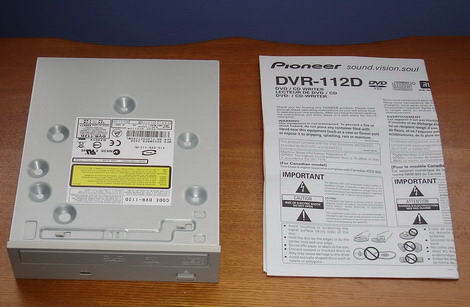
Our bulk package contained the DVR-112D drive and manual.
Now let’s take a look at the drive.
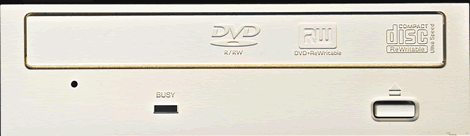
The bezel of the Pioneer DVR-112D is plainly styled. We can also see various logos, an emergency eject hole, single green LED and an eject button.

Drive top
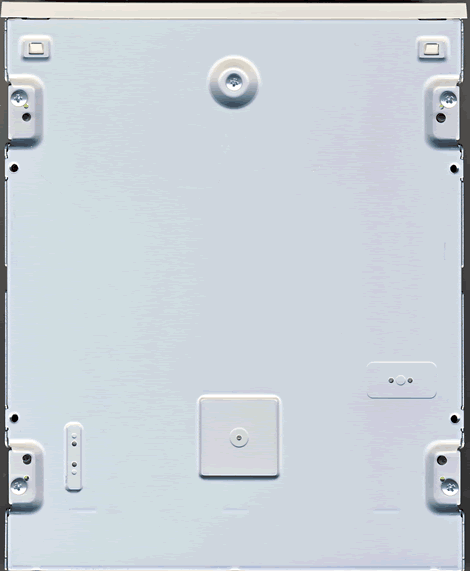
Drive bottom
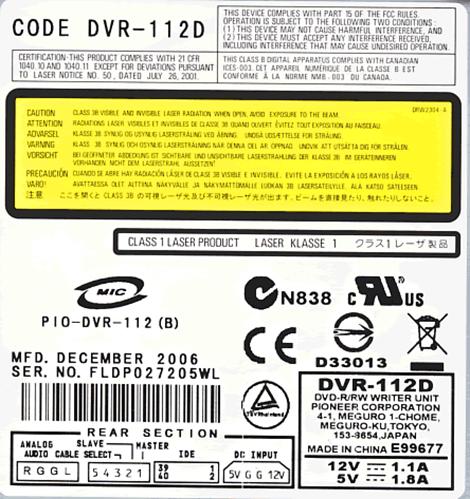
On the top of the drive we found one label and we can see the drive was manufactured in China during December 2006
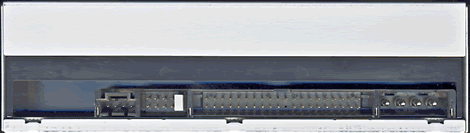
On the rear of the drive we can see from left to right, an audio connector, Master/Slave/CS jumpers, IDE connector and a power connector.
Now let’s head on to the next page were we can take a look at the features of the drive….
Test machine
For this review we will be using a computer with the following configuration:
Hardware:
- Motherboard: ASUSTeK P5W DH Deluxe (Intel Glendale DG I975x chipset)
- Processor: Intel Core 2 Duo E6600
- RAM: 2 GB OCZ Platinum dual channel kit DDR2 800
- GFX: BFG nVidia 8800GTS (640 Megabytes GDDR3)
- Sound: Onboard Realtek ALC882 HD audio controller
- Hard disk: 2X 250GB Seagate Barracuda (SATA 2)
System setup:
The Pioneer DVR-112D was connected to a Secondary Slave IDE channel.

From the screenshot from Nero InfoTool above, we can see the Pioneer DVR-112D supports DVD-RAM read but the drive does not support Mount Rainier. The drive came shipped with firmware version 1.09 and was updated to firmware version 1.15 when it became available.
Firmware update:

We had no problems updating the firmware from version 1.09 to 1.15
Installed software:
Our review PC has Windows Vista Home Premium 64 bit installed.
Features and techniques

The Pioneer DVR-112D is powered by an NEC MC-10041 chipset.

In the above screenshot we can see the internal PCB of the Pioneer DVR-112D.
Disc Quality Scanning:
The Pioneer DVR-112D can be used along with Nero CD-Speed for “Disc Quality Scanning”.

Disc Quality Scan at 8x scanning speed using CD-Speed.
BookType (Bitsetting):
The Pioneer DVR-112D supports automatic bit-setting, and is capable of writing DVD+R DL media with DVD-ROM book type. However, Bit-Setting of DVD+R/RW is not supported.
Here is how you could check if your discs are really written with DVD-ROM book type:
Start Nero CD-DVD Speed and click the Disc info button and you should get something like this:

DVD+R DL with book type DVD-ROM
Another quick test is to start Nero CD-Speed and look at the disc information:

Writing technique
Now it’s time to take a closer look at the write technology used by the Pioneer DVR-112D:
For these tests we used CD-Speed and wrote a full disc at the drives maximum speed.
CD Recordable:
According to the specifications of the Pioneer DVR-112D, it should be able to write CD-R media at a maximum speed of 40x.

The Pioneer DVR-112D uses CAV, (Constant Angular Velocity), to write at its maximum speed of 40X. This gives an average speed of 30.29x and a total writing time of 3 minutes and 15 seconds.
For comparison we have made the following table:
|
CD-R |
Supported |
Write |
Start |
End |
Average |
Write |
|
NEC |
48x |
CAV |
21.41x |
47.92x |
36.32x |
3m:02s |
|
Philips |
48x |
CAV |
21.33x |
48.06x |
35.53x |
3m:04s |
|
Samsung |
48x |
CAV |
21.88x |
48.36 |
37.21x |
2m:52s |
|
Samsung |
48x |
CAV |
21.94x |
48.24x |
37.30x |
2m:52s |
|
Samsung |
48x |
CAV |
21.82x |
48.52x |
37.21x |
3m:00s |
|
Pioneer |
40x |
CAV |
17.83x |
40.47xx |
30.27x |
3m:14s |
|
Pioneer |
40x |
CAV |
19.98x |
40.10x |
30.29x |
3m:15s |
As we can see, the Pioneer DVR-112D was the slowest compared to our other drives when writing CD-R media.
CD Re-writable:
According to the specifications of the Pioneer DVR-112D, it should be able to write CD-RW media at a maximum speed of 32x.

The Pioneer DVR-112D uses Z-CLV, (Zoned Constant Linear Velocity), to write at its maximum speed of 32X. This gives an average speed of 24.95x and a total writing time of 3 minutes and 59 seconds.
For comparison we have made the following table:
|
CD-RW |
Supported |
Write |
Start |
End |
Average |
Write |
|
NEC |
32x |
Z-CLV |
20.08x |
32.00x |
29.71x |
3m:11s |
|
Philips |
32x |
P-CAV |
21.37x |
32.16x |
29.77x |
3m:20s |
|
Samsung |
32x |
Z-CLV |
16.09x |
32.30x |
28.44x |
3m:35s |
|
Samsung |
32x |
Z-CLV |
16.01x |
32.02x |
28.28x |
3m:38s |
|
Samsung |
32x |
Z-CLV |
16.09x |
32.18x |
28.44x |
3m:27s |
|
Pioneer |
32x |
Z-CLV |
16.03x |
32.07x |
24.97x |
3m:45s |
|
Pioneer |
32x |
Z-CLV |
15.97x |
31.79x |
24.95x |
3m:59s |
As we can see, the Pioneer DVR-112D was a little slower compared to our other drives when writing CD-RW media.
18x DVD+R/-R writing speed:
According to the specifications of the Pioneer DVR-112D, it should be able to write DVD+R/-R media at a maximum speed of 18x.

DVD+R
The Pioneer DVR-112D uses CAV, (Constant Angular Velocity), to write at its maximum speed of 18X. This gives an average speed of 13.13x and a total writing time of 5 minutes and 13 seconds.

DVD-R
The Pioneer DVR-112D uses CAV, (Constant Angular Velocity), to write at its maximum speed of 18X. This gives an average speed of 13.08x and a total writing time of 5 minutes and 14 seconds.
For comparison we have made the following table:
|
16x |
Supported |
Write |
Start |
End |
Average |
Write |
|
Samsung |
18x +R |
CAV |
7.54x |
18.12x |
13.21x |
5m:34s |
|
Optiarc |
18x +R |
CAV |
7.53x |
18.02x |
13.26x |
5m:26s |
|
Plextor |
18x +R |
CAV |
7.23x |
18.00x |
12.41x |
5m:34s |
|
Samsung |
18x +R |
CAV |
7.62x |
18.24x |
13.46x |
5m:19s |
|
Pioneer |
18x +R |
CAV |
7.51x |
18.16x |
13.17x |
5m:11s |
|
Pioneer |
18x +R |
CAV |
7.45X |
17.82x |
13.13x |
5m:13s |
As we can see from our table, the Pioneer DVR-112D was one of the fastest drives when writing DVD±R media.
8X DVD+RW writing speed:
According to the specifications of the Pioneer DVR-112D, it should be able to write DVD+RW at a maximum speed of 8x.

The Pioneer DVR-112D uses Z-CLV, (Zoned Constant Linear Velocity), to write at its maximum speed of 8X. This gives an average speed of 7.84x and a total writing time of 7 minutes and 18 seconds.
For comparison we have made the following table:
|
DVD+RW |
Writing |
Average |
Writing |
|
Pioneer |
8x Z-CLV |
7.83x |
7m:26s |
|
Plextor |
8x P-CAV |
7.87x |
7m:15s |
|
Samsung |
8x Z-CLV |
6.96x |
9m:12s |
|
Pioneer |
8x Z-CLV |
7.83x |
7m:42s |
|
Pioneer |
8x Z-CLV |
7.84x |
7m:18s |
The Pioneer DVR-112D was above average at writing our test DVD+RW media.
6x DVD-RW writing speed:
According to the specifications of the Pioneer DVR-112D, it should be able to write DVD-RW at a maximum speed of 6x.

The Pioneer DVR-112D uses CLV, (Constant Linear Velocity), to write at its maximum speed of 6X. This gives an average speed of 6.01x and a total writing time of 9 minutes and 51 seconds.
For comparison we have made the following table:
|
DVD-RW |
Writing |
Average |
Writing |
|
Pioneer |
6x CLV |
6.01x |
9m:56s |
|
Plextor |
6x CLV |
6.03x |
10m:00s |
|
Samsung |
6x Z-CLV |
5.67x |
10m:44s |
|
Pioneer |
6x CLV |
6.02x |
9m:50s |
|
Pioneer |
6x CLV |
6.01x |
9m:51s |
The Pioneer DVR-112D was among the fastest drives when writing DVD-RW media.
10x DVD+R DL writing speed:
According to the specifications of the Pioneer DVR-112D, it should be able to write DVD+R DL at a maximum speed of 10x.

The Pioneer DVR-112D uses Z-CLV, (Zoned Constant Linear Velocity), to write at its maximum speed of 10X. This gives an average speed of 8.49x and a total writing time of 15 minutes and 16 seconds.
10x DVD-R DL writing speed:
According to the specifications of the Pioneer DVR-112D, it should be able to write DVD-R DL at a maximum speed of 10x.

The Pioneer DVR-112D uses Z-CLV, (Zoned Constant Linear Velocity), to write at its maximum speed of 10X. This gives an average speed of 8.50x and a total writing time of 15 minutes and 21 seconds.
For comparison we have made the following table:
|
DVD DL |
Size |
Writing |
Writing |
Book |
|
Plextor |
8152MB |
DVD+R DL 10x |
14m:14s |
DVD-ROM |
|
Pioneer |
8152MB |
DVD+R DL 8x |
17m:03s |
DVD-ROM |
|
Plextor |
8152MB |
DVD+R DL 10x |
13m:55s |
DVD-ROM |
|
Samsung |
8152MB |
DVD+R DL 8x |
19m:06s |
DVD-ROM |
|
Pioneer |
8152MB |
DVD+R DL 10x |
15m:07s |
DVD-ROM |
|
Pioneer |
8152MB |
DVD+R DL 10x |
15m:16s |
DVD-ROM |
The Pioneer DVR-112D was among the fastest drives when writing DVD+R DL and the fastest drive when writing DVD-R DL media.
Let’s head on to the next page where we will check reading performance….
Reading performance
For these tests we will use Nero CD/DVD-Speed to read various CD and DVD’s, including audio discs and DVD-media. As already mentioned in the introduction, this drive supports:
- DVD-ROM 16x
- CD-ROM 40x
Pressed discs:
For this test we used a pressed CD-ROM disc containing the Roxio Media Creator 7.5 install CD that is close to 75 minutes in length. Below you will see the produced result:

The Pioneer DVR-112D reached 41.45x read speed. Let’s compare it with some other drives below.
|
Pressed |
Average |
Start |
End |
Seek |
Seek |
Seek |
|
NEC |
34.71x |
20.01x |
45.97x |
135ms |
145ms |
222ms |
|
Philips |
35.70x |
20.13x |
47.29x |
106ms |
124ms |
176ms |
|
Samsung |
35.75x |
17.35x |
47.38x |
95ms |
95ms |
169ms |
|
Samsung |
35.58x |
19.75x |
47.10x |
99ms |
95ms |
169ms |
|
Samsung |
36.25x |
17.36x |
48.08x |
109ms |
115ms |
187ms |
|
Pioneer |
31.25x |
18.12x |
41.36x |
105ms |
122ms |
198ms |
|
Pioneer |
31.33x |
18.05x |
41.45x |
107ms |
129ms |
197ms |
The Pioneer DVR-112D proved to be below average at reading our test CD-ROM. Access and seek times were fairly good.
CD Recordable discs:
For this test we made a copy of the original Roxio Media Creator 7.5 install CD. The disc we used was a Ricoh 52X certified CD-R disc manufactured by Moser Baer India.

The Pioneer DVR-112D reached 40.92x read speed. Let’s compare it with some other drives below.
|
CD-R |
Average |
Start |
End |
Seek |
Seek |
Seek |
|
NEC |
35.53x |
20.67x |
46.77x |
187ms |
146ms |
218ms |
|
Philips |
36.54x |
20.94x |
48.27x |
104ms |
113ms |
169ms |
|
Samsung |
30.82x |
16.85x |
40.66x |
88ms |
90ms |
157ms |
|
Samsung |
30.65x |
17.28x |
40.52x |
92ms |
90ms |
162ms |
|
Samsung |
30.84x |
16.51x |
40.73x |
105ms |
108ms |
178ms |
|
Pioneer |
31.95x |
18.38x |
41.36x |
116ms |
132ms |
199ms |
|
Pioneer |
30.99x |
18.13x |
40.92x |
115ms |
122ms |
198ms |
The Pioneer DVR-112D performed about average with our CD-R test disc.
CD Re-writable discs:
Again, we made a copy of the original Roxio Media Creator 7.5 install CD; this time we used a Verbatim Ultra Speed (32X) CD-RW disc made by Mitsubishi Chemicals Corporation.

The Pioneer DVR-112D reached 32.88x read speed. Let’s compare it with some other drives below.
|
CD-RW |
Average |
Start |
End |
Seek |
Seek |
Seek |
|
NEC |
30.63x |
17.94x |
40.08x |
171ms |
166ms |
317ms |
|
Philips |
30.75x |
17.67x |
40.55x |
106ms |
115ms |
170ms |
|
Samsung |
30.84x |
17.52x |
40.68x |
87ms |
90ms |
159ms |
|
Samsung |
30.65x |
16.43x |
40.44x |
91ms |
90ms |
163ms |
|
Samsung |
31.17x |
16.75x |
41.15x |
102ms |
107ms |
176ms |
|
Pioneer |
24.96x |
14.61x |
32.94x |
117ms |
131ms |
205ms |
|
Pioneer |
24.91x |
14.57x |
32.88x |
117ms |
133ms |
207ms |
The Pioneer DVR-112D proved to be the slowest drive when reading CD-RW media.
100 minute CD-R:
The Pioneer DVR-112D reached 42.25x when reading our test 100 minute CD-R, the DVR-112D failed to complete the seek time tests ending with an error.
Audio – Digital Audio Extraction:
To test the digital audio extraction performance of the Pioneer DVR-112D, again we used Nero CD/DVD-Speed to measure the transfer rate. The audio disc we used is slightly larger than the disc used for the other tests, to be exact it’s nearly 79 minutes in length (78:53:31).

The Pioneer DVR-112D reached 42.31x when reading our test audio disc. Let’s compare it with some drives below.
|
Audio |
Average |
Start |
End |
Seek |
Seek |
Seek |
|
NEC |
31.30x |
17.89x |
40.13x |
122ms |
142ms |
222ms |
|
Philips |
37.42x |
20.09x |
49.65x |
107ms |
125ms |
173ms |
|
Samsung |
31.55x |
17.57x |
41.85x |
86ms |
101ms |
172ms |
|
Samsung |
31.39x |
17.68x |
41.61x |
88ms |
104ms |
181ms |
|
Samsung |
31.46x |
17.67x |
41.77x |
111ms |
128ms |
192ms |
|
Pioneer |
31.61X |
19.04X |
42.44X |
132ms |
152ma |
223mS |
|
DVR-112D |
31.56x |
19.01x |
42.31x |
136ms |
160ms |
223ms |
The Pioneer DVR-112D performed about average when reading our audio test CD.
DVD reading performance:
Again, we will use Nero CD-Speed to measure the reading performance, this time for various types of DVD discs. The drive should read pressed single layer DVD-discs at 16X.
Pressed DVD Video:
For our DVD reading performance tests we are going to start with a single and Double Layered DVD video discs. While only 1X speed is required to watch DVD movies, it’s useful to be able to read the discs at higher speeds if you’re going to extract (rip) the content of the disc to your hard drive.

DVD Video (single layer)

DVD Video (double layer OTP)

DVD Video (double layer PTP)
The Pioneer DVR-112D is not riplocked and read our single layer disc at 16x and our double layer test discs at 12x
|
DVD |
Average |
Start |
End |
Average |
Start |
End |
|
NEC |
11.83x |
6.56x |
15.77x |
8.89x |
4.94x |
11.82x |
|
Philips |
12.00x |
6.64x |
15.99x |
9.05x |
5.00x |
12.04x |
|
Samsung |
12.12x |
6.78x |
16.16x |
6.44x |
3.60x |
8.57x |
|
Samsung |
12.06x |
6.66x |
16.07x |
6.41x |
3.58x |
8.52x |
|
Samsung |
12.22x |
6.75x |
16.29x |
6.38x |
3.61x |
8.29x |
|
Pioneer |
11.99x |
6.74x |
16.03x |
9.36x |
5.31x |
12.44 |
|
Pioneer |
11.98x |
6.70x |
16.00x |
9.34x |
5.30x |
12.43x |
The Pioneer DVR-112D performed well in our single layer test and was among the fastest drives in our double layer read tests.
DVD – DVD+R/RW:
For this test we used a Verbatim 16X DVD+R and a RICOH 8X DVD+RW with about 4.4Gb of data. Below are the results:

DVD+R

DVD+RW
|
DVD+R |
Average |
Start |
End |
Average |
Start |
End |
|
NEC |
11.95x |
6.59x |
15.98x |
9.79x |
5.37x |
13.08x |
|
Philips |
9.38x |
5.13x |
12.53x |
9.38x |
5.13x |
12.54x |
|
Samsung |
9.15x |
5.03x |
12.22x |
6.24x |
3.45x |
8.34x |
|
Samsung |
9.09x |
5.02x |
12.16x |
6.21x |
3.43x |
8.29x |
|
Samsung |
9.12x |
5.00x |
12.06x |
6.23x |
3.43x |
8.33x |
|
Pioneer |
9.36x |
5.19x |
12.23x |
6.25x |
3.47x |
8.35x |
|
Pioneer |
9.32x |
5.14x |
12.48x |
6.23x |
3.46x |
8.33x |
The Pioneer DVR-112D performed about average when reading our test DVD+R/RW test discs. Now let’s see how it will perform with DVD-R/RW.
DVD – DVD-R/RW:
For this test we used a Verbatim 16X DVD-R disc and a Verbatim 6X DVD-RW disc filled with about 4.4Gb of data. Our test results are found below:

DVD-R

DVD-RW
There are hardly any differences in the speed, compared to reading the DVD+R/RW discs.
|
DVD-R |
Average |
Start |
End |
Average |
Start |
End |
|
NEC |
11.98x |
6.56x |
15.98x |
9.78x |
5.37x |
13.07x |
|
Philips |
9.37x |
5.13x |
12.53x |
9.38x |
5.13x |
12.53x |
|
Samsung |
9.18x |
5.08x |
12.26x |
6.24x |
3.44x |
8.34x |
|
Samsung |
9.12x |
5.05x |
12.19x |
6.22x |
3.43x |
8.31x |
|
Samsung |
9.14x |
5.03x |
12.21x |
6.24x |
3.44x |
8.34x |
|
Pioneer |
9.36x |
5.18x |
12.52x |
6.23x |
3.46x |
8.33x |
|
Pioneer |
9.34x |
5.17x |
12.48x |
6.21x |
3.45x |
8.31x |
Once again the Pioneer DVR-112D performed about average when reading our DVD-R/RW test discs.
DVD±R DL discs:
DVD+R DL:

The Pioneer DVR-112D read our DVD+R DL test disc at 8x reading speed.
DVD-R DL:

The Pioneer DVR-112D read our DVD-R DL test disc at 8x reading speed.
DVD-RAM:

The Pioneer DVR-112D read our DVD-RAM disc at 5x using a CLV reading method.
Summary:
The Pioneer DVR-112D proved to be a reliable reader and had little or no problems reading all our test discs. The Pioneer DVR-112D however was not the fastest reader we have reviewed.
Now let’s head over to the next page where we will test CD-R/RW writing performance……
The specifications of the Pioneer DVR-112D state that the drive is able to write CD-R discs at 40x and CD-RW at 32x. Let us find out how the drive really performs in speed and quality.
Writing Data CD-R discs:
Write quality:
We will test CD-R discs from many different CD-R manufacturers. To really measure the write speed, we used the “create data CD” function in Nero CD-Speed. The discs were written at the maximum speed that the drive supports. For the quality test, we used K-Probe 2 which is a tool developed by a Lite-On employee. It runs under Windows and works with drives made by Lite-On. Also note that different drives and different reading speeds may affect the results obtained when scanning the discs. We used a Lite-On SOHR-5238S drive with firmware 4S09 and scanned the discs at 48X speed.
A written CD-R disc will always have some C1 errors; C1 errors are easily corrected by the drive’s error correction capabilities. The next level of errors is C2, while C2 errors could also be corrected by most drive’s error correction capabilities; they are not wanted on a good quality disc. A good disc should not contain any C2 errors, and preferably have an average C1 error amount of below 2.0 for the best discs, or at least below 10.0 averages for good quality discs. After C2 errors, there are only un-correctable errors that will make a disc unusable.
Below are the obtained results:


|
Brand: |
Unbranded Printable. Thanks to SVP UK for sending us this media |
|
Manufacturer: |
Taiyo Yuden |
|
Code: |
97m24s01f |
|
Disc Type: |
CD-R |
|
Recording Layer: |
Dye Type 1: Long Strategy (Cyanine, AZO) |
|
Capacity: |
79:59.72 (703MB) |
|
Certified Speed: |
48x |
|
Write Speed: |
40x (CAV) |
|
Write Time: |
3m:13s |
|
C1 Average/Sec: |
0.21 |
|
C2 Average/Sec: |
0.0 |
An excellent result to start our CD-R quality tests, (highly recommended).


|
Brand: |
Verbatim Super AZ0+Crystal DL – Thanks to Verbatim UK for sending us this media. |
|
Manufacturer: |
Mitsubishi Chemicals Corporation |
|
Code: |
97m34s23f |
|
Disc Type: |
CD-R |
|
Recording Layer: |
Dye Type 3: Long Strategy (Cyanine, AZO) |
|
Capacity: |
79:59.70 (703MB) |
|
Certified Speed: |
52x |
|
Write Speed: |
40x (CAV) |
|
Write Time: |
3m:15s |
|
C1 Average/Sec: |
1.99 |
|
C2 Average/Sec: |
0.0 |
The write quality on the Verbatim 52x media is very good.


|
Brand: |
RICOH – Thanks to RICOH Europe (BV) for sending us this media. |
|
Manufacturer: |
Moser Baer India Limited |
|
Code: |
97m17s06f |
|
Disc Type: |
CD-R |
|
Recording Layer: |
Dye Type 6: Short Strategy (Phthalocyanine) |
|
Capacity: |
79:59.74 (703MB) |
|
Certified Speed: |
1x-52x |
|
Write Speed: |
40x (CAV) |
|
Write Time: |
3m:14s |
|
C1 Average/Sec: |
1.79 |
|
C2 Average/Sec: |
0.0 |
Our RICOH media manufactured by Moser Baer India has burned with very good quality.


|
Brand: |
BenQ – Thanks to Daxon (Taiwan) for sending us this media. |
|
Manufacturer: |
Daxon |
|
Code: |
97m22s67f |
|
Disc Type: |
CD-R |
|
Recording Layer: |
Dye Type 7: Short Strategy (Phthalocyanine) |
|
Capacity: |
79:59.70 (703MB) |
|
Certified Speed: |
48x |
|
Write Speed: |
40x (CAV) |
|
Write Time: |
3m:13s |
|
C1 Average/Sec: |
0.38 |
|
C2 Average/Sec: |
0.0 |
Once again we have an excellent result, (highly recommended).


|
Brand: |
Infiniti Printable – Thanks to Medea |
|
Manufacturer: |
SKC |
|
Code: |
97m26s26f |
|
Disc Type: |
CD-R |
|
Recording Layer: |
Dye Type 6: Short Strategy (Phthalocyanine) |
|
Capacity: |
79:59.09 (703 MB) |
|
Certified Speed: |
52x |
|
Write Speed: |
40x (CAV) |
|
Write Time: |
3m:17s |
|
C1 Average/Sec: |
1.06 |
|
C2 Average/Sec: |
0.0 |
Another excellent result.
Writing Quality with Re-Writable discs:


|
Brand: |
Verbatim Ultra speed 32x – Thanks to Verbatim UK for sending us this media. |
|
Manufacturer: |
Mitsubishi Chemicals Corporation |
|
Code: |
97m34s25f |
|
Disc Type: |
Ultra Speed CD-RW 32x |
|
Recording Layer: |
Phase Change |
|
Capacity: |
79:59.74 (703MB) |
|
Certified Speed: |
32x |
|
Write Speed: |
32x (Z-CLV) |
|
Write Time: |
3m:59s |
|
C1 Average/Sec: |
8.21 |
|
C2 Average/Sec: |
0.00 |
The result is good.
Summary:
CD-R writing quality and media compatibility is very good with the Pioneer DVR-112D and CD-RW writing quality is good.
Now let’s head on to the next page where we will test DVD recordable performance….
The specifications of this drive tell us that it should write DVD±R at 18x and DVD+RW/-RW at 8x/6x. In this part, we will measure the writing times for various types of DVD+R/RW and DVD-R/RW discs. We will also focus on write quality and media compatibility.
DVD-Writing performance:
Write quality:
You should first notice that this is not a scientific and professional way to test the discs. But according to our testing done in recent months, we would conclude that there is a clear link between the quality reported when scanning the disc and the playability of the disc in different devices. Also notice that different drives report different amounts of errors. K-Probe was designed to work with Lite-On DVD-Writers, so we recommend using a DVD-Writer from Lite-On. In this test we use a Lite-On SHM-165P6S DVD-Writer, as already said; remember that scans done with a Lite-On DVD-ROM or Lite-On combo drive can’t be compared with the results obtained with a Lite-On DVD-Writer. Also remember that different PI/PO ECC sum settings along with different reading speeds in K-Probe will affect the result, we use these settings; PI (Parity Inner) set to summarize 8 ECC blocks, PIF (Parity Inner Failures) set to summarize 1 ECC block, reading speed: 4X CLV (Constant Linear Velocity). Setting the PI sum to 8 and the PIF sum to 1 will give a result that we may compare to the standards for DVD+R/RW and DVD-R/RW.
But what is a good scan? That is a discussion that we don’t think will end soon, as different drives report different amount of errors, some players are more picky about media than others, and so on. But as a comparison we present you with a scan from two pressed DVD discs:

This scan shows the results from a pressed DVD-Video disc (GoldenEye).

This scan shows the result from a pressed DVD-Video disk (The Green Mile). Notice the error jump when shifting to the second layer (the error level actually drops from the end of the first layer to the beginning of the second layer).
If you read below, you will see that both the pressed DVD-discs are well within the standards.
Download the ECMA 267 Standard for DVD-ROM, the ECMA 337 Standard for DVD+R/RW and the ECMA 338 Standard for DVD-R/RW at http://www.ecma-international.org if you want to look at the standards for yourself. Here is some data from the ECMA standards (same for DVD-ROM, DVD-R/RW and DVD+R/RW):
Random errors:
A row of an ECC Block that has at least 1 byte in error constitutes a PI error. In any 8
consecutive ECC Blocks the total number of PI errors before correction shall not exceed 280.
Here we see that a PI error is defined as a row in an ECC block having 1 byte or more containing errors and that the sum of PI errors in 8 ECC blocks after each other should not exceed 280 PI errors.
But what is a row and what is an ECC block? Again we refer to the ECMA standards. We do not copy and paste everything, but if you’re interested, look in the ECMA standards. A row is 182 bytes long where the last 10 bytes contain PI (Parity Inner) information. An ECC block is 208 rows long where the last 16 rows contain the PO (Parity Outer) information. This gives us a maximum possible PI error amount of 208 errors per block and for 8 blocks after each other this sum is of course 8 times higher, giving a maximum possible amount of 1664 PI-8 errors. In practical use, a disc with 1664 PI-8 errors is unreadable.
According to our tests the specified max PI-8 sum of 280 for good discs seems to be a good guideline, as some readers have problems reading discs when the PI-8 errors is over 300 and most players starts to have problems when the PI-8 error level reaches 600 or more.
But what are the PIF errors that K-Probe reports? They are Parity Inner Failures, meaning errors left after PI correction. Only the ECMA 337 standard describes the Parity Inner Failures. So how is a Parity Inner Failure defined? Here is what the ECMA 337 states:
“If a row of an ECC Block as defined in 13.3 contains more than 5 erroneous bytes, the row is said to be “PI-un-correctable”.”
In theory, an ECC block may in the worst-case have 208 PIF since every ECC block is 208 rows long. But the ECMA 337 standard goes further and specifies the max amount of accepted PI Failures (un-correctable errors) allowed on a good disc:
“In any ECC Block the number of PI-un-correctable rows should not exceed 4.”
This means that when the PIF sum is set to 1, the maximum error value should not exceed 4. The theoretical maximum value for PIF is 208 errors.
But what makes a disc unreadable? A POF (Parity Outer Failure) error will make the disc unreadable, but K-Probe does not display the POF’s.
Notice that there are other aspects such as disc reflectivity, jitter, tracking errors and so on that also will affect the readability of a DVD disc – but for this we do not have measuring equipment available.
Also, another note is that we have scanned the discs at 4X CLV speed, by lowering the speed to 2X(DVD-R/RW)/2.4X(DVD+R/RW) or 1X the amount of reported errors may drop on some discs. We scanned at 4X CLV due to lower speeds taking too much time.
To see if there is a connection between the reported amount of errors and readability of the discs we also include the reading curve from a Optiarc AD-7173A DVD-Writer. The reason why we have changed the reader is that some companies disliked that we used a modified firmware to obtain 16x reading speed. So to please them, we are now using a drive that reads DVD+R/-R media at 16x as default. A small speed reduction near the end is still accepted on good discs, but serious reading problems or reading failures is a bad sign.
Easier explanation on how to read the test results.
Maybe this got too technical, and you are wondering what to look for in KProbe reports?
Use this as a guideline for good discs:
- PI (Parity Inner): No larger areas on the disc should exceed 280 PI-8 errors, do not worry too much about high single spikes that exceed 280.
- PIF (Parity Inner Failures): No larger areas on the disc should exceed 4 PIF-1 errors, do not worry too much about high single spikes that exceed 4.
And as always; lower is better 
And look at the reading curve; if it looks clean with no dips it should be good, a small slowdown near the end is accepted.
DVD+R media compatibility and write quality:
In these tests we will be using a Lite-On LH-20A1P with firmware KL05 along with K-Probe to measure the disc quality. We will also be using the Optiarc AD-7173A with firmware 1-02 along with CD-Speed for our read-back tests.


|
Brand: |
BenQ – Thanks to Daxon |
|
Manufacturer: |
Daxon Inc. |
|
Code: |
DAXON AZ3 |
|
Disc Type: |
DVD+R |
|
Capacity: |
4483MB |
|
Certified Speed: |
16x |
|
Write Speed: |
12x (Z-CLV) |
|
Write Time: |
7m:03s |
|
PI-8 errors Average/Sec: |
1.44 |
|
PI-1 failures (PIF) Avg/Sec: |
0.01 |
The result is excellent but the disc was written at 12x.


|
Brand: |
TDK |
|
Manufacturer: |
TDK Corporation |
|
Code: |
TDK003 |
|
Disc Type: |
DVD+R |
|
Capacity: |
4483MB |
|
Certified Speed: |
16x |
|
Write Speed: |
16x CAV |
|
Write Time: |
5m:46s |
|
PI-8 errors Average/Sec: |
1.01 |
|
PI-1 failures (PIF) Avg/Sec: |
0.09 |
The result is very good.


|
Brand: |
Verbatim – Thanks to Verbatim (UK) for sending us this media. |
|
Manufacturer: |
Mitsubishi Chemicals Corporation |
|
Code: |
MCC 004 |
|
Disc Type: |
DVD+R |
|
Capacity: |
4483MB |
|
Certified Speed: |
16x |
|
Write Speed: |
18x (CAV) |
|
Write Time: |
5m:13s |
|
PI-8 errors Average/Sec: |
0.74 |
|
PI-1 failures (PIF) Avg/Sec: |
0.06 |
A good result and the disc were written at faster than its rated speed.


|
Brand: |
Plextor – Thanks to Plextor for sending us this media |
|
Manufacturer: |
Taiyo Yuden |
|
Code: |
YUDEN000T03 |
|
Disc Type: |
DVD+R |
|
Capacity: |
4483MB |
|
Certified Speed: |
16x |
|
Write Speed: |
18x (CAV) |
|
Write Time: |
5m:14s |
|
PI-8 errors Average/Sec: |
0.99 |
|
PI-1 failures (PIF) Avg/Sec: |
0.02 |
The result is very good considering this disc was burned faster than its rated speed.


|
Brand: |
Verbatim – Thanks to SVP UK for sending us this media |
|
Manufacturer: |
Taiyo Yuden |
|
Code: |
YUDEN000T02 |
|
Disc Type: |
DVD+R |
|
Capacity: |
4483MB |
|
Certified Speed: |
8x |
|
Write Speed: |
12x (Z-CLV) |
|
Write Time: |
7m:06s |
|
PI-8 errors Average/Sec: |
0.66 |
|
PI-1 failures (PIF) Avg/Sec: |
0.01 |
No surprises here, an excellent result from the Verbatim 8x media manufactured by Taiyo Yuden, all the more so as this disc was written faster than its rated speed.


|
Brand: |
Sony |
|
Manufacturer: |
Sony |
|
Code: |
SONY D21 |
|
Disc Type: |
DVD+R |
|
Capacity: |
4483MB |
|
Certified Speed: |
16x |
|
Write Speed: |
18x (CAV) |
|
Write Time: |
5m:15s |
|
PI-8 errors Average/Sec: |
1.11 |
|
PI-1 failures (PIF) Avg/Sec: |
0.08 |
Once again we have another good result and the disc was written at faster than its rated speed.
DVD+RW media compatibility and write quality:
We used the same test procedures as in our DVD+R tests.
Below are our obtained results.


|
Brand: |
Verbatim |
|
Manufacturer: |
Mitsubishi Chemicals |
|
Code: |
MKM A03 |
|
Disc Type: |
DVD+RW |
|
Capacity: |
4483MB |
|
Certified Speed: |
8x |
|
Write Speed: |
8x (Z-CLV) |
|
Write Time: |
7m:18s |
|
PI-8 errors Average/Sec: |
1.37 |
|
PI-1 failures (PIF) Avg/Sec: |
0.00 |
The result is excellent.
Summary:
The Pioneer DVR-112D writes DVD+R/RW with excellent/very good quality and is able to burn selected media at higher than its rated speed. In contrast, it also writes selected media at lower than its rated speed.
Now let’s look at DVD-R/RW performance and quality on the next page…..
DVD-R media compatibility and write quality:
In these tests we will be using a Lite-On LH-20A1P with firmware KL05 along with K-Probe to measure the disc quality. We will also be using the Optiarc AD-7173A with firmware 1-02 along with CD-Speed for our read-back tests.


|
Brand: |
Taiyo Yuden unbranded – Thanks to SVP (UK) for sending us this media. |
|
Manufacturer: |
Taiyo Yuden |
|
Code: |
TYG03 |
|
Disc Type: |
DVD-R |
|
Capacity: |
4483MB |
|
Certified Speed: |
16x |
|
Write Speed: |
18x (CAV) |
|
Write Time: |
5m:18s |
|
PI-8 errors Average/Sec: |
1.22 |
|
PI-1 failures (PIF) Avg/Sec: |
0.02 |
The result is excellent and the media was burned at higher than its rated speed.


|
Brand: |
Verbatim – Thanks to Verbatim (UK) for providing this media. |
|
Manufacturer: |
Mitsubishi Chemical Corporation |
|
Code: |
MCC 03RG20 |
|
Disc Type: |
DVD-R |
|
Capacity: |
4483MB |
|
Certified Speed: |
16x |
|
Write Speed: |
18x (CAV) |
|
Write Time: |
5m:19s |
|
PI-8 errors Average/Sec: |
2.55 |
|
PI-1 failures (PIF) Avg/Sec: |
0.06 |
Again the result is good and the media was burned faster than its rated speed.


|
Brand: |
Ricoh – Thanks to Ricoh Europe for sending us this media. |
|
Manufacturer: |
CMC Magnetics |
|
Code: |
CMC MAG AM3 |
|
Disc Type: |
DVD-R |
|
Capacity: |
4483MB |
|
Certified Speed: |
16x |
|
Write Speed: |
16x (CAV) |
|
Write Time: |
5m:47s |
|
PI-8 errors Average/Sec: |
2.75 |
|
PI-1 failures (PIF) Avg/Sec: |
0.07 |
The result is good.


|
Brand: |
TDK |
|
Manufacturer: |
TDK |
|
Code: |
TTH02 |
|
Disc Type: |
DVD-R |
|
Capacity: |
4483MB |
|
Certified Speed: |
16x |
|
Write Speed: |
16x (CAV) |
|
Write Time: |
5m:44s |
|
PI-8 errors Average/Sec: |
3.84 |
|
PI-1 failures (PIF) Avg/Sec: |
0.04 |
The result is very good.


|
Brand: |
BenQ – Thanks to Daxon (Taiwan) for sending us this media |
|
Manufacturer: |
Daxon Inc. |
|
Code: |
DAXON 016S |
|
Disc Type: |
DVD-R |
|
Capacity: |
4483MB |
|
Certified Speed: |
16x |
|
Write Speed: |
16x (CAV) |
|
Write Time: |
5m:44s |
|
PI-8 errors Average/Sec: |
5.72 |
|
PI-1 failures (PIF) Avg/Sec: |
0.08 |
The result is good.


|
Brand: |
Taiyo Yuden unbranded – Thanks to SVP (UK) for sending us this media. |
|
Manufacturer: |
Taiyo Yuden |
|
Code: |
TYG02 |
|
Disc Type: |
DVD-R |
|
Capacity: |
4483MB |
|
Certified Speed: |
8x |
|
Write Speed: |
12x (Z-CLV) |
|
Write Time: |
7m:01s |
|
PI-8 errors Average/Sec: |
3.08 |
|
PI-1 failures (PIF) Avg/Sec: |
0.01 |
Once again the result is very good and the disc was burned at higher than its rated speed.
DVD-RW media compatibility and write quality:
For this test we used the same testing procedures as in our DVD-R tests.


|
Brand: |
Verbatim – Thanks to Verbatim (UK) for sending us this media. |
|
Manufacturer: |
Mitsubishi Chemical Corporation |
|
Code: |
MKM01RW6X01 |
|
Disc Type: |
DVD-RW |
|
Capacity: |
4483MB |
|
Certified Speed: |
6x |
|
Write Speed: |
6x (Z-CLV) |
|
Write Time: |
9m:51s |
|
PI-8 errors Average/Sec: |
2.31 |
|
PI-1 failures (PIF) Avg/Sec: |
0.01 |
The result is excellent.
Summary:
The Pioneer DVR-112D has written our DVD-R media with excellent/good quality and wrote selected media at faster than its rated speed.
Let’s head on to the next page where we will test DVD R DL writing performance and quality……
DVD+R/-R Double Layer writing performance and quality:
The Pioneer DVR-112D supports the DVD+R DL/-R DL standard for writing Double Layer/Dual Layer discs with a size around 8.5 GB at a writing speed of 10x.
For these tests we pre-authored several video clips into an image file and burned the resulting image in Nero Burning Rom. We then used the Lite-On LH-20A1P along with KProbe to test the discs quality; we then finally ran a read-back test on our Optiarc AD-7173A using Nero CD-Speed.
DVD+R DL:


|
Brand: |
Verbatim – Thanks to Verbatim (UK) |
|
Manufacturer: |
Mitsubishi Kagaku Media |
|
Code: |
MKM 003 |
|
Disc Type: |
DVD+R DL |
|
Capacity: |
8103MB |
|
Certified Speed: |
8x |
|
Write Speed: |
10x (Z-CLV) |
|
Write Time: |
15m:16s |
|
PI-8 errors Average/Sec: |
2.18 |
|
PI-1 failures (PIF) Avg/Sec: |
0.08 |
|
BookType |
DVD-ROM |
The Pioneer DVR-112D burned our 8x rated Verbatim media in 15 minutes and 16 seconds. Quality could be better, there is a large cluster of errors at the layer break and reading problems on the first layer of the disc
DVD-R DL:


|
Brand: |
Verbatim – Thanks to Verbatim (UK) |
|
Manufacturer: |
Mitsubishi Kagaku Media |
|
Code: |
MKM 03RD30 |
|
Disc Type: |
DVD-R DL |
|
Capacity: |
8103MB |
|
Certified Speed: |
8x |
|
Write Speed: |
10x (Z-CLV) |
|
Write Time: |
15m:21s |
|
PI-8 errors Average/Sec: |
3.63 |
|
PI-1 failures (PIF) Avg/Sec: |
0.00 (note 1 PIF spike removed for clarity) |
|
BookType |
DVD-R |
The Pioneer DVR-112D burned our Verbatim 8x media in 15 minutes and 21 seconds, with very good writing quality. The media was also burned faster than its rated speed.
Summary:
The Pioneer DVR-112D burned our test DVD+DL faster than its rated speed, but there were some problems with the quality. DVD-R DL quality was very good and the Pioneer DVR-112D wrote the disc at faster than its rated speed.
This concludes our Pioneer DVR-112D review. To read the conclusion, click on the link below....
Positive:
- Excellent/very good CD-R/RW writing quality and compatibility.
- Excellent/very good DVD±R/RW writing quality.
- Excellent/Very good DVD-R DL writing quality and media compatibility.
- Can burn selected DVD±R/DL media faster than its rated speed.
- Reads pressed DVD Video SL/DL at 16x/12x
- Supports BitSetting (BookType DVD-ROM) on DVD+R DL.
- Supports Disc Quality Scanning with CD-Speed.
Negative:
- Some problems with writing quality with our tested DVD+R DL media
- Can only read DVD±R/RW media at 12x/8x.
- Doesn’t support BitSetting for DVD+R/RW
- Single coloured LED for read/write.
- Some DVD+R media was written slower than its rated speed.
Conclusion:
Let us summarize the most important positive and negative points below:
 The Pioneer DVR-112D is one of the fastest drive’s we have tested here on CD Freaks as far as writing DVD media is concerned.
The Pioneer DVR-112D was able to burn all our tested CD-R/RW media with excellent/very good quality and media compatibility was also very good.
DVD±R/RW writing quality was also of a very high standard and on most media very good/excellent, The Pioneer DVR-112D was also able to burn selected DVD±R media at faster than its rated speed, and overall burning performance with DVD±R media was very good indeed. Recording some of the fastest write times we have seen.
There are not many negative things to say about the Pioneer DVR-112D. The drive is not the fastest reader in the world for recordable media, but during our reading tests it did prove reliable.
The Pioneer DVR-112D burned some DVD+R media at lower than its rated speed with Pioneer preferring good writing quality before outright burning speed.
We would also like to see different coloured LED’s being used for read/write.
To sum up, this is what we would say:
“The Pioneer DVR-112D is fast and burns most media with very good quality”.
You may comment on this review below or in this forum thread.
Thanks to:
 |
Plextor SA/NV (B) for providing the Plextor media used in this review. |
 |
Medea International – United Kingdom for providing the media used in this review. |
 |
Ricoh Europe – For providing the media used in this review. |
 |
SVP Communication – The United Kingdom for providing the media used in this review. |
 |
Verbatim - United Kingdom for providing the media used in this review. |
 |
Daxon Technology Inc – Taiwan for providing the BenQ media used in this article. |