
 |
Review: Pioneer DVR-116DBK |
Pioneer was kind enough to send us the DVR-116DBK for review. In this review we will be seeing how this drive from one the world's best known high quality electronics manufacturers performs in our tests.
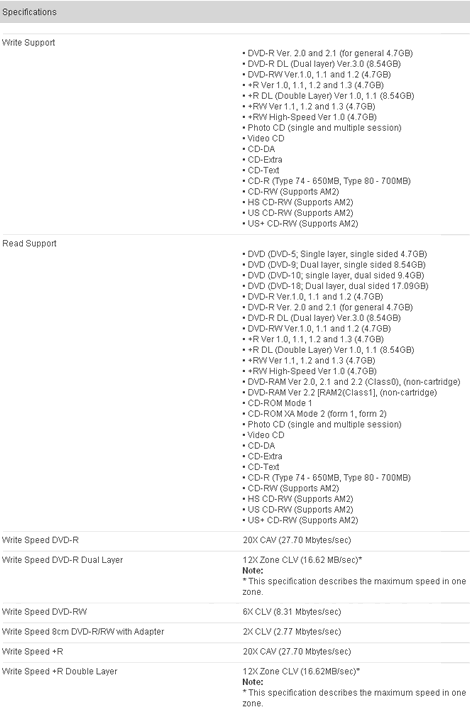
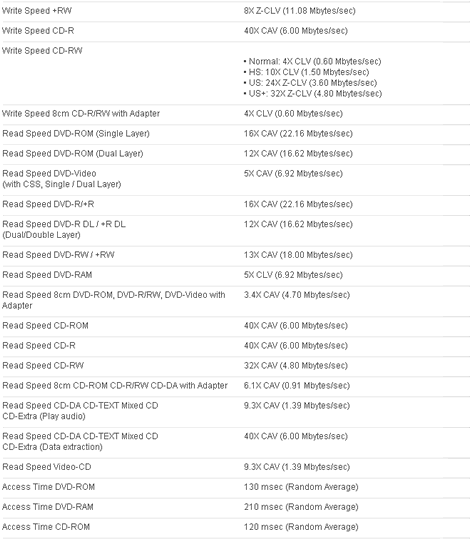
The Pioneer DVR-116DBK supports 20x DVD±R, 8x/6x DVD+RW/-RW, and 12x DVD+R/DL-R DL writing technology, allowing Double/Dual Layer discs of 8.5Gb to be written.
Company Information
We are sure that most of you know Pioneer already, but let us take a look at some of the company information found at: http://www.pioneer.eu/
Pioneer Corporation is a global leader in electronics and audio/video products for the home, car, commerce and industry, particularly in the following core multimedia technologies – digital versatile disc (DVD), plasma display panels (PDP) and in-car navigation and A/V systems.
Founded in 1938 as a manufacturer of audio products and headquartered in Tokyo, Japan, Pioneer has more than 39,000 employees worldwide. Its shares are traded on the Tokyo Stock Exchange.
The company’s track record for developing class-leading technologies has consistently attracted industry acclaim. And its continued focus on innovation remains at the heart of its drive to shape the future of its core consumer electronics markets.
Pioneer world firsts include:
- Separate stereo system, 1962
- Component car stereo, 1975
- GPS car navigation, 1990
- DVD/LD/CD compatible player, 1996
- Plasma display technology, 1997
- DVD recorder compatible with DVD-RW, 1999
- DVD player for professional DJs and VJs, 2004
Pioneer is focused on four key business objectives to be achieved by 2006:
To be the global leader in the DVD industry
To build firm foundations for next generation displays
To develop and strengthen its network-related product line
To expand into key devices and key technology businesses

Sound. Vision. Soul
Pioneer’s ethos of ‘Sound.Vision.Soul’ is at the heart of every aspect of its business. With the world of entertainment developing faster than ever, Pioneer’s aim is to provide visionary products with the ultimate in sound and audio performance, combined with convenience and flexibility to encompass the soul quality of its business and provide the definitive entertainment experience.
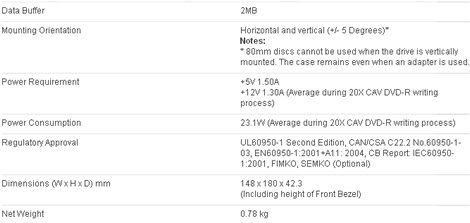
Drive Specifications
What’s inside the box
Now it’s time to take a look at the drive itself and what the drive came shipped with.
Our package was the bulk version.
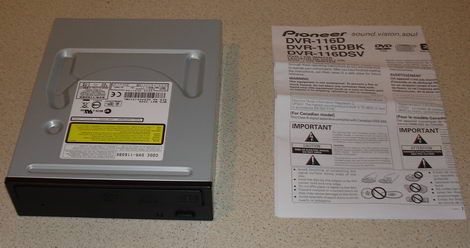
The package contained the Pioneer DVR-116DBK and instruction manual.
Now let’s take a look at the drive.
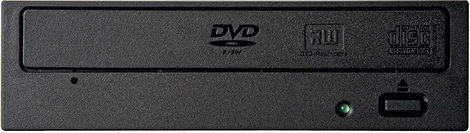
The bezel of the Pioneer DVR-116DBK is plainly styled. We can also see various logos, an emergency eject hole, single green LED and an eject button.
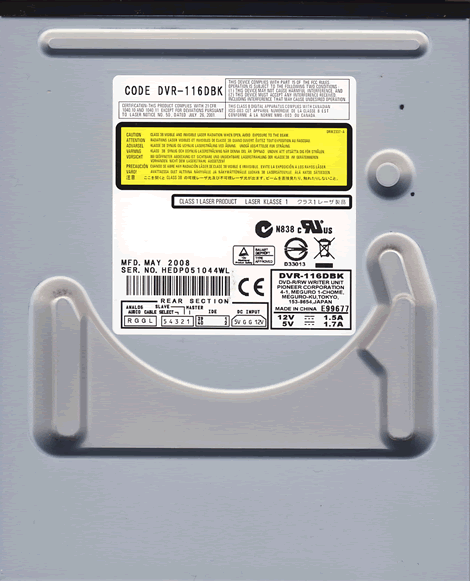
Drive top
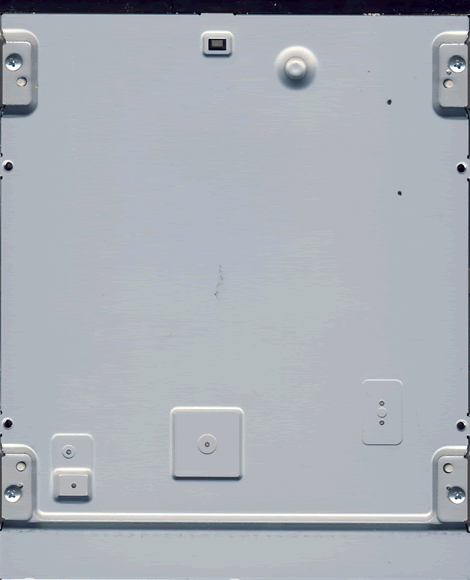
Drive bottom
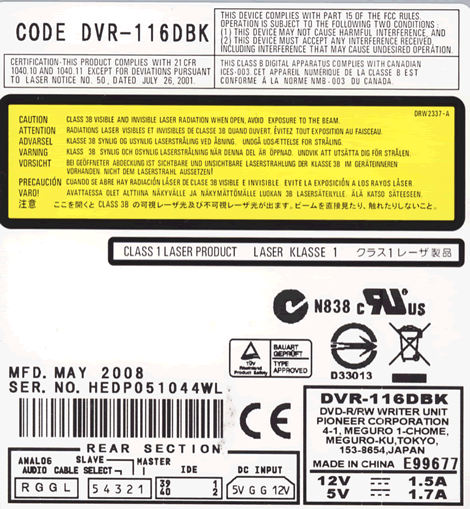
On the top of the drive we found one label and we can see the drive was manufactured in China during May 2008.
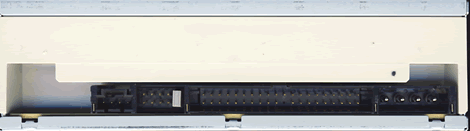
On the rear of the drive we can see an audio connector, jumpers for cable select, master, slave, an IDE connector and power connector.
Now let’s head on to the next page were we can take a look at the features of the drive….
Test machine
For this review we will be using a computer with the following configuration:
Hardware:
- Motherboard: ASUSTeK P5K (Intel P35 chipset)
- Processor: Intel Core 2 Quad Q6600
- RAM: 4 GB OCZ Platinum dual channel kit DDR2 800
- GFX: ATI HD 4870 (512 Megabytes GDDR5 HDCP compliant)
- Sound: Onboard Realtek ALC882 HD audio controller
- Hard disk: 2X 500GB Seagate Barracuda 7200.10 (SATA 2)
- Case: ThermalTake Armor (silver)
- PSU: Enermax Liberty 620W
- Display: Samsung Syncmaster 245B 24” widescreen LCD (HDCP compliant)
- Operating System: Windows Vista Home Premium (64 bit) with Service Pack 1
System setup:

The Pioneer DVR-116DBK was connected to the master channel on the main boards JMicron’s PATA controller.
And another screenshot from Nero InfoTool:

From the screenshot from Nero InfoTool above, we can see the Pioneer DVR-116DBK supports DVD-RAM read, but not write. The drive came shipped with firmware version 1.06.
Drive internals:
Now let’s take a look at the Pioneer DVR-116DBK internal layout.

Internal PCB and drive mechanism

We can see the Pioneer DVR-116DBK is powered by an NEC chipset, although the revision number proved nearly impossible to read, we are pretty sure the chipset is the NEC MC-10043B chipset.
Installed software:
For conducting our various tests, we will be using the following applications.
Our review PC has Windows Vista Home Premium 64 bit installed with Service Pack 1.
Features and techniques
Pioneer Drive Utility
Pioneer has produced a utility aimed at making sure you get a good quality burn on any media. This utility seems to achieve this by slowing down the burning speed automatically. Below is a screenshot of the utility.

Drive Utility
Simply clicking on the “enable” radio button and, then ticking the “Saves optimal writing speed setting to drive” and then clicking on “Apply” will save this setting to the drive. It can be disabled later on by using the utility once more.
We tested the feature on one disc, a Verbatim MCC004. The burning speed was reduced to 6x. The result is below.

The writing quality is excellent, but 6x is rather slow for this media.
BookType (Bitsetting):
The Pioneer DVR-116DBK supports automatic bit-setting and supports Bit-Setting on DVD+R DL media via burning applications such as Nero Burning Rom.
Here is how you could check if your discs are really written with DVD-ROM book type:
Start Nero CD-DVD Speed and click the Disc info button and you should get something like this:

DVD+R DL with BookType DVD-ROM
Another quick test is to start Nero CD-Speed and look at the disc information:

Writing technique
Now it’s time to take a closer look at the write technology used by the Pioneer DVR-116DBK:
For these tests we used CD-Speed and wrote a full disc at the drives maximum speed.
CD Recordable:
According to the specifications of the Pioneer DVR-116DBK, it should be able to write CD-R media at a maximum speed of 40x.

The Pioneer DVR-116DBK uses CAV, (Constant Angular Velocity), to write at its maximum speed of 40X. This gives an average speed of 30.19x and a total writing time of 3 minutes and 19 seconds.
For comparison we have made the following table:

As we can see, the Pioneer DVR-116DBK was one of the slowest drives when writing CD-R media.
CD Re-writable:
According to the specifications of the Pioneer DVR-116DBK, it should be able to write CD-RW media at a maximum speed of 32x.

The Pioneer DVR-116DBK uses Z-CLV, (Zoned Constant Linear Velocity), to write at its maximum speed of 32X. This gives an average speed of 24.96x and a total writing time of 4 minutes and 2 seconds.
For comparison we have made the following table:

As we can see, the Pioneer DVR-116DBK was the slowest drive when writing CD-RW media.
20x DVD+R/-R writing speed:
According to the specifications of the Pioneer DVR-116DBK, it should be able to write DVD+R/-R media at a maximum speed of 20x.

DVD+R
The Pioneer DVR-116DBK uses CAV, (Constant Angular Velocity), to write at its maximum speed of 20X. This gives an average speed of 14.61x and a total writing time of 4 minutes and 40 seconds.

DVD-R
The Pioneer DVR-116DBK uses CAV, (Constant Angular Velocity), to write at its maximum speed of 20X. This gives an average speed of 14.60x and a total writing time of 4 minutes and 46 seconds.
For comparison we have made the following table:

As we can see from our table, the Pioneer DVR-116DBK was above average when writing our test DVD R media.
8X DVD+RW writing speed:
According to the specifications of the Pioneer DVR-116DBK, it should be able to write DVD+RW at a maximum speed of 8x.

The Pioneer DVR-116DBK uses Z-CLV, (Zoned Constant Linear Velocity), to write at its maximum speed of 8X. This gives an average speed of 7.83x and a total writing time of 7 minutes and 19 seconds.
For comparison we have made the following table:

The Pioneer DVR-116DBK was one of the fastest drives when writing our test DVD+RW media.
6x DVD-RW writing speed:
According to the specifications of the Pioneer DVR-116DBK, it should be able to write DVD-RW at a maximum speed of 6x.

The Pioneer DVR-116DBK uses CLV, (Constant Linear Velocity), to write at its maximum speed of 6X. This gives an average speed of 6.01x and a total writing time of 9 minutes and 53 seconds.
For comparison we have made the following table:

The Pioneer DVR-116DBK was one of the fastest drives when writing DVD-RW media.
12x DVD+R DL writing speed:
According to the specifications of the Pioneer DVR-116DBK, it should be able to write DVD+R DL at a maximum speed of 12x. Unfortunately we did not have any media that the Pioneer DVR-116DBK could write at 12x
10x DVD+R DL writing speed:

The Pioneer DVR-116DBK uses Z-CLV, (Zoned Constant Linear Velocity), to write at 10X. This gives an average speed of 8.37x and a total writing time of 14 minutes and 36 seconds.
12x DVD-R DL writing speed:
According to the specifications of the Pioneer DVR-116DBK, it should be able to write DVD-R DL at a maximum speed of 12x. Unfortunately we did not have any media that the Pioneer DVR-116DBK could write at 12x
10x DVD-R DL writing speed:

The Pioneer DVR-116DBK uses Z-CLV, (Zoned Constant Linear Velocity), to write at 10X. This gives an average speed of 8.19x and a total writing time of 15 minutes and 22 seconds.
For comparison we have made the following table:

The Pioneer DVR-116DBK was one of the fastest drives when writing double layer media.
Summary:
The Pioneer DVR-116DBK has excellent writing performance on DVD media. Writing performance on CD-R media is not as fast as the Pioneer DVR-116DBK is restricted to 40x writing speed.
Let’s head on to the next page where we will check reading performance….
Reading performance
For these tests we will use Nero CD-Speed to read various CD and DVD’s, including audio discs and DVD-media. As already mentioned in the introduction, this drive supports:
- DVD-ROM 16x
- CD-ROM 40x
Pressed discs:
For this test we used a pressed CD-ROM disc containing the Roxio Media Creator 7.5 install CD that is close to 75 minutes in length. Below you will see the produced result:

The Pioneer DVR-116DBK reached 41.99x read speed. Let’s compare it with some other drives below.

The Pioneer DVR-116DBK was one of the slowest drives when reading our test CD-ROM media.
CD Recordable discs:
For this test we made a copy of the original Roxio Media Creator 7.5 install CD. The disc we used was a Ricoh 52X certified CD-R disc manufactured by Moser Baer India.

The Pioneer DVR-116DBK reached 41.40x read speed. Let’s compare it with some other drives below.

The Pioneer DVR-116DBK was among the slower drives in terms of speed with our CD-R test disc.
CD Re-writable discs:
Again, we made a copy of the original Roxio Media Creator 7.5 install CD; this time we used a Verbatim Ultra Speed (32X) CD-RW disc made by Mitsubishi Chemicals Corporation.

The Pioneer DVR-116DBK reached 32.95x read speed. Let’s compare it with some other drives below.

The Pioneer DVR-116DBK was one of the slowest drives when reading CD-RW media.
100 minute CD-R:

The Pioneer DVR-116DBK could not read our 100 minute test CD-R.
Audio – Digital Audio Extraction:
To test the digital audio extraction performance of the Pioneer DVR-116DBK, again we used Nero CD-Speed to measure the transfer rate. The audio disc we used is slightly larger than the disc used for the other tests, to be exact it’s nearly 79 minutes in length (78:53:31).

The Pioneer DVR-116DBK reached 42.20x when reading our test audio disc. Let’s compare it with some drives below.

The Pioneer DVR-116DBK was about average when reading our test Audio CD.
Advanced audio – DAE quality test:
Before we move on to testing DVD read speeds, we will take a last audio test, and this time we used the “Advanced DAE Quality Test” feature in CD-Speed. For this test we used a CD-R media from RICOH (Thanks to RICOH Europe (BV) for sending us this media).

The extraction quality is excellent however, CD-Speed reports that the Pioneer DVR-116DBK is too slow above 4x.
DVD reading performance:
Again, we will use Nero CD-Speed to measure the reading performance, this time for various types of DVD discs. The drive should read pressed single layer DVD-discs at 16X.
Pressed DVD Video:
For our DVD reading performance tests we are going to start with a single and Double Layered DVD video discs. While only 1X speed is required to watch DVD movies, it’s useful to be able to read the discs at higher speeds if you’re going to extract (rip) the content of the disc to your hard drive.

DVD Video (single layer)

DVD Video (double layer OTP)

DVD Video (double layer PTP)
The Pioneer DVR-116DBK is not riplocked and read our single layer disc at 16x and our double layer test discs at 12x

The Pioneer DVR-116DBK was about average when reading our test DVD-Video single layer disc and the fastest drive when reading our double layer test discs.
DVD – DVD+R/RW:
For this test we used a Verbatim 16X DVD+R and a RICOH 8X DVD+RW with about 4.4GB of data. Below are the results:

DVD+R

DVD+RW

The Pioneer DVR-116DBK was well above average when reading our test DVD+R media and the fastest drive when reading our test DVD+RW media.
DVD – DVD-R/RW:
For this test we used a Verbatim 16X DVD-R disc and a Verbatim 6X DVD-RW disc filled with about 4.4GB of data. Our test results are found below:

DVD-R

DVD-RW
There are hardly any differences in the speed, compared to reading the DVD+R/RW discs.

Once again the Pioneer DVR-116DBK was well above average when reading DVD-R media and the fastest drive when reading our test DVD-RW media.
DVD±R DL discs:
DVD+R DL:

The Pioneer DVR-116DBK read our DVD+R DL test disc at 12x reading speed.
DVD-R DL:

The Pioneer DVR-116DBK read our DVD-R DL test disc at 12x reading speed.
DVD-RAM:

The Pioneer DVR-116DBK read our DVD-RAM disc at 5x using a CLV reading method.
Summary:
The Pioneer DVR-116DBK has generally very good DVD reading performance. CD reading performance is not quite so good.
Reviewers note:
The Pioneer DVR-116DBK will read DVD±R media at 16x reading speed, only when the media can be burned at 16x or faster by the drive. Media that is burned below this speed can only be read at 12x reading speed.
Now let’s head over to the next page where we will test CD-R/RW writing performance……
The specifications of the Pioneer DVR-116DBK state that the drive is able to write CD-R discs at 40x and CD-RW at 32x. Let us find out how the drive really performs in speed and quality.
Writing Data CD-R discs:
For our data writing tests, we simply burned a full disc using CD-Speed (create data disc) function and burned the discs at the maximum speed allowed.
Write quality:
We will test CD-R discs from many different CD-R manufacturers. To really measure the write speed, we used the “create data CD” function in Nero CD-Speed. The discs were written at the maximum speed that the drive supports. For the quality test, we used Nero CD-Speed’s Disc Quality Scan and combined this with a Transfer Rate Test to test if the resulting disc was readable. Also note that different drives and different reading speeds may affect the results obtained when scanning the discs. We used a Lite-On SOHR-5238S drive with firmware 4S09 and scanned the discs at 48X speed.
There is more than one way to handle C1 and C2 error detection/correction, but a simple and common way is to detect and correct up to two errors per frame in each stage and detect three or more errors:
- E11: 1 error detected and corrected by C1 layer
- E21: 2 errors detected and corrected by C1 layer
- E31: 3 or more errors detected but not corrected by C1 layer
The sum of these (per second) is called the Block Error Rate: BLER=E11+E21+E31
- E32: 3 or more errors detected but not corrected by C2 layer
Any E31 is un-correctable by the C1 layer and will result in the bytes in that frame being redistributed into multiple frames which are passed to the C2 layer.
Any E32 is un-correctable by the C2 layer and will result in interpolation being used for Audio CDs or will result in third layer error correction being use for Data CDs.
Different drives have different ways of reporting these errors in a Disc Quality scan. Lite-On CD-RW drives will report C1 and C2 errors this way:
- C1=BLER=E11+E21+E31
- C2=E32
Here is an easier way to look at Disc Quality Scanning:
A written CD-R disc will always have some C1 errors; C1 errors are easily corrected by the drive’s error correction capabilities. The next level of errors is C2, while C2 errors could also be corrected by most drive’s error correction capabilities; they are not wanted on a good quality disc. A good disc should not contain any C2 errors, and preferably have an average C1 error amount of below 2.0 for the best discs, or at least below 10.0 averages for good quality discs. After C2 errors, there are only un-correctable errors that will make a disc unusable.
In short, our analysis will be based on this guideline to determine the quality of the burned disc:
CD-R/RW quality scans guideline

Below are the obtained results:


An excellent result to start our CD-R tests.


The result is very good indeed.


The result is excellent.


C1 errors are climbing a little at the end of the disc but, the result is still excellent.


The result is good.
Writing Quality with Re-Writable discs:


C1 errors are a little high at the start of the disc but, the result is good.
Summary:
CD-R writing quality is generally excellent and CD-RW writing quality is good.
Now let’s head on to the next page where we will test DVD recordable performance….
The specifications of this drive tell us that it should write DVD±R at 20x and DVD+RW/-RW at 8x/6x. In this part, we will measure the writing times for various types of DVD+R/RW and DVD-R/RW discs. We will also focus on write quality and media compatibility.
Write quality:
Disc Quality Scanning - PI/PO:
DVDs use an error detection and correction system (ECC) which is usually transparent to the end-user, but we can get an idea of the "quality" of a disc by performing Disc Quality Scanning, which shows how many errors the drive is detecting and correcting behind the scenes.
There are two layers or stages of error detection and correction on all DVD media; these are called Parity Inner (PI) and Parity Outer (PO). Data is arranged in ECC blocks containing rows and columns of user data with additional columns of PI error correction and rows of PO error correction.
An ECC block contains 32 KByte of user data with some added control data, scrambled and arranged in 192 rows and 172 columns with an additional 10 columns of PI error correction and 16 rows of PO error correction.
The Parity Inner stage is performed first, and up to 5 bytes in a row can be corrected. Any row with one or more errors is counted as a Parity Inner Error (PIE). Any row with more than 5 errors is considered un-correctable and is counted as a Parity Inner Failure (PIF).
The Parity Outer stage is performed next and will detect and attempt to correct any errors that are still left after the PI stage. Any column that has errors is counted as a Parity Outer Error (POE), and any column that has un-correctable errors is counted as a Parity Outer Failure (POF). If a POF occurs the drive can sometimes re-read the problematic spot and correct the problem; this happens only during normal reading and not during scanning, however.
Disc Quality scanning is influenced by the drive performing the test, and that's why different drives report different results and even the same drive will report (slightly) different results when scanning the same disc again. Please note that PI/PO and Jitter scans only test some aspects of disc quality and that other important aspects are not revealed.
But what is a good scan? That is a discussion that we don’t think will end soon, as different drives report different amount of errors, some players are more picky about media than others, and so on. But as a comparison we present you with scans from two pressed DVD discs:

The scan above shows the results from a pressed, Single Layer DVD-Video disc (Goldeneye).

The above scan shows the result from a pressed Double Layer DVD-Video disc (The Green Mile).
The Lite-On DVD burners used in this review report errors as follows:
- PIE per 8 ECC blocks (rows with 1 or more bytes in error)
- PIF per 1 ECC block (rows with 6 or more bytes in error)
We want to see as low error numbers as possible.
PIE per 8 ECC blocks should be no higher than 280.
PIF per 1 ECC block should be no higher than 4.
Both the pressed DVD-discs above are well within the standards if we ignore the single PIF spike in the DL scan.
If you want to look at the standards for yourself, download the ECMA 267 Standard for DVD-ROM, the ECMA 337 Standard for DVD+R/RW and the ECMA 338 Standard for DVD-R/RW at http://www.ecma-international.org.
Notice that there are other aspects such as disc reflectivity, tracking errors and so on that also will affect the readability of a DVD disc – but for this we do not have measuring equipment available.
Also, another note is that we have scanned the discs at 4X speed, by lowering the speed to 2X (DVD-R/RW)/2.4X (DVD+R/RW) or 1X the amount of reported errors may drop on some discs. We scanned at 4X CLV due to lower speeds taking too much time.
To see if there is a connection between the reported amount of errors and readability of the discs we also include the reading curve from a Optiarc AD-7203A DVD-Writer which by default is able to read DVD±R media at 16x speed. A small speed reduction near the end is still accepted on good discs, but serious reading problems or reading failures is a bad sign.
Jitter:
Jitter is a very complex subject and even more difficult to explain when we start to use optical drives designed for the home market to measure jitter values.
Let’s first look at the DVD specification for pressed DVD discs (in the bold part courtesy of Pioneer Electronics).
“The DVD design target is that when the worst-case disc allowed by the specification, considering the economics of production, is played using the worst-case pickup that can be produced in volume economically, the byte error rate after error correction will still be 1 x 10--20, which is good enough to be acceptable for computer applications.
Since the above target is for "after error correction," the error correction capability must be calculated. Considering the trade-off between error correction capability and the overhead of the added redundancy, the DVD format was set to one ECC block per 32 KB. This requires a byte error rate before correction of 1 x 10⁻².
In order to achieve good economy on both the part of the discs and the playback mechanisms. The current disc tilt specification was determined as a result of the efforts on both sides.
As will be explained hereafter, it is difficult to make the error rate a specification of the disc itself. Therefore, a jitter standard is set by the DVD specifications. A simple calculation based on a normal distribution requires that the jitter rate be under 15.4%, and experimental results indicate that jitter must be under 16%, to achieve the required error rate. Since the disc tilt varies within a revolution, it was decided to adopt the design concept that jitter must remain within 16% at the instantaneous peak value of tilt. Since it is actually very difficult to measure the peak value, the concept became to measure the average jitter at under 15%, and the byte error rate at under 5 x 10⁻³.”
What is Jitter?
In basic terms, we could say jitter is a product of “pit and land distortion” In other words, when the drive reading the disc has to compensate by means of a “tilt servo” which constantly tries to move and refocus the PUH lens for optimum tracking and tries to compensate for the imperfections of pits and lands on the pressed or recordable media. This is further compounded by the hardware used for recording and playback. Not only is the record and replay process limited by the resolution of the optical pickup, it is also horribly non-linear. In addition, the playback of the pits is subject to non-linear crosstalk from nearby pits in the same track, and also from pits in nearby tracks.
The things that causes jitter divide into three main types.
- Variation in pit length and width.
- Crosstalk from nearby pits in the same track.
- Crosstalk from pits in adjacent tracks.
Variation in pit length and width.
The recorded pits themselves are not perfectly accurate. Anything which causes variations in the sizes of the pits will produce jitter. A prime culprit of this is sudden variations in laser power (laser noise). If laser power varies, then the laser beam itself changes and will vary in intensity and possibly focus. This will cause the pit length and width to also vary and we now have jitter.
Crosstalk from nearby pits in the same track.
If the pits are not totally accurate, then the laser beam spot may overrun a pit and gather data from the adjacent pit in the same track, or if the “land” is to short, then the laser beam spot can be influenced by the adjacent pit and this is called inter-symbol interference. Inter-symbol interference is worse at low recording velocities, because the pits are shorter and closer together. And it is the cause of "deviation" of the pit lengths.
Crosstalk from pits in adjacent tracks.
Crosstalk between pits in adjacent tracks is caused by the laser beam spot being larger than the width of the track. It is a largely random contribution and is worse at lower recorded velocities, because the highest frequency components of the readout signal in the wanted track, with which the crosstalk is competing, are weaker.
Some other factors to consider
There are many aspects to consider when we add Recordable DVD media into the mix. We are now dealing with an organic dye, which is inherently unstable. We must also consider the equipment we are using to measure jitter is aimed at the home market. So we must also take into account variations between drives that we are unable to calibrate for such tests.
Now let’s look at some of the hardware limitations of the drives we are using to measure jitter.
If there is no tilt, then the jitter value includes components from light source noise, circuit noise, disc noise, standard interference between symbols (inter -symbol interference), and some small amount of crosstalk from the neighbouring tracks.
Next we consider manufacturing variation in the circuitry.
Variation due to the circuitry have noise-like characteristics, and increase the minimum jitter level, but are thought to have a very small effect on tilt margin. Factors such as offset in the servo circuit, however, both increase the jitter level and decrease tilt margin.
How we will measure jitter.
We will be using a Lite-On DVD writer to conduct these tests along with Nero CD-Speed at 4x scanning speed. In the screen shot below we can see a PI/PIF scan including a jitter test (the purple graph in the lower window) we carried out on a single layer DVD+R media.

Now, let's find a reasonable average jitter level. Experimental results indicate that 8% average value or less is a desirable figure, based on the DVD specification. That does not mean that jitter average values above 8% are bad. In fact, many optical drives will quite happily read recordable DVD media with jitter values of more than 14% average without any problems. Other drives, including standalone DVD players may begin to struggle reading discs with average jitter values above 10%. So there is a fairly wide range of acceptable values. One must test our own playback devices to see what they can cope with.
However, for the purpose of having a basic guideline we can use in our reviews, we present a rating system for average jitter values.
- Less than 8% (average) = Very good
- 8% - 9% (average) = good
- 9% - 12% (average) = average
- Above 12% (average) = poor
Here is an easier explanation on how to read the test results
Maybe this got too technical, and you are wondering what to look for in your Nero DiscSpeed/CD-Speed Quality Scans?
Use this as a guideline for good discs:
- PI (Parity Inner): No larger areas on the disc should exceed 280 PI-8 errors, do not worry too much about high single spikes that exceed 280.
- PIF (Parity Inner Failures): No larger areas on the disc should exceed 4 PIF-1 errors, do not worry too much about high single spikes that exceed 4.
- Jitter: An average jitter value of 8% or less is considered very good. You should not worry too much if the average value is slightly above this figure.
And as always; lower is better 
DVD+R media compatibility and write quality:
In these tests we will be using a Lite-On LH-20A1L with firmware BL05 along with CD-Speed to measure the disc quality. We will also be using the Optiarc AD-7200A with firmware 1.Z2 along with CD-Speed for our read-back tests.


An excellent result, PI and PIF errors are low and jitter at 7.63% average is very nice considering the burning speed.


There is a slight slowdown in the burn at the end of the disc. However, the result is once again excellent.


No surprises here, an excellent result from the Verbatim 8x media manufactured by Taiyo Yuden.


The result is excellent.


The result is once again excellent.


PIF errors are fairly constant throughout the disc but, the result is very good on this difficult to handle media.
DVD+RW media compatibility and write quality:
We used the same test procedures as in our DVD+R tests.
Below are our obtained results.


The result is good.
Summary:
The Pioneer DVR-116DBK burns DVD+R media with generally excellent quality; what’s more, it burned nearly all of our test discs at faster than the media’s rated speed. Also note, there are no re-link PIF spikes on high speed burns, which was a concern on the 112 and 115 series of drives. DVD+RW media writing quality was good on our tested media.
Now let’s look at DVD-R/RW performance and quality on the next page…..
DVD-R media compatibility and write quality:
In these tests we will be using a Lite-On LH-20A1L with firmware BL05 along with CD-Speed to measure the disc quality. We will also be using the Optiarc AD-7200A with firmware 1.Z2 along with CD-Speed for our read-back tests.


The result is very good, considering the disc was burned at faster than its rated speed.


Considering the disc was burned faster than its rated speed, the result is very good.


PIF errors and average jitter level is incredibly low, the result is excellent.


The result is very good.


Considering the disc was burned at 20x, the result is very good, although we do note that burning speed was slowed down at the end of the disc.


The result is good.
DVD-RW media compatibility and write quality:
For this test we used the same testing procedures as in our DVD-R tests.


There are some worrying PIF spikes, but overall the quality is quite good.
Summary:
The Pioneer DVR-116DBK can write DVD-R media with excellent quality and can burn media different media at faster than its rated speed. We only tested one DVD-RW disc and the writing quality was fairly good.
Let’s head on to the next page where we will test DVD R DL writing performance and quality……
DVD+R/-R Double Layer writing performance and quality:
The Pioneer DVR-116DBK supports the DVD+R DL/-R DL standard for writing Double Layer/Dual Layer discs with a size around 8.5 GB at a writing speed of 12x. Unfortunately, we didn’t have any media that was supported at this speed.
DVD+R DL:
For these tests we wrote an image file of a DVD-Video compilation of as near full capacity as possible with CD-Speed. We then used the Lite-On along with CD-Speed to test the discs quality; we then finally ran a read-back test on our Optiarc AD-7200A using Nero CD-Speed.
Reviewers Note:
The Lite-On LH-A201L is not able to perform a jitter test on the second layer of a DL disc. We therefore omitted the jitter test in our DL media tests.


There is quite a large PI spike at the layer break, other than this the result is very good.


Considering the disc was burned at more than 3 times its rated speed, the result is very good.
DVD-R DL:


PI errors are fairly high on the second layer but well within specification, PIF errors are low and our read-back test is perfect, the result is good.
Summary:
The Pioneer DVR-116DBK writing quality on our tested DVD+R DL media was very good/good and, the DVR-116DBK is quite a fast drive when writing DVD R DL media.
Let’s round off this review with the Authors page, with some real world and advanced tests....
Author’s page:
Introduction:
On this page, the author of the review has the freedom to run tests that she/he thinks will enhance the review. These tests, unlike our standard tests, which we try to keep consistent throughout the whole review team, so that our reviews are as consistent as possible. This page gives the reviewer the opportunity to show some advanced and real world tests that other review team members may not be able to run.
Real World tests:
Real world tests are designed to simulate what normal users might use their drives for in everyday use. For example, writing discs with a burning application.
Audio Extraction:
For this test we used EAC (Exact Audio Copy) to test the drives Audio extraction performance. As we can see from the screenshot below, the drive supports accurate stream, C2 error info and caching.

Below is the results produced by EAC:

Burst mode

Secure mode
The Pioneer DVR-116DBK performed well in burst mode but, was slow in secure mode.
Nero Burning Rom:
In the following tests, we burned discs from the main media groups with Nero Burning Rom
CD-R:
For our data writing tests, we simply set up a new compilation of 703Mb using Nero Burning ROM software. Writing method used is DAO (Disc At Once), and the disc is set up as a non-multisession disc with “finalize disc” enabled. The screenshot below shows how long it takes to write a disc at the highest speed. (40x)

The Pioneer DVR-116DBK burned our test CD-R at 40x in 3 minutes and 30 seconds.
Let’s compare with other drives in our table below.

The Pioneer DVR-116DBK was about average when writing our test CD-R.
DVD R:
In this test we will measure the time for writing to DVD R discs. We used Nero Burning Rom to burn an ISO compilation containing 4483Mb of data. We used the Disc-At-Once write method.

The Pioneer DVR-116DBK burned our test DVD R at 20x in 4 minutes and 52 seconds.
Let’s compare with other drives in our table below.

The Pioneer DVR-116DBK was one of the fastest drives when writing our test DVD R media.
DVD DL:
In this test we will measure the time for writing to DVD R DL discs. We used Nero Burning Rom to burn an ISO DVD-Video compilation containing 8103Mb of data. We used the Disc-At-Once write method.

The Pioneer DVR-116DBK burned our test DVD R DL at 10x in 15 minutes and 8 seconds.
Let’s compare with other drives in our table below.

The Pioneer DVR-116DBK was one of the fastest drives when writing our test DVD+R DL media
Standalone DVD-Player compatibility test:
We only have 3 standalone DVD-Players available and 1 standalone DVD-RAM DVD-R recorder to test the DVD+R DL medias (Book Type: DVD-ROM) and the DVD-R DL media (Book Type: DVD-R):
- Panasonic DVD-RV32
- Panasonic SA-HT520
- Proline DVDP350
- Panasonic DMR-E50 recorder
Compatibility results:

All our DVD Standalone devices played the DVD+R DL media burned by the Pioneer DVR-116DBK without any problems.
Only one DVD Standalone device would play the Pioneer DVR-116DBK burned DVD-R DL media without any problems.
We would like to mention, that the compatibility issue with standalone DVD Players/Recorders and the DVD-R DL media format is caused by incompatibilities with the standalone devices used in this review, and not the Pioneer DVR-116DBK or media format used.
CSS Encrypted DVD-Video ripping tests:
Most modern DVD burners don’t have Video riplock and in most cases will read a pressed DVD-Video SL disc at 16x speed. However, some drives use a CSS riplock when it comes to extracting data from the disc. If you attempt to rip a pressed DVD-Video with CSS encryption to your hard drive, then the ripping speed may be locked at a much lower speed than 16x.
To test this feature, we needed a reference from a drive that we know does not employ CSS riplock. We choose the Optiarc AD-7203A as a reference drive for this purpose and ripped a SL and DL pressed DVD-Video to our hard drive using DVDFab Platinum (full disc option).
We should point out, that ripping and compressing a DL DVD-Video disc to DVD 5 format is quite CPU intensive. The more power your system has, the less likely your system power will affect the results. The PC used in this review is equipped with a fast Intel Quad Core processor and fast hard drives. We checked to make sure our review PC was not having an impact on the results.
Below we can see our reference results.

SL CSS encrypted DVD Video disc “Goldeneye” (Optiarc AD-7203A reference result)
Time taken = 6m:12s

DL CSS encrypted DVD Video disc “The Green Mile” (Optiarc AD-7203A reference result)
Time taken = 12m:43s
Now let’s test the Pioneer DVR-116DBK using the same testing procedures.
SL CSS encrypted DVD-Video (Goldeneye):

The Pioneer DVR-116DBK is not CSS riplocked and ripped our test DVD-Video SL disc in 6 minutes and 13 seconds.
DL CSS encrypted DVD-Video (The Green Mile):

The Pioneer DVR-116DBK is not CSS riplocked and ripped our test DVD-Video DL disc in 11 minutes and 52 seconds.
To compare with other drives, we present the table below.

The Pioneer DVR-116DBK was fairly fast when ripping our test DVD-Video media.
Advanced tests:
To round off this review, we will run some advanced tests on the Pioneer DVR-116DBK. These tests are: “Sheep Test”, and some special disc tests.
 For this test, we will use the Sheep tests made by Alexander Noé. Why is it called sheep test? That’s because the logo of the first 1 to 1 copy program called CloneCD is a sheep. When looking at supported writers, you will notice that the feature list has sheep to indicate if a feature is supported or not. In this case we are interested in the writer’s ability to backup/write weak sectors. Also called: “Correct EFM encoding of regular bit-patterns”.
- No sheep: Can’t backup any safedisc 2 versions without the help of software tricks
- 1 Sheep: Can backup safedisc 2 up to version 2.4x without software tricks
- 2 Sheep: Can backup safedisc 2, including version 2.5x
- 3 Sheep: Can write all possible weak sectors, few if any writers could do this.
One of our forum moderators Womble; has written a guide concerning the “Sheep Test” that can be and be found here.
In the screenshot below taken from CloneCD, we see the Pioneer DVR-116DBK supports everything.

The Pioneer DVR-116DBK supports DAO-RAW96 recording mode, which basically means, it can write uncorrected data and sub-channel data.


As we can see from the results, the Pioneer DVR-116DBK is a two sheep burner.
Overburning CD-R:
We tested the Pioneer DVR-116DBK to see if it could overburn CD-R media. The results are below.
700MB (80 minute) over-burn test:

The Pioneer DVR-116DBK reported a maximum overburn capacity of 83:41.72. We then setup a test burn with CD-Speed of slightly less than maximum and burned the disc, 83:09.25 to be exact.

As we can see, the Pioneer DVR-116DBK had no problems in writing our test disc. Now let’s see if the Pioneer DVR-116DBK can read back our created disc.

Unfortunately the Pioneer DVR-116DBK could not fully read back the over-burned disc that the drive created.
MINI DVD discs:
In this section we are going to test if the Pioneer DVR-116DBK is capable of writing and reading mini DVD-RW discs with a capacity of 30 minutes/1.46 GB.

The Memorex media is made by CMC Magnetics. Thanks to Memorex Europe for sending us this media.

The Pioneer DVR-116DBK had no problems in writing our test mini DVD-RW disc. Now let’s check if the Pioneer DVR-116DBK can also read back our test disc.

The Pioneer DVR-116DBK read back our test mini DVD-RW disc without any problems.
Video-CD disc:
For our final test we wanted to see how the Pioneer DVR-116DBK would read a Video-CD, for this test we created a Video-CD with Nero Burning ROM 8, and used NERO CD-Speed to read the disc back. Below is our result:

The Pioneer DVR-116DBK had no problems in reading our test VCD and also read the disc at 40x reading speed.
This concludes our Pioneer DVR-116DBK review. To read the conclusion, click on the link below....
Positive:
- Generally excellent DVD±R writing quality and performance.
- Generally excellent CD-R writing quality.
- Can burn selected DVD±R media faster than its rated speed.
- Very good DVD reading performance and reliability.
- Reads pressed DVD Video SL/DL and recordable media at 16x/12x.
- Supports BitSetting (BookType DVD-ROM) on DVD+R DL.
- Can read and write mini DVD media.
Negative:
- 40x CD-R writing speed is slow by today’s standards.
- Noise levels are quite high at 20x writing speed.
Conclusion:
Let us summarize the most important positive and negative points below:
The main positive points:
The Pioneer DVR-116DBK is a fast drive as far as writing DVD±R media is concerned, recording some of the fastest times on DVD±R discs burned in our reviews.
The Pioneer DVR-116DBK wrote our tested DVD±R media with generally excellent quality. It was also nice to see that PIF re-link spikes, which were a concern on the earlier Pioneer drives when writing to DVD+R media at high speed has been solved.
The Pioneer DVR-116DBK was also able to burn selected DVD±R media at faster than its rated speed, in many cases much faster.
The Pioneer DVR-116DBK also has excellent DVD±R DL writing performance and generally, writing quality is very good indeed.
CD-R writing quality was of a very high standard and in most cases excellent on our tested media.
The main negative points:
Not many negative points to the Pioneer DVR-116DBK at all. CD-R writing speed is quite slow by today’s standards.
Audio ripping speeds in secure mode were also quite slow.
Noise levels when burning at 20x was quite high and, much more noticeable than the DVR-115 series of drives at the same burning speed.
To sum up, this is what we would say:
“In true Pioneer tradition, the Pioneer DVR-116DBK has generally excellent writing quality across all the main media groups. Another very good drive from Pioneer”
Because of the generally excellent writing quality across the main media groups, we decided to award the Pioneer DVR-116DBK our CD Freaks “Safe Buy” award.

You may comment on this review below or in this forum thread.
Thanks to:
 |
SVP Communication – The United Kingdom for providing the media used in this review. |
 |
Medea International – United Kingdom for providing the media used in this review. |
 |
Verbatim - United Kingdom for providing the media used in this review. |
 |
Daxon Technology Inc – Taiwan for providing the BenQ media used in this article. |
 |
Pleomax for providing the media used in this review. |
 |
Ricoh Europe – For providing the media used in this review. |
 |
For providing the Memorex media used in this review. Memorex is one of the largest providers of all types of media for larger parts of the world. |