

DVD+RW)
Reviewer: Dennis
Provided by: Moka Europe
B.V.
Firmware: version
BX30
Manufactured: December 2003
Three years ago the Taiwanese Ritek company, one of the world's largest
manufacturers of recordable media, created the Ridata brand. This new brand was
created to focus on Optical Storage Devices so that Ritek could provide the
market with both optical storage products and the accompanying media. Ridata was
successfully introduced in the Asian and American market and now Ridata is
focussing on Europe.
 The direct importer of Ritek products for Europe is Moka Europe B.V. We would like to
thank this company for providing us with Ritek's latest product, the RDA-08041
8x DVD+R(W) recorder. As many of our readers will know drives that support 8x
DVDR recording have been available for a while now. A common problem has always
been however that 8x recordable media is very hard to come by. An advantage of
buying a DVD recorder from a company that also manufactures media is that this
problem is easily solved: the Ridata drive is delivered with 8x certified Ritek
DVD+R media!
Test Machine:
For the tests we'll be using the following configuration:
Hardware:- Motherboard: GigaByte GA-7VAXP
- Processor: AMD AthlonXP 2100+
- RAM: 512MB (PC2700)
- GFX: ASUS V8200 (GeForce 3 Ti200)
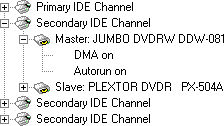
The Ridata DVD recorder was hooked up as Master to the (onboard) secondary
IDE-controller and identifies itself as "JUMBO DVDRW DDW-081". From this model
number and the installed firmware version (BX30) we can see that the Ridata
RDA-08041 is actually a rebadged NU DDW-081 DVD recorder. So, this review
can also be seen as a review of the Nu Tech drive. Note that for each drive in
our system DMA (Direct Memory Access) and autorun were
enabled.
Used Software:
The Dutch Windows XP Professional SP1 operating system is installed on our
test machine. We'll be using the following software to perform the various
tests:
- Ahead Nero Burning Rom
v6.3.0.3
- Ahead Nero CD/DVD
Speed v2.11
- Ahead InCD v4.1.5.10
- Ahead Nero InfoTool
v2.07
- SlySoft CloneCD
v4.3.2.2
- Kris Schoofs
DVD Identifier v3.2 build 2
- Plextor PlexTools
Professional v2.11
look at the drive's package, the drive itself and its specifications and
features.
As with any review we do, we're going to start by checking out the contents
of the retail package Moka
Europe send to us. Notice that we're taking a look at the European retail
package here. In the box of the Ridata DVD recorder we can find the following
items:

- Ridata RDA-08041 drive
- Brief user's guide
- Mounting screws and audio cable
- Sonic MyDVD CD-ROM containing;
- MyDVD Video Suite 4
- CinePlayer 1.5
- RecordNow! 6.5
- DLA 4.5
- MyDVD Video Suite 4
- 10 pcs. of Ritek 8x DVD+R media (RITEK-R03-001)
When looking at the Ridata package we feel that it could have been better.
The package does not include any flatcables, extra jumper caps, etc. The user's
guide that is shipped with the drive is very, very brief and inexperienced users
will have a hard time building the Ritek recorder into their system. Luckily it
isn't all bad since the Ridata drive is shipped with no less than 10 pieces of
8x Ritek DVD+R media. When it comes to software Ridata ships Sonic's software
with their drives. This is not a bad choice but we'll get back to this later on
this page of our review.
The Drive:
The front of the Ridata drive looks pretty standard. On the drive's tray we
can find the Ridata logo and right below that we can find the 'DVD+ReWriteable'
logo. From left to right we can find a headphone jack, volume control, emergency
eject hole, a busy/write LED, a play/forward button and a stop/eject button:

The back of the Ridata drive looks the same as any DVD recorder. From left to
right we have some unknown jumpers, a digital audio connector, an analog audio
connector, the device jumpers (Master/Slave/CableSelect), the IDE interface
connector and last but not least the power connector:

When we look at the label on the Ridata drive we can see the model number
(RDA-08041) in the right top corner and the usual warning messages. On the left
sticker we can see the Nu Tech model number (DDW-081) and that the drive has
been manufactured in December 2003, on the 9th to be exact:

Software:
As we already briefly mentioned the Ridata drive is shipped with software
from the Sonic company. The Sonic CD-ROM contains pretty much everything you
need to make your own CD and DVD compilations (Sonic RecordNow!). Besides that
the Sonic CD-ROM also contains software with which you can create your own
DVD-Video or VCD discs (Sonic MyDVD Video Suite), DVD and VideoCD playback
software (Sonic CinePlayer) and packet writing software (Sonic Drive Letter
Access).

Sonic MyDVD Welcome
Screen

Sonic CinePlayer
Drive Specifications:
Let's begin with a listing of the drive's specifications as listed on the Ritek
website:
CD, Video CD, Multi-session, Photo CD, Enhanced CD, i-trax CD, CD extra,
CD Plus, CD-Text, CD-R ,CD-RW and CD-MRW Discs.
DVD-18), DVD-R, DVD-RW, DVD+R, DVD+RW, DVD+VR, DVD+MRW.
Record Now, My DVD, DLA, Simple Backup Application
software.
To our surprise the specifications as posted on the Ritek site were different
than the ones posted on the Nu Tech website. After checking some things we found
that the specifications on the Ritek site were not correct. The Ridata drive,
for instance, does not support 48x CD-ROM, 48x CD-R and 16x DVD-ROM speeds but
instead it supports 40x CD-R, 40x CD-ROM and 12x DVD-ROM speeds. Let's take a
look at what Nero InfoTool reports us:

As you can see Nero InfoTool agrees with what we just said: the Ridata drive
supports 40x CD-R writing and 40x CD-ROM read speeds. InfoTool also reports us
that the drive has firmware BX30 installed and a 2MB buffer. The drive can read
most types of media, except for DVD-RAM. C2 Error information is not supported
according to InfoTool and neither is the Mount Rainier standard.
From the screenshot we can also see that the drive is a RPC II
(Regional Playback Control) DVD reader. This means that the
drive has been set to play region 2 DVDs (Europe) and has four region changes
left. After the last change the drive will be locked to the last used region.
This was done by motion picture studios to control the release of movie titles
in each world region. This lock can then be reset four times by the manufacturer
of the drive.
Drive Features:

Buffer Underrun Protection:
Nero reports us that the Ridata drive supports the Seamless Link technology
to prevent coasters when your computer cannot supply the recorder with enough
data. The Seamless Link technology monitors the amount of data that is stored in
the recorder's buffer (2MB in this case). When this amount falls beneath a
certain level the recording process is paused while the recorder attempts to
receive data from the PC to refill the buffer. As soon as the buffer has been
refilled, the recorder will start recording again.
Running OPC:
The Ridata recorder uses Running OPC (Optimum Power
Control) while recording data to a disc. Simply said, this means that
during the write process the quality of the disc is constantly monitored and
maintained. If needed the write speed can be reduced to increase the overall
quality of the recorded disc. In the CD and DVD write tests below you can
actually see the OPC in action. The recording speed has spikes which indicates
that the running OPC is checking the quality of the disc.
Recording Speeds:
Let's take a look at the Ridata's DVD+R/RW and CD-R/RW write performance when
using Nero CD Speed:
DVD+Recordable Media:

From this image you can see that the Ridata drive starts the write process at
6x and after writing around 400MB the write speed is increased to the drive's
maximum recording speed of 8x. The speed drops you see are from the running OPC
as we explained above. The Ridata's average recording speed was 7.49x. As
a comparison, the Plextor PX-708A has an average recording speed of 7.69x
using Nero CD Speed.
DVD+ReWriteable Media:

There isn't much to tell about the Ridata's DVD+RW writing performance as it
uses the CLV (Constant Linear Velocity) recording
method which means that recording speed, 4x in this case, is the same throughout
the entire recording process.
CD-Recordable Media:

From the produced graph we can see that the Ridata drive uses the Full CAV
(Constant Angular Velocity) recording method for CD-Rs.
While the maximum recording speed of the Ridata drive (41.73x) was higher
than the Plextor PX-708A's maximum recording speed (40x), its average
recording speed was actually lower (31.21x versus 33.36x). This is
because the Plextor PX-708A uses the Partial-CAV recording method and reaches its maximum recording
speed of 40x much sooner than the Ridata drive.
CD-ReWriteable Media:

This last graph shows us that the Ridata drive uses the P-CAV writing method
for CD-RW discs. This is the same recording method as the Plextor PX-708A uses
only the Plextor has a slighly higher average recording speed (23.75x
compared to the Ridata's 23.57x).
look at the Ridata's read performance with all types of media.
In this part of our Ridata RDA-08041 review we'll test how fast the drive can
read various media. As we already mentioned before, the Ridata drive can read
DVD media at 12x while CD media can be read at 40x. Let's see if this is indeed
the case.
DVD-Video:
For our DVD reading tests we're going to start with a DVD-Video read test of
a single-layered and double-layered DVD disc. Keep in mind that a low read speed
has no effect on the drive's performance when playing a DVD. The drive's read
speed is only important when you, for example, want to rip a DVD disc to your
hard disk.


From both graphs you can see that the Ridata drive has a limited read speed
of 4x max when it comes to reading DVD-Video discs. This means that the Ridata
drive is not very suited for ripping DVD discs since it will take a long time to
rip a disc to your hard disk. Below you can see the results we achieved compared
to other DVD recorders:
| DVD Video | Average Read Speed (SL) | Start Read Speed (SL) | End Read Speed (SL) | Average Read Speed (DL) | Start Read Speed (DL) | End Read Speed (DL) |
| Plextor PX-504A | 3.73x | 2.07x | 4.98x | 3.43x | 1.91x | 1.96x |
| Plextor PX-708A | 9.01x | 5.00x | 12.04x | 6.03x | 3.37x | 8.03x |
| Ridata RDA-08041 | 3.10x | 1.72x | 4.14x | 2.84x | 1.58x | 3.78x |
| Sanyo CRD-BPDV2 | 8.77x | 4.15x | 11.70x | 4.28x | 3.45x | 3.88x |
DVD+R(W):
To test the Ridata's read performance with DVD+R and DVD+RW media we simply
copied 4.4GB to an empty DVD+R and DVD+RW disc. Below you can see the
results:


When it came to reading DVD+R(W) media the Ridata drive performed a lot
better than when reading the DVD-Video discs. This time the drive had no
problems reaching 8x with both the DVD+R and DVD+RW media. In the table below
we've compared the achieved results again. This time the Ridata had the highest
average read speed:
| DVD +R(W) | Average Read Speed (+R) | Start Read Speed (+R) | End Read Speed (+R) | Average Read Speed (+RW) | Start Read Speed (+RW) | End Read Speed (+RW) |
| Plextor PX-504A | 3.77x | 2.08x | 5.04x | 3.37x | 1.88x | 1.72x |
| Plextor PX-708A | 6.05x | 3.33x | 8.10x | 6.07x | 3.34x | 8.11x |
| Ridata RDA-08041 | 6.24x | 3.43x | 8.36x | 6.24x | 3.43x | 8.36x |
| Sanyo CRD-BPDV2 | 4.01x | 2.64x | 4.02x | 4.02x | 2.65x | 5.77x |
DVD-R(W):
To test the Ridata's read performance with DVD-R and DVD-RW media we again
copied roughly 4.4GB to an empty DVD-R and DVD-RW disc. Below you can see the
results again:


As you can see we had some problems when reading the DVD-R and DVD-RW media.
When we did our tests with DVD-R media the Ridata drive read the discs fine but
always gave an error when doing the seek times tests. We tried four different
DVD-R media brands but they all failed, even when we burned them at 1x (using a
Plextor PX-708A DVD recorder). When reading the DVD-RW media the drive did work
although it showed some read problems at the end of the disc.
| DVD -R(W) | Average Read Speed (-R) | Start Read Speed (-R) | End Read Speed (-R) | Average Read Speed (-RW) | Start Read Speed (-RW) | End Read Speed (-RW) |
| Plextor PX-504A | 3.76x | 1.89x | 5.04x | - | - | - |
| Plextor PX-708A | 6.00x | 3.37x | 8.04x | 6.06x | 3.34x | 8.11x |
| Ridata RDA-08041 | 6.23x | 3.42x | 8.34x | 4.64x | 2.57x | 6.22x |
| Sanyo CRD-BPDV2 | 4.02x | 3.06x | 4.02x | 4.02x | 3.20x | 4.02x |
CD-ROM:
For the transfer rate tests we used a pressed CD-ROM containing the PlexTools
software (v1.05) which was exactly 74 minutes (333.000 sectors) long. Below you
can see the produced Nero CD-DVD Speed graph:

When reading pressed CD-ROM media the Ridata drive performed very well as it
had no problems reaching its rated speed of 40x and going faster than that. The
drive's seek times were also pretty good and well within specification of 120ms
random stroke:
| Pressed Discs | Average Read Speed | Start Read Speed | End Read Speed | Seek Times Random | Seek Times 1/3 | Seek Times Full |
| Plextor PX-504A | 29.62x | 17.44x | 39.09x | 110ms | 113ms | 188ms |
| Plextor PX-708A | 31.40x | 18.48x | 41.45x | 98ms | 116ms | 175ms |
| Ridata RDA-08041 | 31.12x | 5.04x | 41.46x | 101ms | 115ms | 169ms |
| Sanyo CRD-BPDV2 | 29.30x | 16.33x | 38.71x | 85ms | 102ms | 177ms |
CD-R:
For the transfer rate tests with CD-Recordable Media we used a back-up (CD-R)
of the PlexTools software disc. The used disc was a 'That's Write' CD-R
certified up to 16x writing and manufactured by Gigastorage. Here are the
results:

The graph shows us that the Ridata drive again had no problems reaching its
rated read speed of 40x and going faster than that. Its seek times were also
pretty good again. When we compare them to other drives we've reviewed we can
see that the Ridata has the highest average CD-R read speeds:
| CD-R Discs | Average Read Speed | Start Read Speed | End Read Speed | Seek Times Random | Seek Times 1/3 | Seek Times Full |
| Plextor PX-504A | 30.67x | 18.35x | 40.31x | 116ms | 119ms | 174ms |
| Plextor PX-708A | 31.48x | 18.83x | 41.37x | 95ms | 111ms | 164ms |
| Ridata RDA-08041 | 32.32x | 18.50x | 42.94x | 101ms | 112ms | 158ms |
| Sanyo CRD-BPDV2 | 30.31x | 16.20x | 39.92x | 114ms | 115ms | 204ms |
CD-RW:
To test the transfer rate with CD-RW discs we once again used the "PlexTools
v1.05" disc only this time we read from a CD-ReWriteable disc. The used disc was
a 'Plextor High Speed CD-RW' disc. Below you can see the produced graphs with
Nero CD-DVD Speed again:

As you can see from the produced graph the Ridata drive has a limited read
speed for CD-RW media. With an average read speed of 20.47x it was the slowest
drive I've reviewed:
| CD-RW Discs | Average Read Speed | Start Read Speed | End Read Speed | Seek Times Random | Seek Times 1/3 | Seek Times Full |
| Plextor PX-504A | 26.08x | 15.34x | 34.45x | 113ms | 124ms | 178ms |
| Plextor PX-708A | 31.46x | 18.47x | 41.55x | 109ms | 116ms | 183ms |
| Ridata RDA-08041 | 20.47x | 11.56x | 27.23x | 103ms | 112ms | 169ms |
| Sanyo CRD-BPDV2 | 30.59x | 16.97x | 40.44x | 84ms | 103ms | 175ms |
Audio - Digital Audio Extraction:
To test the Ridata's digital audio extraction performance we again used Nero
CD-DVD Speed to do a transfer rate test. The audio disc we used was of a
slightly larger size than in our previous tests (77 minutes). In the graph below
you can see the performance of the DVD-recorder:

Here the Ridata drive showed a great performance as it reached almost 44x
when reading our audio disc. With an average read speed of 32.94x it's by
far the fastest drive I've reviewed:
| Audio Discs | Average Read Speed | Start Read Speed | End Read Speed | Seek Times Random | Seek Times 1/3 | Seek Times Full |
| Plextor PX-504A | 25.87x | 15.35x | 34.09x | 110ms | 119ms | 177ms |
| Plextor PX-708A | 31.84x | 18.90x | 41.98x | 97ms | 117ms | 181ms |
| Ridata RDA-08041 | 32.94x | 18.62x | 43.61x | 100ms | 112ms | 166ms |
| Sanyo CRD-BPDV2 | 30.72x | 18.24x | 40.21x | 84ms | 103ms | 208ms |
As a final test we used the PlexTools Professional software to extract the
audio disc to our hard disk. Normally we also include the results with Exact
Audio Copy (EAC) but for an unknown reason the Ridata drive didn't work very
well with the EAC software. It constantly gave us timing problems or extraction
was terribly slow (less than 1x). Here are the results with the PlexTools
Professional software. As you can see the complete disc was extracted in 2
minutes and 36 seconds with a maximum speed of 41.7x. An excellent result!

Audio - Advanced DAE Quality Test:
As always, to conclude our CD media read tests we did an 'Advanced DAE
Quality Test' with Nero CD-DVD Speed. You can see the produced results
below:

Once again an excellent result. The Ridata drive gets a quality score of 100%
and a high average read speed of 30x which is not bad at all. The drive
had no problems reading SubChannel Data and CD-Text. The Ridata drive could read
data from the lead-in area of the disc but not from the lead-out area of the
disc.
performs when writing recordable DVDs and CDs...
The most important thing about a DVD recorder is of course its DVD recording performance. As we already mentioned the Ridata drive supports 8x DVD+R, 4x DVD+RW, 40x CD-R and 24x CD-RW recording speeds. For our first tests we're going to start with the drive's DVD+R performance.
Writing DVD+R:
To test the Ridata's performance when writing DVD media we set up a new DVD-Video compilation of roughly 4400MB in Nero Burning ROM 6 and started the recording process. For the 8x DVD+R recording test I used one of the bundled Ritek DVD+R discs with the following ADIP information:
-----------------------------------------------------
Unique  Disc Identifier :  [DVD+R;RITEK-R03-001]
-----------------------------------------------------
Disc  Type : [DVD+R]
Manufacturer ID : [RITEK]
Media Type ID : [R03]
Product  Revision : [001]
Disc Application Code : [General Purpose]
Recording  Speeds : [2.4x - 4x - 8x]
Blank Disc Capacity : [2,295,104 Sectors = 4,482.6  MB = 4.38 GB]
-----------------------------------------------------
[DVD  Identifier - http://DVD.Identifier.CDfreaks.com]
-----------------------------------------------------

The screenshot shows us that the complete compilation was written in 8 minutes and 9 seconds. This is a few seconds slower than the Plextor PX-708A drive (8m:01s) but the difference is minimal.
Writing Data CD-R:
For our data writing tests we simply set up a new compilation of 700MB using the Nero Burning Rom software. We used the DAO (Disc At Once) writing method. The disc was finalized and set-up as a non-multisession disc. In the screenshot below you can see the burn process completed successfully:

As you can see from the screenshot, the burn process was completed in 3 minutes and 7 seconds. This is again a little slower than the Plextor PX-708A which needed 2 minutes and 58 seconds to write 700MB of data. But, even though the Ridata drive was slower, a burn process of just over three minutes is not bad at all and more than fast enough for most people.
Writing Audio CD-R:
As a final write test we wrote an audio CD to see if the Ridata drive could write the disc at maximum speed. From the screenshot below you can see that the drive had no problems writing our audio compilation at maximum speed.

As a small extra test we wrote the audio compilation with CD-Text and afterwards tested if the Ridata drive could read back the CD-Text. This was no problem for the drive.
Now that we've finished the write tests, let's check the write quality...
One of the most important things about a DVD recorder (and a CD-RW recorder too) is probably the write quality. A recorder is completely useless when it cannot reliably record data to a disc. On this page of our Ridata review we're going to check how well the Ridata drive can write both DVD and CD media.
DVD+R Write Quality:
Before I start the DVD quality test I have to mention that I unfortunately do not own a Lite-On DVD recorder or any other drive that works with the K-Probe DVD error measurement software. Luckily I do own a picky DVD reader, the Plextor PX-504A. If the recorded disc can be read without problems in this drive, you can be sure that the disc was written correctly. As an additional test I also watched every DVD-Video back-up I created on my Sony DVD player.
Ritek 8x:
-----------------------------------------------------
Unique  Disc Identifier :  [DVD+R;RITEK-R03-001]
-----------------------------------------------------
Disc  Type : [DVD+R]
Manufacturer ID : [RITEK]
Media Type ID : [R03]
Product  Revision : [001]
Disc Application Code : [General Purpose]
Recording  Speeds : [2.4x - 4x - 8x]
Blank Disc Capacity : [2,295,104 Sectors = 4,482.6  MB = 4.38 GB]
-----------------------------------------------------
[DVD  Identifier - http://DVD.Identifier.CDfreaks.com]
-----------------------------------------------------

The first Nero CD/DVD Speed graph shows us an excellent curve. The Plextor PX-504A drive had no problems reading back our Ritek DVD+R media that was written at 8x.
Fuji 4x:
-----------------------------------------------------
Unique  Disc Identifier :  [DVD+R;RICOHJPN-R01-002]
-----------------------------------------------------
Disc  Type : [DVD+R]
Manufacturer ID : [RICOHJPN]
Media Type ID :  [R01]
Product Revision : [002]
Disc Application Code : [General  Purpose]
Recording Speeds : [2.4x - 4x]
Blank Disc Capacity : [2,295,104 Sectors =        4,482.6 MB = 4.38  GB]
-----------------------------------------------------
[DVD Identifier  - http://DVD.Identifier.CDfreaks.com]
-----------------------------------------------------

The next disc we wrote was a Fuji 4x DVD+R disc manufactured by Ricoh. The disc was written at 8x in the Ridata drive and as you can see from the Nero CD/DVD Speed graph, the disc was perfectly readable.
TDK 2.4x:
-----------------------------------------------------
Unique  Disc Identifier :  [DVD+R;RICOHJPN-R00-001]
-----------------------------------------------------
Disc  Type : [DVD+R]
Manufacturer ID : [RICOHJPN]
Media Type ID :  [R00]
Product Revision : [001]
Disc Application Code : [General  Purpose]
Recording Speeds : [2.4x]
Blank Disc Capacity : [2,295,104 Sectors =        4,482.6 MB = 4.38  GB]
-----------------------------------------------------
[DVD Identifier  - http://DVD.Identifier.CDfreaks.com]
-----------------------------------------------------

The next disc we wrote was a TDK disc but as you can see from the DVD Identifier information, this disc was also manufactured by Ricoh although a different (older) revisision. The disc was certified for 2.4x recording and the Ridata wrote the disc at this speed (24m:30s). This disc was also perfectly readable in the Plextor recorder.
Sony 4x:
-----------------------------------------------------
Unique  Disc Identifier :  [DVD+R:MCC-002-000]
-----------------------------------------------------
Disc  Type : [DVD+R]
Manufacturer ID : [MCC]
Media Type ID : [002]
Product  Revision : [Not Specified]
Disc Application Code : [General  Purpose]
Recording Speeds : [2.4x - 4x]
Blank Disc Capacity : [2,295,104 Sectors =    4,482.6  MB =    4.38  GB]
-----------------------------------------------------
[DVD Identifier  - http://DVD.Identifier.CDfreaks.com]
-----------------------------------------------------

This time we used a Sony DVD+R disc manufactured by MCC and certified for 4x recording. The Ridata drive wrote the disc at maximum speed, 8x (8m:06s). Once again the recorded disc was perfectly readable in the Plextor recorder.
MMORE 2.4x:
-----------------------------------------------------
Unique  Disc Identifier :  [DVD+R;OPTODISC-OP1-001]
-----------------------------------------------------
Disc  Type : [DVD+R]
Manufacturer ID : [OPTODISC]
Media Type ID :  [OP1]
Product Revision : [001]
Disc Application Code : [General  Purpose]
Recording Speeds : [2.4x]
Blank Disc Capacity : [2,295,104 Sectors =        4,482.6 MB = 4.38  GB]
-----------------------------------------------------
[DVD Identifier  - http://DVD.Identifier.CDfreaks.com]
-----------------------------------------------------

The next DVD+R disc we wrote was an old MMORE disc manufactured by Optodisc and certified for 2.4x recording. The Ridata drive wrote the disc at its certified speed and as you can see from the graph, it was perfectly readable.
Philips 4x:
-----------------------------------------------------
Unique  Disc Identifier :  [DVD+R;RICOHJPN-R01-002]
-----------------------------------------------------
Disc  Type : [DVD+R]
Manufacturer ID : [RICOHJPN]
Media Type ID :  [R01]
Product Revision : [002]
Disc Application Code : [General  Purpose]
Recording Speeds : [2.4x - 4x]
Blank Disc Capacity : [2,295,104 Sectors =        4,482.6 MB = 4.38  GB]
-----------------------------------------------------
[DVD Identifier  - http://DVD.Identifier.CDfreaks.com]
-----------------------------------------------------

The last disc we tested was a Philips 4x disc. As the disc is manufactured by Ricoh and thus basically the same disc as the Fuji DVD+R disc, it will come as no surprise the Philips disc was written at 8x. From the Nero CD/DVD Speed graph we can see that once again the disc was perfectly readable. So, overall a perfect result when it comes to DVD write quality.
CD-R Write Quality:
For the CD-R error measurement tests we used the PlexTools Professional software and a Plextor Premium drive. In the produced graphs below you can see an overview of errors occurring during the read process. Note that every burned disc will always have C1 errors. These are errors that are corrected by the drive and they will not effect the disc in a bad way as long as their amount is limited. C2 errors are however very bad for a disc and are harder to read and correct. When there are CU errors present on the disc it means you have bad burned disc and it can't be read in the test drive you're using as a reader. Also keep in mind that the number of C1/C2/CU errors depends on a number of different factors. The combination of software, hardware and read speed have an effect on the results.

Samsung [CMC Magnetics] - 48x certified - 40x write
| Manufacturer: | CMC Magnetics |
| Code: | 97m26s66f |
| Disc Type: | CD-R |
| Recording Layer: | Dye Type 6: Short Strategy (Phthalocyanine) |
| Capacity: | 79:59.71 (703MB) |
| Certified Speed: | 48x |
| Write Speed: | 40x |
| Write Time: | 3m:07s |
| C1 Average/Sec: | 2.3 |
| C2 Average/Sec: | 0.0 |
| CU Average/Sec: | 0.0 |
The first disc we tested was a Samsung CD-R manufactured by CMC Magnetics. The disc was certified for 48x recording speeds and the Ridata wrote the disc at its maximum speed of 40x. The created disc had a low amount of C1 errors and since there were no C2 and CU errors the disc was written perfectly.

MAM-E [Mitsui] - 48x certified - 16x write
| Manufacturer: | Mitsui |
| Code: | 97m27s58f |
| Disc Type: | CD-R |
| Recording Layer: | Dye Type 8: Short Strategy (Phthalocyanine) |
| Capacity: | 79:59.74 (703 MB) |
| Certified Speed: | 48x |
| Write Speed: | 16x |
| Write Time: | 5m:24s |
| C1 Average/Sec: | 7.8 |
| C2 Average/Sec: | 0.0 |
| CU Average/Sec: | 0.0 |
The MAM-E discs, manufactured by Mitsui, had quite a lot of C1 errors on them and even some C2 errors (19 in total). Considering the disc was also written at a low speed of only 16x this is not a very good burn. The disc was readable after it was burned but the overall quality could have been a lot better.

Maxell [Hitachi Maxell] - 40x certified - 40x write
| Manufacturer: | Hitachi Maxell |
| Code: | 97m25s29f |
| Disc Type: | CD-R |
| Recording Layer: | Dye Type 9: Short Strategy (Phthalocyanine) |
| Capacity: | 79:59.74 (703 MB) |
| Certified Speed: | 40x |
| Write Speed: | 40x |
| Write Time: | 3m:06s |
| C1 Average/Sec: | 2.0 |
| C2 Average/Sec: | 0.0 |
| CU Average/Sec: | 0.0 |
The Maxell disc was recorded perfectly. There was an average C1 count of 2.0 and there were no C2 and CU errors on the disc.

DataRight [Moser Baer] - 48x certified - 40x write
| Manufacturer: | Moser Baer |
| Code: | 97m17s06f |
| Disc Type: | CD-R |
| Recording Layer: | Dye Type 6: Short Strategy (Phthalocyanine) |
| Capacity: | 79:59.74 (703 MB) |
| Certified Speed: | 48x |
| Write Speed: | 40x |
| Write Time: | 3m:06s |
| C1 Average/Sec: | 2.9 |
| C2 Average/Sec: | 0.0 |
| CU Average/Sec: | 0.0 |
The DataRight media was recorded pretty well but it's too bad there were some (12) C2 errors on the disc. The disc was completely readable after it was burned but it's not a good burn since C2 errors are never wanted.

Taiyo Yuden - 24x certified - 32x write
| Manufacturer: | Taiyo Yuden |
| Code: | 97m24s01f |
| Disc Type: | CD-R |
| Recording Layer: | Dye Type 1: Long Strategy (Cyanine, AZO) |
| Capacity: | 74:43.01 (656 MB) |
| Certified Speed: | 24x |
| Write Speed: | 32x |
| Write Time: | 3m:06s |
| C1 Average/Sec: | 3.1 |
| C2 Average/Sec: | 0.0 |
| CU Average/Sec: | 0.0 |
The Taiyo Yuden disc was recorded perfectly. The C1 error count is a little high at the beginning of the disc but nut too high to cause any read problems. The Taiyo Yuden disc was also recorded at a higher speed than it was certified for so overall this is a good result.
Now that we've finished our quality tests, it's time to check the drive's re-write performance...
The Ridata DVD recorder supports 4x DVD+RW and 24x CD-RW re-writing speeds.
On this page of our review we'll see how well the Ridata drive can re-write data
and how it performs with packet writing.
Re-Writing Data:
For our first test we're going to record a DVD-Video compilation to 4x DVD+RW
media. In the screenshot below you can see the burn process completed
successfully in 14 minutes and 34 seconds:

There isn't much to tell about the Ridata's performance with DVD+RW media
since the achieved result was as one would expect when burning at 4x. The Ridata
RDA-08041 was a little faster than the Plextor PX-708A (14m:40s) but not by
much.

The Ridata's CD-RW performance was also as one would expect. The drive wrote
the 650MB compilation in 3 minutes and 34 seconds, again a little
faster than the Plextor PX-708A (3m:40s).
Packet Writing:
For our packet writing tests we used Ahead's InCD 4 software and tested both
the Ridata's CD-RW and DVD+RW performance. For our first DVD+RW test we set-up a
test folder with random data measuring roughly 4.35GB in size. After formatting
was complete we measured the time it took for the drive to write the test data.
In the table below we've summed up our results:
| DVD+RW Packet Writing | InCD Formatting 4.4GB | InCD Copying 4.4GB | Average Write Speed |
| Plextor PX-708A | 0m:26s | 14m:50s | 3.8x |
| Ridata RDA-08041 | 0m:23s | 14m:56s | 3.8x |
The Ridata packet writing performance was almost the same as the Plextor
PX-708A. The Ridata needed just a little more time to write our test data but
both drives had the same average write speed of 3.8x. Not a bad result at
all.
For our next CD-RW tests we set-up a test folder with random data measuring
400MB in size. We then inserted an empty disc and measured the time it took for
the drive to format the disc after which the test data was dragged and dropped
to the disc via the Windows Explorer. In the table below you can see the results
again:
| CD-RW Packet Writing | InCD Formatting 650MB | InCD Copying 400MB | Average Write Speed |
| Plextor PX-708A | 4m:03s | 2m:34s | 17.9x |
| Ridata RDA-08041 | 3m:47s | 2m:33s | 17.9x |
And with the CD-RW packet writing tests we can also see that the Ridata and
Plextor drive perform very similar. Both drives needed the same time to write
our test folder with data and thus both drive had the same average writing
speed. The Ridata drive was a little faster when formatting the CD-RW disc
though.
advanced testing...
For our final (advanced) tests we're going to test how the Ridata RDA-08041
drive performs with data and audio copy-protections. Besides that we'll also
check if the drive can overburn, if it can read GigaRec discs and if it can
handle 8cm discs. Let's start with the data copy-protections:
Copy-Protected Data:
For our copy-protected data tests we, as always, used CloneCD to read and
write several popular copy-protections. In the picture below you can see that
the Ridata drive is fully supported by CloneCD:

The Ridata drive supports the DAO-RAW96 recording mode which basically means
that the drive can write uncorrected data and SubChannel Data. In the table
below we've summed up all of our results and after the table we will clarify our
results:
| Protected Data | Game Title | Protection (version) | Read Time | Back-up Works |
 | Desperados | LaserLock | 26m:42s | Yes |
 | Serious Sam Second Encounter | SafeDisc v2.51.021 | 13m:45s | No |
 | C&C Generals | SafeDisc v2.80.010 | 13m:59s | No |
 | Neverwinter Nights | SecuRom v4.76.00.0051 | 2m:27s | No |
 | Fifa Football 2004 | PlayStation LibCrypt | 2m:03s | Yes |
The Ridata drive showed a poor performance when writing the data protections.
When it came to reading the discs there were no problems but the drive failed to
produce a working back-up of our SafeDisc and SecuRom protected games. Even with
CloneCD's 'Amplify Weak Sectors' option enabled, the SafeDisc back-ups didn't
work in our Toshiba SD-M1502 DVD-ROM.
Copy-Protected Audio:
For the copy protected audio tests we simply inserted the audio discs in the
drive and waited if the drive could recognize the disc and if so, could extract
the audio tracks. In the table below we've summed up our results. Note that
before we did any of these tests we disabled the 'Auto Insert Notification' for
the Ridata drive:
| Protected Audio | Audio Title | Protection (version) | Exact Audio Copy |
| Shakira - Laundry Service | Key2Audio version 2 | Read the disc without problems | |
| Celine Dion - A New Day Has Come | Key2Audio version 3 | Read the disc without problems | |
| Bitte Ein Beat! - Beat 5 | Cactus Data Shield 200 | Read the disc without problems | |
| Yorin FM - Hitzone 21 | Doc.loc | Read the disc without problems | |
Luckily, when it came to reading audio protections, the Ridata drive
performed a lot better. It had no problems whatsoever reading our protected
audio discs!
Overburning:
For our overburning test we, as always, used the Nero CD/DVD Speed software
and started the test. According to the software the Ridata drive can fully
overburn up to 99 minutes:

To test if the results we got from Nero CD/DVD Speed were correct we burned a
99 minute audio compilation using the Nero 6 software. The burn process was
completed without a problem and reading back the disc was also no problem. The
top read speed the Ridata drive was a whopping 47.30x!

GigaRec Discs:
GigaRec is a new technology that was introduced with the
Plextor Premium drive (and as of yet this is the only drive that supports this
technique). In short GigaRec allows you to expand the capacity of a normal 80
minute (700MB) CD-R disc up to 111 minutes (or almost 1GB of data). GigaRec has
different rates and for our next test we used a GigaRec disc that was recorded
with the highest setting, 1.4x, which means that there is 111 minutes of
audio on a standard 80 minute disc. Unfortunately the Ridata drive recognized
the GigaRec disc as a blank disc and thus it could not read back any of the data
on the disc.
8cm Discs:
For our final test we'll, as always, test if the Ridata drive can read and
write 8cm discs. For this test we set-up a 200MB data compilation in Nero 6 and
started the write process. As expected the write process was completed
successfully:

That concludes our Ridata RDA-08041 review! Let's go to our final
words and conclusions...
Positive:
- Retail package includes good software and 10pcs. of 8x DVD+R media.
- Fast DVD recorder. Supports 8x DVD+R, 4x DVD+RW, 40x CD-R and 24x CD-RW.
- Good DVD+R write quality. Running OPC working well.
- Good read performance with DVD+R media, CD-ROM media and audio discs.
- Excellent performance with copy protected audio discs.
- Supports overburning up to 99 minutes.
- Supports DAO-RAW writing.
- Supports reading and writing of 8cm discs.
- Supports reading and writing of CD-Text information.
- Supports reading and writing of full SubChannel Data.
Negative:
- Retail package could do with some flatcables, extra jumper caps and a
better manual.
- Mount Rainier not supported.
- DVD-Video read speeds limited to 4x.
- Problems with reading DVD-R media.
- Write quality with certain CD-R media questionable.
- Poor performance with data copy protections.
Conclusion:
As we already mentioned in our review the
Ridata drive is based on the NU DDW-081 DVD recorder and as some of you will
know, NU offers a firmware upgrade for their drive with which you can turn the
DDW-081 into a dual format (DVD±RW) DVD recorder. For this review we decided not
to upgrade the drive's firmware. If you want to know how the NU DDW-081 performs
with the dual format firmware, please check out our NU DDW-081/082
review.
Overall we can say that we were pretty happy
with the Ridata drive. When looking at the, in our opinion, most important
features of a DVD recorder such as write performance and write quality, the
Ridata RDA-08041 performed excellent. It was able to write all of our test DVDs
at their certified speed and some 4x DVD+R media could be perfectly written at
8x. Each DVD+R disc we wrote was perfectly readable after it was written. When
it came to RW performance the drive also performed well. The only thing that
could be improved is the drive's CD-R write quality since we had some C2 errors
during our tests. This can probably be fixed via a firmware upgrade.
When it came to read performance we had a bit of a mixed result. The Ridata
drive performed excellent when reading DVD+R media, CD-R(OM) media and audio
discs. However, when it came to reading DVD-Video discs the drive's read speed
is limited to 4x. This is not important when watching a DVD movie but it doesn't
make the drive very suitable for ripping DVDs to your hard disk. During our read
tests we had some problems with DVD-R media. All of the discs we tested could be
read by the drive but during the seek time tests with Nero CD/DVD Speed the
drive failed. This is also something that can be improved via a firmware
upgrade.
During our advanced tests we also had a mixed result. On the one hand the
Ridata drive read our copy protected audio discs without a problem but on the
other hand it failed to back-up both the SafeDisc and SecuRom protected data
discs. Luckily, when it came to overburning and reading 8cm discs the Ridata
drive performed very well again.
The price of the Ridata RDA-08041 drive is about €120,- (US$ 147,-) which is
not a bad price but considering that the NU DDW-081 cost around €85,- (US$
104,-) here in The Netherlands, we feel that the price difference is a bit too
much. But, for €35 extra you do get 10 pieces of 8x DVD+R media bundled with the
Ridata drive. We'll, as usual, leave it up to you to decide if you're willing to
pay this increased price.
If you want to discuss this drive please react below or post your
reaction(s) in this thread in our Recording
Hardware Forum.