
| | Review: Toshiba SD-R5372 |
Toshiba USA was kind enough to provide their SD-R5372 16X DVD Writer for a review. Toshiba is a technology giant and holds a very well known brand-name in the Consumer Electronics arena. This Toshiba drive is a unique unit and was the first DVD Writer on the market to achieve DVD+R DL writing speeds faster than 4X. The SD-R5372 can write to DVD+R DL media at a speedy rate of 5X. It also supports 16X writing on both DVD+R and DVD-R media. How does the SD-R5372 shape up against the competition? We'll find out by taking an in-depth look at this drive's performance and features in this review.
Company information:
We found the following information on the Toshiba USA website.
Principal Business - Toshiba America, Inc. (TAI) is the holding company for one of the nation's leading group of high technology companies. TAI is the parent of six operating companies that together span a diversified range of modern electronics, each conducting research and development, manufacturing, sales and service in its field of expertise.
TAI is a subsidiary of Toshiba Corporation, a world leader in high technology products, with 364 consolidated subsidiaries worldwide.
Headquarters
Toshiba America, Inc.
1251 Avenue of the Americas
Suite 4110
New York, NY 10020
Product Overview - The Toshiba America Group specializes in advanced electronics and is a recognized leader in products that enhance the home, office, industry and health care environments. Toshiba markets and manufactures information and communication systems, electronic components, heavy electrical apparatus, consumer products and medical diagnostic imaging equipment.
ANNUAL SALES: 6.0BILLION (FY 2002)
Markets - Customer markets comprise retailers, consumers, hospitals and medical facilities, municipalities, universities, businesses and other high technology manufacturers. 
Toshiba Operating Companies & Businesses & Principal Products
| Toshiba America Information Systems, Inc. (TAIS) | Toshiba America |
| Toshiba America Medical Systems, Inc. (TAMS) | Toshiba America |
| Toshiba America Electronic Components, Inc. (TAEC) | Toshiba International |
Finance Company - Toshiba America Capital Corporation (TACC)
Research Company
Toshiba America Research, Inc. (TARI)
Piscataway, New Jersey
Mobile and Wireless Technology
Facilities
Manufacturing Facilities
Toshiba America Business Solutions, Inc. (TABS) has a production facility in Mitchell, South Dakota, where they manufacture toner for photocopiers.
Toshiba America Consumer Products, Inc. (TACP) has two production facilities in North America. At their plant in Lebanon, Tennessee, TACP manufactures color television sets, and TACP manufactures the television chassis at their facility just across the border in Ciudad Juarez, Mexico.
In Houston, Texas, Toshiba International Corporation (TIC) has a facility where they produce motors and other industrial equipment.
R & D Facilities
Toshiba America Information Systems, Inc. (TAIS), located in Irvine, California, has an R&D center for personal computers, digital documentation, telecommunications, and network systems.
Toshiba America Medical Systems, Inc. (TAMS) has an R&D center for Medical Equipment Systems at its facility in South San Francisco, California.
In the Silicon Valley area, Toshiba America Electronic Components, Inc. (TAEC)'s researchers are working on LSIs at their facility in San Jose, California.
History - Toshiba Corporation, the Tokyo-based parent company, established American operations in 1965. By 1989, Toshiba America had achieved its current structure of separate operating companies marketing a variety of diversified electronics and high technology products.
Corporate Citizenship
Toshiba America Foundation
The Toshiba America Foundation is a private, endowed, not-for-profit grantmaking organization. Created in 1990, the Foundation is dedicated to supporting science and mathematics education programs, projects and activities in the US. The giving program focuses on elementary through high school programs.
Toshiba/NSTA ExploraVision Awards
Toshiba America works with the National Science Teachers Association to co-sponsor one of the world's largest science competition for K-12 students. The company invests more than $1 million annually in the program.
Drive specifications:
Found on the Toshiba USA website:
A leading developer in optical storage, Toshiba continues to leverage its expertise with the dual format optical disk drive. Compatible with the multitude of current formats, this latest drive enables users to read, record and rewrite content to DVD-R/RW and +R/RW media and CDs. Available as an upgrade kit, the SD-R5372 desktop drive comes packed with the Nero editing suite, instructions and all the cables necessary for installation, ensuring simple and quick upgrades. With Toshibas DVD recordable drive, transferring home videos, photos and other digital files from the computer to the living room DVD player becomes virtually effortless.
With the desire to preserve higher capacity information continually on the rise, storage manufacturers are constantly exploring ways to save more information on a smaller space. The continued development of DVD technology brings these opportunities closer to reality. In the current state of multiple formats, users can find optimal performance in a unit that reads and records all of the major standards, ensuring that data recorded today will be accessible tomorrow.
- 5X DVD+R DL Write
- 16X DVD+R Write
- 6X DVD-RW Write *
- 8X DVD+RW Write*
- 16X DVD-R Write Capable*
- 16X DVD-ROM Read
- 12X DVD+/-R Read
- 8X DVD+R DL Read
- 6X DVD+/-RW Read
- 2X DVD-RAM Read
- 48X CD-R Write
- 10X CD-RW Write HS
- 24X CD-RW Write US
- 48X CD-ROM/R Read
- 24X CD-RW Read
- Horizontal or Vertical Mount
- External Dimensions (W x H x D):
- 146mm x 41.5mm x 189.5mm
- MTBF 100,000 hours
- Weight: 1.0 kg
- Click for Warranty Information
- Click for SD-R5372 Kit Information
* Free firmware upgrade available that boost DVD-R write speed from 12X to 16X, DVD+RW write speed from 4X to 8X and DVD-RW write speed from 4X to 6X.
| Average Random Access Time: | |
| DVD-ROM (16X) | 120ms |
| CD-ROM (40X) | 100ms |
| DVD-RAM (2X) | 200ms |
| Average Random Seek Time | |
| DVD-ROM (12X) | 115ms |
| CD-ROM (40X) | 100ms |
| DVD-RAM (2X) | 160ms |
| Sustained Data Transfer Rate: | |
| DVD-ROM | 21,632KByte/s |
| DVDR | 16,224KByte/s |
| DVD+R DL | 10,816KByte/s |
| CD-ROM/-R | 7,200 KByte/s |
| DVD-RAM | 2,704 KByte/s |
| Burst: | |
| Multi Word DMA Mode 2 (ATAPI) | 16.7MB/sec |
| PIO Mode 4 (ATAPI) | 16.7MB/sec |
| Ultra DMA | 33.3MB/sec |
| Physical Characteristics: | |
| Dimensions | 1.63" x 5.75" x 7.46" (41.5mm x 146mm x 189.5mm) |
| Weight | 2.20 lbs. (1.0kg) |
| Supported Disc Formats: | |
| Write | DVD-R, DVD-RW, DVD+R, DVD+R DL, DVD+RW, CD-R, |
| Read | DVD-ROM, DVD-R/RW, DVD+R, DVD+R DL, DVD+RW, |
| Environmental: | |
| Operation Temperature | 41F - 122F (5C to 50C) |
| Other: | |
| Buffer Size | 2MB |
| Power Requirements | DC 5V/12V |
| MTBF | 100,000 POH |
What's inside the box?
Here we take a look at the Toshiba SD-R5372 retail package and the contents included in the bundle.
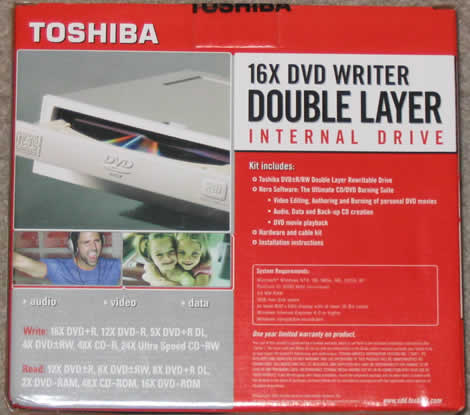
Backside of the retail box.
Left side of the retail box.
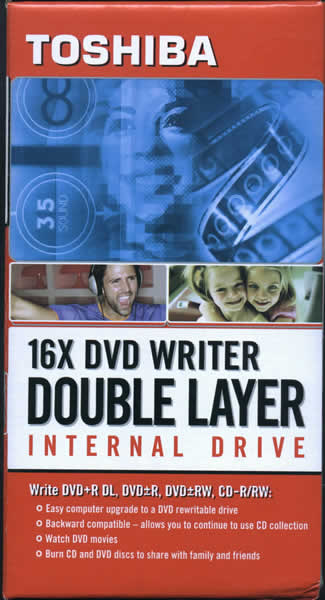
Right side of the retail box.

Top of the retail box.
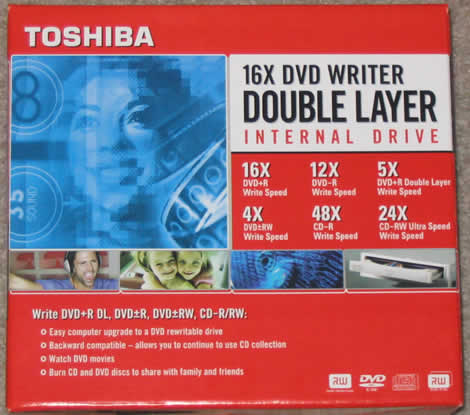
Front of the retail box.
The front of the retail box has an interesting design. You can see that Toshiba is drawing attention to the 16X DVD WRITER and DOUBLE LAYER capabilities of the drive. Notice that the specifications of the drive are actually even better than what the box has printed on it. This is due to Toshiba's recent firmware updates that have added additional capabilities such as 16X DVD-R writing and 6X DVD-RW writing.
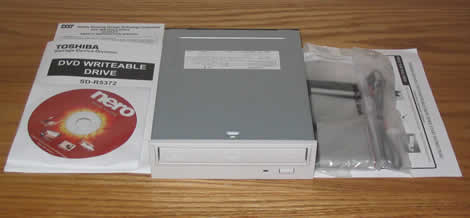
Retail box contents.
Let us look over the contents of the retail package.
The box contains:
- The Toshiba SD-R5372 drive
- One 40 wire IDE cable
- Audio cable
- Mounting screws
- Nero OEM Suite CD-ROM
- Quick Start Instructions
- Safety Instruction Manual
- Installation Instructions
The bundle contains everything that you would need to get the drive installed and burning discs in no time. We would also like to point out that the included Nero burning suite is one of our preferred CD/DVD writing suites and we give Toshiba two thumbs up for including this software. It is good to see that Toshiba included an IDE cable in the kit, but we would prefer an 80 wire version. We miss having a blank DVD±R disc and preferably also one DVD rewriteable disc included in the bundle.
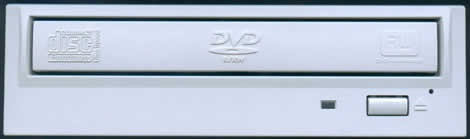
Drive face. A simple design that looks like many other optical drives we have seen. On the drive tray from left to right, we have a Compact Disc Ultra Speed ReWriteable logo, a DVD Forum (DVD-R/RW) logo and a DVD Alliance (DVD+R/RW) logo. Underneath we have the single color (green) LED, the eject button, an eject symbol, and the emergency eject hole.
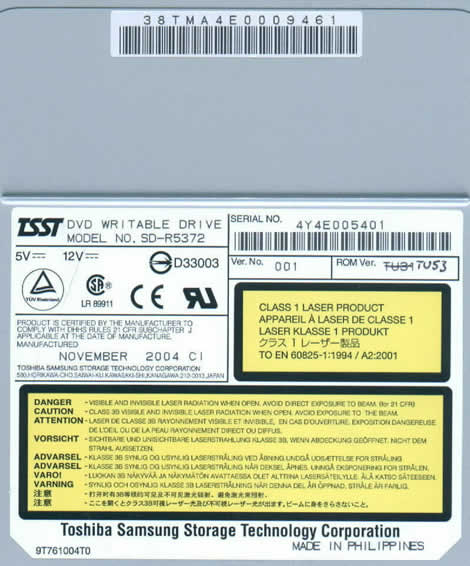
The bottom of the drive holds two stickers. We can see that this drive was made in the Philippines during November 2004.
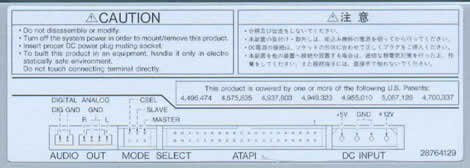
Caution sticker and jumper diagram, which is found on the top of the drive.
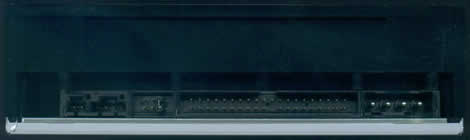
Here is the rear of the drive. Starting on the left we have a digital audio connector, analog audio connector, jumper pins to set the drive to master, slave or cable select, IDE connector, and finally the power connector.
On the next page we will take a look at the test machine testing software, drive features and the included software…
Test machine:
For this review we will be using a computer with the following configuration:
CPU: AMD Athlon XP 1533 MHz
Bus Speed: 133 MHz
Motherboard: KT400-8235
BIOS: Phoenix 6.00 PG
Memory: 768 MB (60ns)
Sound: Avance AC97 Audio
Video: NVIDIA GeForce2 GTS/GeForce2 Pro
Hard disk: Western Digital WD1600JB-00EVA0 160GB.
System set-up:

The Toshiba SD-R5372 was connected as Secondary Master and identified as TOSHIBA CD/DVDW SD-R5372. DMA (Direct Memory Access) and autorun was enabled for all devices.
Software:
Windows XP Professional SP2 is installed on this computer. We will be using the following software in this review:
⋅ DVDIdentifier 3.5
⋅ Nero Burning ROM version 6.6.0.6
⋅ Nero CD/DVD Speed v3.70
⋅ Nero InfoTool v2.27
⋅ Slysoft CloneCD v5.1.0.0
⋅ K-Probe v2.4.2
Installation and supported features:
Our drive came shipped with firmware TU51. We quickly installed the drive without any problems. Upon installation, we immediately updated to firmware version TU53. We later updated to firmware TU55 to test the 8X DVD+RW and 6X DVD-RW capabilities, but the majority of the review was done utilizing firmware TU53.

Toshiba's firmware update utility.
After a quick reboot we pulled up Nero InfoTool to obtain the following screenshot.

It is nice to see that the drive supports DVD-RAM reading. It does not support Mt. Rainier, but very few drives support this. The buffer size is listed as 2MB, however some other drives are built with an 8MB buffer. A larger buffer is preferred, but this is a minor complaint. All in all, the supported features look very good.
Here is another screenshot from Nero Burning ROM:

We notice that the Book Type Settings dialog is missing from Nero. Further testing indicates that this drive does indeed support bitsetting, which is a positive and can lead to better compatibility of DVD+R discs in older standalone players. DVD+R and DVD+R DL discs are both set with the DVD-ROM booktype automatically on this drive. DVD+RW discs are given a booktype of DVD+RW.
Included software:
Here we will take a look at the software that is included with the drive. Please take note that we may not use the included software in the performance testing part of the review.

The Nero program suite is owned and developed by Nero Software; it contains programs for creating most types of CD/DVD discs, a packet writing program, a media player, etc. This is one of our preferred writing program suites, and we give Toshiba two thumbs up for including this in their retail package.
Now it's time to take a look at the reading performance! Head on over to the next page…
Reading performance:
For these tests we will use Nero CD-DVD Speed to read various CD's and DVD's, including audio discs and DVD-Video. According to the specifications, this drive supports a specified read speed of 16X for DVD-ROM's and 48X for CD-ROM's.
Pressed CD-ROM discs:
For this test we used a pressed CD-ROM disc containing Canon Digital Camera Solution Disk ver 9.0 that is 73:12.38 minutes long. Below you will see the produced result:

We can see the drive had no trouble reading the entire disc, reaching 44.89x near the end. It appears that the Toshiba SD-R5372 would have been able to hit 48x if this CD-ROM would have been a full 80 minute disc.
| Pressed | Average | Start | End | Seek | Seek | Seek |
| Philips | 29.98x | 16.88x | 39.89x | 101ms | 113ms | 164ms |
| MSI | 30.45x | 17.77x | 40.11x | 94ms | 101ms | 154ms |
| BenQ | 30.78x | 17.52x | 40.39x | 99ms | 116ms | 167ms |
| Pioneer | 31.16x | 18.30x | 41.01x | 124ms | 142ms | 280ms |
| Samsung | 35.65x | 20.40x | 47.22x | 96ms | 102ms | 172ms |
| Mad Dog | 34.10x | 19.54x | 45.17x | 109ms | 127ms | 187ms |
| Philips | 35.69x | 20.59x | 47.25x | 118ms | 130ms | 206ms |
| AOpen | 37.34x | 21.29x | 49.42x | 105ms | 118ms | 196ms |
| LG | 31.10x | 17.91x | 40.93x | 102ms | 123ms | 192ms |
| Lite-On | 36.54x | 21.45x | 48.12x | 117ms | 140ms | 201ms |
| LG | 31.01x | 16.83x | 41.22x | 127ms | 118ms | 129ms |
| ASUS | 30.62x | 17.67x | 40.55x | 128ms | 147ms | 291ms |
| Samsung | 35.46x | 20.31x | 46.96x | 94ms | 102ms | 174ms |
Philips | 29.98x | 17.03x | 39.65x | 108ms | 121ms | 172ms |
NU | 31.45x | 17.54x | 41.59x | N/A | N/A | N/A |
Toshiba | 33.85x | 19.38x | 44.89x | 117ms | 126ms | 222ms |
Please note that CD-ROM size varies slightly in these
tests. The table should be used as a rough comparison between drives.
The Toshiba SD-R5372 is a good CD-ROM reader, but the seek
times are slightly high.
CD-Recordable discs:
For this test we made a copy of the original Canon Digital
Camera Solution CD. The disc we used was a Verbatim 48X certified CD-R disc
manufactured by Mitsubishi Chemicals Corporation.

CD-R read speeds are also looking good on this Toshiba
drive.
CD-R | Average | Start | End | Seek | Seek | Seek |
Philips | 30.68x | 17.53x | 40.51x | 96ms | 107ms | 157ms |
MSI | 30.45x | 17.71x | 40.08x | 81ms | 94ms | 142ms |
BenQ | 30.76x | 17.60x | 40.41x | 96ms | 106ms | 157ms |
Pioneer | 31.12x | 18.21x | 41.08x | 125ms | 143ms | 282ms |
Samsung | 36.49x | 21.20x | 48.13x | 91ms | 96ms | 165ms |
Mad Dog | 35.49x | 20.74x | 46.78x | 125ms | 131ms | 189ms |
Philips | 36.54x | 21.46x | 48.14x | 124ms | 151ms | 230ms |
AOpen | 36.49x | 21.20x | 48.11x | 99ms | 115ms | 185ms |
LG | 30.63x | 17.62x | 40.14x | 105ms | 129ms | 183ms |
Lite-On | 36.63x | 21.46x | 48.29x | 125ms | 157ms | 234ms |
LG | 30.53x | 16.83x | 40.27x | 116ms | 118ms | 128ms |
ASUS | 30.96x | 18.26x | 40.81x | 125ms | 143ms | 282ms |
Samsung | 36.65x | 21.28x | 48.33x | 92ms | 95ms | 163ms |
Philips | 30.69x | 17.68x | 40.44x | 126ms | 137ms | 175ms |
NU | 32.20x | 18.48x | 42.65 | N/A | N/A | N/A |
Toshiba | 35.55x | 20.66x | 46.95x | 107ms | 120ms | 204ms |
Please note that CD-R size varies slightly in these tests.
The table should be used as a rough comparison between drives.
The Toshiba SD-R5372 is an above average CD-R
reader.
CD-ReWriteable discs:
Again we made a copy of the original Canon Digital Camera
Solution CD. The disc we used was a Verbatim HighSpeed 12X CD-RW disc
manufactured by Mitsubishi Chemicals Corporation.

CD-RW reading maxed out at 23.77x, which is very close to
the 24x speed advertised. A larger capacity CD-RW disc would have definitely
allowed the drive to hit read speeds above 24x.
CD-RW | Average | Start | End | Seek | Seek | Seek |
Philips | 30.70x | 17.59x | 40.54x | 102ms | 111ms | 161ms |
MSI | 30.66x | 17.53x | 40.53x | 79ms | 91ms | 153ms |
BenQ | 31.36x | 17.55x | 41.44x | 109ms | 113ms | 194ms |
Pioneer | 25.45x | 14.74x | 33.72x | 130ms | 149ms | 291ms |
Samsung | 24.07x | 14.02x | 31.15x | 88ms | 97ms | 166ms |
Mad Dog | 25.92x | 14.93x | 34.33x | 126ms | 135ms | 200ms |
Philips | 23.81x | 13.97x | 31.39x | 122ms | 156ms | 232ms |
Aopen | 36.55x | 21.31z | 48.22x | 102ms | 114ms | 185ms |
LG | 30.64x | 17.69x | 40.56x | 105ms | 127ms | 180ms |
Lite-On | 24.25x | 14.04x | 32.15x | 129ms | 167ms | 233ms |
LG | 30.54x | 16.59x | 40.43x | 119ms | 116ms | 129ms |
ASUS | 25.32x | 14.63x | 33.52x | 129ms | 149ms | 288ms |
Samsung | 23.99x | 14.02x | 31.63x | 86ms | 95ms | 162ms |
Philips | 30.70x | 17.71x | 40.55x | 131ms | 149ms | 179ms |
NU | 32.20x | 18.17x | 42.53x | N/A | N/A | N/A |
Toshiba | 17.95x | 10.47x | 23.77x | 125ms | 129ms | 221ms |
Please note that CD-RW size varies slightly in these tests.
The table should be used as a rough comparison between drives.
The Toshiba SD-R5372 is the slowest CD-RW reader in our
comparison chart. It does perform as advertised at 24x CD-RW read, but it can't
compete with other drives that achieve 32x, 40x, or even 48x CD-RW reading
speeds.
Audio - Digital Audio Extraction:
To test the digital audio extraction performance of the
Toshiba SD-R5372, we again used Nero CD/DVD-Speed to measure the transfer rate.
The audio disc we used is approximately 74 minutes long (74:02:70).

The Toshiba
SD-R5372 hit just under 40x maximum when reading a 74 minute Audio CD.
Audio | Average | Start | End | Seek | Seek | Seek |
Philips | 31.43x | 17.55x | 41.67x | 107 ms | 122ms | 166ms |
MSI | 30.66x | 17.53x | 40.53x | 79ms | 91ms | 153ms |
BenQ | 31.36x | 17.55x | 41.44x | 109ms | 113ms | 194ms |
Pioneer | 25.45x | 14.74x | 33.72x | 130ms | 149ms | 291ms |
Samsung | 37.30x | 21.21x | 49.43x | 94ms | 110ms | 189ms |
Mad Dog | 25.71x | 14.82x | 34.09x | 120ms | 140ms | 194ms |
Philips | 37.40x | 21.06x | 49.59x | 117ms | 127ms | 204ms |
AOpen | 37.50x | 21.38x | 49.72x | 115ms | 120ms | 206ms |
LG | 31.37x | 17.57x | 41.39x | 95ms | 121ms | 211ms |
Lite-On | 36.92x | 21.36x | 48.89x | 126ms | 157ms | 234ms |
LG | 31.27x | 16.81x | 41.20x | 118ms | 124ms | 115ms |
ASUS | 31.10x | 19.91x | 41.38x | 125ms | 146ms | 286ms |
Samsung | 37.53x | 19.73x | 49.76x | 85ms | 97ms | 171ms |
Philips | 31.44x | 17.75x | 41.69x | 107ms | 124ms | 176ms |
NU | 32.98x | 18.32x | 43.70x | N/A | N/A | N/A |
Toshiba | 29.66x | 16.59x | 39.26x | 126ms | 133ms | 229ms |
Please note that Audio CD size varies slightly in these
tests. The table should be used as a rough comparison between drives.
The Toshiba SD-R5372 is one of the slower drives for
reading Audio CD's. On the positive side, the DAE Quality is a perfect 10 and it
does achieve an Accurate Stream.
Advanced Audio - DAE quality test:
Before we move on to testing DVD read speeds, we perform
one last audio test. This time we used the 'Advanced DAE Quality Test" feature
in CD-Speed.

The drive shows excellent Audio extracting quality and the
'Read CD Text" and 'Read Subchannel Data" features are supported, which is a
positive. Unfortunately, the drive is unable to read from the Leadin or the
Leadout of CDs. CD Speed also indicates that this drive might be too slow to be
used as the reading (source) drive during a 16x 'On The Fly' CD copy.
DVD
Reading
performance:
DVD - DVD Video:
For our DVD reading performance tests we are going to start
with single and double layer DVD video discs. While only 1X speed is required to
watch DVD movies, it is useful to be able to read the discs at higher speeds if
you're going to extract (rip) the content of the disc to your hard drive.

SL DVD Video

DL DVD Video
The Toshiba SD-R5372 was able to hit 16X read speeds on the
single layer DVD Video disc and approximately 8X on the double layer DVD Video
disc.
DVD | Average | Start | End | Average | Start | End |
Philips | 11.97x | 6.59x | 15.99x | 6.02x | 3.34x | 8.01x |
MSI | 8.67x | 4.83x | 11.54x | 6.37x | 3.56x | 8.48x |
BenQ | 11.87x | 6.60x | 15.79x | 6.01x | 3.36x | 8.00x |
Pioneer | 11.80x | 6.74x | 15.72x | 9.38x | 5.31x | 12.50x |
Samsung | 12.08x | 6.76x | 16.11x | 6.42x | 3.58x | 8.53x |
Mad Dog | 3.74x | 2.06x | 5.00x | 3.43x | 1.90x | 4.58x |
Philips | 9.62x | 6.77x | 6.52x | 6.19x | 3.45x | 8.22x |
AOpen | 12.04x | 6.71x | 16.05x | 6.61x | 3.68x | 8.79x |
LG | 7.62x | 4.26x | 10.16x | 6.16x | 3.44x | 8.18x |
Lite-On | 11.96x | 6.77x | 15.94x | 6.15x | 3.46x | 8.19x |
LG | 7.60x | 4.12x | 10.13x | 6.14x | 3.38x | 8.16x |
ASUS | 3.92x | 2.17x | 5.25x | 3.94x | 2.19x | 5.25x |
Samsung | 11.50x | 6.78x | 13.11x | 6.41x | 3.57x | 8.51x |
Philips | 11.97x | 6.61x | 15.97x | 6.02x | 3.35x | 8.01x |
NU | 6.40x | 3.54x | 8.53x | 5.87x | 3.26x | 7.81x |
Toshiba | 12.22x | 6.75x | 12.30x | 5.96x | 3.31x | 7.96x |
Please note that disc size varies slightly in these tests.
The table should be used as a rough comparison between drives.
The Toshiba SD-R5372 is one of the fastest drives for SL
DVD Video reading and it is also a good DL DVD Video reader.
DVD - DVD+R(W):
For this test we used a Taiyo Yuden 8X DVD+R and a RICOH 4X
DVD+RW with about 4.4GB of data. Below are the results:

DVD+R

DVD+RW
The Toshiba SD-R5372 reads DVD+R discs at 12x P-CAV (Partial Constant Angular Velocity) and
DVD+RW discs at 6x P-CAV.
DVD+R | Average | Start | End | Average | Start | End |
Philips | 6.23x | 3.39x | 8.35x | 6.25x | 3.43x | 8.37x |
MSI | 6.38x | 3.49x | 8.52x | 6.37x | 3.49x | 8.52x |
BenQ | 6.25x | 3.42x | 8.36x | 6.25x | 3.43x | 8.36x |
Pionner | 9.38x | 5.17x | 12.54x | 6.26x | 2.62x | 8.36 |
Samsung | 6.22x | 3.44x | 8.31x | 6.23x | 3.44x | 8.32x |
Mad Dog | 11.94x | 6.56x | 15.96x | 5.98x | 3.29x | 7.99x |
Philips | 6.23x | 3.44x | 8.33x | 6.23x | 3.47x | 8.33x |
AOpen | 8.79x | 4.83x | 11.73x | 5.83x | 3.20x | 7.79x |
LG | 7.69x | 4.25x | 10.29x | 6.15x | 3.41x | 8.22x |
Lite-On | 6.19x | 3.42x | 8.28x | 6.23x | 3.46x | 8.33x |
LG | 7.66x | 4.11x | 10.23x | 6.15x | 3.32x | 8.21x |
ASUS | 9.35x | 5.19x | 12.52x | 6.26x | 3.48x | 8.36x |
Samsung | 6.23x | 3.44x | 8.32x | 6.22x | 3.43x | 8.31x |
Philips | 6.24x | 3.42x | 8.34x | 6.24x | 3.42x | 8.34x |
NU | 6.47x | 3.53x | 8.63x | 6.46x | 3.52x | 8.65x |
Toshiba | 10.88x | 6.57x | 12.06x | 5.96x | 3.86x | 6.23x |
Please note that disc size varies slightly in these tests.
The table should be used as a rough comparison between drives.
The Toshiba 12X DVD+R reading speed is better than many
other drives and the P-CAV technique helps it to clock in the second best
Average Read Speed. DVD+RW reading speeds are one of the slowest out of all of
the drives that we have tested. The drive appears to be a very good reader and
we would have liked to see 16x DVD+R reading and also faster DVD+RW reading
speeds.
DVD - DVD-R(W) :
For this test we used a Taiyo Yuden 8X DVD-R disc and a
Verbatim 4X DVD-RW disc filled with approximately 4.38Gb of data. Our test
results are found below:

DVD-R

DVD-RW
The Toshiba SD-R5372 reads DVD-R discs at 12x P-CAV
(Partial Constant Angular Velocity) and DVD-RW discs at 6x P-CAV.
DVD-R | Average | Start | End | Average | Start | End |
Philips | 6.24x | 3.41x | 8.33x | 6.23x | 3.38x | 8.35x |
MSI | 6.37x | 3.46x | 8.51x | 6.36x | 3.48x | 8.51x |
BenQ | 6.24x | 3.40x | 8.35x | 6.23x | 3.40x | 8.33x |
Pioneer | 9.38x | 5.25x | 12.53x | 6.24x | 3.45x | 8.34x |
Samsung | 6.22x | 3.43x | 8.32x | 6.22x | 3.43x | 8.31x |
Mad Dog | 11.96x | 6.56x | 15.98x | 5.98x | 3.29x | 7.99x |
Philips | 6.10x | 3.39x | 8.16x | 6.11x | 3.39x | 8.17x |
Aopen | 8.80x | 4.83x | 11.76x | 5.88x | 3.23x | 7.84x |
LG | 7.68x | 4.26x | 10.26x | 6.16x | 3.41x | 8.23x |
Lite-On | 6.05x | 3.34x | 8.09x | 6.05x | 3.35x | 8.09x |
LG | 7.67x | 4.12x | 10.25x | 6.14x | 3.31x | 8.21x |
ASUS | 9.37x | 5.22x | 12.52x | 6.25x | 3.46x | 8.35x |
Samsung | 6.19x | 3.41x | 8.27x | 6.22x | 3.43x | 8.32x |
Philips | 6.23x | 3.40x | 8.33x | 6.24x | 3.41x | 8.34x |
NU | 6.46x | 3.49x | 8.66x | 6.46x | 3.49x | 8.64x |
Toshiba | 10.90x | 6.63x | 11.88x | 5.97x | 3.89x | 6.24x |
Please note that disc size varies slightly in these tests.
The table should be used as a rough comparison between drives.
Once again we see very good reading speeds with the write
once media (DVD-R) but very slow reading speeds with the rewriteable media
(DVD-RW) speeds. The Toshiba was the second fastest drive for reading
DVD-R discs, but it is one of the slowest DVD-RW readers.
DVD-RAM:
The specifications of the Toshiba SD-R5372 indicate that it
can read DVD-RAM media.

The Toshiba SD-R5372 reads DVD-RAM discs at 2x speed.
Special thanks to Tor Magne for performing this DVD-RAM read test.
Disc Recognition:
During our tests we also noticed that the Toshiba SD-R5372
seemed to take longer to initially recognize discs. To test the recognition time
against other drives, we used a Taiyo Yuden 8x DVD-R disc and clocked how long
it took the drives to fully recognize the disc.
Drive |
|
NEC | 16 |
LiteOn | 15 |
Memorex | 16 |
Toshiba | 24 |
From our testing we can see that the Toshiba SD-R5372 takes
a few more seconds to recognize discs compared to other DVD writers.
Overall Reading Performance thoughts:
The Toshiba SD-R5372 is a good reader with very good
performance on CD-ROM, CD-R, Single Layer DVD Video, DVD+R and DVD-R. Compared
to the competition, the Toshiba drive is slow at reading rewriteable media types
such as CD-RW, DVD+RW and DVD-RW. Audio Extraction quality is excellent. The
drive can read Double Layer DVD Video at 8X CAV, which is about average compared
to most drives on the market. We would still like to see double layer discs read
at slightly higher speeds. The Toshiba reads DVD+R and DVD-R at 12X P-CAV
(Partial-Constant Angular Velocity), which is faster than most other drives on
the market. We also definitely liked the ability to read DVD-RAM
discs!
But now let's head on to the next page for something more
interesting, CD-R Writing performance...
The specifications of the Toshiba SD-R5372 state that the drive is able to write CD-R discs at 48x. Let us find out how the drive really performs in speed and quality.
CD-R Writing performance:
First, let us examine the CD-R writing technology used by the Toshiba SD-R5372 by burning a data disc in CD-DVD Speed:

Here we can see that the Toshiba SD-R5372 has no trouble reaching it's rated CD-R write speed of 48X. The drive uses a CAV (Constant Angular Velocity) technique for CD-R writing to achieve a maximum of 48.55X and an average speed of 35.33x. Let us compare this to a few other drives.

We can see that the ASUS DRW-1604P uses Z-CLV (Zone-Constant Linear Velocity) to write CD-R at 32x. This gives an average write speed of 24.92x.

The Memorex F16 uses CAV (Constant Angular Velocity) to write CD-R at 48X, this gives an average speed of 37.23x.
We also used the Toshiba SD-R5372 to write a Memorex 52x CD-R disc with 700Mb of data using Nero Burning ROM software. Writing method used is DAO (Disc At Once), and the disc is set up as a non-multisession disc with 'finalize disc" enabled.

The Toshiba SD-R5372 took 2 minutes and 39 seconds to write the CD-R disc in Nero Burning ROM. Let us compare the Toshiba's CD-R writing speeds with some other drives in the table below.
| CD-R | Supported | Write | Start | End | Average | Write | Write |
| Plextor | 48x | CAV | 21.28x | 48.14x | 36.43x | 2m:43s | 2m:45s |
| Philips | 40x | CAV | 17.74x | 40.60x | 29.86x | 3m:21s | 3m:17s |
| BenQ | 40x | CAV | 17.75x | 40.61x | 29.37x | 3m:24s | 3m:23s |
| Pioneer | 32x | Z-CLV | 16.03x | 32.20x | 24.94x | 4m:00s | 4m:15s |
| Samsung | 40x | P-CAV | 20.91x | 39.55x | 34.27x | 2m:47s | 2m:49s |
| Mad Dog | 48x | CAV | 21.41x | 48.16x | 36.38x | 2m:56s | 2m:58s |
| Philips | 48x | CAV | 18.98x | 42.88x | 32.47x | 3m:01s | 3m:03s |
| Memorex | 48x | CAV | 21.74x | 49.42x | 37.23x | 2m:37s | 3m:11s |
| AOpen | 48x | CAV | 22.07x | 49.66x | 37.69x | 2m:44s | 2m:47s |
| LG | 40x | Z-CLV | 16.01x | 40.48x | 31.76x | 3m:15s | 3m:15s |
| Lite-On | 48x | CAV | 21.90x | 49.55x | 37.49x | 2m:38s | 2m:44s |
| Asus | 32x | Z-CLV | 16.03x | 32.66x | 24.92x | 3m:58s | 4m:05s |
| LG | 40x | Z-CLV | 16.00x | 40.91x | 31.74x | 3m:23s | 3m:17s |
| Toshiba | 48x | CAV | 21.53x | 48.55x | 35.33x | 2m:44s | 2m:39s |
We can see here that the Toshiba drive is one of the fastest CD-R burners listed in our table. The SD-R5372 achieved the fastest CD-R write time in Nero Burning ROM. What about the CD-R write quality of the Toshiba SD-R5372? Let's find out now!
CD-R Write Quality:
Here we will test with a variety of different CD-R discs to measure speed and write quality. To really measure the write speed, we used the 'create data CD" function in Nero CD-DVD Speed. The discs were written at the maximum speed that the drive supports. For the quality test we used K-Probe 2, which is a tool developed by a Lite-On Employee. Kprobe runs on Windows and functions with drives made by Lite-On. Please note that different drives as well as different reading speeds may affect the results obtained when scanning the discs. Here we used a Lite-On LTR-32123S drive with firmware XS0Z and scanned the discs at 40X speed (Actual speed is approximately 43X CAV on 80 minute CD-Rs).
A written CD-R disc will always have some C1 errors reported by the scanning drive; C1 errors are easily corrected by the drive's error correction capabilities. The next level of errors is C2. C2 errors can also be corrected by most drive's error correction capabilities, but they are not wanted with a good quality disc. A good disc should not have any C2 errors being reported, and preferably have an average C1 error amount of below 2.0 for the best discs, or at least below a 10.0 C1 average for good quality discs. After C2 errors there are only un-correctable errors that will make a disc unusable.
We now present you with our results:

| Brand: | Verbatim Data Life Plus '“ (Thanks to Verbatim USA for providing) |
| Manufacturer: | Mitsubishi Chemicals Corporation |
| Code: | 97m34s23f |
| Disc Type: | CD-R |
Recording Layer: | Dye |
Capacity: | 79:59.73 (703MB) |
Certified Speed: | 52x |
Write | 48x |
Write | 2m:44s |
C1 | 0.85 |
C2 | 0.0 |
Fantastic C1
average and very good results overall! We can easily recommend these CD-R
discs.

Brand: | Office |
Manufacturer: | Moser |
Code: | 97m17s06f |
Disc | CD-R |
Recording Layer: | Dye |
Capacity: | 79:59.74 (703MB) |
Certified Speed: | 52x |
Write | 48x |
Write | 2m:45s |
C1 | 2.36 |
C2 | 0.0 |
Good C1
average, good results, good discs!

Brand: | Memorex |
Manufacturer: | CMC |
Code: | 97m26s66f |
Disc | CD-R |
Recording Layer: | Dye |
Capacity: | 79:59.71 (703MB) |
Certified Speed: | 52x |
Write | 48x |
Write | 2m:44s |
C1 | 2.72 |
C2 | 0.0 |
The Toshiba
is knocking down CD-R types one after another with good results. Again the C1
Average is nice and low. This Memorex brand 52x CD-R works great on this drive.

Brand: | Fujifilm '“ (Thanks to Fujifilm USA for |
Manufacturer: | Taiyo |
Code: | 97m24s01f |
Disc | CD-R |
Recording Layer: | Dye |
Capacity: | 79:59.72 (703MB) |
Certified Speed: | 48x |
Write | 48x |
Write | 2m:45s |
C1 | 0.80 |
C2 | 0.0 |
Taiyo Yuden
discs are well known for their excellent quality. The Toshiba SD-R5372 does a
good job with these Fujifilm branded discs.

Brand: | Harmony |
Manufacturer: | Digital |
Code: | 97m27s06f |
Disc | CD-R |
Recording Layer: | Dye |
Capacity: | 79:59.73 (703MB) |
Certified Speed: | 24x |
Write | 8x |
Write | 10m:49s |
C1 | 1.42 |
C2 | 0.0 |
The Toshiba
SD-R5372 only supports these 24x certified discs at 8x maximum. While this might
sound disappointing, these low quality discs usually cause trouble in other
drives such as slow downs and poor write quality. The produced write quality is
very good.

Brand: | GQ |
Manufacturer: | Lead |
Code: | 97m26s54f |
Disc | CD-R |
Recording Layer: | Dye |
Capacity: | 79:59.74 (703MB) |
Certified Speed: | 52x |
Write | 8x |
Write | 10m:50s |
C1 | 1.65 |
C2 | 0.0 |
These 52x
certified discs could only be written at 8x maximum. These discs are lower
quality CD-R, and we could accept a slower writing speed than 52x, but 8x is way
too slow! At least the produced quality is good. The Average C1 error value is
low and there are no C2 errors.

Brand: | GQ |
Manufacturer: | Lead |
Code: | 97m24s16f |
Disc | CD-R |
Recording Layer: | Dye |
Capacity: | 79:59.74 (703MB) |
Certified Speed: | 52x |
Write | 48x |
Write | 2m:46s |
C1 | 1.63 |
C2 | 0.0 |
Great results
on this SONY ATIP CD-R manufactured by Lead Data. Now why couldn't Toshiba have
supported the other Lead Data CD-R as well as this?

Brand: | FujiFilm '“ (Thanks to FujiFilm USA for |
Manufacturer: | Prodisc |
Code: | 97m32s19f |
Disc | CD-R |
Recording Layer: | Dye |
Capacity: | 79:59.73 (703MB) |
Certified Speed: | 32x |
Write | 48x |
Write | 2m:44s |
C1 | 2.49 |
C2 | 0.0 |
Can this
drive ever produce a bad quality CD-R disc? Not in any of our tests! Another
good result! Another Fujifilm CD-R produced with good results.

Brand: | I/O |
Manufacturer: | RiTEK |
Code: | 97m15s17f |
Disc | CD-R |
Recording Layer: | Dye |
Capacity: | 79:59.70 (703MB) |
Certified Speed: | 48x |
Write | 48x |
Write | 2m:45s |
C1 | 0.57 |
C2 | 0.0 |
Fantastic C1
Average at 0.57! The Toshiba SD-R5372 can really produce some nice Ritek CD-R
discs.
Writing
data CD-RW discs:
The
specifications of the Toshiba SD-R5372 state that the drive is able to write
CD-RW discs at 24x maximum. Let us find out how the drive really performs in
speed and quality. First, let us examine the CD-RW writing technology
used;

The Toshiba
SD-R5372 writes at 24x to Ultra Speed CD-RW discs using Z-CLV (Zone-Constant Linear Velocity). The drive
uses 4 zones to achieve 24x CD-RW writing.
We also wrote
a disc with 650Mb of data using Nero Burning ROM software. Writing method used
is DAO (Disc At Once), and the disc is set up as a non-multisession disc with 'finalize disc"
enabled.

The Toshiba drive took 4 minutes and 16 seconds to write
650 MB to the CD-RW disc. Again we present a comparison table.
CD-RW | Supported | Write | Start | End | Average | Write | Write |
Plextor | 24x | P-CAV | 21.12x | 24.00x | 23.89x | 3m:40s | 3m:34s |
Philips | 24x | P-CAV | 17.74x | 25.20x | 23.13x | 3m:56s | 3m:41s |
BenQ | 24x | P-CAV | 17.73x | 24.54x | 23.14x | 3m:54s | 3m:40s |
Pioneer | 24x | Z-CLV | 16.00x | 24.06x | 22.47x | 4m:04s | 4m:00s |
Samsung | 32x | P-CAV | 20.94x | 31.85x | 30.21x | 3m:10s | - |
Mad Dog | 24x | Z-CLV | 20.08x | 24.01x | 23.68x | 3m:52s* | 3m:53s |
Philips | 24x | Z-CLV | 16.04x | 24.07x | 22.63x | 4m:10s | - |
AOpen | 24x | Z-CLV | 16.01x | 24.03x | 22.06x | 4m:17s | - |
LG | 24x | Z-CLV | 16.01x | 23.80x | 23.35x | 3m:54s | - |
Lite-On | 24x | Z-CLV | 15.98x | 23.97x | 22.57x | 4m:19s | 3m:55s |
ASUS | 24x | Z-CLV | 15.96x | 24.00x | 22.46x | 4m:07s | 3m:50s |
LG | 24x | Z-CLV | 16.00x | 24.00x | 23.33x | 3m:57s | 3m:34s |
Toshiba | 24x | Z-CLV | 12.03x | 24.07x | 20.23x | 4m:19s | 4m:16s |
We can see that the Toshiba SD-R5372 is one of the slowest
CD-RW burners in our comparison table. The additional fourth zone definitely
slows up the overall burn process, but does it lead to higher quality CD-RW
burns? Let's find out now by performing some CD-RW write quality
tests.
CD-RW
Write Quality:

Brand: | Verbatim '“ (Thanks to Verbatim USA for |
Manufacturer: | Mitsubishi Chemicals Corporation |
Code: | 97m34s25f |
Disc | CD-RW |
Recording Layer: | Phase |
Capacity: | 74:43.00 (656MB) |
Certified Speed: | 32x |
Write | 24x |
Write | 4m:19s |
C1 | 436.60 |
C2 | 0.0 |
The C1 errors
are very high, but at least there are no C2 errors and the disc appears to be
fully readable. We have seen better results with these discs on other drives. It
is much more difficult to obtain a good quality result on CD-RW discs compared
to CD-R discs. Since there are no C2 errors we consider this an ok result, but
it could be better.

Brand: | Memorex |
Manufacturer: | Infodisc |
Code: | 97m25s31f |
Disc | CD-RW |
Recording Layer: | Phase |
Capacity: | 79:59.73 (703MB) |
Certified Speed: | 24x |
Write | 24x |
Write | 4m:31s |
C1 | 2064.00 |
C2 | 0.79 |
Results here
are not good. C1 errors jump into the 3000+ range and the dreaded C2 errors also
make an appearance.

Brand: | Verbatim '“ (Thanks to Verbatim USA for |
Manufacturer: | Mitsubishi Chemicals Corporation |
Code: | 97m34s23f |
Disc | CD-RW |
Recording Layer: | Phase |
Capacity: | 74:43.00 (656MB) |
Certified Speed: | 4-12x |
Write | 10x |
Write | 7m:59s |
C1 | 78.89 |
C2 | 0.0 |
These results
are acceptable for a CD-RW disc. 'Lower" C1 errors compared to the other CD-RW
discs and there are no C2 errors showing up.

Brand: | Memorex |
Manufacturer: | Infodisc |
Code: | 97m25s30f |
Disc | CD-RW |
Recording Layer: | Phase |
Capacity: | 79:59.73 (703MB) |
Certified Speed: | 4-12x |
Write | 10x |
Write | 8m:38s |
C1 | 21.71 |
C2 | 0.0 |
This Memorex
High Speed 12x CD-RW produced the best result out of all the CD-RW media tested
here. There is a C1 average of 21.71 and there are no C2 errors anywhere to be
found, which is good.
CD-R/RW performance Summary:
The Toshiba's CD-R writing performance is excellent as far
as speed and quality is concerned. Every single type of CD-R we tested produced
a good quality CD-R disc. Our only complaint in the CD-R realm is that the 52x
Lead Data CD-R's are only supported at 8x. CD-RW writing is slow compared to the
competition and the write quality for 24x CD-RW writing could use some
improvement. Overall it is an excellent CD-R writer and an ok CD-RW
writer.
But after
all, it's a DVD-Writer, so head on to next page and read about DVD-Writing
performance and DVD media compatibility…
The specifications of this drive tell us that it should write both DVD+R and DVD-R discs at 16x. In this portion of the review we will measure the write time for various types of DVD-/+R discs. We will also focus on write quality and media compatibility.
DVD-Writing performance:
First, we shall take a look at the writing technology used for DVD+R and DVD-R writing.
16X DVD+R Writing speed:

The Toshiba SD-R5372 uses CAV (Constant Angular Velocity) to write DVD+R at 16x. This gives an average writing speed of 11.70x and a total write time of 5 minutes and 34 seconds. The Toshiba uses some type of running OPC technology when writing (shown as small dips in the transfer curve above), which should help to improve burn quality. We tested numerous 16X DVD+R discs and this is the fastest result we could obtain. On many of our tests the write speed dropped to 12x near the end of the burn.
16X DVD-R Writing speed:

The Toshiba SD-R5372 also uses CAV (Constant Angular Velocity) to write DVD-R at 16x. This gives an average writing speed of 11.74x and a total write time of 5 minutes and 43 seconds. We tested with numerous Verbatim 16x DVD-R discs, and this is the only disc that completed at full 16x speed. Let us compare to the writing techniques used by a few other drives.

The ASUS DRW-1604P uses Z-CLV, (Zone-Constant Angular Velocity) to write DVD+R at 16X. This gives an average write speed of 10.29x and a total burn time of 6 minutes and 48 seconds.

The LG GSA-5163D uses P-CAV (Partial-Constant Angular Velocity) to write at 16x speed. This gives an average speed of 12.75x and a total writing time of 5 minutes and 30 seconds.
We can see that the Toshiba drive is faster than the ASUS DVD writer, but a little bit slower than the LG DVD writer. Let us compare the writing time statistics to a larger pool of DVD writers in the table below.
| 16x | Write | Supported | Start | End | Average | Write |
| Plextor | P-CAV | 12x +R | 6.04x | 12.08x | 10.35x | 6m:15s |
| Philips | CAV | 16x +R | 4.52x | 16.02x | 11.56x | 5m:48s |
| NEC | CAV | 16x +R | 6.75x | 15.96x | 11.70x | 6m:04s |
| Pioneer | Z-CLV | 16x +R | 6.01x | 16.20x | 10.32x | 6m:51s* |
| BenQ | CAV | 16x +R | 5.37x | 16.00x | 11.51x | 5m:47s |
| Philips | CAV | 16x +R | 6.69x | 16.00x | 11.98x | 5m:52s |
| Samsung | CAV | 16x +R | 6.74x | 12.09x | 12.03x | 5m:58s |
| Mad Dog | CAV | 16x +R | 6.64x | 15.96x | 11.69x | 6m:05s |
Memorex | CAV | 16x +R | 6.65x | 15.97x | 11.95x | 5m:59s |
Aopen | CAV | 16x +R | 6.69x | 15.90x | 11.90x | 6m:51s |
LG | P-CAV | 16x +R | 7.30x | 16.01x | 12.87x | 5m:34s |
Lite-On | CAV | 16x +R | 6.66x | 16.02x | 11.97x | 6m:01s |
ASUS | Z-CLV | 16x +R | 6.01x | 16.04x | 10.29 | 6m:48s |
LG | P-CAV | 16x +R | 7.30x | 15.94x | 12.75x | 5m:30s |
Toshiba | CAV | 16x +R | 5.88x | 16.07x | 11.70x | 5m:34s |
*Actual
writing time was only 12x for the Pioneer DVR-A08XLA on 16x DVD+R.
Taking a look at the table, we can see that the Toshiba
drive is one of the fastest DVD writers available. The only drives that are
faster at 16x DVD writing are the two offerings from LG.
A more
important question is; how is the DVD±R/RW write quality of this drive? After
all, you do want to be able to produce discs that are readable and useful. Let
us find out now!
Write quality analysis:
You should first take note that this is not a scientific
and professional way to test the discs. But according to our testing done in the
past, we would conclude that there is a clear link between the quality reported
when scanning the disc and the playability of the disc in different devices.
Also notice that different drives report different amounts of errors. K-Probe was designed to work with Lite-On DVD-Writers. So we recommend using a
DVD-Writer from Lite-On. In these
tests we use a Lite-On SOHW-1633S
DVD-Writer. Remember that scans done with a Lite-On DVD-ROM or Lite-On combo drive can't be compared with the
results obtained with a Lite-On
DVD-Writer. Also remember that different PI/PIF ECC sum settings along with different reading speeds
in K-Probe will affect the result, we use these
settings; PI (Parity Inner) set to summarize 8 ECC blocks, PIF (Parity Inner Failures) set to
summarize 1 ECC block, reading
speed: 4X CLV (Constant Linear Velocity). Setting the PI sum to 8 and the PIF sum to 1 will give a result that we
may compare to the standards for DVD+R/RW and DVD-R/RW.
But what is a good scan? That is a discussion that we don't
think will end soon. This is due to the fact that different drives report
different amounts of errors, some players are more picky about media than others
and many other factors. For comparison purposes we present you with a scan from
two pressed DVD discs.
This scan below shows the results from a pressed, Single
Layer DVD-Video disc (Ronin
DVD).

This next scan shows the result from a pressed Double Layer
DVD-Video disc (Lord of the Rings, The Return of the King). Notice the error
jump when shifting to the second layer (the error levels actually drop from the
end of the first layer to the beginning of the second layer).

If you read below you will see that both of the pressed
DVD-discs are well within the standards.
Download the ECMA 267 Standard for DVD-ROM, the ECMA 337 Standard for DVD+R/RW and the ECMA 338 Standard for DVD-R/RW at http://www.ecma-international.org if you want to look at the standards for yourself. Here is
some data from the ECMA standards
(it is the same for DVD-ROM, DVD-R/RW and DVD+R/RW):
Random errors:
A row of an
ECC Block that has at least 1
byte in error constitutes a PI error. In any 8
consecutive ECC Blocks the total number of PI errors before
correction shall not exceed 280.
Here we see what a PI error is defined as a row in an ECC block having 1 byte or more
containing errors. And that the sum of PI errors in 8 ECC blocks after each other should not exceed 280 PI
errors.
But what is a row and what is an ECC block? Again we refer to the ECMA standards. We did not copy and paste everything
but if you are interested in further details, please look in the ECMA standards. A row is 182 bytes long
where the last 10 bytes contain PI (Parity Inner) information. An ECC block is 208 rows long where the last 16 rows
contain the PO (Parity Outer) information. This gives us a maximum possible PI
error amount of 208 errors per block and for 8 blocks after each other this sum
is of course 8 times higher giving a maximum possible amount of 1664 PI-8
errors. In practical use a disc with 1664 PI-8 errors is unreadable.
According to our tests the specified max PI-8 sum of 280
for good discs seems to be a good guideline, as some readers have problems
reading discs when the PI-8 errors are over 300 and most players start to have
problems when the PI-8 error level reaches 600 or more.
But what are the PIF errors that K-Probe reports? They are Parity
Inner Failures, meaning errors left after PI correction. Only the ECMA 337 standard describes the Parity
Inner Failures. So how is a Parity Inner Failure defined? Here is what the ECMA 337 states:
'If a row of
an ECC Block as defined in 13.3
contains more than 5 erroneous bytes, the row is said to be 'PI-uncorrectable"."
In theory an
ECC block may in the worst case
have 208 PIF since every ECC block is 208 rows long. But the
ECMA 337 standard goes further
and specifies the max amount of accepted PI Failures (uncorrectable errors) allowed on a good
disc:
'- In any ECC Block the number of PI-uncorrectable rows should not exceed
4."
This means that when the PIF sum is set to 1 the maximum error value should
not exceed 4. The theoretical maximum value for PIF is 208 errors.
But what makes a disc unreadable? A POF (Parity Outer Failure) error will
make the disc unreadable, but K-Probe does not display the POF's.
Notice that there are other aspects such as disc
reflectivity, jitter, tracking errors and so on that also will affect the
readability of a DVD disc '“ but for this we do not have measuring equipment
available.
Another detail to note is that we have scanned the discs at
4X CLV speed, by lowering the
speed to 2X(DVD-R/RW)/2.4X(DVD+R/RW) or 1X the amount of reported
errors may drop on some discs. We use the 4X CLV scan speed for all of our PI/PIF
tests.
To see if there is a connection between the reported amount
of errors and readability of the discs, we also include a transfer rate test
reading curve from the NEC ND-3500A DVD-Writer. A small speed reduction near the
end of the reading curve is still accepted on good discs, but serious reading
problems or reading failures is a bad sign.
Easier explanation on how to read the test
results.
Maybe this got too technical, and you are just wondering
what to look for in a Kprobe
graph?
Use this as a guideline for
good discs:
PI (Parity Inner): No larger areas on the disc should exceed 280 PI-8 errors,
do not worry too much about high single spikes that exceed 280. Lower error
levels are always better.
PIF
(Parity Inner Failures): No larger areas on the disc should
exceed 4 PIF-1 errors, do not worry too much about high single spikes that
exceed 4. Lower error levels are always better.
What about the reading curve? If the graph looks smooth
with no dips then the disc should be very good. A small slowdown near the end is
acceptable.
DVD+R media compatibility and write
quality:


Brand: | SONY '“ |
Manufacturer: | SONY |
Code: | SONYD21 |
Disc | DVD+R |
Capacity: | 4483MB |
Certified Speed: | 16x |
Write | 16x |
Write | 5m:34s |
PI-8 | 3.29 |
PI-1 | 0.04 |
There are a few PIF spikes in the Kprobe scan, but the
averages look good and the transfer rate test is perfect. This is a good 16x
DVD+R burn.


Brand: | Memorex |
Manufacturer: | CMC |
Code: | CMC |
Disc | DVD+R |
Capacity: | 4483MB |
Certified Speed: | 16x |
Write | 8x |
Write | 8m:18s |
PI-8 | 14.82 |
PI-1 | 0.10 |
This 16x DVD+R media from Memorex is only supported at 8x,
but the write quality is good. Nice looking Kprobe results and a very smooth
CD-DVD Speed reading curve. With these positive results at 8x, we really have to
wonder why Toshiba does not support these discs at 16x? We would also like to
note that the SD-R5372 burns 8x DVD+R using a P-CAV (Partial-Constant Linear
Velocity) technique, which leads to faster 8x DVD+R burn times compared to
Z-CLV.


Brand: | Verbatim '“ (Thanks to Verbatim USA for |
Manufacturer: | Mitsubishi Chemicals Corporation |
Code: | MCC004 |
Disc | DVD+R |
Capacity: | 4483MB |
Certified Speed: | 16x |
Write | 16x |
Write | 5m:36s |
PI-8 | 1.57 |
PI-1 | 0.02 |
The Kprobe
results look relatively good here, but the irregular PIF spikes are somewhat
concerning. The transfer rate test had quite a few dramatic drops in reading
speed, which illustrates some quality problems. We also burned a few other
MCC004 discs that turned out to be unreadable. Toshiba could use some
improvements in write quality with these discs.


Brand: | Ritek '“ |
Manufacturer: | Ritek |
Code: | RITEKR04 |
Disc | DVD+R |
Capacity: | 4483MB |
Certified Speed: | 16x |
Write | 12x |
Write | 5m:59s |
PI-8 | 21.65 |
PI-1 | 0.09 |
Unfortunately
these 16x discs can only be written at 12x. PI error levels look good and
the PIF average is also good. There are a few PIF spikes here and there, but
they are not very concerning. Overall this is an ok result for a 12x DVD+R
write.


Brand: | FujiFilm '“ (Thanks to Fujifilm USA for |
Manufacturer: | Taiyo |
Code: | YUDEN000T02 |
Disc | DVD+R |
Capacity: | 4483MB |
Certified Speed: | 8x |
Write | 12x |
Write | 5m:59s |
PI-8 | 0.85 |
PI-1 | 0.02 |
These 8x
discs could be burned at 12x! The quality results are impressive here with
Fujifilm branded Taiyo Yuden media. We tested with additional discs and the
results were not always this consistent with regards to the good
quality.


Brand: | Prodisc |
Manufacturer: | Prodisc |
Code: | PRODISC |
Disc | DVD+R |
Capacity: | 4483MB |
Certified Speed: | 8x |
Write | 6x-8x |
Write | 11m:14s |
PI-8 | 2.29 |
PI-1 | 0.04 |
The first
PRODISCR03 disc that we tried burning at 8x had some major quality issues and
resulted in an unreadable disc. The 2nd disc
(above) slowed down during the 8x write process (to 6x) and produced an
excellent result.


Brand: | RiDATA |
Manufacturer: | Ritek |
Code: | RITEK |
Disc | DVD+R |
Capacity: | 4483MB |
Certified Speed: | 8x |
Write | 8x |
Write | 7m:41s |
PI-8 | 3.52 |
PI-1 | 0.03 |
The PI/PIF
results are very good and the reading curve is acceptable. The only alarming
item to point out is the large drop in reading speed at the very end of the
transfer rate test.


Brand: | Verbatim '“ (Thanks to Verbatim USA for |
Manufacturer: | Mitsubishi Chemicals Corporation |
Code: | MCC |
Disc | DVD+R |
Capacity: | 4483MB |
Certified Speed: | 8x |
Write | 8x |
Write | 8m:28s |
PI-8 | 2.76 |
PI-1 | 0.27 |
Ouch! We have
some large PI/PIF spikes near the end of the Kprobe graph and some heavy drops
in reading speed near the end of the CD-DVD Speed test. Toshiba could use some
write quality improvements with Verbatim media!


Brand: | Memorex |
Manufacturer: | CMC |
Code: | CMCMAG |
Disc | DVD+R |
Capacity: | 4483MB |
Certified Speed: | 8x |
Write | 8x |
Write | 11m:26s |
PI-8 | 7.99 |
PI-1 | 0.19 |
Even though
the PI and PIF averages look good, there is a large PIF spiking and the
resulting disc is unreadable. We tested with numerous pieces of CMCMAGE01 media
and the Toshiba had trouble almost every time. This definitely needs
improvement! This is one of the most common media types on the
market!


Brand: | GQ |
Manufacturer: | Optodisc |
Code: | OPTODISC OR8 |
Disc | DVD+R |
Capacity: | 4483MB |
Certified Speed: | 8x |
Write | 8x |
Write | 7m:42s |
PI-8 | 1.56 |
PI-1 | 0.01 |
The Kprobe
scan looks great but the reading curve has some major trouble in the middle and
near the end of the disc. These are not the best quality discs but the Toshiba
SD-R5372 did an ok job with them.
DVD+RW media compatibility and write
quality:
The
specifications of the Toshiba firmware TU55 state that it supports DVD+RW
writing up to 8x speeds. We tested with a couple different types of 8x DVD+RW
media, but unfortunately none of these were supported at 8x by the Toshiba
SD-R5372.

Verbatim 8x DVD+RW, maximum recording speed with this
recorder is 2.5x.

Ritek 8x DVD+RW, maximum recording speed with this recorder
is 4x.
These are the
only two types of 8x DVD+RW media currently available. So where is this
mysterious 8x DVD+RW writing capability that Toshiba claims with firmware TU55?
We don't know! We could only perform DVD+RW tests at 4x maximum.


Brand: | Ritek '“ |
Manufacturer: | Ritek |
Code: | RICOH |
Disc | DVD+RW |
Capacity: | 4483MB |
Certified Speed: | 4x |
Write | 4x |
Write | 15m:01s |
PI-8 | 12.03 |
PI-1 | 0.62 |
PI/PIF
results look good and the reading curve is also okay. Note that this DVD+RW disc
was unreadable in our NEC ND-3500AG drive, so we had to perform the transfer
rate test on the LiteOn SOHW-1633S instead.


Brand: | Verbatim |
Manufacturer: | Mitsubishi Chemicals Corporation |
Code: | MKM |
Disc | DVD+RW |
Capacity: | 4483MB |
Certified Speed: | 4x |
Write | 4x |
Write | 14m:52s |
PI-8 | 198.70 |
PI-1 | 5.72 |
Again our NEC
ND-3500AG drive could not read the disc so we used the LiteOn SOHW-1633S for a
transfer rate test. The results are some very high PI spikes along with a
troublesome reading curve. Toshiba could use some improvements with the write
strategy on this media.
Other DVD+RW media:
We also
tested with two other types of 4x DVD+RW discs; OPTODISCOP4 and INFODISCA10.
Unfortunately both of these disc types were only supported at 2.4x maximum write
speed.
DVD+R/RW Performance Summary:
To be honest we were not too impressed with the overall
write quality with DVD+R media. Some discs were written with good quality and
some were written with bad quality. Toshiba needs to work on improving the
writing quality and supporting more media at certified speeds. For DVD+RW
writing, Toshiba SD-R5372 did not support 8x DVD+RW writing on either Verbatim
or Ritek 8x DVD+RW even though Toshiba claims that firmware TU55 should support
it. 4x DVD+RW writing quality could use some improvement and Toshiba also needs
to fix their media compatibility to support the 4x DVD+RW discs from OPTODISC
and INFODISC.
Head on to
the next page and read about DVD-R/RW compatibility and write
quality...
DVD-R/RW media compatibility and write quality:


| Brand: | Verbatim Data Life Plus |
| Manufacturer: | CMC '“ With Mitsubishi Technology |
| Code: | MCC 03RG20 |
| Disc Type: | DVD-R |
| Capacity: | 4489MB |
| Certified Speed: | 16x |
| Write Speed: | 16x |
| Write Time: | 5m:43s |
| PI-8 errors Average/Sec: | 50.13 |
| PI-1 failures (PIF) Avg/Sec: | 0.13 |
Hold your horses! This 16x DVD-R burn turns into an unreadable mess. We burned multiple pieces of Verbatim 16x DVD-R and had reading problems on all of the resulting discs.


| Brand: | SONY (Thanks to SONY USA for providing) |
| Manufacturer: | SONY Japan |
| Code: | SONY16D1 |
| Disc Type: | DVD-R |
| Capacity: | 4489MB |
| Certified Speed: | 16x |
| Write Speed: | 16x |
| Write Time: | 6m:36s |
| PI-8 errors Average/Sec: | 17.86 |
| PI-1 failures (PIF) Avg/Sec: | 0.12 |
This disc
started burning at 16x, but the Toshiba then dropped the burn speed to 12x about half way through the burn. PI/PIF Averages are ok and the reading curve looks ok until the very end of the disc. This is an acceptable result.


| Brand: | SONY (Thanks to SONY USA for providing) |
| Manufacturer: | SONY Japan |
| Code: | SONY08D1 |
| Disc Type: | DVD-R |
| Capacity: | 4489MB |
| Certified Speed: | 8x |
| Write Speed: | 12x |
| Write Time: | 7m:41s |
| PI-8 errors Average/Sec: | 6.52 |
| PI-1 failures (PIF) Avg/Sec: | 0.11 |
This 8x DVD-R was able to be written at 12x. At the very end of the burn, the speed dropped to 8x. The quality is very good on this disc except for the very end of the disc where the burn speed dropped.


| Brand: | Verbatim Data Life Plus |
| Manufacturer: | Mitsubishi Chemicals Singapore |
| Code: | MCC 02RG20 |
| Disc Type: | DVD-R |
| Capacity: | 4489MB |
| Certified Speed: | 8x |
| Write Speed: | 8x |
| Write Time: | 9m:57s |
| PI-8 errors Average/Sec: | 8.83 |
| PI-1 failures (PIF) Avg/Sec: | 1.19 |
The SD-R5372 writes 8x DVD-R using a 3 zoned Z-CLV (Zone-Constant Linear Velocity) technique. Very large PI/PIF spiking at the end of the disc and an unrecovered read error in the transfer rate test. Very bad results. Toshiba needs to fix the writing strategies for this media. We tried multiple discs and received similar results each time.


| Brand: | Fujifilm '“ (Thanks to Fujifilm USA for providing) |
| Manufacturer: | Taiyo Yuden |
| Code: | TYG02 |
| Disc Type: | DVD-R |
| Capacity: | 4489MB |
| Certified Speed: | 8x |
| Write Speed: | 12x |
| Write Time: | 7m:25s |
| PI-8 errors Average/Sec: | 34.52 |
| PI-1 failures (PIF) Avg/Sec: | 0.15 |
Now this is just sad. This is one of the worst results I have ever seen on this high quality Taiyo Yuden 8x DVD-R media. The resulting disc appears to be useable but we are accustomed to much better results when using these high quality discs.


| Brand: | RiDATA (Thanks to Advanced Media/Ritek USA for providing) |
| Manufacturer: | Ritek |
| Code: | RITEKG05 |
| Disc Type: | DVD-R |
| Capacity: | 4489MB |
| Certified Speed: | 8x |
| Write Speed: | 4x |
| Write Time: | 15m:14s |
| PI-8 errors Average/Sec: | 23.55 |
| PI-1 failures (PIF) Avg/Sec: | 0.15 |
Unfortunately, these 8x RiDATA DVD-R discs are only supported at 4x maximum write speed. The resulting quality is good, but what is Toshiba thinking by only supporting these very popular 8x discs at only 4x?


| Brand: | Unbranded |
| Manufacturer: | Prodisc |
| Code: | ProdiscF01 |
| Disc Type: | DVD-R |
| Capacity: | 4489MB |
| Certified Speed: | 8X |
| Write Speed: | 8X |
| Write Time: | 9m:55s |
| PI-8 errors Average/Sec: | 9.02 |
| PI-1 failures (PIF) Avg/Sec: | 0.05 |
These results are a pleasant suprise. ProdiscF01 media was burned at 8x with very good quality. We can recommend these discs for use with the Toshiba SD-R5372.


| Brand: | Memorex '“ (Thanks to Memorex for providing) |
| Manufacturer: | CMC |
| Code: | CMC MAG. AE1 |
| Disc Type: | DVD-R |
| Capacity: | 4489MB |
| Certified Speed: | 8x |
| Write Speed: | 8x |
| Write Time: | 9m:51s |
| PI-8 errors Average/Sec: | 12.06 |
| PI-1 failures (PIF) Avg/Sec: | 0.98 |
The resulting disc displays some very high PI/PIF spiking and major slowdowns at the end of the reading curve. It produced a working disc, but the writing quality still needs improvement.


| Brand: | SpinX |
| Manufacturer: | Moser Baer India |
| Code: | MBI 01RG20 |
| Disc Type: | DVD-R |
| Capacity: | 4489MB |
| Certified Speed: | 4x |
| Write Speed: | 4x |
| Write Time: | 15m:10s |
| PI-8 errors Average/Sec: | 1.90 |
| PI-1 failures (PIF) Avg/Sec: | 0.41 |
PI/PIF graph looks good but the reading curve has some slowdowns. Overall an acceptable result, but it could be better.
DVD-RW media compatibility and write quality:
The specifications of the Toshiba firmware TU55 state that it supports DVD-RW writing up to 6x speeds. Let us take a look at the 6x DVD-RW writing technique used by the drive.

6x DVD-RW writing on MKM 01RW6X01

6x DVD-RW writing on RITEKW06
The Toshiba SD-R5372 uses CLV (Constant Linear Velocity) to write DVD-RW discs at 6x. Now we will examine the quality of the produced discs.


| Brand: | Verbatim '“ (Thanks to Verbatim for providing) |
| Manufacturer: | Mitsubishi Chemicals Corporation |
| Code: | MKM 01RW6X01 |
| Disc Type: | DVD-RW |
| Capacity: | 4489MB |
| Certified Speed: | 6x |
| Write Speed: | 6x |
| Write Time: | 10m:16s |
| PI-8 errors Average/Sec: | 14.87 |
| PI-1 failures (PIF) Avg/Sec: | 0.02 |
Results with Verbatim 6x DVD-RW look good!


| Brand: | RiDATA '“ (Thanks to Advanced Media/Ritek USA for providing) |
| Manufacturer: | Ritek |
| Code: | RITEKW06 |
| Disc Type: | DVD-RW |
| Capacity: | 4489MB |
| Certified Speed: | 6x |
| Write Speed: | 6x |
| Write Time: | 10m:19s |
| PI-8 errors Average/Sec: | 10.53 |
| PI-1 failures (PIF) Avg/Sec: | 0.19 |
Not quite as good as the Verbatim 6x DVD-RW results, but still an acceptable result with these 6x Ritek DVD-RW discs.


| Brand: | Verbatim '“ (Thanks to Verbatim for providing) |
| Manufacturer: | Mitsubishi Chemicals Corporation |
| Code: | MCC 01RW4X |
| Disc Type: | DVD-RW |
| Capacity: | 4489MB |
| Certified Speed: | 4x |
| Write Speed: | 4x |
| Write Time: | 14m:59s |
| PI-8 errors Average/Sec: | 24.93 |
| PI-1 failures (PIF) Avg/Sec: | 0.19 |
The resulting disc was not readable in our NEC 3500A, so instead we did a transfer rate test on our LiteOn SOHW-1633S. The results are ok.


| Brand: | RiDATA '“ (Thanks to Advanced Media/Ritek USA for providing) |
| Manufacturer: | Ritek |
| Code: | RITEKW04 |
| Disc Type: | DVD-RW |
| Capacity: | 4489MB |
| Certified Speed: | 4x |
| Write Speed: | 2x |
| Write Time: | 29m:41s |
| PI-8 errors Average/Sec: | 21.97 |
| PI-1 failures (PIF) Avg/Sec: | 4.83 |
Unfortunately these 4x DVD-RW's are only supported at 2x. Quality results are ok.
DVD-R/RW Performance Summary: The Toshiba SD-R5372 had writing quality problems on many of the DVD-R discs that we tested with. DVD-R writing quality needs some attention and improvements! DVD-RW discs can be written at 6x and the quality is ok.
The next page takes a look at the DVD+R DL performance...
DVD+R Double Layer writing speed and compatibility:
The Toshiba SD-R5372 supports the DVD+R9 DL standard for writing Double Layer discs with a size of 8.5 GB, at a writing speed of 5x. First let us take a look at the DVD+R DL writing technique used by the SD-R5372.

Verbatim (MKM001) DVD+R DL written at 5x.
The Toshiba SD-R5372 writes to DVD+R DL at 5x using P-CAV (Partial-Constant Linear Velocity). Notice that there were some slight slowdowns in the writing speed near the transition from Layer 0 to Layer 1.
We also tested with 2 other types of DVD+R DL media by writing a DVD ISO image in Nero 6 using the Disc-at-once writing method:

Memorex (RITEKD01) DVD+R DL written at 2.4x. Total writing time is 42:41.

Fujifilm (RICOHJPND00) DVD+R DL written at 2.4x. Total writing time is 49:14.
Next we will examine the writing quality on these DVD+R DL discs.
DVD+R DL Write quality:


| Brand: | Verbatim '“ (Thanks to Verbatim USA for providing this media) |
| Manufacturer: | Mitsubishi (Singapore) |
| Code: | MKM 001 |
| Disc Type: | DVD+R DL |
| Capacity: | 8152MB |
| Certified Speed: | 2.4x |
| Write Speed: | 5x |
| Write Time: | 21m:58s |
| PI-8 errors Average/Sec: | 1.35 |
| PI-1 failures (PIF) Avg/Sec: | 0.00 |
The PI/PIF levels look good but there are a large amount of errors reported in the Kprobe test, which could be an indication of a quality problem. The reading curve on the Toshiba had some trouble at the layer break, but the LiteOn SOHW-1633S had no trouble reading the entire disc smoothly in the transfer rate test.


| Brand: | Memorex '“ (Thanks to Memorex USA for providing) |
| Manufacturer: | Ritek |
| Code: | Ritek.D01 |
| Disc Type: | DVD+R DL |
| Capacity: | 8152MB |
| Certified Speed: | 2.4x |
| Write Speed: | 2.4x |
| Write Time: | 42m:41s |
| PI-8 errors Average/Sec: | 6.81 |
| PI-1 failures (PIF) Avg/Sec: | 0.64 |
An acceptable PI/PIF graph and a perfect reading curve on both drives!


| Brand: | Fujifilm '“ (Thanks to Fujifilm USA for providing) |
| Manufacturer: | RICOH |
| Code: | RICOHJPN D00 |
| Disc Type: | DVD+R DL |
| Capacity: | 8152MB |
| Certified Speed: | 2.4x |
| Write Speed: | 2.4x |
| Write Time: | 41m:19s |
| PI-8 errors Average/Sec: | 10.77 |
| PI-1 failures (PIF) Avg/Sec: | 0.02 |
Unfortunately the Toshiba did very badly with these Fujifilm DVD+R DL discs. The PI/PIF levels are way out of spec and the disc was unreadable in multiple drives.
Let's compare the Toshiba SD-5372 with other DVD+R DL capable drives.
| Drive | Size | Writing | Writing | Book | Kprobe | Kprobe |
| Philips | 8016 MB | 2.4x | 45m:05s | DVD-ROM | 3.05 | 0.02 |
| SONY | 8016 MB | 2.4x | 44m:37s | DVD-ROM | 66.52 | 0.05 |
| LaCie d2 | 8103 MB | 2.4x | 42m:44s | DVD-ROM | 6.43 | 0.16 |
| Philips | 8103 MB | 2.4x | 45m:59s | DVD-ROM | 3.33 | 0.05* |
| BenQ | 8151 MB | 2.4x | 45m:46s | DVD-ROM | 3.21 | 0.02 |
| Pioneer | 8152 MB | 4x | 27m:02a | DVD-ROM | 2.42 | 0.11 |
| Samsung | 8103 MB | 2.4x | 43m:46s | DVD+DL | 8.26 | 0.01* |
| Philips | 8103 MB | 2.4x | 44m:08s | DVD-ROM | 3.31 | 0.01* |
| Aopen | 8103 MB | 2.4x | 44m:01s | DVD-ROM | 4.12 | 0.12 |
| Mad Dog | 8131 MB | 4x | 26m:44s | DVD-ROM | 2.74 | 0.12* |
| LG | 8103 MB | 4x | 26m:55s | DVD-ROM | 1.81 | 0.01 |
| Lite-On | 8152 MB | 4x | 27m:09s | DVD-ROM | 2.61 | 0.15 |
| LG | 8103 MB | 2.4x | 44m:25s | DVD-ROM | 2.19 | 0.04 |
| ASUS | 8131 MB | 4x | 26m:58s | DVD-ROM | 3.29 | 0.18* |
| Samsung | 8103MB | 6x | 23m:30s | DVD+DL | 11.58 | 0.03* |
| Philips | 8103MB | 2.4x | 45m:52s | DVD-ROM | 2.28 | 0.04* |
| NU | 8103MB | 4x | 37m:00s | DVD-ROM | 1.89 | 0.02* |
| Toshiba | 8131 MB | 5x | 21m:58s | DVD-ROM | 1.35 | 0.00* |
* Verbatim DVD+R9 DL
** Philips DVD+R9 DL
*** Traxdata DVD+R9 DL
The Toshiba SD-R5372 is the fastest DVD+R DL writer in our chart and the quality also appears to be one of the best. However, don't forget that our Kprobe test contained some errors and the reading curve had some trouble, so the quality might not be the absolute best.
Standalone DVD-Player compatibility:
We tested with three different standalone DVD players to check the playback abilities of our DVD+R DL discs. The players we tested with are:
⋅ Philips DVP-642
⋅ Koss KD365
⋅ Toshiba SD-2300
The Toshiba SD-R5372 automatically sets a Book Type of DVD-ROM on DVD+R DL discs, which should help to ensure maximum compatibility with standalone devices.
Both layers of the Verbatim DVD+R DL disc played fine on all three of our standalone players. The RITEKD01 disc also played back fine on all players. The Fujifilm DVD+R DL disc froze up the screen and was unplayable in all of the standalone players.
DVD+R9 DL Summary: The Toshiba SD-R5372 drive can write to Verbatim DVD+R DL media at 5x, producing discs with a DVD-ROM Book Type that can be played without hassle in a range of standalone DVD players. Results on Memorex (Ritek) DVD+R DL media are ok. The Fujifilm DVD+R DL disc (RICOHJPND00) was burned with very bad quality and resulted in an unuseable disc. Toshiba needs to improve the support for these RICOH DVD+R DL discs.
Before we round off this review, let us run the drive through some advanced tests at next page…
To round off this review we will run some advanced tests on the Toshiba SD-R5372.
Copy protection:
For this test, we will use the Sheep tests made by Alexander Noé. Why is it called sheep test? That is because the symbol of the first 1 to 1 copy program named CloneCD is a sheep. When looking at supported writers, you will notice that the feature list has sheep to indicate if a feature is supported or not. In this case we are interested in the writer's ability to backup/write weak sectors. Also called: 'Correct EFM encoding of regular bit-patterns".
⋅ No sheep: Can't backup any safedisc 2 versions without the help of software tricks
⋅ 1 Sheep: Can backup safedisc 2 up to version 2.4x without software tricks
⋅ 2 Sheep: Can backup safedisc 2, including version 2.5x
⋅ 3 Sheep: Can write all possible weak sectors, few if any writers could do this.
One of our forum moderators, Womble, has written a guide concerning the 'Sheep Test" that could be found here.
In the screenshot below we see that the Toshiba SD-R5372 supports all available write and read features in CloneCD:

The Toshiba SD-R5372 supports DAO-RAW96 recording mode. This means that the drive is able to write uncorrected data as well as subchannel data.
Below are our results from the 'Sheep Tests":
| Sheep Tests | Reader: |
| One Sheep Writer | Yes |
| Two Sheep Writer | Yes |
| Safedisc Writer | No |
| Three Sheep Writer | No |

The Toshiba SD-R5372 qualifies as a two sheep writer, but it cannot copy discs protected with Safedisc ver 2.90 and above.
Overburning:
To test the overburning capabilities of the Toshiba SD-R5372, we used the overburning test in Nero CD/DVD-Speed.

The maximum capacity that we could reach is 95:31.18 when testing with an 80 minute Ritek CD-R.
Mini DVD-R/RW:
To test the mini DVD-R/RW capabilities of the Toshiba SD-R5372, we burned one Memorex mini DVD-R 8cm and one Verbatim mini DVD-RW 8cm.

Memorex 4x Mini DVD-R

Verbatim 2x Mini DVD-RW
The Toshiba SD-R5372 was able to complete the burn process on both disc types, but the Verbatim Mini DVD-RW took an extra long time to finish the burn process. We also checked the quality of these two discs.


| Brand: | Memorex '“ (Thanks to Memorex USA for providing) |
| Manufacturer: | Ritek |
| Code: | RITEKG04 |
| Disc Type: | Mini DVD-R |
| Capacity: | 1395.6MB |
| Certified Speed: | 4x |
| Write Speed: | 4x |
| Write Time: | 5m:05s |
| PI-8 errors Average/Sec: | 35.48 |
| PI-1 failures (PIF) Avg/Sec: | 7.12 |
The resulting disc has a PIF Average that is higher than what we would have liked to see. A good disc should not have PIF errors over 4. The transfer rate test also had some trouble, but at least the disc is fully readable and appears to be in working condition.

| Brand: | Verbatim '“ (Thanks to Verbatim USA for providing) |
| Manufacturer: | Mitsubishi |
| Code: | MCC01RW11n9 |
| Disc Type: | Mini DVD-RW |
| Capacity: | 1397.8MB |
| Certified Speed: | 2x |
| Write Speed: | 2x |
| Write Time: | 15m:30s |
| PI-8 errors Average/Sec: | 6.16 |
| PI-1 failures (PIF) Avg/Sec: | 2.13 |
There is a huge spike in the PI/PIF graph and the disc is unreadable in multiple drives. Needs improvement here!
This completes our review, head on to the last page to read our conclusion…
Positive:
- Good CD Audio extracting quality.
- Supports reading CD Text and Subchannel data.
- Reads Single Layer DVD Video discs at 16x.
- Reads DVD±R media at 12x P-CAV (Partial-Constant Angular Velocity)
- Reads DVD-RAM media.
- Excellent CD-R writing quality and speed.
- Fast 16x and 12x DVD±R writing.
- Automatically sets the Book Type for DVD+R and DVD+R DL media to DVD-ROM.
- Supports writing DVD-RW at 6x.
- Supports writing DVD+R DL at 5x.
- Supports DAO-RAW writing.
- Qualifies as a two sheep writer.
- Supports overburning CD-R up to 95 minutes.
- Firmware updates provide enhanced specifications and writing speeds.
Negative:
- Slow CD-RW reading.
- Only 6x maximum DVD±RW reading speed.
- Slower disc recognition times compared to other drives.
- Slow CD-RW writing compared to other drives.
- Questionable writing quality on some DVD+R media.
- Questionable writing quality on some DVD-R media.
- Does not support 16x writing on any 8x media.
- 8x DVD+RW writing not functional.
- DVD media compatibility: many certified discs are not supported at full speed.
- Does not support reading from the Leadin or Leadout.
- No PI/PIF/PO (Disc Quality) scanning support.
- No bitsetting for DVD+RW discs.
Conclusion:
 The Toshiba SD-R5372 is the first DVD writer developed by Toshiba Samsung Storage Technology to be distributed under the Toshiba brand name. This drive was also the first DVD recorder to hit 5x writing on DVD+R DL media. Let us discuss the positive and negative aspects of the drive.
The main positive points: The SD-R5372 has some very nice reading capabilities. The Toshiba is able to read some discs that other drives (such as the NEC ND-3500AG) are unable to fully read. Testing and comparisons indicate that the drive has good error correction capabilities. The 12x P-CAV reading on DVD±R media is definitely a very positive feature and allows the SD-R5372 to read recordable DVD discs faster than many of the competitors. The drive is able to extract Digital Audio with perfect quality and supports reading CD-Text and subchannel data. Single Layer DVD Video discs are read at full 16x speed, which is very good because some other competitors limit DVD Video reading to a measly 5x maximum. The Toshiba SD-R5372 is also able to read DVD-RAM media, which is a handy feature that many other drives are lacking. CD-R writing is fast and done with excellent quality. DVD±R writing at 16x and 12x is very fast. Automatic bitsetting to DVD-ROM Book Type occurs with DVD+R and DVD+R DL media and ensures maximum compatibility on older standalone DVD players. Toshiba was also kind enough to upgrade the DVD-RW specifications to 6x DVD-RW writing with the TU55 firmware. 6x writing functioned without any hassles with Verbatim and Ritek 6x DVD-RW media. Double Layer DVD+R discs are able to be written at 5x with good results. This drive is also the fastest DVD+R DL writer that we have tested with. The drive qualifies as a two sheep writer and should be able to backup CD-ROM discs protected by Safedisc versions 2.5x and below. For advanced users, CD-R media can be overburned up to 95 minutes. Lastly, we would like to mention that Toshiba continues to add additional enhancement features to this drive via firmware updates. Toshiba has even announced that it will support DVD-R DL writing on the SD-R5372 in a future firmware update!
The main negative points: The Toshiba SD-R5372 is slower than other competing drives at initial disc recognition. CD-RW reading speeds are slow. DVD±RW reading speeds only reach 6x maximum. We would like to see 8x reading at the least for DVD±RW media and preferably even faster speeds than that! CD-RW writing is slower than other drives due to a Z-CLV (Zone-Constant Linear Velocity) CD-RW writing technique that utilizes four zones. DVD writing quality is questionable on many different media types, especially Verbatim DVD media. Toshiba claims that firmware TU55 supports 8x DVD+RW writing, but our testing with Verbatim and Ritek 8x DVD+RW discs indicates that it does not support 8x writing! The DVD media compatibility is lacking and many discs are not supported at their certified speed. We would also like to see some 8x DVD±R discs supported at 16x write speed! The SD-R5372 does not support reading from the Leadin or Leadout on CD media. There is no Disc Quality testing supported by the Toshiba SD-R5372, which will be annoying to advanced users who wish to test their burn quality. DVD+RW bitsetting is not available. The most important items that need improvement are the DVD writing quality and the writing speed support for a wider range of DVD media.
The drive is available starting as low as $ 53.00 USD for an OEM bulk unit or from $89.99 for a retail box from some online retailers (Price from http://cdfreaks.pricegrabber.com per 04.12.2005).
To sum it all up, the best we could say is; 'A good reader and good CD-R burner that functions ok as a DVD burner, but needs write quality improvements and increased media compatibility". Hopefully Toshiba can fix some of the negative points found in this review and make the SD-R5372 an even better drive!
You may discuss and comment on this review in this forum thread. This forum thread may also be used to ask questions about this drive or request additional tests.
Thanks to:
 For providing the Verbatim media used in this review. Verbatim provides high quality media all over the world and strives to be the standard for DVD hardware reviewing.
 Advanced Media/Ritek-USA for providing the RiDATA media used in this review. RiDATA is an official Ritek brand and thus you are guaranteed to get quality Ritek manufactured discs when buying RiData media.
 For providing the Memorex media used in this review. Memorex is one of the largest providers of all types of media for larger parts of the world.
For providing the Fujifilm media used in this review. Fujifilm makes high-performance media for video and storage applications.
 For providing some of the SONY media used in this review. Sony is a leading manufacturer of audio, video, communications, and information technology products for the consumer and professional markets.