 |
Review: Yamaha CRW-F1E Reviewer: G@M3FR3@K Provided by: Yamaha Firmware: version 1.0b Production date: June 2002 |
If you've followed our website
the last couple of weeks you will undoubtedly have noticed some reports on
Yamaha's latest recorder, the CRW-F1 drive. This drive promises some very
innovative features and is, in our opinion, one of the most anticipated/hyped
recorders of this year. During some months Yamaha has revealed pieces of
their puzzle showing the drive and its abilities to the
public.
Yamaha has always been known
for their innovative features (take for instance their previous model, the
CRW3200E drive which had a special audio write method (Audio Master
Quality Recording) and was one of the first drives to support the 'Mount
Rainier' format). This new CRW-F1 model continues that tradition in every way.
New features include 'DiscT@2', 'Advanced Audio Master Quality Recording' and
'Full CAV Writing'. Besides that the Yamaha CRW-F1 drive supports high write and
read speeds of 44X and, more important, re-write speeds of 24X. Sounds
interesting? Well read on to see what these features mean and what we think of
this new Yamaha drive!
Test Machine:
For the tests we'll be using
the following configuration:
Hardware:
- Motherboard: ASUS K7V
- Processor: AMD Athlon 700Mhz
- RAM: 256MB (PC133)
- GFX: ASUS V8200 (GeForce 3 Ti200)
- Hard Disks: DiamondMax 40GB & 30GB (7200rpm)
- IDE Controller: PCI UDMA100 Controller
- USB Controller: NEC USB 2.0 Controller
System set-up:
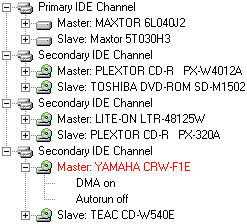
The Yamaha CRW-F1 was set-up as MASTER on the (onboard) Secondary IDE Channel and, as you can see, identifies itself as "YAMAHA CRW-F1E". DMA (Direct Memory Access) was enabled
and Autorun was disabled for every device. All drives (including the Yamaha
CRW-F1) support UDMA33. The other drives that are listed are running on the PCI
UDMA Controller.
Used Software:
The Windows XP Professional
operating system is installed on our test machine. We'll be using the following
software to perform the various tests:
- Ahead InCD
v3.31.0 - Ahead Nero Burning Rom
v5.5.9.0 - Ahead Nero CD Speed v0.85e
beta - Ahead Nero InfoTool
v1.02 - Elaborate Bytes CloneCD
v4.0.1.10 - Exact Audio Copy v0.9 beta
4 - G&M CDR Identifier
v1.63
On the
next page we'll take a look at the package of the Yamaha
CRW-F1...
First things first as we check
out the contents of the Yamaha CRW-F1 drive. In the box Yamaha send to us we
find the following things:
- The Yamaha CRW-F1 drive itself

- Owner's manual (four
languages) - Software guide (four
languages) - IDE 40-pins flatcable
- Audio cables
- Mounting screws
- Yamaha CRW-F1 software disc
containing;- Ahead's Nero Burning Rom
- Ahead's
InCD
- Ahead's Nero Burning Rom
- One blank 44X 700MB Yamaha CD-R
(manufactured by Verbatim*) - One blank 24X 650MB Yamaha CD-RW
(manufactured by Mitsubishi*)
As always a nice and complete
package as we see it. Nero Burning Rom is included with the CRW-F1 drive as we
also saw with the Yamaha CRW3200E model. For people that are unfamiliar with
Nero Burning Rom, Yamaha has included a small manual on how to get started,
covering the most basic actions (burning a data CD, an audio CD and how to use
the extra features such as 'DiscT@2' and 'Advanced Audio Master Quality
Recording').
Installation:
Installation was quick and
easy as with most IDE drives. We set the drive's jumper to master and hooked it
up to the onboard secondary IDE controller. We then booted the pc and the drive
was recognized and ready to be used. UDMA was automatically enabled in Windows
XP and set to UDMA Mode 2 (UDMA33). When experiencing problems in Windows XP
with the Yamaha drive you can read online how to enable DMA properly.
The Drive:

As you see from the picture
above this Yamaha CRW-F1 drive looks just like the previous models. The drive is
very white and has the same purple or blue LED (depending on the state the drive
is in) as we also found on the CRW3200E drive for instance. Besides the LED we
find the Yamaha logo and the 'High Speed CD ReWriteable' logo. We of course can
also find the usual headphone jack, a volume control and an
eject-button.
One the back of the drive we
find the usual IDE and power connectors, the MASTER/SLAVE jumpers and the SPDIF
(analog/digital) output connectors.
The Software:
The software delivered with
the Yamaha drive does not include anything special. We can find Ahead's Nero
Burning Rom and InCD on the Yamaha CRW-F1 software disc. Many people will know
these softwares and they really don't need an introduction anymore.

Nero Burning Rom is a complete
software package for your mastering needs. It can handle many types of disc
formats and even supports writing DVD discs. Besides that the latest Nero
Burning Rom version supports the Yamaha CRW-F1's special features such as
'DiscT@2', 'Advanced Audio Master Quality Recording' and 'CD-RW Audio Edit Mode'
which we'll get back to later on in this review.

InCD is Ahead's packet writing
software to use with your CD-ReWriteable discs. With this software you can
format a CD-RW disc and use it as a large floppy disc. InCD now also supports
the 'Mount Rainier' (CD-MRW) format which we'll also get back to later on in
this review when we test the Yamaha CRW-F1's CD-MRW performance.
On the
next page we'll take a look at the features the Yamaha
CRW-F1...
First things first as we check
out the drive specifications as mentioned on the Yamaha website and as detected with additional software like Nero InfoTool :
Drive Specifications:
| Write Speeds: | 44X: 6.600KB/s Full CAV 16X: 2.400KB/s CLV 8X: 1.200KB/s CLV 4X: 600KB/s CLV 1X: 150KB/s CLV |
| Re-Write Speeds: | 24X: 3.600KB/s P-CAV 16X: 2.400KB/s CLV 12X: 1.800KB/s CLV 10X: 1.500KB/s CLV 4X: 600 KB/s CLV 2X: 300 KB/s CLV |
| Read Speeds (max): | 44X: 6.600KB/s Full CAV (max) |
| Buffer Size: | 8 MB |
| Interface: | Enhanced IDE (E-IDE)/ATAPI |
| Supported Formats: | CD-DA, CD-TEXT, CD-ROM, Mixed Mode CD-ROM (CD-ROM+CD-DA), CD-ROM XA, Photo CD, Video CD, CD EXTRA, CD-MRW |
| Recording Modes: (detected with Nero InfoTool) |
Packet, TAO, DAO, SAO, RAW SAO, RAW SAO 16, RAW SAO 96, RAW DAO 96 |
| Audio Master Mode: | 2X, 4X, 8X / 79min max |
| System Requirements: | Windows 95/98/98SE/Me (32MB RAM), 2000 (64MB RAM), XP (128MB RAM) |
| Disc Loading: | Tray, auto load/auto eject |
| Dimensions WxHxD: | 146.0 x 41.3 x 193.1 mm |
| Weight: | 0.9 kg |
| Extra's: | DiscT@2, Advanced Audio Master Quality Recording, CD-RW Audio Track Edit Mode, 48-hour advance exchange and two-year warranty. |
The Yamaha CRW-F1 drive has
some impressive features on board. The only thing that seems a little weird is
the small list of supported write speeds. We'll get back to this later on in
this review as we'll also do with the other supported features listed in the
drive specifications. Let's give you a screenshot of Nero InfoTool first and the
detected features of the CRW-F1 drive:

As you can see from the
screenshot the Yamaha CRW-F1 supports all features a CD-Writer should have
including the new 'Mount Rainier' format. Let's take a closer look at some of
the supported features/technologies:
Buffer (Underrun Protection):
The claimed buffer size of the
Yamaha CRW-F1 is 8MB. Let's check this with Nero Burning Rom
(v5.5.9.0):

 The buffer
underrun technique the Yamaha CRW-F1 uses is called 'SafeBurn'. But SafeBurn is
more than just a technique to prevent buffer underruns. It's a complete process
to guarantee an optimum burn result. Part of the SafeBurn system is the generous
8MB buffer size and 'Optimum Write Speed Control', which automatically adjusts
the writing speed depending on the type of media you're using. The beating heart
of the CRW-F1 drive is the Yamaha YDC132-V chipset which controls all features
as you can see in the picture below:

Mount Rainier:
The Yamaha CRW3200E drive was
one of the first drives to support the Mount Rainier format together with the
Mitsumi CR-480ATE drive and of course Yamaha's new CRW-F1 drive also supports it. We'll test the drive's Mt. Rainier abilities later on in this review. Here's a small introduction of the CD-MRW format. Click on
the Mt. Rainier logo to read our article on the Mt. Rainier format:
 "...Mount Rainier enables native OS support of data storage on CD-RW.
This makes the technology far easier to use and allows the replacement of the
floppy. This is done by having defect management in the drive, by making the
drive 2k addressable, by using background formatting, and by standardizing both
command set and physical layout. The new standard is promoted by Compaq,
Microsoft, Philips, and Sony and is supported by over 40 industry leaders: OS
vendors, PC-OEM's, ISV's, chip makers, and media makers.
The purpose of the proposal
made by the Mount Rainier group is to make CD-RW easier to use for data storage
and interchange. The changes proposed will enable the operating system support
of dragging and dropping data to CD-RW discs. Formatting delays will also be
eliminated and the use will be comparable to using a hard disk or a floppy..."
Advanced Audio Master Quality Recording:
Another feature we already saw
on the Yamaha CRW3200E drive was 'Audio Master Quality Recording' which could,
in theory, significantly increase the quality of your audio discs. By increasing
the length of the pits and lands on the disc jitter on the disc is reduced
resulting in a clearer audio signal:
 |
 Master |
The first image (standard
audio CD burned at 24X) illustrates a considerably less clear signal than the
second image (using Yamaha's Audio Master). You can see this by looking at the
circles. The less clear the image, the higher the jitter factor.
The Audio Master feature does have one negative point: the memory capacity of a 650MB or 700MB CD-R is respectively 63 or 68 minutes. This is because the 'pits' and 'lands' on the disc are longer and take up more space than with normal writing. With the CRW-F1 drive Yamaha has introduced 'Advanced Audio Master
Quality Recording' which introduces write support for 1X and 8X recording
(normally you could only use 4X) and besides that you can now record music up to
79 minutes when using 900MB media (99 minutes CD-R). We will of course also test
this during our review.
CD-RW Audio Track Editing Mode:
Another feature the Yamaha
CRW-F1 supports is called 'CD-RW Audio Track Editing Mode' which we again also
found on the CRW3200E drive. The 'CD-RW Audio Track Editing Mode' is a special
feature with which you can edit audio tracks recorded on a CD-RW disc without
having to delete the entire CD first. This means that individual tracks can be
added or deleted from the disc.
With Nero Burning Rom you can
start a new audio compilation and choose a new tab called 'RW Edit Disc' as you
can see from the screenshot below:
We of course tested this
feature by starting 'an editable Audio CD-RW disc' (second option) and then
using the third option ('Modify an existing Audio CD-RW disc'). Although the
'CD-RW Audio Track Editing Mode' is a great feature it does have some
limitations:
- When you want to add a
track between let's say track 4 and 5 you first need to delete all tracks
after track 4, add your new track and then re-add the tracks you just deleted.
When you start the write process the TOC and selected tracks will be deleted
and a new lead-in and lead-out will be written. - You can only delete
consecutive tracks (see the Nero message below). Therefore it's for instance
not possible if you have an audio CD-RW disc with 7 tracks to only delete
track 4 because you first have to erase track 5, 6 and 7. You can then of
course re-add these tracks when setting up your compilation.

- Because the disc is written in TAO mode (Track At Once) it's not possible to add CD-text to the disc (only possible in Disc At Once
mode).
As we see it, the easiest way
to take advantage of the 'CD-RW Audio Track Editing Mode' is to just add tracks
to an existing audio CD-RW disc. This way you don't need to delete tracks
first.
Because the Yamaha CRW-F1 drive has a lot of features we've spread them
out over two pages. On the next page we continue the features of the
drive...
DiscT@2:
DiscT@2 (pronounced as 'disc
tattoo') is a new innovation developed by Yamaha and it was first seen during
the CeBit conference of this year. By precise tracking, rotation, laser
intensity and positioning the Yamaha CRW-F1 drive is able to write images or
text onto the unused outer portion of any CD-R disc. This technology does have
some limitations such as:
- The disc has to be closed
to add DiscT@2. - DiscT@2 only works on the
unused part of a CD-R. When the CD-R is full you can't add a 'tattoo'. - Visibility of the tattoo
varies greatly depending on the dye of the CD-R (Metal Azo works best).
- DiscT@2 doesn't work on
CD-RW discs.
But nonetheless DiscT@2 can spice up your CD-Recordable discs and you have the option to give your discs a personal touch by adding some images or you can for instance just add the disc title to your compilation.  The DiscT@2
technology can be used with Ahead's Nero Burning Rom. If you've selected the
Yamaha CRW-F1 drive as writer you can choose DiscT@2 via 'Recorder, DiscT@2' or
you can simply start a new compilation (close the wizard) and enable the option
in the Misc tab as you can see from the picture on the right. The Nero DiscT@2
Editor will then be started and calculate the available disc space on the CD-R.
You can then add graphics or text to the disc.

The editor has some build-in
features to make it easier to add text to your disc. It needs some getting used
to but once you get the hang of it the only limitation is your own imagination.
Below you can see some discs that were 'tattooed'. For our tests we used CD-R
discs with a dark blue dye (Metal Azo) to get the best results. When you use
CD-R discs with a lighter dye the images will be hard to see. Unfortunately most
CD-R discs nowadays use a lighter/green dye which doesn't work very well with
DiscT@2. For those people thinking that coloured discs will work well with
DiscT@2 we can quickly say this isn't so. Coloured discs (green, purple, pink,
etc.) simply don't work at all.
Disc #1:
- Brand: MMORE
- Disc Type, Material: CD-R, Cyanine
- ATIP Lead-in: 97m 26s 40f
- Nominal Capacity: 656.69MB (74m 45s
00f) - Disc Manufacturer maybe:
Unknown
Let's start with an image
where you can clearly see the data area and tattoo area on the disc:

Disc #2:
- Brand: Yamaha
- Disc Type, Material: CD-R, Cyanine
- ATIP Lead-in: 97m 34s 21f
- Nominal Capacity: 702.83MB (79m 59s
74f) - Disc Manufacturer maybe: Verbatim (Metal
AZO)
Now for the special DiscT@2
disc that was delivered with the Yamaha package. We burned some text to the disc
together with some images (the well known sheep from CloneCD!):


Disc #3:
- Brand: Yamaha
- Disc Type, Material: CD-R, Cyanine
- ATIP Lead-in: 97m 28s 12f
- Nominal Capacity: 702.83MB (79m 59s
74f) - Disc Manufacturer maybe: GigaStorage,
MaxMax
And a final picture with some
nice looking women just to show you that you can really add any kind of tattoo
you want to. You can again also clearly see the data and tattoo part:
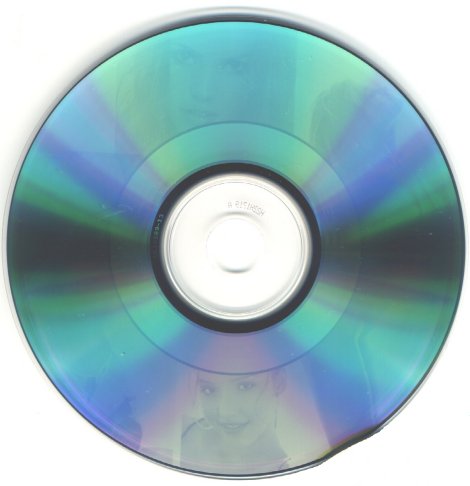
Writing DiscT@2 takes about 11
minutes for a complete CD. When you're writing only a small part of the CD-R
this will of course take less time. As you can see from the images the results
are quite good but like said before you must use the Metal Azo type discs or
other discs with a dark blue dye. Other type discs simply don't work because of
their lighter (or too dark) dye colour.
Write Method:
Next we will take a look at
which writing methods the Yamaha uses to write CD-R's. We used Nero CD Speed to do a
test write. Because the Yamaha CRW-F1 drive is one of the first drives
supporting 'Ultra-Speed CD-RW' writing we also did a test write using the
CD-ReWriteable media. Below you can see the produced graphs of both
tests:
CD-Recordable:

CD-ReWriteable:

The yellow line indicates the rotation speed (rpm) of the CD-R(W).
In the produced graphs you can
see that the Yamaha CRW-F1 uses the full CAV method when writing a CD-Recordable
disc and P(artial)-CAV when writing the ultra-speed CD-ReWriteable
disc.
CD-R |
In the left screenshot you see that the Yamaha CRW-F1 drive couldn't reach the 44X as claimed. It reaches a top write speed of 43.30X. This is because Yamaha, unlike other manufacturers, uses the 80 minute mark as an indication for the write speed. The Nero CD Speed test uses the 76 minute mark. The Yamaha CRW-F1 reaches an average speed of 32.96X. |
CD-RW |
When writing CD-RW media you can see from the right screenshot that ultra-speed in this case indeed means ultra fast writing. The Yamaha CRW-F1's CD-RW performance is even faster than normal writing with their previous model, the CRW3200E! The average CD-RW write speed was 23.81X. Finally we have faster re-write
speeds!
Next
up in our Yamaha CRW-F1 review, the data read
tests.
In this part of our Yamaha
CRW-F1 review we'll start testing the reading of normal/unprotected data discs.
Let's see how fast the Yamaha drive can read data and if it can really reach the
claimed 44X. For the tests we used Nero CD
Speed and repeated the tests several times
to make sure the results were accurate.
The data read tests are
divided into four sections:
Transfer Rate Test - Original/Pressed Discs:
For the transfer rate tests we
used a pressed CD-ROM containing PlexTools v1.05 which was exactly 74 minutes
(333.000 sectors) long. Below the produced graph with Nero CD Speed:

And of course the speeds and
seek times of the Yamaha CRW-F1 drive:
 |
In the left screenshot you see that the Yamaha CRW-F1 couldn't reach the claimed 44X and gets a top reading speed of 41.18X. This is even slower than some 40X readers we've reviewed like the Plextor PX-W4012TU (41.71X)!The seek times with original/pressed media were also not that good as you can see in the screenshot on the right. |
 |
In the table below we compare
the achieved times with other drives we've previously reviewed. The Yamaha
CRW-F1 is listed separately since it's the only 44X reader. As you can see from
the table below the Yamaha is slower than some of the 40X readers:
| Original Discs |
Average Reading Speed |
Start Reading Speed |
End Reading Speed |
Seek Times Random |
Seek Times 1/3 |
Seek Times Full |
| 40X Max Readers | ||||||
| Lite-On LTR-32123S |
31.75X | 19.02X | 41.65X | 94ms | 103ms | 168ms |
| PleXCombo PX-320A |
31.21X | 18.38X | 41.21X | 108ms | 120ms | 216ms |
| Plextor PX-W4012U USB 2.0 |
31.62X | 18.70X | 41.71X | 118ms | 139ms | 208ms |
| Yamaha CRW3200E |
29.46X | 17.37X | 38.89X | 94ms | 107ms | 199ms |
| 44X Max Readers | ||||||
| Yamaha CRW-F1 |
31.22X | 18.46X | 41.18X | 120ms | 139ms | 263ms |
| 48X Max Readers | ||||||
| Lite-On LTR-40125S |
37.44X | 22.21X | 49.57X | 96ms | 96ms | 266ms |
| TEAC CD-W540E |
36.85X | 22.08X | 48.43X | 88ms | 102ms | 229ms |
| VisionTek Xtasy 48X |
36.54X | 21.19X | 48.15X | 99ms | 100ms | 168ms |
| The grey area's indicate the highest speed / best time |
||||||
Transfer Rate Test - CD-Recordable Media:
For the transfer rate tests
with CD-Recordable Media we again used the PlexTools v1.05 disc only this time
we read from a back-up disc. The disc used was a 'That's Write' CD-R certified
up to 16x writing and manufactured by Gigastorage. Here's the ATIP information
from CDR Identifier:
- ATIP: 97m 28s 12f
- Disc Manufacturer: Gigastorage Corp.
- Reflective layer: Dye (Long strategy; e.g. Cyanine,
Azo etc.) - Media type: CD-Recordable
- Recording Speeds: min. unknown - max.
unknown - Nominal Capacity: 702.83MB (79m 59s 74f / LBA:
359849)
The back-up disc was of course
also 74 minutes (333.000 sectors) long. Below the produced graph with Nero CD
Speed:

The speeds and seek times the
Yamaha CRW-F1 drive reached with the CD-Recordable media:
 |
In the left screenshot you see that the Yamaha CRW-F1 performed better with the CD-Recordable media than with the original/pressed media but it still fails to reach 44X. The top read speed was 42.57X.
The seek times with |
 |
In the table below we compare
the achieved times with other drives we've previously reviewed. The Yamaha
CRW-F1 performs better than the CRW3200E drive and the other 44X readers but
it's very close:
| CD-R Discs |
Average Reading Speed |
Start Reading Speed |
End Reading Speed |
Seek Times Random |
Seek Times 1/3 |
Seek Times Full |
| 40x Max Readers | ||||||
| Lite-On LTR-32123S |
32.21X | 19.05X | 42.07X | 92ms | 105ms | 243ms |
| PleXCombo PX-320A |
31.43X | 18.83X | 41.36X | 110ms | 125ms | 218ms |
| Plextor PX-W4012U USB 2.0 |
31.81X | 19.07X | 41.81X | 116ms | 137ms | 204ms |
| Yamaha CRW3200E |
30.50X | 18.28X | 40.09X | 92ms | 106ms | 196ms |
| 44X Max Readers | ||||||
| Yamaha CRW-F1 |
32.39X | 19.41X | 42.57X | 116ms | 135ms | 254ms |
| 48x Max Readers | ||||||
| Lite-On LTR-40125S |
37.44X | 22.21X | 49.57X | 96ms | 96ms | 266ms |
| TEAC CD-W540E |
36.85X | 22.08X | 48.43X | 88ms | 102ms | 229ms |
| VisionTek Xtasy 48X |
36.54X | 21.19X | 48.15X | 99ms | 100ms | 168ms |
| The grey area's indicate the highest speed / best time |
||||||
Transfer Rate Test - CD-ReWriteable Media:
To test the transfer rate with
CD-RW discs we again used the "PlexTools v1.05" disc only this time we read from
a CD-ReWriteable disc. We created a back-up of the disc using a PleXCombo PX-320A . The disc used was a 'Plextor CD-RW' disc. Here's the ATIP
information from CDR Identifier:
- ATIP: 97m 27s 00f
- Disc Manufacturer: Disc ID not allowed
- Reflective layer: Phase change
- Media type: CD-ReWriteable
- Recording Speeds: min. 4X - max. 8X
- Nominal Capacity: 651.86MB (74m 12s 00f / LBA:
333750)
The CD-RW disc was of course
also 74 minutes (333.000 sectors) long. Below the produced graph with Nero CD
Speed:

Yamaha CRW-F1 drive reached with the CD-ReWriteable media:
 |
In the screenshots you can see that the Yamaha CRW-F1 drive gets very close to 44X this time. The Yamaha drives are known for their high read speeds with CD-ReWriteable media. The top read speed was 43.66X.
The seek times with |
 |
In the table below we compare
the achieved results to some of the reviews we've done previously. The Yamaha
CRW-F1 now does perform a lot better than the 40X readers but it's still a
little short of the claimed 44X reading:
| CD-RW Discs |
Average Reading Speed |
Start Reading Speed |
End Reading Speed |
Seek Times Random |
Seek Times 1/3 |
Seek Times Full |
| 40x Max Readers | ||||||
| Lite-On LTR-32123S |
25.99X | 15.31X | 34.38X | 91ms | 101ms | 361ms |
| PleXCombo PX-320A |
25.20X | 14.87X | 33.27X | 105ms | 124ms | 215ms |
| Plextor PX-W4012U USB 2.0 |
31.61X | 18.61X | 41.74X | 117ms | 141ms | 210ms |
| Yamaha CRW3200E |
31.14X | 18.37X | 41.11X | 157ms | 108ms | 206ms |
| 44X Max Readers | ||||||
| Yamaha CRW-F1 |
33.06X | 19.46X | 43.66X | 119ms | 139ms | 263ms |
| 48x Max Readers | ||||||
| Lite-On LTR-40125S |
32.32X | 19.05X | 42.54X | 94ms | 96ms | 405ms |
| TEAC CD-W540E |
37.53X | 22.12X | 49.54X | 99ms | 96ms | 303ms |
| VisionTek Xtasy 48X |
32.23X | 18.96X | 42.57X | 91ms | 101ms | 170ms |
| The grey area's indicate the highest speed / best time |
||||||
Transfer Rate Test - Conclusion:
Overall we had quite a
disappointing result since we couldn't reach the claimed 44X with any of the
read tests. When reading original/pressed media the Yamaha CRW-F1 drive was even
slower than some of the 40X readers we've reviewed. When you look at the results
Yamaha previous model, the CRW3200E, reached you can see that this drive was
also slower than the claimed 40X. We therefore think that Yamaha uses the 80
minute mark as an indication for the read speed instead of the 72 or 74 minute
mark other manufacturers are using. Perhaps it would have been better to release
the drive as a 40X reader.
So far
for the data reading part. Now let's check the audio reading (DAE) speeds on the
next page...
On the box of the Yamaha website we can read that its DAE speed is also 44X ("44x high-fidelity audio ripping"). On this page we'll test just that. For the audio read tests we used our usual 'tools', Exact Audio Copy (EAC) and Nero CD Speed .
Features:
First we checked the features the Yamaha CRW-F1 supports using EAC:
 As you can see from the screenshot on the left the Yamaha drive supports caching and has an accurate stream. The drive cannot retrieve the C2 error information from the disc. Below some more information on these terms:
- 'Caching':
If your drive caches the audio that was just read, it would be a problem to read this data again in order to compare both extractions to find out if they match. - 'Accurate Stream':
This means the drive won't jitter, thus no jitter correction has to be done anymore. - 'C2 Error Info':
Some newer drives are able to return C2 error information beside the actual audio data. In that case EAC doesn't need to read all data twice anymore, which will result in a big speedup.
Digital Audio Extraction - Exact Audio Copy:
For the Digital Audio Extraction (DAE) tests we started Exact Audio Copy (EAC) and simply extracted the separate audio tracks in uncompressed WAV format to our hard disk. Our test disc (Thunderdome XXII - CD1) had 20 tracks and a total playing time of 77 minutes and 45 seconds. We used both the 'Burst' mode and the 'Secure' mode:
- 'Burst Mode':
Burst mode is the fastest mode available. The audio sectors are just read without any error-detection and error-correction. - 'Secure Mode':
The extracted audio is checked for correctness and if errors occur, EAC will try to recover them.
Below the screenshots of the speeds the Yamaha CRW-F1 drive reached in both extraction modes:

Yamaha CRW-F1 DAE speed - Burst Mode

Yamaha CRW-F1 DAE speed - Secure Mode
The Yamaha CRW-F1 drive again couldn't reach 44X but comes very close in Burst Mode. The top DAE speed was 43.0X and when we compare it to the 40X readers we see it beats the Plextor PX-W4012A but not by much. The Yamaha CRW-F1 drive performs better than the CRW3200E drive as you can see from the table below:
| EAC DAE Speeds |
Burst Mode Average |
Burst Mode Maximum |
Secure Mode Average |
Secure Mode Maximum |
| 40X Max Readers | ||||
| Lite-On LTR-32123S |
29.8X | 42.0X | 9.5X | 11.9X |
| Mitsumi CR-480ATE |
29.1X | 40.1X | 10.3X | 13.5X |
| PleXCombo PX-320A |
29.7X | 41.8X | 9.2X | 12.1X |
| Plextor PX-W4012A |
30.6X | 42.3X | 9.5X | 12.4X |
| Yamaha CRW3200E |
29.1X | 40.4X | 7.1X | 7.8X |
| 44X Max Readers | ||||
| Yamaha CRW-F1 |
30.9X | 43.0X | 7.1X | 9.7X |
| 48X Max Readers | ||||
| Lite-On LTR-40125S |
35.3X | 48.0X | 11.0X | 14.2X |
| TEAC CD-W540E |
29.3X | 40.8X | 10.1X | 13.0X |
| VisionTek Xtasy 48X |
35.0X | 48.6X | 7.1X | 7.8X |
| The grey area's indicate the highest speed / best time | ||||
Digital Audio Extraction - Nero CD Speed:
Now let's check our results we got with Exact Audio Copy using Nero CD Speed. You can see a screenshot of the tests below:

The tests done with Nero CD Speed confirm our previous test and the Yamaha again reaches a top DAE speed of about 43X. The seek times were however quite high and thus not that good. The CRW-F1 does have an accurate stream and gets a quality score of 10 which is the highest score. Finally the CPU usage was low which is good:
| Original Audio Disc |
Average Reading Speed |
Start Reading Speed |
End Reading Speed |
Seek Times Random |
Seek Times 1/3 |
Seek Times Full |
Quality/ Accurate Stream |
| 40X Max Readers | |||||||
| Lite-On LXR-24101A USB 2.0 |
31.15X | 18.42X | 41.07X | 91ms | 114ms | 178ms | 10/yes |
| Lite-On LTR-32123S |
31.91X | 18.87X | 42.09X | 90ms | 107ms | 179ms | 10/yes |
| PleXCombo PX-320A |
31.68X | 18.82X | 41.74X | 102ms | 121ms | 217ms | 10/yes |
| Pletor PX-W4012TU USB 2.0 |
32.06X | 19.06X | 42.22X | 115ms | 140ms | 211ms | 10/yes |
| 44X Max Readers | |||||||
| Yamaha CRW-F1 |
32.74X | 19.50X | 42.96X | 118ms | 141ms | 263ms | 10/yes |
| 48X Max Readers | |||||||
| Lite-On LTR-40125S |
37.35X | 19.98X | 49.07X | 88ms | 102ms | 177ms | 10/yes |
| TEAC CD-W540E |
30.98X | 18.33X | 40.82X | 84ms | 95ms | 136ms | 10/yes |
| VisionTek Xtasy 48X |
37.23X | 19.96X | 49.11X | 84ms | 96ms | 167ms | 10/yes |
| The grey area's indicate the highest speed / best time | |||||||
Advanced DAE Quality Test:
To conclude our DAE test we did the 'Advanced DAE Quality Test' with Nero CD Speed . This test is a very hard and intense test for any reader.
We created a new test disc using a Plextor PX-W4012TU recorder. We used some high quality 'Hi-Space' media which are also available from our online shop (for our Dutch and Belgian visitors only). These Hi-Space discs have a 24 carats gold reflective cover and can be written up to 24x. Here are the results from the Advanced DAE Quality Test:

The average DAE speed of the Yamaha CRW-F1 drive is pretty high but it's only a little faster than the 40X readers and it's thus again a little disappointing. Luckily the drive has no problems reading the CD-Text and SubChannel Data from the disc but it can't read any data from the lead-out of the disc:

We of course also tested if the Yamaha drive could indeed read CD-Text. We played an audio disc with CD-Text using NeroMediaPlayer and the CRW-F1 could indeed read it without problems as you can see in the screenshot below (Artist and Song Title are displayed):

Now that we've concluded our data and audio reading part, let's see how well the Yamaha drive can read a (heavily) scratched disc and a low quality disc.
It happens to all of us sooner
or later: a disc is scratched and cannot be read properly anymore... In this
test we took a CD-Recordable and (heavily) scratched it with some fine
sandpaper. We then did a surface scan with Nero CD Speed and you
can see the results below. First off let's start with the ATIP information from
the used CD-Recordable:
- ATIP: 97m 15s 11f
- Disc Manufacturer: Ritek Co.
- Reflective layer: Dye (Long strategy; e.g. Cyanine, Azo
etc.) - Media type: CD-Recordable
- Recording Speeds: min. unknown - max.
unknown - Nominal Capacity: 702.83MB (79m 59s 74f / LBA:
359849)
Now for the achieved results. We
read the disc with the Yamaha CRW-F1 drive and then read the same disc with
several other recorders for comparison. You can see the result of the Yamaha
drive in the screenshot below. Please note that damaged sectors can still be
read. The important percentage is the one of the unreadable sectors. Of course
the less, the better:

Yamaha CRW-F1 reading scratched disc
In the table below we've summed
up our test results comparing them to other drives we've previously reviewed.
Again, keep in mind that the important percentage is the one of the unreadable
sectors. Of course the less, the better:
| Scratched Disc |
Good | Damaged | Unreadable | ||||
| PleXCombo PX-208TU |
55.80% | 28.53% | 15.67% | ||||
| VisionTek Xtasy 48X |
36.89% | 44.41% | 18.70% | ||||
| Toshiba SD-M1502 |
35.84% | 38.56% | 25.60% | ||||
| PleXCombo PX-320A |
64.58% | - | 35.42% | ||||
| Mitsumi CR-480ATE |
59.87% | - | 40.13% | ||||
| TEAC CD-W540E |
32.08% | 27.38% | 40.54% | ||||
| Yamaha CRW3200E |
48.59% | - | 51.41% | ||||
| Plextor PX-W4012TU |
35.95% | 8.78% | 55.28% | ||||
| Yamaha CRW-F1 |
37.72% | - | 62.28% | ||||
| The grey area's indicate the least amount of unreadable sectors - : drive cannot report damaged sectors |
|||||||
Low Quality Disc:
To add a little more to our
scratched data reading tests we've added another test for you. We wrote a low
quality 74 minute CD-Recordable using the VisionTek Xtasy 48X drive and Nero Burning Rom. We disabled its SMART-BURN feature so errors would probably
be created. The ATIP information from the used CD-Recordable:
- ATIP: 97m 31s 01f
- Disc Manufacturer: unknown
- Reflective layer: Dye (Long strategy; e.g. Cyanine, Azo
etc.) - Media type: CD-Recordable
- Recording Speeds: min. unknown - max.
unknown - Nominal Capacity: 656.69MB (74m 45s
00f)
We then scanned the disc with
Nero CD Speed using various drives we've previously reviewed. You can see
a screenshot of the Yamaha CRW-F1 drive reading the low quality disc
below:

Yamaha CRW-F1 reading low quality disc
In the table below we've summed
up our test results again, comparing them to other drives we've previously
reviewed. Again, keep in mind that the important percentage is the one of the
unreadable sectors. Of course the less, the better:
| Scratched Disc |
Good | Damaged | Unreadable | ||||
| Plextor PX-W4012TU |
99.44% | 0.56% | 0.0% | ||||
| PleXCombo PX-208TU |
89.60% | 10.40% | 0.0% | ||||
| Toshiba SD-M1502 |
86.21% | 13.79% | 0.0% | ||||
| VisionTek Xtasy 48X |
59.44% | 40.56% | 0.0% | ||||
| PleXCombo PX-320A |
89.49% | - | 10.51% | ||||
| TEAC CD-W540E |
66.21% | 11.75% | 22.03% | ||||
| Mitsumi CR-480ATE |
60.34% | - | 39.66% | ||||
| Yamaha CRW-F1 |
48.81% | - | 51.19% | ||||
| The grey area's indicate the least amount of unreadable sectors - : drive cannot report damaged sectors |
|||||||
Conclusion:
When reading the heavily
scratched disc and the low quality disc the Yamaha CRW-F1 gets the last place
with both tests, Yamaha definitely needs to tweak the drive's performance when
it comes to correcting errors a the disc via a future firmware upgrade for
instance.
That
concludes the reading part of our review. Now it's time to see how the Yamaha
CRW-F1 performs when writing discs...
As mentioned before the Yamaha
CRW-F1 can write discs at a maximum speed of 44X using the Full-CAV method.
Yamaha has always been known for their CAV write method with which the speed is
steadily increased during the write process instead of dividing the disc into
different write zones (Z-CLV). CAV or Full-CAV is a lot faster than Z-CLV and
many manufacturers are switching to this technique.
For the write tests We set-up a
basic write process using the latest Nero Burning
Rom version 5.5.9.0. We used the DAO (Disc At Once) method for writing the disc. The disc was finalized
and set-up as a non-multisession disc. In the screenshot below you can see the
burn process completed successfully at 44X:

 The disc was written without problems in 3 minutes and 4
seconds. Another thing we have to mention here is the limited amount of
available write speeds the Yamaha CRW-F1 offers. You can write at 1X/4X/8X/16X
and then a big leap to 44X. The Yamaha CRW-F1 doesn't offer any speeds in
between. This means that you're letting the drive itself decide the best write
speed when you select 44X writing. During the write process the Yamaha chipset
will determine the best write speed and will increase or decrease the speed
accordingly.
Is this an advantage or
disadvantage? Well you will have to decide for yourself since this is totally a
personal feeling. Of course when you're letting the drive decide the best write
speed you can't do anything to prevent a bad burn, except by of course
decreasing the speed to 16X. But on the other hand if the drive makes a good
burn at the highest speed possible and does this reliably then there's no
problem. We did several burns with the Yamaha CRW-F1 drive and all discs worked
fine afterwards. There were not all written at 44X but they did all work and
that's what's important.
You can force the Yamaha CRW-F1 drive to write all media at 44X by disabling its 'Optimum Writespeed Control' in Nero Burning Rom but we would never recommend this
since the chance of a shiny coaster is simply to big.
Comparing:
Because the Yamaha CRW-F1 drive doesn't allow the user to select different write speeds between 16X and 44X we couldn't directly compare the drive for each write speed. We can tell you that a write time of about 3 minutes and 4 seconds is in between the write times of a 40X and 48X
recorder as expected. Some of the drives were however faster when writing at 40X
than the Yamaha writing at 44X such as the Lite-On LTR-48125W. This is not that
strange since this drive uses a very aggressive write strategy.
On the 'Media Compatibility'
page of our Yamaha CRW-F1 review you can see some of the write times we achieved
with different media.
Writing Audio:
 The next thing we're going to
check is the Yamaha CRW-F1's audio writing abilities. As already mentioned on
page 3 (features) of our review, this Yamaha drive supports the 'Advanced Audio
Master Quality' recording technique. We already saw this technique with Yamaha's
previous model but with the CRW-F1 drive they've taken it one step further
introducing 1X and 8X recording (besides the standard 4X) and support for 99
minute media so you can burn 79 minutes of music.
The memory capacity of a 650MB
or 700MB CD-R is respectively 63 or 68 minutes. This is because the 'pits' and
'lands' on the disc are longer and take up more space than with normal writing.
With 99 minute media it's now possible to write 79 minutes of music to the
disc.
To test the Yamaha's 'Advanced
Audio Master Quality Recording' feature we ripped the tracks (in WAV format) of
an audio disc with Exact Audio Copy (Secure Mode) and then started a new audio
session in Nero Burning Rom version 5.5.9.0. When writing audio you can see an
option to enable 'Audio Master Q.R.':

Because we made a compilation of
79 minutes we need to overburn the disc (since, as explained above, normally you
could only fit 68 minutes on a 700MB CD-R when writing in the special audio
mode). We used some DataTrack 99 minute CD-R discs for the tests.

In the screenshot below you can see the process completed successfully. The disc was written at 4X without any problems in 24 minutes and 16 seconds:

We then listened to the created
disc and tried them in a car stereo (Sony CDX-L400X). As we already suspected
the disc played fine and we couldn't hear the difference between a disc created
with the 'Advanced Audio Master Quality Recording' mode or without
it.
Conclusion:
The Yamaha CRW-F1 drive does
what it promises but it falls a little short of the claimed 44X writing (see
page 4: features continued, write method). The Yamaha CRW-F1 is faster than most
of the other 40X recorders we've reviewed and is of course slower than the 48X
recorders. As we saw when we did the various write tests the Yamaha CRW-F1 drive
has a limited amount of available write speeds. It's really up to you to decide
if this is an advantage or a disadvantage. On the next page we did some quality
tests with various media at full write speed which will clarify some
things.
When writing audio the Yamaha
CRW-F1 offers the mentioned 'Advanced Audio Master Quality Recording' mode but
unfortunately we, just as with the Yamaha CRW3200E with its 'Audio Master
Quality Recording', couldn't tell the difference between a disc written in this
special audio mode and an audio disc written at full speed. What does this mean?
Well maybe our ears aren't that good or maybe it's just that the CD-players we
tested aren't very picky. However if you have a sensitive CD-player like a car
stereo which has problems playing CD-Recordables, 'Advanced Audio Master Quality
Recording' will definitely come in handy.
On the
next page of our Yamaha CRW-F1 review we've done some write quality tests using
Lite-On's C1/C2 error measurement software...
A new test we're now going to do
is with Lite-On's C1/C2 error scan program called WSES. This program can
accurately scan a disc for errors and it's a better method of checking the write
quality then when using Nero CD Speed for instance. For the quality tests we
wrote several different CD-Recordable media and then measured the C1/C2 errors
from the disc. The created disc was scanned using a Lite-On LTR-48125W drive
(WSES only works with Lite-On drives) at 40X reading.
Introduction:
C1 and C2 errors are not really
on a disc. They occur during reading. The more difficult it is for a drive to
read a disc, the more errors will occur while reading that disc. A good disc
should report low error rates even at high scanning speeds. But don't forget
that a bad disc can also have low error rates after burning. A good disc will
still report low error rates if you put the disc into direct sunlight, while a
bad disc will damage and/or may degrade after some months. The results below are
thus not an indication whether or not the used disc is of a good quality. It's
merely an indication if the burn process was done properly.
In the figures below you will
see a graphical overview of errors occurring during the read process. Please
note that every created/burned disc will always have C1 errors. These are errors
that are corrected by the drive and they will not effect the disc in a bad way
as long as their amount is limited. C2 errors are however very bad for a disc
and are harder to read and correct. When there are too many C2 errors present on
the disc it means you have bad burned disc and it can't be read in the test
drive your using as a reader (a coaster). Although a low amount of C2 errors can
still be recovered by the drive, a zero amount of C2 errors is always
preferred!
The Tests:
700MB MMORE CD-R80:
- Contents: Data
- Certified Speed: 32X
- Write Speed: 44X (3m:04s)
- Disc Type, Material: CD-R, Phthalocyanine
- ATIP Lead-in: 97m 17s 06f
- Nominal Capacity: 702.83MB (79m 59s 74f)
- Disc Manufacturer maybe: India,
MoserBaer
Disc can be read fine. There are
no C2 errors and the amount of C1 errors is limited. This is thus a good burn
done at 44X:

700MB Discplanet Media:
- Contents: Data
- Certified Speed: 16X
- Write Speed: 16X (5m:27s)
- Disc Type, Material: CD-R, Cyanine
- ATIP Lead-in: 97m 15s 11f
- Nominal Capacity: 702.83MB (79m 59s 74f)
- Disc Manufacturer maybe: Ritek
Disc can be read fine. There are
no C2 errors and the amount of C1 errors is this time very limited. This is thus
also a good burn done at 16X, the certified speed of the media:

700MB Hi-Space Metal:
- Contents: Data
- Certified Speed: 24X
- Write Speed: 40X (3m:16s)
- Disc Type, Material: CD-R, Phthalocyanine
- ATIP Lead-in: 97m 25s 07f
- Nominal Capacity: 702.69MB (79m 59s 00f)
- Disc Manufacturer maybe: MPO,
France
Disc can be read fine. There are
no C2 errors and the amount of C1 errors is limited. This is a good burn done at
40X while the disc was certified for 24X:

700MB Nashua:
- Contents: Data
- Certified Speed: 12X
- Write Speed: 16X (5m:33s)
- Disc Type, Material: CD-R, Phthalocyanine
- ATIP Lead-in: 97m 16s 06f
- Nominal Capacity: 702.83MB (79m 59s 74f)
- Disc Manufacturer maybe: Memorex
Black
Although the disc can be read
fine there are a lot of C1 errors on the disc. Notice that the display scale is
now 300 instead of the normal 60 (above the red arrow). The Nashua media is
quite old and was certified for 12X writing. The Yamaha wrote it at 16X. There
are no C2 errors on the disc so it can still be read ok:

650MB Taiyo Yuden:
- Contents: Data
- Certified Speed: 40X
- Write Speed: 40X (2m:59s)
- Disc Type, Material: CD-R, Cyanine
- ATIP Lead-in: 97m 24s 01f
- Nominal Capacity: 656.40MB (74m 43s 01f)
- Disc Manufacturer maybe: Taiyo
Yuden
Disc can again be read fine.
There are no C2 errors and the amount of C1 errors is limited. More errors than
with the Discplanet Media discs, less than with the MMORE discs. Another good
burn done at 40X:

700MB Maxell:
- Contents: Audio, 74 minutes
- Certified Speed: 40X
- Write Speed: 40X (3m:04s)
- Disc Type, Material: CD-R,
Phthalocyanine - ATIP Lead-in: 97m 25s 29f
- Nominal Capacity: 702.83MB (79m 59s 74f)
- Disc Manufacturer maybe: Maxell
And the last disc we've tested
can also be read just fine. There are no C2 errors and the amount of C1 errors
is again limited. Another successful burn done at 40X, the certified speed of
the media:

Conclusion:
Judging from the results we got
with discs burned at full speed using the Yamaha CRW-F1 drive we can say all
discs were written without any problems and had no serious errors on them. All
discs could be read just fine and they all had a little amount of C1 errors. Not
one disc had C2 errors which is of course a good thing. It seems the lack of
supported write speeds is thus no problem for the Yamaha CRW-F1 drive since it
does a pretty good job in deciding the best write speed for the used
media.
Note that from the media we
tested only the MMORE discs could be written at 44X. They also had the most
amount of C1 errors on them (except for of course the Nashua media). The amount
was limited so this is no problem at all. The least amount of errors were found
on the Discplanet Media CD-R's but these discs were also written at a low speed
(16X). All discs could be read fine after they were burned.
Now that
we've finished our read, write and quality tests, it's time to test the drive
for its ability to read data and audio
copy-protections.
In this part of the Yamaha
CRW-F1 review we'll start testing the reading and writing of copy-protected data
discs. Copy-protections are used on almost every game nowadays so it's important
a writer can handle the various protections out there. For the tests we used the
latest CloneCD version 4.0.1.10 from Elaborate
Bytes . As you might know if you've read our
CloneCD v4.0
preview , CloneCD now uses Profiles for each
type of disc. In this review we created a separate Profile for each protection
with the common settings used in the old CloneCD versions. E.g. for SafeDisc we
only selected the 'Fast Error Skip' setting.
As an extra 'service' or help you can download the Profiles we have used in this review. Click on the Profile images to download the used
Profile. Store these files in your CloneCDProfiles folder on your hard disk.
Alternatively you can view and download all used Profiles from our CloneCD
forum , by clicking here.
Now let's start by giving you a
screenshot of the supported drive capabilities of the Yamaha CRW-F1 drive with
CloneCD v4.0.1.10:

As you can see in the picture
above, the Yamaha CRW-F1 is fully supported by CloneCD (DAO-RAW96). To determine
the copy-protection used on our game discs we scanned every disc with the latest
ClonyXXL version 2.0.0.6. ClonyXXL can be obtained from kickme.to/englishclony.
In the table below we've summed up all of our results and after the table we
will clarify our results and compare the read times with other recorders we've
previously reviewed:

LaserLock:
 For the LaserLock test we use a game called 'Desperados' protected with LaserLock 2. As a comparison we read from both the original disc and from a back-up (CD-Recordable) disc. We did this because there can be quite a difference in read time as you can also see from the results we got with the Yamaha CRW-F1 drive. While the original disc is read in 46 minutes and 33 seconds, the back-up was read in 4 minutes and 58 seconds. Not a bad result for LaserLock as you can
see from the table below:

SafeDisc:
 To test the SafeDisc protection we used a game called 'Beavis and Butthead: BungHole in One'. The SafeDisc protection is quite old but it uses a lot of errors on the first 5% of the disc which can make reading the disc take a really long time. But, just as we saw with the Yamaha CRW3200E drive the Yamaha's work very well with CloneCD's 'Fast Error Skip' and the disc is read at full speed in 2 minutes and 36 seconds. Just a few seconds short of our 'SafeDisc
Reader Champions', the Plextor drives:

SafeDisc 2:
For our next tests we used a game called 'The Sims: House Party' protected with SafeDisc version 2.10.030. As expected the disc was again read at full speed in 2 minutes and 10 seconds. To test the Yamaha CRW-F1's ability to write
this protection we wrote the image with ' Amplify Weak
Sectors ' (AWS) disabled. The created back-up disc was then tested in
the following drives:
- Toshiba DVD-ROM SD-M1502:
success - Plextor PX-W4012A: success
- PleXCombo PX-320A: success
- Lite-On LTR-48125W: success
- Yamaha CRW-F1: success
The SafeDisc 2 protection was
no problem at all for the Yamaha CRW-F1 drive. A better result than we got with
the Yamaha CRW3200E drive since this drive couldn't create a fully working
back-up without using 'AWS'. An interesting result! Let's compare the read time
with some of the other drives we've reviewed:

SafeDisc 2.51:
Besides our SafeDisc and
SafeDisc 2 tests we need to take a look at the latest SafeDisc 2 version
'called' SafeDisc v2.51. This is a new version of the regular SafeDisc 2 and has
caused quite a few problems for a lot of writers (which didn't have problems
with the normal SafeDisc 2). For this test we used a game called 'Serious Sam 2:
The Second Encounter' protected with SafeDisc v2.51.021:
We read the image with the Yamaha CRW-F1 drive using the same 'SafeDisc
(2) [no AWS]' Profile as for our normal SafeDisc and SafeDisc 2 tests. The
' Hide CDR Media ' option was enabled in the CloneCD tray to test playing
from the CD-RW drives. The results when playing from the following drives:
- Toshiba DVD-ROM SD-M1502:
failed - Plextor PX-W4012A: success
- PleXCombo PX-320A: success
- Lite-On LTR-48125W: failed
- Yamaha CRW-F1: success
 As you can see from the list above the created back-up didn't play from all drives. It failed in the picky Toshiba DVD-ROM and it also failed to start from the Lite-on drive. Next we re-wrote the same image file but now with the 'AWS' option enabled using the 'SafeDisc 2(.51)
[AWS]' Profile. The 'Hide CDR Media' option was again enabled in the CloneCD
tray to test playing from the CD-RW drives. The results when playing from the
following drives:
- Toshiba DVD-ROM SD-M1502:
success - Plextor PX-W4012A: success
- PleXCombo PX-320A: success
- Lite-On LTR-48125W: success
- Yamaha CRW-F1: success
With 'AWS' enabled the Yamaha
CRW-F1 created a fully working back-up which played from all drives we tested it
in. Let's give you a final comparison of the read times we achieved with the
Yamaha drive and compare it to other drives we've reviewed:

SecuRom *NEW*:
 The next protected data tests we did was with a game called 'Neverwinter
Nights' protected with a newer version of SecuRom. Note that we didn't apply the
official game patch for this title since with this patch no back-up works. We
tried to read the third disc of the game (play disc) and the Yamaha CRW-F1 could
read the disc at full speed. We then tested the created back-up disc in several
drives and the game started every time. When playing from a CD-RW drive you have
to enable CloneCD's 'Hide CDR Media' option.

PlayStation/LibCrypt:
 As expected the Yamaha CRW-F1 had no problems reading the PlayStation
disc and can read the SubChannel Data at full speed. The CRW-F1 drive was again
a little faster than the previous Yamaha model, the CRW3200E as you can see from
the table below where we compare the achieved read times to other recorders
we've reviewed for the final time:

Conclusion:
Just as we saw with Yamaha's
previous model, the CRW3200E, the CRW-F1 drive showed some excellent performance
when reading and writing the various copy-protections. The Yamaha CRW-F1 has
been improved a lot and could read all protections even faster than the
CRW3200E. When reading the SafeDisc and SecuRom protections the CRW-F1 drive is
extremely fast and was the fastest reader more than once.
When writing the various
copy-protections the Yamaha CRW-F1 didn't disappoint us one bit. It could create
a fully working back-up of the SafeDisc 2 protection, something that CRW3200E
drive couldn't do. When dealing with the SafeDisc v2.51 protection the drive
could create a partially working back-up which worked in most drives we tested
it in. When we enabled CloneCD's 'Amplify Weak Sectors' option the back-up
worked in all drive we tested it in. It's too bad the drive still needed 'AWS'
to make a perfect back-up since else the Yamaha CRW-F1 could be considered the
best drive for data protections...
Next up
in our Yamaha CRW-F1 review, the reading of protected audio
discs...
Now that we've taken a look at
how well the Yamaha drive can handle data protection it's time to see how well
it does with protected audio discs. Audio discs are protected more and more and
so it's important a drive can read these protections. For the tests we used
Exact Audio Copy (EAC) and CloneCD. In CloneCD we used the default 'Multimedia Audio CD'
Profile. For more information on how to handle copy-protected audio discs read
this
thread on our Audio forum.
Key2Audio version 2:
 The first protection we're going to
take a look at is Key2Audio developed by Sony DADC. The disc we're using is
'Shakira: Laundry Service' protected with version 2 of the Key2Audio protection.
On the front of the CD-cover we can read the text 'will not play on PC/MAC'. For
more information on Key2Audio please visit www.key2audio.com.

Shakira: Laundry Service - Key2Audio 2
We first started EAC, inserted
the disc and closed the tray. We waited until the CD-contents were displayed. As
you can see the Yamaha CRW-F1 drive can recognize the disc's contents and we see
that it has 13 audio tracks and one extra (protected) data track:

After selecting all the audio
tracks (we of course left the data track alone) we could extract them at full
speed to our hard disk without any problems. Next we tried to copy the disc with
CloneCD and the 'Multimedia Audio' Profile:

As you can see from the screenshot the disc is being read at full speed without any problems. We of course also wrote the created image to an ultra-speed CD-ReWriteable disc (at 24X!) to see if the tracks were indeed properly extracted. The disc sounded fine on our stereo. Notice the read time for the Key2Audio version 2 disc: only 1 minute and 57
seconds!
Key2Audio version 3:
For the Key2Audio version 3
tests we used an audio disc with the title 'Celine Dion: A new day has come'. On
the front of the CD-cover we again find the text 'will not play on
PC/MAC'.

Celine Dion: A new day has come - Key2Audio 3
We again fired up EAC and
waited until the recorder has recognized the disc. As you can see the Yamaha
CRW-F1 drive again has no problems recognizing the disc's contents and we can
see that the 'Celine Dion' disc has the same structure as the 'Shakira' disc.
There are 17 audio tracks and one (protected) data track:

After selecting all the audio
tracks again (we of course left the data track alone) we could extract them at
full speed to our hard disk without any problems. The same result as we got with
the 'Shakira' disc. Next we tried to copy the disc with CloneCD and the
'Multimedia Audio' Profile:

As you can see from the screenshot the disc was again read without any problems at full speed. We again wrote the image file to check if the disc had been properly extracted. Again the disc played fine on our stereo. Notice the read time again: only 2 minutes and 21 seconds! An
excellent result.
Cactus Data Shield:
Unfortunately we didn't have
any Cactus Data Shield (CDS) protected discs available at the time of this
review. But we can give you the results when trying to copy a protection based
on the CDS protection. For these tests we used a program called CCD-Lock v1.72 RC1a. With this tool you can modify the CloneCD image control file and add illegal TOC (Table Of Contents) entries to
protect your discs. In this example we protected an audio disc:
The created (copy-protected)
back-up disc showed up as having a total play length of 00m:01s. The disc did
play though after a while. Now let's see if the Yamaha CRW-F1 drive is able to
extract the audio tracks from the disc again using EAC. Unfortunately EAC
crashes with an error and the same goes for CloneCD:
 |
 error |
So that's weird... Although the
Yamaha could recognize the disc, both programs give an error and refuse to read
the disc. We also tried to read the disc with Feurio! This program could display
the contents of the disc but the tracks were recognized as data instead of audio
and Feurio! refused to extract them. So the Yamaha CRW-F1 has no problems with a
commercial audio copy-protection such as Key2Audio, but it fails with a free
version! The same result as we got with the Plextor PX-W4012TU
recorder.
Conclusion:
The results with the Key2Audio
audio protection were very good. The Yamaha CRW-F1 had no problems reading the
discs and extracting the audio tracks. The audio tracks could be extracted at
full speed with both Exact Audio Copy and CloneCD without any problems. It was a
little surprising to see the Yamaha fail with a free audio copy-protection such
as CCD-Lock but we had the same experience with the Plextor
PX-W4012TU.
Next up
in our Plextor Yamaha CRW-F1 review, writing CD-ReWriteable media and the Mount
Rainier tests...
In this part of the review
we'll take a look at the Yamaha CRW-F1's CD-ReWriting abilities and its Mount
Rainier (CD-MRW) support. For both tests we used Ahead's InCD version 3.31.0. For the
erase tests we used Elaborate Bytes'
CloneCD version 4.0.1.10.
Packet Writing:
We formatted the Mitsubishi 650MB ultra-speed CD-RW disc which was certified for
24X re-writing. We fired up InCD, inserted the empty CD-ReWriteable disc in the
recorder and measured the time it took from inserting the disc till it was
ejected again. Before formatting the CD-RW disc we checked the InCD settings for
the drive and noticed that the Yamaha CRW-F1 drive has an option to use the
CAV (Constant Angular Velocity) besides the normal P-CAV (Partial-Constant Angular Velocity) write
method:

Yamaha CRW-F1 InCD Page Settings
Also note that the option
'Format disc to CD-MRW' (Mt. Rainier) has been disabled in the screenshot. We
will do the CD-MRW tests later on this page of our review.
When formatting was complete we
measured the time it took for the drive to write our test folder of data
(containing 400MB (419.742.820 bytes)). We've measured the write time in both
the P-CAV and CAV write method but we couldn't measure the difference of more
than a few seconds. This is probably because our test folder uses mainly large
files of around 70MB and you will only notice a difference in write time when
writing a lot of smaller files. In the table below we've summed it all up for
you:

The Yamaha CRW-F1 showed an
excellent result and the difference between a 24X CD-ReWriter and a 10X or 12X
drive is striking as you can see from the table if your compare the write times.
As you can also see from the results the CRW-F1 drive also erases CD-RW discs at
24X:

Yamaha CRW-F1 erasing CD-RW disc
After erasing the CD-RW disc with CloneCD we wrote the same test data again but now with Nero Burning Rom. In the screenshot below you can see that the Yamaha CRW-F1 needs 2 minutes and 31 seconds to
write the test data. This is about two minutes faster than a 12X
CD-ReWriter:

Mount Rainier Tests:
The Yamaha CRW-F1 is Yamaha's
second drive supporting the Mt. Rainier (CD-MRW) format. We had some problems
when reviewing the CRW3200E drive so let's see if this new Yamaha drive can do
better. If you want to read more on the CD-MRW format please read our Mount Rainier
article . In the table below you can see an
overview of the achieved results using InCD version 3.31.0:

As you can see in the table
above the Yamaha CRW-F1 drive this time had no problems with our Mt. Rainier
tests and even beats the VisionTek/Lite-On drive with several tests. Overall a
good result for the Yamaha drive.
Conclusion:
The Yamaha CRW-F1 performs
excellent with CD-ReWriteable media. As you will have seen from the achieved
results, 24X re-writing is a lot faster than 12X re-writing. The drive was a
little slow when doing a quick erase with CloneCD but with the other tests it
beats the 10X and 12X drives with more than two or even three
minutes!
With the CRW-F1 drive Yamaha
has improved the Mt. Rainier support. The drive could handle all tests we did
and could keep up with the VisionTek drive in most tests. Sometimes it was even
a few seconds faster and it thus achieves an excellent result.
On the
next page we've summed up our tests results with various
media...
In this part of our Yamaha CRW-F1 review we'll test how fast the drive can write different CD-Recordable media. Of course we tested every disc afterwards if errors had occurred as you can see on page 9: write quality. We used a 650MB avi-file and various files to make a total file size of 700MB. We used Nero Burning Rom to write this file in DAO (Disc At Once) mode. Every disc was finalized and set-up as
non-multisession. We used CD-R discs that were certified for as many different
write speeds as possible (12-40X). In the table below we've summed it all up for
you:

The Yamaha CRW-F1 drive could write
most discs at a higher speed than they were certified for. The Discplanet Media
discs were written at their certified speed. As we already saw on page 9 of our
review the created discs could all be read fine after they were burned. As a
conclusion we can thus say that the media checks the burner performs are good
and it's no problem that you can only select 44X as write speed besides 16X and
lower.
When writing CD-ReWriteable media we
had a mixed result. All discs could be written at 10X but only the Yamaha 74BHS
CD-RW disc could be written at 12X. The ultra-speed Yamaha 74BF CD-RW disc,
manufactured by Mitsubishi, could of course be written at 24X.
To conclude our
review we will take a look at how far the Yamaha CRW-F1 can overburn and if it
can handle 8cm CD-R's and 99 minute
CD-R's...
We're almost done with our
Yamaha CRW-F1 review and we'll, as always, conclude with our 'special discs'
tests. These include an overburning test and a test to see if the latest Yamaha
drive can write 8cm CD-R's. We'll of course also test if the drive can read 99
minute discs. First off, the overburning test:
Overburning:
We used DataTrack 99min/900MB
CD-R's for our tests that were certified up to 40X writing. We used Nero CD Speed to do an
overburn test. We set the 'Test capacity' to 99 minutes and started the test.
You can see the achieved results below:

As you can see from the
screenshot Nero CD Speed reports that the Yamaha CRW-F1 can fully overburn to 99
minutes. Next we did a 'real' burn process we actually found that the Yamaha
could only overburn to around 98 minutes. Else we would get a 'Track following
error'. We then tried to read another overburned disc and the Yamaha CRW-F1
would also read it to 98 minutes as you can see in the screenshot
below:

8cm CD-R Tests:
To conclude our Yamaha CRW-F1
review we tried to write 8cm CD-R's manufactured by Plasmon. The discs can hold
a maximum of 23min/200MB and were certified up to 12x writing. Here's the ATIP
information of the disc:
- ATIP: 97m 27s 19f
- Disc Manufacturer: Plasmon Data Systems,
Ltd. - Reflective layer: Dye (Short strategy; e.g.
Phthalocyanine) - Media type: CD-Recordable
- Recording Speeds: min. unknown - max.
unknown - Nominal Capacity: 201.86MB (23m 00s 00f / LBA:
103350)
We set-up up Nero Burning Rom
to burn a compilation of about 200MB and started the write process. The disc was
written without any problems at a slow 8X. We of course did a final test with
Nero CD Speed to verify if the disc was written correctly:

As you can see from the
screenshot the 8cm disc is read without any problems at full speed.
That
concludes our Yamaha CRW-F1 review! Let's go to our final words and
conclusions.
Positive Points:
- Nice and complete software package with good manuals
- Two year warranty
- Supports 44X Full-CAV writing
- Supports 24X P-CAV re-writing
- Supports 44X Full-CAV reading
- 8MB buffer plus SafeBurn
- Excellent and innovative features:
- Advanced Audio Master Quality Recording
- CD-RW Audio Track Editing Mode
- DiscT@2
- Includes Ahead's Nero Burning Rom and InCD
- Good DAE speeds (43X)
- Good DAE quality
- Excellent read speeds with copy-protected discs
- Supports Mount Rainier format
- Supports DAO-RAW writing
- Supports overburning (up to 98 minutes)
- Supports writing of 8cm discs
- Supports reading and writing of CD-Text
- Supports reading and writing of full SubChannel Data
- Supports CloneCD's 'Amplify Weak Sectors' option
- Could back-up SafeDisc 2 (before version v2.51.021)
- Could partially back-up SafeDisc v2.51.021
- Could read Key2Audio (audio protection) just fine
Negative Points:
- 'Correct EFM Encoding of Regular Bit Patterns' not fully supported
- Couldn't reach 44X when reading and writing various media
- Poor performance when reading scratched/low quality discs
When we started our Yamaha CRW-F1 review we already mentioned that this drive must be one of the most hyped recorders of this year. During the CeBit conference this year Yamaha first showed off this drive and its abilities. The drive offers some very unique features such as DiscT@2 with which you can burn images and/or text to the unused part of your CD-R disc. With this feature it's now possible to give your discs a personal touch and although this technology has its limitations, it really adds something new to their CD-RW drives.
Unfortunately the drive did have some negative points. The drive has been released as a 44X recorder and reader but the drive failed to reach these speeds in all of our tests. This is probably because Yamaha uses the 80 minute mark as an indication for the read and write speed but our test software (and most other manufacturers) uses the 74 minute mark. The CRW-F1 would sometimes be only a few seconds faster than a 40X recorder and perhaps it would have been wiser to bring out the CRW-F1 drive as a 40/24/40 drive instead of a 44/24/44 drive.
Another disadvantage is the lack of supported write speeds. When writing data the Yamaha can be set to 1/4/8/16X and then a big gap to 44X. We didn't write this down in our negative points lists because, as you will have seen during our review, the quality of the created discs was fine. The Yamaha CRW-F1's 'Optimum Writespeed Control' does a good job determining the best write speed for you media and it's thus not a problem to set the write speed to 44X and letting the drive figure out the best write speed.
As far as the negative points go these were the only disadvantages we could find. The Yamaha CRW-F1 drive is the first drive to support ultra-speed re-writing of 24X and this is a major step forward compared to the previous speeds of 10X or 12X. This drive showed some excellent write times when we did our packet writing tests and it also has been improved compared to the previous model, the CRW3200E, when it comes to handling the ' Mount Rainier ' format.
When dealing with copy-protections the Yamaha again showed some excellent read times and it was often the fastest reader for certain types of copy-protections. The drive had no problems reading the SubChannel Data at full speed, something most other drives can't do. It was too bad the drive did not support 'Correct EFM Encoding of Regular Bit Patterns' completely which is needed for the SafeDisc v2.51.021 protection but luckily when we enabled CloneCD's 'Amplify Weak Sectors' this was also fixed. The 'normal' SafeDisc 2 protection was no problem for the drive. Another thing that has been improved compared to the Yamaha CRW3200E.
When reading the audio copy-protections we also got a good result. Key2Audio could be read without any problems with both CloneCD and Exact Audio Copy. Last but not least the Yamaha CRW-F1 is also a pretty good overburner and can write and read 98 minute discs without any problems.
The price of the Yamaha CRW-F1 is listed as $ 154,- (EUR 154,-) on PriceWatch.com which is a steep price but in our opinion when you're looking for a good drive with some excellent features and possibilities this price isn't too high.