 |
Review: Crucial RealSSD C300 128GB SSD |
Crucial were kind enough to send me the Crucial RealSSD C300
128GB SSD for review. The Crucial RealSSD C300 series of SSD was the
first, and is still the only native SATA 6Gbps SSD on the market as I write
this article. The RealSSD C300 is also backwards compatible with SATA 3Gbps,
and in this article I will test the RealSSD C300 connected via SATA 6Gbps and
also SATA 3Gbps.
Crucial’s parent company “Micron”, manufacture the RealSSD
C300 series. Micron is a huge company, and actually manufactures RAM and Flash
chips among other related technologies. The Crucial RealSSD C300 is powered by
a Marvell SSD controller, and uses Micron’s own 34nm MLC
NAND, which is all housed in either a 1.8 inch or 2.5 inch form factor case. In
the case of our review sample, we received the 2.5 inch version. The Crucial
RealSSD C300 can be installed in a laptop, Netbook, or in our case for this
article, the RealSSD C300 was installed on my main review desktop PC.
We'll find out in this review how this new SSD performs in
our range of benchmarks and real world tests.
Crucial company information
I’m sure most MyCE members will be familiar with the Crucial
brand name. Crucial has been manufacturing high performance, high quality PC
memory, SSDs, and other PC related hardware for many years.
If you would like to find out more about Crucial, you can
visit the Crucial website.
Packaging
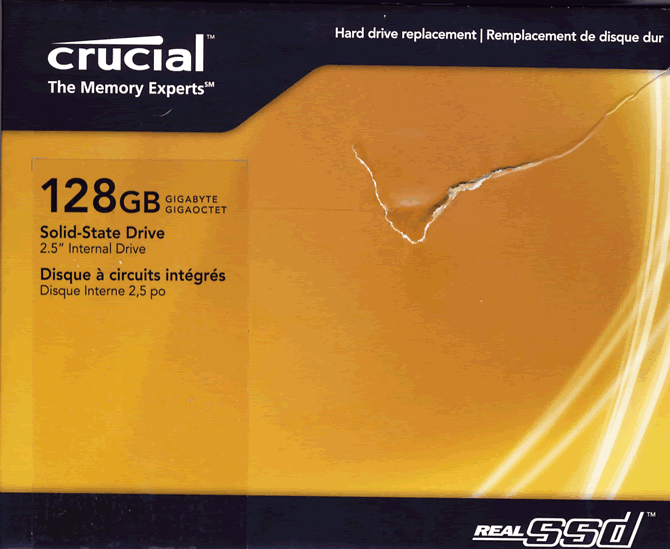
Box top
As
we can see, the package arrived damaged, quite probably by some mishandling by
the carrier who delivered the package. However, the RealSSD C300 was well
protected inside the box, and there were no visible signs of damage to the SSD
itself.
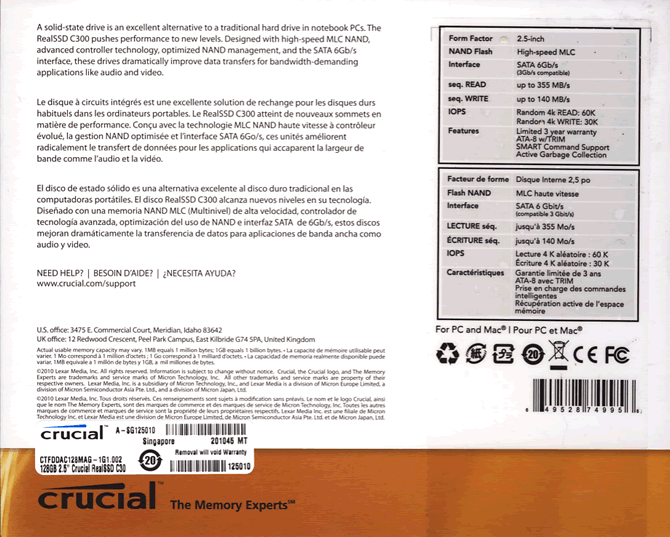
Box bottom

Box front

Box sides
What’s inside the box
Now it’s time to take a look at the drive itself and what
the drive came shipped with.
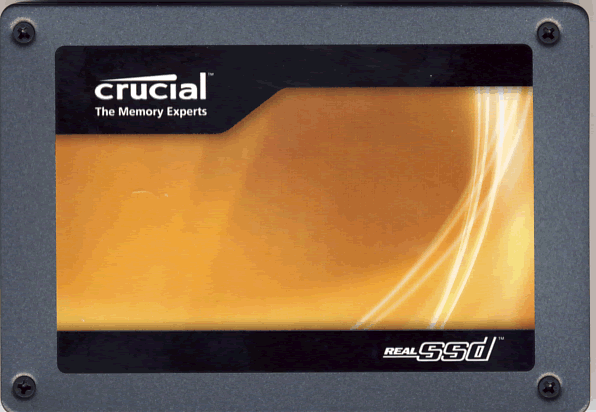
The package contained the Crucial RealSSD C300 128GB SSD
itself, an installation guide, and warranty information.

Drive bottom
On the bottom of the drive, we can see the model (CTFDDAC128MAG-1G1),
the drive’s capacity, the firmware version of the SSD (0002), and also that the
drive was manufactured in Singapore. We can also see the drive’s SATA power and
data connectors.
When the drive arrived firmware version 0006 had just become
available, so we first updated the firmware to version 0006 before we began the
tests.
The Crucial RealSSD C300 is well constructed, in a strong
aluminium housing.
Now let's head to the next page, where we look in more
detail at the Crucial RealSSD C300.
Crucial RealSSD C300 hardware.
Now let’s take a look at the Crucial RealSSD C300 hardware.
PCB

PCB underside
Near the centre of the above screenshot we can see the
Marvell SSD controller, and also visible are 8 NAND chips, the other side of
the PCB being populated by a further 8 NAND chips.
The Marvell SSD controller

The SSD controller used in the Crucial RealSSD C300 is made
by Marvell, designated 88SS9171 – BJP2. The Marvell 88SS9171 is believed to be
a dual core ARM9 processor with 8 channels to the NAND. The 128GB RealSSD C300
uses lower density NAND than the NAND used on the 256GB version, therefore the
amount of parallelism that can be used to access the NAND is less on the 128GB
model, which in turn means that write speed is not quite so high on the 128GB
model compared to the 256GB version.

PCB topside
On the topside of the PCB we can see a further 8 34nm MLC
NAND chips manufacturedr by Micron, and
also the drive’s cache, which turns out to be a
massive 256MB.

NAND

256MB Cache
As we can see from the above screenshots, the NAND and cache
are manufactured by Micron.
Crucial RealSSD C300 128GB Specifications

Note that the specifications for the Crucial RealSSD C300
128GB are in the pink shaded area
Drive maintenance features
For Windows 7 users and some distributions of Linux, the
Crucial RealSSD C300 supports ATA TRIM to keep the NAND clean when the drive is
connected via a SATA 3Gbps connector, providing you use the Microsoft default
SATA drivers, or the Intel RST version 9/10 drivers. However, when the RealSSD
C300 was connected to my motherboard’s onboard Marvell SE9128 SATA 6Gbps
controller, I could see no evidence of TRIM working on this controller. One
would expect that the Marvell drivers do not allow the TRIM command to pass to
the SSD.
The Crucial RealSSD C300 can also be “secure erased”, which
will return all NAND on the SSD to its factory default clean state. You can do
this via the DOS application “HDDErase” or as I prefer by using a Linux “live”
distribution called Parted Magic.
Now let’s head to the next page where we will look at our
test PC and testing procedures...
Test machine
For this review we will be using a computer with the
following configuration:
Hardware:
- Motherboard: Gigabyte GA-P55A-UD4 (Intel P55 chipset)
- Processor: Intel Core i5 750
- RAM: 4GB GEIL Ultra Line DDR3 2133MHz (dual channel)
- GFX: Sapphire Vapor X HD 5770 (1024 Megabytes GDDR5 HDCP compliant)
- Sound: Onboard Realtek ALC889 HD audio controller
- Hard disk OS: 100GB OCZ Vertex 2 SSD
- Hard disk storage: 1X 500GB Samsung Spinpoint F3, and 1X 1TB
Samsung Spinpoint F1. - Case: Antec 900
- PSU: Enermax Liberty 620W
- Display: Samsung Syncmaster 245B 24” widescreen LCD (HDCP
compliant) - Operating System: Windows 7 Home Premium 64bit
The Crucial RealSSD C300 SSD was connected to an SATA 2 port
(ICH10R) on the motherboard of our review PC and all tests on the drive in SATA
3Gbps mode were carried out with the drive connected to this connector.
All the tests were then repeated with the RealSSD C300
connected to the onboard Marvell SE9128 SATA 6Gbps controller on our review PC.
In the BIOS of our review PC, SATA 3 mode was set to turbo mode, and all tests
were carried out with the controller set in this mode.
AHCI mode was also selected for all drives in the BIOS of
our test PC, and all tests were carried out in this mode.
Test applications
To test the performance of the Crucial RealSSD C300 128GB
SSD, we will be using the following test applications in this review.
- HD Tune Pro
- HD
Tach - ATTO
- Iometer
- AS SSD
Benchmark - CrystalDiskMark
- MyCE Reality Suite
Test procedures
We will start off our testing procedures explanation by
stating that we did not run many basic benchmarks on the Crucial RealSSD C300
series drive. You may ask why we have run so few benchmarks?
SSD technology has moved so fast in the last couple of years,
that basic benchmarks alone are now of very limited use, as they don't really
tell us much about performance and how the drive will behave in the real world.
We have therefore decided to show some basic benchmarks of the Crucial RealSSD
C300 SSD, and will complement this with advanced benchmarks using IOMeter and
AS SSD benchmark. We will also show how the Crucial RealSSD C300 performs in
the real world with our recently introduced MyCE Reality Suite test.
Test drives
- 120GB OCZ Vertex SSD (firmware 1.5)
- 120GB OCZ Apex SSD
- 500GB Samsung SpinPoint F3 (HD502HJ)
- 64GB Traxdata Ultra S Plus SSD
- Seagate Momentus XT 500GB (Hybrid drive)
- Western Digital VelociRaptor 300GB
- OCZ Agility 120GB (firmware 1.5)
- Intel X25-M 80GB (series G1)
- OCZ Vertex 2 100GB
- Crucial RealSSD C300 128GB
The Crucial RealSSD C300 SSD came supplied with firmware
version 0002, but was updated to version 0006 before the tests began.
Reviewers note
We were only able to test with the WD Velociraptor HDD for a
very short time, in fact, only enough time to run the IOMeter tests.
Drive preparation for running the tests
All the drives used in this review were in a "used
state" with the exception of the Crucial RealSSD C300 and the Intel
X25-M. To simulate a "used state" on the Crucial RealSSD C300, we
completely filled the drive with files then deleted all the files, repeating
this procedure five times. The Intel X25-M was stuck with a sequential writing
speed of only 36MB/s, and with no TRIM support and little point of carrying out
tests on a drive in this state, a secure erase was performed to recover the
performance before testing began.
- Both our spinning HDD drives were defragged before the
start of each test. - All SSD and HDD used in this article had their partitions
aligned to the Windows 7 x64 defaults.
Where we use graphs in this article to display results, we
will use the following colours to make it easier, for our readers to see which drive
we are reviewing.
 Crucial RealSSD C300 100GB SSD
(SATA 6Gbps mode)
 Crucial RealSSD C300 100GB SSD
(SATA 3Gbps mode)
 Comparison SSD
 Comparison HDD
Now let's head to the next page, where we look at some
basic benchmarks...
Reading Benchmarks
HD Tune Pro

SATA 3Gbps

SATA 6Gbps
We present the graph below for comparison with other recently
tested drives.

From our limited number of test samples, we can clearly see that the Crucial RealSSD C300 series SSD is
very fast; in fact it’s the fastest reading drive in this test.
HDTach read/write test (long bench 32MB zones):

SATA 3Gbps
We could only run HD-Tach in SATA 3Gbps mode, as the
application refused to work at all in SATA 6Gbps mode.
The average reading speed is 237.7 MB/s and the average
writing speed is 138 MB/s.
ATTO disk benchmark
ATTO has become a standard tool for measuring the data
throughput of HDD and SSD. It measures the performance of reading and writing,
using different file sizes and block sizes.

SATA 3Gbps

The reading speed results on the Crucial RealSSD C300 are
extremely impressive, topping out at over 285MB/s for SATA 3Gbps and 387 MB/s
for SATA 6Gbps, writing speeds are not quite so high, topping out at 140.6
MB/s.
CrystalDiskMark 3.0
Crystal Disk Mark is quite a handy benchmarking application,
as it focuses on the file sizes that can cause a problem on a system drive.

SATA 3Gbps

SATA 6Gbps
These are pretty strange results between SATA 3Gbps and SATA
6Gbps. While sequential reading speeds are extremely impressive when the
RealSSD C300 is connected to SATA 6Gbps, random QD32 speed is low compared to
SATA 3Gbps, and writing speeds are very much down with SATA 6Gbps.
I suspect this has more to do with the implementation of
SATA 6Gbps on my motherboard, or very poorly optimized SATA 6Gbps drivers.
AS SSD Benchmark
AS SSD benchmark is a benchmarking tool specifically
designed to test SSDs. The application tests sequential reading and writing
performance, 4K random reading and writing performance.
AS SSD benchmark also tests 4K threaded performance. This is
very exciting, as this test is the first available test that I am aware of,
that simulates how a PC operating system actually works. A modern PC and OS,
such as Windows Vista does not just run a single thread at a time, it runs many
threads. The AS SSD benchmark "4K 64Thrd" tests run 64 threads
simultaneously throughout the test. If this result is good, then you can be pretty
sure the drive will perform extremely well as a system drive.
After the tests complete, AS SSD benchmark derives a total
score for the drive being tested. This is based on all aspects of the test
results, and gives an indication of how the drive is performing overall.
Now let’s look at the result from the Crucial RealSSD C300
in the form of a screenshot. All our other comparison drives’ results are
presented in the form of a graph.

SATA 3Gbps

SATA 6Gbps

Once again, SATA 3Gbps is outperforming SATA 6Gbps. Nonetheless,
the Crucial RealSSD C300 is performing extremely well with this benchmark.
Summary:
The sequential reading speeds on the Crucial RealSSD C300
SSD are excellent and the fastest single SATA drive we have ever tested here at
MyCE.com. Sequential writing speeds are reasonable, but the RealSSD C300 is
outperformed in this area by a number of SSDs.
Let's head to the next page for our IOMeter test
results.....
I/O Performance
There is little point of having an SSD drive that has
blazing sustained reading and writing speeds, if the drive can't handle reading
and writing of small random files. If you intend to use your new SSD drive to
store and run your operating system, then the drive must be able to cope with
the many small random files that Windows will write to the drive continually.
So we feel it is very important to test how many of these random files that a
drive can handle in one second. I believe that anything over 1000 I/O’s per
second would be enough for most users running a consumer grade mainstream PC,
and should provide a smooth running system. But obviously, the more I/O's that
a drive can handle, the faster the drive will feel and leave more headroom for
those huge multitasking sessions that users sometimes engage in.
The things that we will look at are the total I/O per second
and total MB/s.
Partition alignment and sector boundaries
Windows 7 will automatically align a partition during
partition creation, Windows XP won’t. It is imperative that an SSD’s partition
is aligned. Windows XP is also restricted to sector boundaries, while Windows 7
will use 4k boundaries if it can. The RealSSD C300 is 4k boundary aware, and will
use these boundaries when it can. Of course it will also remap LBA’s for compatibility
with the sector boundaries so the drive can be used with Windows XP.
IOMeter allows us to set the sector boundaries for
conducting the tests, and we have therefore set the sector boundaries at 4K,
which means the IOMeter tests are valid for Windows 7 and Windows Vista users.
XP users will not be able to obtain such results.
We will provide a screenshot of the tests on the review
drive for those of you who like to see the actual test result. All the
comparison drive results are represented in the form of graphs.
If any of you would like to see a screenshot from any
IOMeter test on a particular drive, please feel free to request one, and I’ll
post the screenshot in the forum thread.
IOMeter 4K random (outstanding I/Os = 4, 32) write test.
Our first test involves creating continual 4KB random files
on the target drive with IOMeter. We use a 4KB file size, as it is believed
that Windows will create and modify many of this size of file constantly in the
background during a typical Windows session. We will use queue depths of 4 and
32 for these tests on the Crucial RealSSD C300, and the OCZ Vertex 2 SSD.

SATA 3Gbps (QD4)

SATA 6Gbps (QD4)

SATA 3Gbps (QD32)

SATA 6Gbps (QD32)
IOPS

MB/s

4K random writing performance is excellent on the Crucial
RealSSD C300, however it can’t match the speed of the SandForce SF-1200 based
OCZ Vertex 2.
IOMeter 4K random (outstanding I/Os = 4, 32) Read test.
If there are many 4k files created, then that must also mean
that many 4k files need to be read. This test measures 4k reading performance.

SATA 3Gbps (QD4)

SATA 6Gbps (QD4)

SATA 3Gbps (QD32)

IOPS

MB/s

While the RealSSD C300 really couldn’t keep up with the
performance of the OCZ Vertex 2 for random write, the RealSSD C300 more than
makes up for this with 4K random reading performance, where the Crucial RealSSD
C300 with over 55,000 IOPS is outstanding, and a good deal faster than any of
the other drives in this article.
IOMeter 512KB (outstanding I/Os = 4) write test.
Sequential writing performance is also very important; in
this test sequential writing performance is measured.

SATA 3Gbps

SATA 6Gbps
IOPS

MB/s

Sequential writing performance is not a strong point of the
RealSSD C300 128GB SSD, that doesn’t mean that the C300 is slow, but it’s
certainly not as fast as many of the SSDs in this test.
IOMeter 512KB (outstanding I/Os = 4) read test.
This test measures 512k sequential reading performance.

SATA 3Gbps

SATA 6Gbps
IOPS

MB/s

Sequential reading performance in SATA 6Gbps mode is
outstanding, and the RealSSD C300 is by some margin the fastest reading drive.
When in SATA 3Gbps mode, the RealSSD C300 is still an excellent performer.
IOMeter Workstation 1 simulation (outstanding I/Os = 64).
When running applications you will find that there is a
mixture of small random files, and larger sequential files being created and
read. Not only that, it isn’t just one file at a time. In this test we measure
a simulated workstation pattern, with a queue depth of 64 (threaded).

SATA 3Gbps

SATA 6Gbps
IOPS

MB/s

The Crucial RealSSD C300 has done very well in the
workstation simulation, it is ahead of the Intel X-25M, and comfortably ahead
of the two Indilinx based drives. It can’t however match the Vertex 2 for
performance in this test.
Summary
The Crucial RealSSD C300 has performed very well in the
IOMeter tests. It is comfortably the fastest SSD when it comes to reading
performance, and writing performance is also of a very high standard.
On the next page we will check out application and games
loading performance....
These tests are very simple, but very important to some
users of solid state drives.
We simply started an application or game, and measured the
time taken for the application or game to fully load and start.
Application loading times
Adobe Fireworks CS3

The Crucial RealSSD C300 was slightly faster than the Intel
and the two Indilinx based drives, and came oh so close to beating the Vertex
2. In this instance, SATA 6Gbps mode was slightly faster than SATA 3Gbps mode.
Corel PaintShop Pro 12

Again, the Crucial RealSSD C300 really pushes the Vertex 2,
and is faster than the Intel and Indilinx based drives.
Games loading times
FAR CRY 2

Once again, the Crucial RealSSD C300 is marginally faster
than the two Indilinx drives and the Intel X25-M but can’t quite match the
Vertex 2, but they really are very close indeed.
F.E.A.R. 2

The Crucial RealSSD C300 is once again is just piped at the
post by the Vertex 2, but the margin is so very close.
Summary
The Crucial RealSSD C300 pushes the Vertex 2 very hard, and
is only marginally slower at loading the tested applications and games. The
results are so marginal that I would seriously doubt anyone would be able to
tell them apart.
Now let's head to the next page for some real world tests....
It has become clear recently that simply conducting endless
benchmarks on SSD drives is pointless. Real users may run a few benchmarks when
they first fit their SSD drive, but most users just want a drive that performs
well in the real world. They want their drive to work "out of the
box" and work fast and smoothly.
Most of the latest SSD drives can deliver very fast
sustained reading and writing speeds, but these alone tell you very little
about how the drive will perform in the real world.
If you intend to use your SSD as your primary system drive,
with an operating system and applications installed and running from the drive,
real world performance becomes much more important, than just fast sequential
read and write speeds.
Real world copy
tests
We will now conduct a few real world copy tests. These tests
simulate what real people do with their drives. We will be conducting writing
tests, using two large single files and a multiple file copy of various file
sizes.
We should point out that this is not a scientific way of
measuring performance. These timings were taken with a stop watch; we have
however ensured that the reading drive is well able to supply a data stream to
our writing drive, which is high enough not to be slowing down the performance
of the writing drive.
We will once again be comparing the obtained results with
our comparison drive’s, and will present the results in the form of graphs.
Multiple file copy writing test
For this test we copied the Nero Burning Rom install folder
from our review PC to the D: drive (OCZ Technology Vertex 2 100GB) and then
copied the contents to the Crucial RealSSD C300 SSD and our other comparison
drives.
Our test copy contained 1,772 files of various sizes with a
combined capacity of 307MB.

The Crucial RealSSD C300 did well in this test, and is only
marginally slower than the SandForce based drive.
Single large file writing test (7.95GB)
For this test we used a single DVD9 ISO file which had been
copied to the D: drive of our review PC (OCZ Vertex 2 100GB). The file was then
copied to the Crucial RealSSD C300 120GB SSD and our comparison drives.

The Crucial RealSSD C300 with a maximum sequential write
speed of 140MB/s was always going to struggle in this test, however it is
faster than the Intel X-25M.
Write a folder of JPG picture files.
For this test we copied a folder of JPG picture files from
our OCZ Vertex 2 SSD to the Crucial RealSSD C300 SSD, and our other comparison
drives. The folder contained 3714 JPG pictures, with a total capacity of
5.16GB.

Again the RealSSD C300 is left a little bit behind by the
other modern SSDs in this test, but note how SATA 3Gbps is more than 10 seconds
faster than with SATA 6Gbps.
Write a folder of MP3 audio files.
For this test we copied a folder of MP3 audio files from our
OCZ Vertex 2 SSD to the Crucial RealSSD C300 SSD and our other comparison
drives. The folder contained 851 MP3 audio files, with a total capacity of
3.85GB.

In SATA 3Gbps mode, the Crucial RealSSD C300 is more closely
matched with the performance of the other modern SSDs in this test, but once
again SATA 6Gbps is more than 13 seconds slower.
Summary
The Crucial RealSSD C300 has performed well in these tests,
but it isn’t the fastest SSD when you copy files to it. Once again SATA 3Gbps
has proved faster than SATA 6Gbps, but I suspect this has nothing to do with
the Crucial RealSSD C300, and more to do with the Marvell SATA 6Gbps
implementation on our review PC, or just poorly optimized drivers.
Windows start-up and closedown
For these tests, we simply used a stop watch and tested the
amount of time taken for a full installation of Windows 7 to boot to the
desktop, and then timed how long it took for Windows 7 to close down by the
normal start menu method.
The timing was started once the BIOS had initialised and
reached the “loading OS message”.

Windows 7 boot time

Windows 7 closedown
The Crucial RealSSD C300 is the joint fastest drive when
booting our Windows 7 full install, and has also done extremely well in the
Windows 7 shutdown.
Installing applications
Installing applications is possibly something you don't do
that often. But should you replace your system disk, then you will most likely
have to re-install your applications. Most of the SSD drives I have tested up
until now are quite slow at installing applications, most likely because their
I/O performance was quite limited.
For these tests, we picked some popular applications and
copied the entire contents of the CD or DVD media to an OCZ Vertex 2 100GB SSD.
We did this to make sure that the reading speed of our CD/DVD reader would not
hamper the performance of the target drive.
We then installed these applications onto our comparison HDD
drives, which were all running mirror image installations of our Windows 7 Home
Premium 64bit installation, and recorded the amount of time taken to install
the application with a stopwatch, on each of the drives.
MS Office 2007 Professional (full install)
MS Office is another of those applications that make you
cringe at the thought of re-installing it.
Let's find out how our drives coped with the MS Office 2007
full install.

The Crucial RealSSD C300 has done very well in this test,
and is close on the Vertex 2's heels.
Adobe Fireworks CS3
Adobe Fireworks CS3 is another popular package. Let's find
out how our drives coped with installing this application.

Most drives will struggle with this application, but the Crucial
RealSSD C300 took this task in its stride, in fact all the modern SSDs did very
well in this test.
Single drive copy tests
These tests are to simulate a single drive in a PC or
laptop. In other words, we will copy a series of files from one folder on the
tested drive to another folder on the same drive. This means the drive is simultaneously
reading and writing during the tests. We also want to make this a realistic
test. So we have used a folder or MP3 music files, and then repeated the test
with a folder of JPG picture files.
Single drive copy tests – 851 MP3 song files (3.85GB total)

The Crucial RealSSD C300's excellent reading performance has
helped it into first place in this test when in SATA 3Gbps mode.
Single drive copy tests – 3714 JPEG picture files (5.16GB total)

Once again, the Crucial RealSSD C300 is the fastest drive in
this test, but this time SATA 6Gbps has proved to be the faster.
Summary
Our real world tests, though not scientific in nature, we
feel are more realistic than simply running benchmarks. What is clear from our
tests is, that the Crucial RealSSD C300 is an outstanding SSD drive when used
as an operating system drive, with the storage of data left to a large
traditional spinning HDD. This we feel is how most people will use an SSD. In
this scenario the Crucial RealSSD C300 is outstanding.
Now let’s round of this article with our MyCE Reality
Suite tests on the next page.....
MyCE Reality Suite (storage).
So what is the MyCE Reality storage test?
The MyCE Reality Suite of tests is made from real everyday
applications and real data, there are no simulated tests, and everything is in
the real world. The only thing that's synthetic is that everything is automated
to make the tests fair, no matter which drive the tests are run on.
Recorded user sessions, by means of a script, are used to
launch the applications, load data, edit data, and then finally write that data
back to the target drive. The scripts do load the system much more than a human
could with these tests, as the scripts do not make mistakes, or pause to think
about what has to be done next.
Measurement system (revision 2)
The measuring system is part hardware and part software. The
hardware is proprietary and under an NDA, but what I can tell you is: The
measuring system can now accommodate SATA2, SATA3, USB3, PCIe, and DMI.
Testing method.
Once all the test data files were complete, they were then
copied to a single folder. I then fitted an old 80GB HDD into the PC and did a
clean install of Windows 7 Home Premium x64. The latest hardware drivers were
installed and Windows update was run to install any new updates that were
available up to 13/05/2010. At this point the applications that were to be used
in the tests were installed and updated with the latest patches.
The folder containing the application test data files was
then copied over to our fresh Windows 7 HDD. The drive was cleaned up and then
the four test scenarios were recorded, with the scenario playback data file
which will run each test scenario saved to the desktop. A drive snapshot was
then taken of the complete HDD and the drive snapshot image copied to a second
HDD for safe keeping.
The image is then simply restored to each of the drives on
test. In the case of SSD’s the partition is then realigned “on the fly” and for
SSDs that support TRIM, the free space is filled and then deleted to force
TRIM. All other HDDs and SSDs in the system are then disconnected to make sure
the complete test can only run on the drive we are testing.
A 20 minute settling time is allowed before the tests are run,
then each of the 4 tests is run and the results gathered. This process is
repeated for each of the drives we are testing.
The test scenarios are as follows.
- Graphics content
- Video editing
- Audio import and compression
- Application multitasking
Let’s begin the tests.
MyCE Reality Suite – Graphics content.
Using ACDSee Pro 3, 100 JPG pictures with an average size of
10MB are imported into the ACDSee library, and then 12 of these JPG files are
then selected for a batch process, of resize, compress the quality to 80%, and
finally write the edited pictures back to the drive. The test is approximately
78% read and 22% write.

The Crucial RealSSD C300 has performed extremely well with
the graphics suite, with SATA 6Gbps proving to be substantially faster than
SATA 3Gbps.
MyCE Reality Suite – Video editing.
Using Vegas Pro, a 14GB HD MPEG2 video stream is loaded into
the editor, from which 2 segments are then cut and pasted into new segments. There
is a lot of disc caching going on in this test, and the test is approximately
55% read and 45% write.

All the SSDs do very well here with the Crucial RealSSD C300
claiming second place when used in SATA 6Gbps mode.
MyCE Reality Suite – Audio import and compression.
Using Sony Soundforge 10, a batch process is run consisting
of 30 24bit (192000hz sample rate) .wav files, and 100 16bit (44100hz sample
rate) .wav files are imported and then converted to MP3 audio files with a bit rate
of 128kbps, and the converted files are written back to the drive. The test is
approximately 72% read and 28% write.

This time the Crucial RealSSD C300 takes third place.
MyCE Reality Suite – Application multitasking.
For this we used several popular applications, Microsoft
Word 2007, Microsoft Access 2007, Microsoft Excel 2007, Microsoft Outlook 2007,
Adobe reader, Adobe Photoshop CS3, uTorrent, Windows media player, and Internet
Explorer 8.
This session runs for approximately 12 minutes. The test is
started by downloading a Linux distribution via uTorrent, Windows media player
is then opened and a 1080p video file is opened and played for the duration of
the test. Microsoft Outlook is opened and any new emails are received, read,
then replied too, a document in Adobe reader is opened and scrolled from start
to finish, 3 Microsoft Word documents with graphics content are opened, browsed
and some sections of the documents are copied and pasted into a forth document
and then saved back to the drive. The same applies to Microsoft Access and
Excel. 100 MP3 files are imported into Windows media library. Six JPG images
are loaded into Adobe Photoshop and some minor editing is done and the files
saved back to the drive.
Finally, Internet Explorer 8 is opened with 10 tabs, and the
contents of the 10 tabs refreshed, and browsed while the other applications are
busy in the background.
I would describe the multitasking pattern as modest.
During this test there is approximately 85% reading and 15%
writing.

The Crucial RealSSD C300 once again takes third place in
this test.
Summary
I firmly believe that the MyCE Reality Suite gives a very
good overall picture of how a drive can perform in the real world, and in this
case, the Crucial RealSSD C300 SSD is certainly very capable of extremely good
performance.
This concludes our review. To read the final thoughts and
conclusion, click the link below....
Final thoughts and the conclusion
Positive:
- Silky smooth operation as a system drive and completely
stable. - Outstanding reading performance.
- Outstanding 4K random I/O performance
- SATA 6Gbps support
- Excellent multitasking potential.
- TRIM support under Windows 7 (SATA 3Gbps)
- Lightning fast access times.
- Completely silent operation.
- Fast operating system start-up and shutdown times.
- Fast application loading.
- 3 years warranty.
Negative:
- Apparently no TRIM support in SATA 6Gbps mode.
User experience
A modern operating system such as Windows 7 rarely does one
thing at time; it processes hundreds of threads at once. Just take a look at
the processes and services that are running in task manager for an idea of how
much is going on, even with the PC idling at the desktop. When you start
running applications on top of this, the workload increases in line with the number
and type of applications you are running. It’s also fair to say that many of
these processes are already loaded into system RAM, but many are also loaded
and unloaded into RAM from the system drive as and when they are required.
The fact of the matter is this. If you are running a mainstream
or high end modern PC with a powerful CPU and graphics card, and are still
running a traditional HDD as a system drive, regardless of how fast that HDD
is, it is still bogging the system down substantially. It has long since passed
the stage where one can meaningfully debate if an SSD is really faster than a
traditional HDD. The fact is they are, and not just by a little bit: they are
much faster.
When I first started testing SSDs more than 2 years ago, it
was less clear then how much an SSD improved performance. A lot of things have
changed with SSDs over the last 2 years. The SSD controllers are much more
powerful and the NAND itself is getting smaller and faster.
If we look at the 3 basic requirements for a fast SSD, they
are as follows.
- Small file threaded performance needs to be high
- Small random file performance needs to be high
- Sequential read and write speeds needs to be high
The Crucial RealSSD C300 128GB has all of the above with the
possible exception of sequential writing performance, which even then is
perfectly adequate, and a good deal faster than many SSDs. What you end up with
in the Crucial RealSSD C300, is an SSD that performs extremely well, and during
the course of these tests remained perfectly stable, and did not exhibit any
perceivable drop off in performance.
Conclusion:
Let us summarise the most important positive and negative
points below:
The
main positive points:
The Crucial RealSSD C300 128GB SSD has the fastest reading
speeds from a single drive we have ever tested here on MyCE.com
4K random IOP performance is phenomenal and small file
threaded performance is excellent.
With TRIM support in Windows 7 with SATA 3Gbps, the Crucial
RealSSD C300 should remain at near peak performance during the expected life
cycle of the drive.
Noise levels from the drive are nil; there are no moving
parts so the drive is completely silent.
The
main negative points:
The apparent lack of TRIM support when the RealSSD C300 is
connected to the current Marvell SATA 6Gbps controller is a little disappointing,
but this can’t be blamed on Crucial, or the RealSSD C300. It is really up to
Marvell to implement TRIM support with an updated driver, if this is possible.
Price is still a stumbling block to purchasing an SSD drive,
although NAND prices are now beginning to drop a little.
To sum up, this is what we
would say:
It is inevitable that the Crucial RealSSD C300 will be
directly compared to SandForce SF-1200 based SSDs. The 120GB/128GB capacity
market is very competitive.
When the Crucial RealSSD C300 256GB SSD launched early this
year, it was without doubt the fastest single SSD available. Unfortunately for
Crucial, SandForce burst onto the scene with their SF-1200 SSD controller based
SSDs.
While the RealSSD C300 256GB is still arguably the fastest single
SATA SSD, the 128GB model (at least on paper) can’t match the performance of
the SandForce based drives, but it does come close, in fact so close that in
the real world and everyday use, I could not tell the two apart regarding
performance.
SATA 6Gbps performance was a little bit disappointing, but
as I have already mentioned, I can’t help but feel that this is more to do with
how SATA 6Gbps has been implemented on my GigaByte GA-P55A-UD4 motherboard.
Thankfully Intel P67 will soon make an entrance, and I feel (if
time permits) that I should revisit the Crucial RealSSD C300 SSD, and test it
on the new native SATA 6Gbps support on the Intel P67 chipset, so stay tuned.
Pricing, taken from Scan
computers UK (8/12/2010) Price in Euro, is from the current exchange rate.
|
Model |
User capacity |
Price |
Cost per GB |
|
Crucial RealSSD |
119.2GB |
£209.02 |
£1.75 |
|
OCZ Vertex 2-E |
119.2GB |
£175.65 |
£1.47 |
|
Intel |
74.5GB |
£136.62 |
£1.83 |
The Crucial RealSSD C300 128GB SSD is priced slightly higher
than its nearest competitor, the OCZ Vertex 2 120E. The price difference
however is not high, and if you prefer the Crucial RealSSD C300 over the Vertex
2, then surely the £34 price difference should not stop you buying the Crucial
RealSSD C300 128GB SSD. It’s a fine and strong performing SSD with very few
negative things to mention.
Our parting sentence is
“The Crucial RealSSD C300 is an excellent SSD, strong in
areas where it needs to be, and the fastest reading SATA SSD we have ever tested
here on MyCE.com”.
The performance and usability of the Crucial RealSSD C300
128GB SSD was so good, that we decided to award the drive our MyCE.com “Editor’s
choice” award.


This is the current price for the RealSSD C300 128GB SSD:
[field name=iframe]
You may comment on this review below.
Thanks to:
|
|
EFD Software for |
|
|
Simpli Software |
|
|
Alex |