 |
Review: Toshiba THNSNF512GCSS |
Way back in 1987 Toshiba invented NAND flash memory, yes
that is correct, one quarter of a century ago. One wonders if the inventor, Dr.
Fujio Masuoka could have envisaged what NAND has become today, and the
applications that NAND flash memory is used for. Without NAND, there would be
no SD cards, no smart mobile phones, no USB pen drives, and of course no SSDs.
NAND was developed from EEPROM, the big difference from NAND
to EEPROM is, that NAND flash can be erased and written in blocks, whereas an
EEPROM had to be completely erased before it could be reprogrammed. Of course
modern NAND has come a long way in the past 25 years. It has got faster, and
smaller.
The SSD I'm looking at today is from the manufacturer who
invented NAND, Toshiba. The THNSNF512GCSS, which
Toshiba were kind enough to send me for review, is in fact the first SSD to use
19nm toggle mode MLC NAND. The THNSNF range of SSDs is available in capacities
of 64GB, 128GB, 256GB, and 512GB. The model I will be looking at today is the
512GB version.
Toshiba company information
Toshiba should need no introduction, but those of you who
would like to find out more about Toshiba, can do so at their website.
The Toshiba THNSNF512GCSS - 512GB SSD
Now it’s time to take a look at the drive itself and what it
came shipped with.
Packaging
The SSD I received was a bare drive, and arrived in a
cardboard box, with no markings.
Inside the box
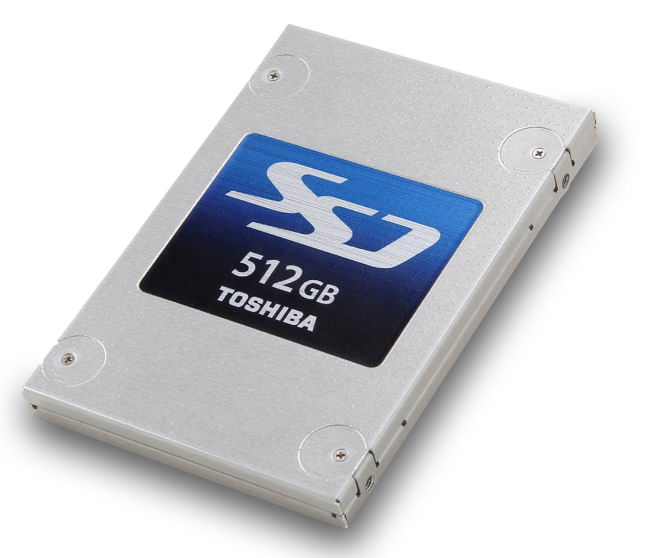
The retail Toshiba THNSNF512GCSS 512GB SSD
Drive top
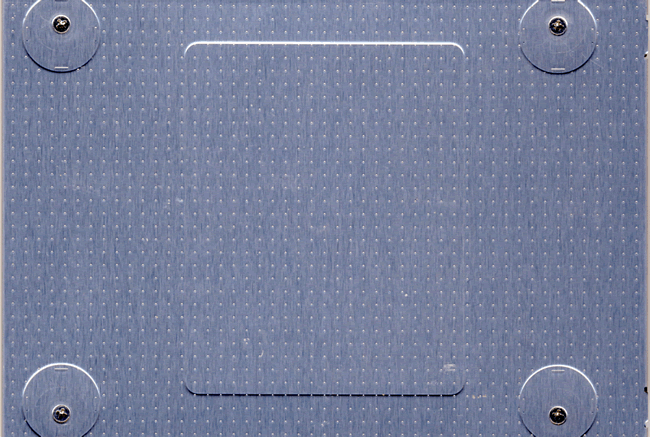
The top of the unit is made of metal, and as you can see,
the review sample had no label.
Drive underside
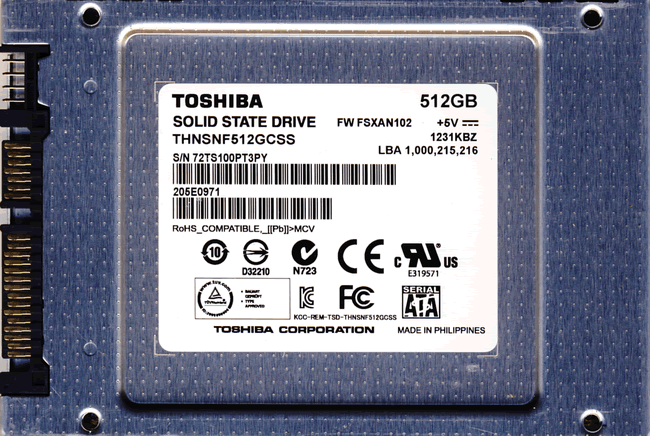
On the underside of the SSD, I found a label which displays
the SSD model number, storage capacity, and indicating that the SSD was
manufactured in the Philippines. The label also states that the firmware
version is FSXAN102, but our review sample arrived with firmware version
FSR1N101, which is most likely a later version of the firmware. The bottom of
the case is also made of metal and acts as a heat sink for the SSD controller
and NAND.
The case itself is 7mm thick and designed to be housed in a
standard 2.5 inch drive bay, or a 3.5 inch drive bay using a converter bracket.
Now let's head to the next page, where we look in more
detail at the Toshiba THNSNF512GCSS SSD.....
A closer look at the Toshiba THNSNF512GCSS hardware.
Let's take a look at the hardware found inside the Toshiba THNSNF512GCSS SSD.
Inside the case.

PCB topside
As you can see in the above screenshot, the top of the PCB
has no components whatsoever.

PCB underside
On the underside of the PCB we can see eight NAND chips, the
SSD controller, and various support components.

The SSD controller
From the screenshot it is nearly impossible to read any
markings, but with some help from a good friend at Myce, we were able to
identify the markings. The SSD controller is manufactured by Marvell and is
designated N8B97202 4JW. So it looks like a custom controller from Marvell with
firmware from Toshiba. Interestingly, I could find no sign of any external
cache.
The SSD controller also employs Toshiba's own proprietary
QSBCTM (Quadruple Swing-By Code) error correction, which is said to
be a strong and a highly efficient error correction code (ECC). The SSD
controller also supports advanced power management (APM) features to minimize
power consumption.

19nm toggle mode MLC NAND
Once again, reading any markings on the NAND package proved
nearly impossible, but again with some help, we were able to find some markings
on the NAND packages, and they are designated Toshiba TH58TEG9D2JBAS9.
There are eight NAND chip packages on board the Toshiba THNSNF512GCSS 512GB SSD, with each package having a capacity
of 64GB.
Specifications
I found the following specifications at Toshiba's website.

Let’s head to the next page where we take a look at our
testing methods and the review PC.
Test machine
For this review I will be using a computer with the
following configuration:
Hardware:
- Motherboard: Asus P8Z77 V Deluxe (Intel Z77 chipset)
- Processor: Intel 3rd generation Core i7 3770K
- RAM: 16GB Samsung Green DDR3 1600MHz (dual channel)
- GFX: Onboard Intel HD 4000
- Sound: Onboard Realtek ALC898 HD audio controller
- Hard disk OS: OCZ Vector 256GB SSD
- Hard disk storage: 1X 500GB Samsung Spinpoint F3, and 1X 1TB
Samsung Spinpoint F1. - Case: Antec Performance One P280
- PSU: Antec True Power modular 550W
- Display: Dell UltraSharp U2412M 24” widescreen IPS LCD (HDCP
compliant) - Operating System: Windows 8 Professional 64bit
The Toshiba THNSNF512GCSS SSD was connected to the Intel
native SATA 6Gbps (port 0) on the Z77 motherboard of our review PC and all
tests on the drive were carried out with the drive connected to this port.
AHCI mode was also selected for all drives in the UEFI of
our test PC, and all tests were carried out in this mode. The SATA 6Gbps drivers
used on our review PC were the Intel Rapid Storage Technology (RST) Version
11.6.0.1030

Test applications
To test the performance of the Toshiba THNSNF512GCSS series 512GB
SSD, I will be using the following test applications in this review.
- HD-Tune Pro
- ATTO
- Iometer
- AS SSD
Benchmark - CrystalDiskMark
- MyCE Reality Suite
- Anvil’s
Storage Utilities
Test procedures
I will start off our testing procedures explanation by
stating that I did not run many synthetic benchmarks on the Toshiba
THNSNF512GCSS SSD. You may ask why I have run so few synthetic benchmarks?
SSD technology has moved so fast in the last couple of years,
that basic synthetic benchmarks alone are now of very limited use, as they don't
really tell us much about performance and how the drive will behave in the real
world. I have therefore decided to show some basic benchmarks of the Toshiba
THNSNF512GCSS series SSD, and will complement this with advanced benchmarks
using IOMeter and AS SSD benchmark. I will also show how the Toshiba
THNSNF512GCSS series SSD performs in the real world with our MyCE Reality Suite
test.
The reality of SSD performance
While I can easily show you which SSD is technically the faster,
when you use one of these modern SSDs as an operating system drive it becomes
very difficult to tell them apart as far as performance is concerned.
A typical use of a small capacity SSD at the moment is to
have your operating system and applications installed onto the SSD. The
performance difference compared to a traditional HDD is enormous, however when
you start to compare SSD to SSD the difference becomes almost impossible to
detect.
Let’s look at why this is the case.
Drive A can boot to the desktop in 8.11 seconds, and drive B
can boot to the desktop in 8.12 seconds, the difference in time is
milliseconds, and can one really tell the difference?
The fact is, all modern SSDs are only ticking over when they
are only running the OS and launching applications, it’s only when you get to
some of the larger capacity SSDs, with enough free space to be able to hold the
actual data that you’re going to be working with, be that video, audio or
pictures, for example, that you actually get a tangible difference in
performance. This is where the SSDs with the better sequential performance start
to pull well ahead of the SSDs which have lower sequential read/write
performance.
Small file random IOPS vs sequential performance
IOPS
This is a fairly complex subject, but I will do my best to
explain things in a manner that is easy to understand.
The term IOPS is the amount of input or output transactions
that can take place in a one second interval, so for example, if an SSD is
quoted as being able to cope with 20,000 4K random write IOPS, then the SSD
should be able to cope with 20,000 input transactions in a period of one
second. If the same SSD is said to be able to produce 20,000 4K random read
IOPS, then the same SSD should be able to produce 20,000 4K random read output
transactions in a one second interval.
Ok, now we have some figures to work with, the next question
is how many IOPS are actually required?
This will depend on your usage pattern. If you are a typical
desktop user who browses the internet, does some word processing or perhaps
some audio or video editing, and perhaps plays a few games, then in actual
fact, you don’t need to have massive 4K random read/write performance. The
actual amount of 4K random performance that is required for a fast and smooth
running system for a desktop user with a usage pattern similar to the above
will be well under 1,000 4K IOPS.
On the other hand, if the SSD is being used for running a
large and complex database server, then 4K random performance is the absolute
measurement of how fast that server will run, as this type of application does
most of its input and output transactions in the 4K domain.
So why would I need an SSD with 80,000 4K IOPS for a
desktop?
In fact you don’t need this type of performance for a
desktop, but an SSD which is capable of coping with 80,000 4K IOPS will be
faster than an SSD which can only cope with 20,000 4K IOPS.
OK, I just said if under 1,000 4K IOPS are actually required
for typical desktop usage, why is an SSD with 80,000 4K IOPS faster than an SSD
with only 20,000 4K IOPS, confused?
You may ask, if I only require 1,000 4K IOPS surely the rest
is wasted?
While you may never need 80,000 4K IOPS, IOPS is all about
latency. The reason that an SSD can cope with as much as 80,000 4K IOPS is because
latency in this domain is very low. With 4K files, even if you require to
process 500 of them at the same time, you are not talking about a huge amount
of data, it has far more to do with how long it takes the SSD to process a
single file, and the amount of time required to process a single 4K is all
about how long it takes for the SSD to access or store that data before it can
move on to the next transaction.
In other words an SSD with 80,000 4K IOPS performance will
handle those 500 files faster than the SSD with 20,000 IOPS.
So how will a desktop user even notice this faster speed if
so little 4K random IOPS and data are actually used?
Multitasking is a good example. The more tasks you run at
the same time, you more you will notice the speed difference.
Sequential performance
I have always maintained that sequential performance was
every bit as important as small random file performance for a desktop SSD. To
me this was always so obvious for a desktop user. For example, let’s say you
want to launch an application or game. Both have some fairly large files to
load, and also a great many small files, but the point is, even the smaller
files are sequential in nature. Now let’s say you’re into audio or video
editing. Video files tend to be huge, and the files are written or read
sequentially. Isn’t this how many users are using their PCs these days?
Summary
So how does this shape up in the real world? Which is
better, massive 4K IOPS or massive sequential performance?
In an ideal world you want both, as an SSD with massive
random 4K IOPS and sequential performance will always be faster than an SSD
that has high sequential performance and moderate 4K random IOPS performance,
and the same applies to an SSD that has massive 4K random performance and
moderate sequential performance. The SSD which has high performance in both
patterns will always be the faster SSD.
However, you can still have an SSD that is very fast for
desktop use that has moderate random 4K performance and massive sequential
performance, the same can be said about a drive having massive random 4K
performance and moderate sequential performance, as it is about getting the
balance right if you have to compromise on one or the other.
Test drives
- Plextor PX-256M2S SSD
- Crucial RealSSD C300 128GB SSD
- OCZ Vertex 3 240GB SSD
- Intel 510 series 120GB SSD
- Crucial M4 256GB SSD
- OCZ Octane 512GB SSD
- Plextor PX-256M3 256GB SSD
- OCZ Vertex 4 512GB SSD
- Kingston Hyper X 3K 240GB SSD
- SanDisk Extreme 120GB SSD
- OCZ Agility 4 256GB SSD
- Corsair Neutron GTX 240GB SSD
- Samsung 830 256GB SSD
- OCZ Vector 256GB SSD
- Toshiba THNSNF512GCSS
512GB SSD
Drive preparation for running the tests
All the SSDs used in this article were in a clean and fresh
state when the testing period started. From then on, each drive had to rely on
its own NAND cleaning effectiveness for the remainder of the tests.
For the sake of clarity, I now only include SATA 6Gbps SSDs
in these tests, and all were connected to the native Intel SATA 6Gbps (port 0)
of my motherboard for these tests.
- All SSDs used in this article had their partitions aligned
to the Windows 8 x64 defaults.
Where I use graphs in this article to display results, I
will use the following colours to make it easier, for our readers to see which drive
we are reviewing.
 Toshiba THNSNF512GCSS 512GB
SSD
 Comparison SSD
Now let's head to the next page, where I look at some
basic benchmarks...
Synthetic Benchmarks
HD Tune Pro
In this benchmark I am checking sequential reading speed.

With an average sequential reading speed of 388.8 MB/s the Toshiba
THNSNF512GCSS is showing a reasonable turn of speed.
Let's see how this compares to other recently tested SSDs in
the table below.

The Toshiba THNSNF512GCSS doesn't do to well in the HD Tune
Pro 5 test run, which seems to be a trait with the new Marvell SSD controllers,
and I found similar results with the OCZ Vertex 4, and Agility 4, which
basically use the same Marvell silicon.
ATTO disk benchmark
ATTO has become a standard tool for measuring the data throughput
of HDD and SSD. It measures the performance of reading and writing, using
different file sizes and block sizes.

The reading speed results on the Toshiba THNSNF512GCSS are
extremely impressive, topping out at 554 MB/s, and writing speed is also excellent
topping out at over 512 MB/s.
CrystalDiskMark 3.0
Crystal Disk Mark is quite a handy benchmarking application,
as it focuses on the file sizes that can cause a problem on a system drive.

As we can see from the above screenshot, sequential reading
and writing speeds are excellent, and random read and write speeds at higher
queue depths are very impressive.
AS SSD Benchmark
AS SSD benchmark is a benchmarking tool specifically
designed to test SSDs. The application tests sequential reading and writing
performance, 4K random reading and writing performance.
AS SSD benchmark also tests 4K threaded performance. This is
very exciting, as this test is the first available test that I am aware of,
that simulates how a PC operating system actually works. A modern PC and OS,
such as Windows 7/8 does not just run a single thread at a time, it runs many
threads. The AS SSD benchmark "4K 64Thrd" tests run 64 threads
simultaneously throughout the test. If this result is good, then you can be
pretty sure the drive will perform extremely well as a system drive.
After the tests complete, AS SSD benchmark derives a total
score for the drive being tested. This is based on all aspects of the test
results, and gives an indication of how the drive is performing overall.
Now let’s look at the result from the Toshiba THNSNF512GCSS
SSD in the form of a screenshot. All our other comparison drives’ results are
presented in the form of a graph.


The Toshiba THNSNF512GCSS is showing excellent performance in
the AS SSD test run, and finishes the test in fourth place.
Summary:
The Toshiba THNSNF512GCSS 512GB SSD has performed well in
the basic synthetic benchmarks. Random reading and writing performance is very
good, and not to be outdone, sequential reading and writing speed is excellent.
However, as we have learnt over the years, synthetic benchmarks don't really
tell us much about how an SSD will perform in the real world. So let's wait and
see how the Toshiba THNSNF512GCSS performs in the real world a little later in
this article.
Let's head to the next page for our IOMeter test
results.....
I/O Performance
There is little point of having an SSD drive that has
blazing sustained reading and writing speeds, if the drive can't handle reading
and writing of small random files. If you intend to use your new SSD drive to
store and run your operating system, then the drive must be able to cope with
the many small random files that Windows will write to the drive continually.
So I feel it is very important to test how many of these random files that a
drive can handle in one second. I believe that anything over 1,000 I/O’s per
second would be enough for most users running a consumer grade mainstream PC,
and should provide a smooth running system. But obviously, the more I/O's that
a drive can handle, the faster the drive will feel and leave more headroom for
those huge multitasking sessions that users sometimes engage in.
The things that I will look at are the total I/O per second and
total MB/s.
Partition alignment and sector boundaries
Windows 8, Windows 7, and Windows Vista will automatically
align a partition to 4k boundaries during partition creation, Windows XP won’t.
It is imperative that an SSD’s partition is aligned. Windows XP is also restricted
to sector boundaries, while Windows 7 and 8 will use 4k boundaries if they can.
The Toshiba THNSNF512GCSS series is 4k boundary aware, and will use these
boundaries if possible. Of course it will also remap LBAs for compatibility
with the sector boundaries so that the drive can be used with Windows XP.
IOMeter allows us to set the sector boundaries for
conducting the tests, and I have therefore set the sector boundaries at 4K,
which means the IOMeter tests are valid for Windows 7, Windows 8 and Windows
Vista users. XP users will not be able to obtain such results.
I will provide a screenshot of the tests on the review drive
for those of you who like to see the actual test result. All the comparison
drive results are represented in the form of graphs.
If any of you would like to see a screenshot from any
IOMeter test on a particular drive, please feel free to request one, and I’ll
post the screenshot in the forum thread.
All the IOMeter tests create a 10GB data set on the target
drive, and each test is run for a duration of 3 minutes.
IOMeter 4K random write test with repeating data.
The first test involves creating continual 4KB random files
on the target drive with IOMeter. I use a 4KB file size, as it is believed that
Windows will create and modify many of this size of file constantly in the
background during a typical Windows session. It is said that most 4K random
writes take place at a queue depth of only one, and I have been requested to
include this test in my reviews.
Queue depth 1

Toshiba THNSNF512GCSS 512GB SSD – 4K random write (QD1)

At 31.09 MB/s the Toshiba THNSNF512GCSS 512GB SSD is not
doing so well in this test, and low queue depth random write performance is
certainly not a strong point of the Toshiba THNSNF512GCSS. More than likely
this is due to the THNSNF512GCSS not having a cache to speed things along at
low queue depths.
Our next test involves creating continual 4KB random files
on the target drive with IOMeter. I use a 4KB file size, as it is believed that
Windows will create and modify many of this size of file constantly in the
background during a typical Windows session. I will use queue depths of 4 and
32 for these tests.
Queue depth 4

Toshiba THNSNF512GCSS 512GB SSD (Queue depth 4)

At a queue depth of 4, the Toshiba THNSNF512GCSS is
performing somewhat better, but is still a long way behind some of the newer
SSDs in this test.
Queue depth 32

Toshiba THNSNF512GCSS 512GB SSD (Queue depth 32)

Once again the Toshiba THNSNF512GCSS has moved up the table,
but is still quite a long way behind the newest SSDs in this test.
IOMeter 4K random write test with fully random data.
This test is exactly the same as the test above except that
the test data is fully random and is therefore much more difficult to compress.
This test was requested as SandForce based SSDs gain a lot of performance by
being able to compress data on the fly. While the above test shows the
SandForce based SSDs in a best case scenario, the following test will show the
SandForce based SSDs in a much more realistic scenario.
Queue depth 4

Toshiba THNSNF512GCSS 512GB SSD – 4K random write (QD4 with fully random data)

The Toshiba THNSNF512GCSS pays no penalty when writing data
which is incompressible, however it is still a long way behind most of the SSDs
in this test.
4K random write queue depth profile
For this test I used various queue depths from 1 – 32 to
give you an idea how this SSD performs at different queue depths. For a normal
desktop user for lightweight multitasking, the queue depth will rarely rise
above 2. For heavy multitasking, the queue depth is unlikely to rise above a
value of 8.
The results are shown below.

As we can see, the Toshiba THNSNF512GCSS scales quite well
with increasing queue depths, but the problem is it's starting from a low
throughput to begin with.
Below I present a table of the results in more detail.

IOMeter 4K random read test.
If there are many 4k files created, then that must also mean
that many 4k files need to be read. This test measures 4k reading performance.
It is said that most 4K random reads take place at a queue
depth of only one, and readers have requested that I include this test in my
reviews.
Queue depth 1

Toshiba THNSNF512GCSS 512GB SSD (Queue depth 1)

The Toshiba THNSNF512GCSS is once again off to a poor start
when compared to our other modern SSDs.
Queue depth 4

Toshiba THNSNF512GCSS 512GB SSD (Queue depth 4)

With a slightly higher queue depth the THNSNF512GCSS is
performing much better, and is now sitting mid-table.
Queue depth 32

Toshiba THNSNF512GCSS 512GB SSD (Queue depth 32)

If the Toshiba THNSNF512GCSS was disappointing at a queue
depth of 1, it has certainly made up for it at a queue depth of 32, and gets
very close to the OCZ Vector.
4K random read queue depth profile.
This test shows how the review drive scales with increasing
queue depths.

Below I present a table of the results in more detail.

If we look at the Toshiba THNSNF512GCSS 4K random read
performance in detail, we can see that it scales exceptionally well with increasing
queue depths.
IOMeter 512KB write test with repeating data.
Sequential writing performance is also very important; in
this test sequential writing performance is measured.

Toshiba THNSNF512GCSS
512GB SSD - 512K Sequential write with repeating data

The Toshiba THNSNF512GCSS SSD has excellent sequential
writing speed, and even with data that is easily compressible by the SandForce
based SSDs, the Toshiba THNSNF512GCSS comes very close to beating them,
finishing this test in fifth place.
IOMeter 512KB sequential write test with fully random data.
This test is exactly the same as the test above except that
the test data is fully random in nature. This test was requested as SandForce
based SSDs gain a lot of performance by being able to compress data on the fly.
While the above test shows the SandForce based SSDs in a best case scenario,
the following test will show the SandForce based SSDs in a more realistic light.
In the real world, the data is neither 100% incompressible nor 100%
compressible, it is somewhere in between. So please keep this in mind.

Toshiba THNSNF512GCSS 512GB SSD – 512K sequential write with fully random data

With data that is not so easy to compress, the SandForce SF-2281
based SSDs take a big hit in performance. On the other hand, the Toshiba
THNSNF512GCSS 512GB SSD is performing extremely well, and is the second fastest
SSD in this test.
IOMeter 512KB sequential read test QD1.
This test measures 512k sequential reading performance at
very low queue depths.

Toshiba THNSNF512GCSS 512GB SSD – 512K sequential reading test QD1

The Toshiba THNSNF512GCSS 512GB SSD has exceptional
sequential reading performance at very low queue depths, and finishes this test
in third place.
IOMeter 512KB sequential read test (dual threaded).
This test measures 512k sequential reading performance QD2.

Toshiba THNSNF512GCSS 512GB SSD – 512K sequential reading test QD2

At a more realistic queue depth the Toshiba THNSNF512GCSS
512GB is still showing excellent sequential reading performance.
IOMeter Workstation simulation (outstanding I/Os = 64).
When running applications you will find that there is a
mixture of small random files, and larger sequential files, being created and
read. Not only that, it isn’t just one file at a time. In this test I measure a
simulated workstation pattern, with a queue depth of 64 (threaded).

Toshiba THNSNF512GCSS 512GB SSD – Workstation simulation

The Toshiba THNSNF512GCSS 512GB SSD is showing exceptional
performance with our Workstation test pattern, and finishes the test run in
second place, with a massively impressive 414.62 MB/s.
Summary
It's a mixed bag with the Toshiba THNSNF512GCSS 512GB SSD.
In some instances it's showing exceptional performance, such as 4K random
reading performance at high queue depths. Sequential reading and writing
performance is also excellent. In the Workstation pattern the performance is
exceptional. At the other end of the scale, low queue depth 4K random reading
and writing performance could be better.
Now let’s head to the next page where we will look at how
the Toshiba THNSNF512GCSS SSD performs using a brand new benchmarking
application....
Anvil’s Storage Utilities
As well as performing SSD endurance tests. Anvil’s Storage
Utilities has a very nice SSD benchmarking application. The SSD benchmark tests
many different aspects of SSD performance, including 4K random at different
queue depths, and also sequential performance, but more importantly than this,
all using real test data.
Another very nice feature of Anvil’s SSD benchmark is the
fact that you can change the compression levels of the test data. The
compression levels of the datasets used for the tests can be varied from 0%
compression right up to 100% compressed data, and there are even a few data
profiles already included, such as database (8%) compression, and also an
application profile (46%) compression, which is designed to simulate real
application data being read and written to the SSD.
Anvil’s Storage Utilities is still in beta at the moment,
but the application is currently solid enough to use in this article, and I have
already verified the results obtained using an SATA analyser.
I will include a screenshot of the review drive, and all
comparison results will be presented in the form of graphs. If you would like
to see screenshots of the test results obtained on the other SSDs in this
article, you can do so by following the link here.
I will also be testing three different compression profiles,
which are as follows.
- 0 fill (100% compressible data)
- Application simulation profile (46% compressed)
- 100% (non compressible data)
So let’s begin the tests.
0 fill

Toshiba THNSNF512GCSS 512GB SSD 0 fill)

Writing score

Reading score

Total score
In the 0 fill test, the Toshiba THNSNF512GCSS has not done too
badly overall, but the poor 4K random reading and writing performance at low
queue depths, has meant that its overall score is near the bottom of the table.
Application profile

Toshiba THNSNF512GCSS 512GB SSD (application profile)

Writing score

Reading score

Total score
The application test pattern is much more realistic in terms
of the type of data that real users will use. The Toshiba THNSNF512GCSS has
performed better in this test, and manages to climb up one place in the table.
100% incompressible

Toshiba THNSNF512GCSS 512GB SSD (100% incompressible)

Writing score

Reading score

Total score
With test data that can't be compressed at all, the Toshiba
THNSNF512GCSS 512GB SSD still hasn't been able to overtake the SandForce based
SSDs. However it is still performing well.
Summary
One should keep in mind that although Anvil’s Storage
Utilities SSD benchmark is a very good benchmark, and tests many aspects of SSD
performance, ultimately it is demonstrating which SSD is technically the
fastest, and this may not be showing (for example) which drive will be fastest
in the real world with a home user's work pattern.
The Toshiba THNSNF512GCSS 512GB hasn't quite been able to
stay with many of the newer SSDs in these tests. That is not to say that the
Toshiba THNSNF512GCSS isn't performing well, because it is. It's just that at
low queue depths, with 4K random data, which does count for a high percentage
of the overall score in Anvil's SSD benchmark, the Toshiba THNSNF512GCSS just
can't keep pace with many of the SSDs in this article.
Now let's head to the next page for some real world tests....
It has become clear that simply conducting endless
benchmarks on SSD drives is pointless. Real users may run a few benchmarks when
they first fit their SSD drive, but most users just want a drive that performs
well in the real world. They want their drive to work "out of the
box" and run fast and smoothly.
Most of the latest SSD drives can deliver very fast
sustained reading and writing speeds, but these alone tell you very little
about how the drive will perform in the real world.
If you intend to use your SSD as your primary system drive,
with an operating system and applications installed and running from the drive,
real world performance becomes much more important than just fast sequential
read and write speeds.
Real world copy tests
I will now conduct a few real world copy tests. These tests
simulate what real people do with their drives. I will be conducting writing
tests, using a large single file, and I will then round off the tests by
copying a folder of MP3 audio files, and also a folder of JPG pictures.
In past reviews I simply used Windows copy and paste to copy
the files from one drive to the target drive, and then I measured the time
taken to complete the test with a stop watch. This method was flawed in a
couple of ways. Windows employs a cache, so even when the files had been
copied, some of the data was still in the Windows cache and hadn't yet been
written to the SSD. The other flaw was that a stop watch is not a very accurate
way of measuring the time taken to complete the test.
I had also noticed that copying the small file set had
become pointless, as most modern SSDs have a rather large cache, in fact large
enough to be able to take the complete file set in this cache without having to
commit that data to NAND before the test had completed. I could have increased
the amount of data in the test, but I felt this was moving away from the real
world. For example, who would copy 2GB of data containing only very small
files?
I concluded it was perhaps better just to drop this test
completely, and just focus on the large 8GB ISO file, the folder of MP3 audio
files, and the folder of JPG picture files. I also have taken the opportunity
to increase the amount of data to be copied in the MP3 and JPG tests, to make
sure the SSD's memory cache can't obtain an unfair advantage.
The other change is, I now use an application to copy the
data, which also times how long it take to complete the test. This application
also supports "cache write-through". What this basically means is, there
is now no caching of the files, and instead the data being copied must be
committed to the target SSD as its being copied.
Obviously making such changes to the methods of testing is
not taken lightly. To make changes means a lot of extra work, as all the
comparison drives have to be re-tested with the new method. However, here at
Myce.wiki, we believe we should always try to improve our reviews, and if that
means updating the testing methods and some initial extra work, then that benefits
the whole Myce community.
For the reading drive, I had to make sure that it was fast
enough not to be holding back the target drive. For the reading drive I have
chosen the OCZ RevoDrive X2 PCIe SSD. The OCZ RevoDrive X2 is capable of
reading speeds of 740MB/s, and also sits on the low latency PCIe x16 system
bus.
For the tests themselves, I will show a screenshot of the
copy test for the SSD that I'm reviewing. All other results will be presented
in the form of a graph, so you can easily compare the results.
Single large file writing test (7.95GB)
For this test I used a single DVD9 ISO file which had been
copied to the OCZ RevoDrive X2 240GB SSD. The file was then copied to the Toshiba
THNSNF512GCSS SSD and our comparison drives.

Toshiba THNSNF512GCSS 512GB SSD

The large ISO file contains quite a lot of incompressible
data which is a handicap to the SF-2281 based SSDs. Incompressible data is no
problem for the Toshiba THNSNF512GCSS, and which is showing excellent
performance.
Write a folder of JPG picture files.
For this test I copied a folder of JPG picture files from
the OCZ RevoDrive X2 SSD to the Toshiba THNSNF512GCSS 512GB SSD, and our other
comparison drives. The folder contained 7861 JPG pictures, with a total
capacity of 8410.3MB.

Toshiba THNSNF512GCSS 512GB SSD

Once again, the Toshiba THNSNF512GCSS 512GB SSD is showing excellent
performance, and finishes this test in second place.
Write a folder of MP3 audio files.
For this test I copied a folder of MP3 audio files from our
OCZ RevoDrive X2 SSD to the Toshiba THNSNF512GCSS SSD and our other comparison drives.
The folder contained 1691 MP3 audio files, with a total capacity of 9176.5MB.

Toshiba THNSNF512GCSS 512GB SSD

Once again the Toshiba THNSNF512GCSS is showing excellent
performance and yet again the second fastest SSD.
Summary
We already know the Toshiba THNSNF512GCSS has excellent
writing performance, and essentially these tests are based on writing
performance. What these tests do show is that in the real world the Toshiba
THNSNF512GCSS maintains this excellent writing performance.
Single drive copy tests
These tests are to simulate a single drive in a PC or
laptop. In other words, I will copy a series of files from one folder on the
tested drive to another folder on the same drive. This means the drive is simultaneously
reading and writing during the tests. I also want to make this a realistic test,
so I have used a folder of MP3 music files, and then repeated the test with a
folder of JPG picture files.
Single drive copy tests – 1,691 MP3 song files (9176.5MB total)

Toshiba THNSNF512GCSS 512GB SSD

With this test the SSD has to read and write data, and what
this test does show is that the Toshiba THNSNF512GCSS has excellent performance,
finishing the test in second place.
Single drive copy tests – 7,861 JPEG picture files (8410.3MB total)

Toshiba THNSNF512GCSS 512GB SSD

Once again, the Toshiba THNSNF512GCSS is showing excellent
performance, and is again finishes the test in second place.
Windows start-up and closedown
For these tests, I simply used a stop watch and tested the
amount of time taken for a full installation of Windows 8 to boot to the
desktop, and then timed how long it took for Windows 8 to close down by the
normal Start Menu method.
The timing was started once the BIOS had initialised and
reached the “loading OS message”.

Windows 8 boot time

Windows 7 closedown
There is very little difference in the time taken to boot
Windows 8 between the modern SATA 6Gbps SSDs, and the same applies to the time
taken to shut the PC down.
Installing applications
Installing applications is possibly something you don't do
that often. But should you replace your system disk, then you will most likely
have to re-install your applications. Most of the SSD drives I have tested up
until now are quite slow at installing applications, most likely because their
I/O performance was quite limited.
For these tests, we picked some popular applications and
copied the entire contents of the CD or DVD media to an OCZ RevoDrive x2 240GB
SSD. We did this to make sure that the reading speed of our CD/DVD reader would
not hamper the performance of the target drive.
We then installed these applications onto our comparison drives,
which were all running mirror image installations of our Windows 8 Professional
64-bit installation, and timed the amount of time taken to install the
application with a stopwatch on each of the drives.
MS Office 2007 Professional (full install)
MS Office is one of those applications that make you cringe
at the thought of re-installing it.
Let's find out how our drives coped with the MS Office 2007
full install.

The Toshiba THNSNF512GCSS showed an excellent turn of speed
when installing this large office suite, and finished the test in fourth place.
Adobe Fireworks CS3
Adobe Fireworks CS3 is another popular package. Let's find
out how our drives coped with installing this application.

There isn’t a huge margin in the amount of time taken to
install this application with our modern SSDs. However, the Toshiba
THNSNF512GCSS finishes in second place in this test.
Summary
Our real world tests, though not scientific in nature, I
feel are more realistic than simply running benchmarks. What is clear from these
tests is that the Toshiba THNSNF512GCSS 512GB SSD has excellent performance in
the real world.
Let’s check out application and game loading performance
on the next page of this article.....
These tests are very simple tests, but very important to
some users of SSD drives.
We simply started an application or game, and measured the
time taken for the application or game to fully load and start.
Application loading times
Adobe Fireworks CS3

These types of tests are becoming pretty pointless, as there
is so little difference in tangible performance between the modern SSDs.
However, the Toshiba THNSNF512GCSS loads this large application in 3.54
seconds, and finishes the test in third place.
Corel PaintShop Pro 12

Again, I doubt anyone could tell difference from the fastest
to the slowest modern SATA 6Gbps SSD, as they are all very close, but for
posterity the Toshiba THNSNF512GCSS finishes mid table.
Games loading times
FAR CRY 2

This time the OCZ Vector is the fastest, and the Toshiba
THNSNF512GCSS finishes in fifth place, although I would doubt anyone could
really notice the difference when compared to any of these SSDs.
F.E.A.R. 2

This time the Toshiba THNSNF512GCSS is only marginally beaten
by the Corsair Neutron.
Summary
By now it's is becoming very clear that the Toshiba
THNSNF512GCSS SSD delivers excellent performance, and its first rate sequential
reading speed is paying a handsome dividend.
Now let’s round off this article with the Myce Reality
Suite tests on the next page.....
MyCE Reality Suite (storage).
So what is the Myce Reality storage test?
The Myce Reality Suite of tests is made from real everyday
applications and real data, there are no simulated tests, and everything is in
the real world. The only thing that's synthetic is that everything is automated
to make the tests fair, no matter which drive the tests are run on.
Recorded user sessions, by means of a script, are used to
launch the applications, load data, edit data, and then finally write that data
back to the target drive. The scripts do load the system much more than a human
could with these tests, as the scripts do not make mistakes, or pause to think
about what has to be done next.
Measurement system (revision 2)
The measuring system is part hardware and part software. The
hardware is proprietary and under an NDA, but what I can tell you is: The
measuring system can now accommodate SATA2, SATA3, and USB3.
Testing method.
Once all the test data files were complete, they were then
copied to a single folder. I then fitted an old 80GB HDD into the PC and did a
clean install of Windows 7 Home Premium x64. The latest hardware drivers were
installed and Windows update was run to install any new updates that were
available up to 08/01/2012. At this point the applications that were to be used
in the tests were installed and updated with the latest patches.
The folder containing the application test data files was
then copied over to our fresh Windows 7 HDD. The drive was cleaned up and then
the four test scenarios were recorded, with the scenario playback data file
which will run each test scenario saved to the desktop. A drive snapshot was
then taken of the complete HDD and the drive snapshot image copied to a second
HDD for safe keeping.
The image is then simply restored to each of the SSDs on
test. After imaging the drive the partition is then realigned “on the fly” and the
free space is filled and then deleted to force TRIM. A 20 minute settling time
is allowed before the tests are run, then each of the 4 tests is run and the
results gathered. This process is repeated for each of the drives I am testing.
The test scenarios are as follows.
- Graphics content
- Video editing
- Audio import and compression
- Application multitasking
Let’s begin the tests.
Myce Reality Suite – Graphics content.
Using ACDSee Pro 3, 100 JPG pictures with an average size of
10MB are imported into the ACDSee library, and then 12 of these JPG files are
then selected for a batch process, of resize, compress the quality to 80%, and
finally write the edited pictures back to the drive. The test is approximately
78% read and 22% write.

The Toshiba THNSNF512GCSS has done extremely well here, and finishes
the test in fourth place.
Myce Reality Suite – Video editing.
Using Vegas Pro, a 14GB HD MPEG2 video stream is loaded into
the editor, from which 2 segments are then cut and pasted into new segments. There
is a lot of disc caching going on in this test, and the test is approximately
55% read and 45% write.

Once again the Toshiba THNSNF512GCSS is showing excellent
performance.
Myce Reality Suite – Audio import and compression.
Using Sony Sound Forge 10, a batch process is run consisting
of 30 24bit (192000 Hz sample rate) .wav files, and 100 16bit (44100 Hz sample
rate) .wav files are imported and then converted to MP3 audio files with a bit rate
of 128kbps, and the converted files are written back to the drive. The test is
approximately 72% read and 28% write.

Yet again the Toshiba THNSNF512GCSS is performing extremely
well, and finished this test in fourth place.
MyCE Reality Suite – Application multitasking.
For this test I used several popular applications, Microsoft
Word 2007, Microsoft Access 2007, Microsoft Excel 2007, Microsoft Outlook 2007,
Adobe reader, Adobe Photoshop CS3, uTorrent, Windows media player, and Internet
Explorer 9.
This session runs for approximately 12 minutes. The test is
started by downloading a Linux distribution via uTorrent, Windows media player
is then opened, and a 1080p video file is opened and played for the duration of
the test. Microsoft Outlook is opened and any new emails are received, read,
then replied too, a document in Adobe reader is opened and scrolled from start
to finish, 3 Microsoft Word documents with graphics content are opened, browsed
and some sections of the documents are copied and pasted into a forth document
and then saved back to the drive. The same applies to Microsoft Access and
Excel. 100 MP3 files are imported into Windows media library. Six JPG images
are loaded into Adobe Photoshop and some minor editing is done and the files
saved back to the drive.
Finally, Internet Explorer 9 is opened with 10 tabs, and the
contents of the 10 tabs refreshed, and browsed while the other applications are
busy in the background.
I would describe the multitasking pattern as moderate to
heavy.
During this test there is approximately 85% reading and 15%
writing.

With queue depths higher in this test the Toshiba
THNSNF512GCSS is able to show what it can really do when pushed hard, and is
performing extremely well, finishing the test in fourth place.
Summary
I firmly believe that the Myce Reality Suite gives a very
good overall picture of how a drive can perform in the real world, and in this
case, the Toshiba THNSNF512GCSS 512GB SSD is clearly a very fast SSD.
Now let’s head to the next page, and see how well the
drive performs after heavy use....
Speed degradation after heavy testing
On this page I will test how the SSD performs after heavy
testing and usage, and also how the SSDs perform when the amount of data stored
on the SSD increases.
I now have a new policy as to how I go about testing an SSD.
In the past I would deliberately try and get an SSD into a “used state”, by
filling the drive several times before starting the tests. This seemed to work
quite well up until the SandForce based SSDs appeared, but because of the way
the SandForce controller works, it was near impossible to tell if deliberately
trying to get a SandForce based SSD into a “used state” had actually worked or
not.
A new strategy was required. So now I begin the tests with
the SSD in a clean state and allow it to look after itself during the testing
period. I start off the tests by running AS SSD benchmark. This gives me the
“as new” reading and writing performance of the SSD.
Once all the tests have been completed, the drive is then
tested as a system drive, and just used normally for many days which will also
includes idle time (this is something I have always done with a review sample).
At the end of the period, the drive is filled to capacity and then all files
are deleted from the drive and then a “quick format” is performed.
The last test is a rerun of AS SSD benchmark, and the result
from the final test is compared with the first run when the SSD was in an “as
new” state.
Let's find out what happens.
New state 3/12/2012

Used state 8/12/2012
With 4.78 Terabytes of data already written to the drive
during a testing period of just 4 days, one would have expected the performance
to have dropped off slightly, and this is the case. The reading and writing
4K-64Thrd throughput has dropped, and also latency has increased with access
times rising. However, given that so much data has been written in such a short
timeframe, the Toshiba THNSNF512GCSS has stood up to the challenge very well
indeed.
Filling up the SSD with data
For obvious reasons, when an SSD is tested, the drive is
always tested as a spare drive, and is generally always empty (no data on the
drive) during the synthetic benchmarks. There is no other way of having a level
playing field for all the SSDs under test. This of course changes during the
real world tests we conduct here at Myce.wiki.
Real users of course don't buy an SSD for it to remain
empty, and how full the SSD will eventually become varies from one user to the
next. What I thought would be useful is to run tests on the SSDs with real data
on the drives, and at different levels regarding how full the drive is.
For these tests the SSD is connected as a spare, and I test
at three different levels.
- Level 1: There an operating system installed on the
SSD, and all the applications that I use are also installed. In my case
that amounts to approximately 44GB of data on the SSD. - Level 2: The SSD is filled to 60% of its formatted
capacity. - Level 3: The SSD is filled to 80% of its formatted
capacity.
For the 60% and 80% tests, the type of data varies from
compressible to incompressible data, and file sizes range from a few Kilobytes
to very large files of several Gigabytes, then a single run of Anvil's SSD
Benchmark is run (100% incompressible).
It is also worth noting that the larger capacity SSDs will
tend to slow down less than their smaller counterparts, as the larger SSDs will
have more free NAND available to work with.
Level 1: Operating system and applications installed.

Toshiba THNSNF512GCSS 512GB SSD - Operating system and applications installed.
Level 2: SSD filled to 60% of its formatted capacity.

Toshiba THNSNF512GCSS 512GB SSD - Filled to 60% of the drive's formatted
capacity.
Level 3: SSD filled to 80% of its formatted capacity.

Toshiba THNSNF512GCSS 512GB SSD - Filled to 80% of the drive's formatted
capacity
In the graph below, I present the results.

One would expect as the SSD fills with data the drive will
slow down. and the Toshiba THNSNF512GCSS has slowed down by quite a large
margin. Reading speed is largely unaffected, but writing speeds have dropped
markedly. One would have to argue that if a consumer purchases a 512GB SSD,
then they will most likely not just have the operating system alone on the SSD.
If the consumer fills the SSD with applications or games then they probably
won't notice the difference. If however they use the available free space after
the operating system and applications are installed as a scratch disc for
something like Adobe Photoshop, then they will for sure notice that the Toshiba
THNSNF512GCSS has slowed down.
Myce Sustainable Performance Test
Over the last four months I have been studying countless
analyzer traces of real computing workloads, and also developing a test that
would accurately emulate and measure how performance is sustained over a period
of time. For obvious reasons, it is not possible to test an SSD review sample
over several months before publishing a review. The solution was to condense
this down to a manageable test, that doesn't take too long to run.
I will make it clear right from the outset that this is not
a torture test. Bringing any SSD to its knees is not helpful in the least, as I
for one would not use any SSD that had slowed down to crawl, just to prove a
point. The Myce Sustainable Performance test, I believe is a tough, but
sensible test pattern to use for measuring how an SSD will be behave once it's pushed
hard over a period of time.
The test pattern is "workstation" based, and
closely emulates a typical video or graphics workstation environment. The
results are measured using the same hardware I use for the Myce Reality Suite
tests, however, the test data and measuring system use a different method.
From the 80% full test listed above, I already have an SSD
with a lot of data on it. Adding to the data that is already there, the
"Sustainable Performance" test data is added. This test data is
approximately 20GB is size, so once this is added the SSD is pretty full.
The test is then run for a period of 20 minutes. 60
performance measurements are taken for every minute of the test, and an average
performance figure is generated after each minute. At the end of the test I
have 20 performance measurements which are then used to generate the graph
below.
The faster SSDs will obviously sustain more writes then the
slower SSDs. For the fastest SSD in this test, the test pattern generated 146GB
of writes, and 193GB of data was read from the SSD during the test.
When reading the graph, you should not pay too much
attention to which drive is the fastest, but instead look at the sustainable
performance curve of each SSD, as this is what this test is all about.
For the SSD that I am reviewing, I will also add a second
graph which looks at the result in more detail.
So let's look at the results.

Sustainable Performance test

Detailed results of the review drive
We knew from the previous test that the Toshiba
THNSNF512GCSS slowed down when filled with data, but what the above graph also
shows is that garbage collection is also quite lazy, and couldn't keep up with
the demands of this test.
At the start of the test, the Toshiba THNSNF512GCSS is in
second place with an excellent data rate of 345MB/s. Seven minutes into the
test it drops to third place, and by the end of the test the throughput has
dropped by 66MB/s. This is not a huge drop by any means, and the Toshiba
THNSNF512GCSS is still outperforming many SSDs in this test, even at the end of
this very tough test.
This concludes our review. To read the final thoughts and
conclusion, click the link below....
Final thoughts and the conclusion
User experience
A modern operating system such as Windows 8 rarely does one
thing at time; it processes hundreds of threads at once. Just take a look at
the processes and services that are running in task manager for an idea of how
much is going on, even with the PC idling at the desktop. When you start
running applications on top of this, the workload increases in line with the number
and type of applications you are running. It’s also fair to say that many of
these processes are already loaded into system RAM, but many are also loaded into
and unloaded from RAM to the system drive as and when they are required.
If we look at the 4 basic requirements for a really fast
SSD, they are as follows.
- Small file threaded performance needs to be high.
- Small random file performance needs to be high.
- Sequential read and write speeds needs to be high.
- Fast access times.
The Toshiba THNSNF512GCSS SSD has all of the above
attributes, and feels very snappy in use as a system drive.
Stability
I have only had the Toshiba THNSNF512GCSS SSD for a few days,
so it’s not possible to comment on the drive's long term reliability, and
unfortunately it's on short term loan so I will not be able to do any long term
testing. What I can say is that during the testing period, the Toshiba
THNSNF512GCSS has been 100% stable, and has caused no problems whatsoever.
The Toshiba THNSNF512GCSS is as “plug n play” as it gets.
There are no special tweaks needed other than simply making sure that AHCI SATA
mode is enabled in the system UEFI (BIOS), and installing the latest Intel RST
SATA drivers if you want to get the best performance and compatibility out of
this SSD.
Conclusion:
Let us summarise the most important positive and negative
points below:
Positive:
- Silky smooth operation as a system drive.
- Excellent sequential reading and writing performance, even
at very low queue depths. - Outstanding 4K random reading performance at high queue depths.
- SATA 6Gbps support.
- TRIM support under Windows 7 and Windows 8.
- Fast access times.
- Completely silent operation.
- Fast operating system start-up and shutdown times.
Negative:
- Writing performance drops as the SSD is filled with data.
- Lazy garbage collection struggles to clean the NAND fast
enough, when the SSD is getting full and is under heavy load.
To sum up, this is what I
would say:
The Toshiba THNSNF512GCSS has a split personality. When the
SSD is just running the operating system and has loads of free space, then
there are so many good things to say about the Toshiba THNSNF512GCSS. It's as
fast as any other SSD I have tested this year, and faster than most. However,
once the Toshiba THNSNF512GCSS starts to fill with data, writing speeds start
to drop off, and once the SSD filled to 80% or beyond, that drop in writing
performance is quite substantial.
The 19nm toggle MLC NAND is no doubt a breakthrough in NAND
technology, it's fast, should be cost effective, and I have no doubt in my mind
if this NAND was coupled to a more powerful SSD controller with optimised
firmware, this NAND would be near untouchable regarding its performance. As it
stands, the Toshiba THNSNF512GCSS is a fast SSD, and exceptionally fast when
the NAND is clean, and there is plenty of free space on the SSD. But, I can't
help but feel that with an optimised firmware, and more aggressive garbage
collection, the Toshiba THNSNF512GCSS could have been so much better.
Had the Toshiba THNSNF512GCSS SSD been released eight months
ago, then I would no doubt be raving about its performance, but as it stands,
this market segment is very competitive, and a few of the newer SSDs released
this year such as the OCZ Vector, Corsair Neutron GTX, and the OCZ Vertex 4 are
faster, and offer better sustainable performance regardless of how full of data
they have become.
Toshiba makes no mention of warranty for the THNSNF512GCSS
SSD, so I can only conclude that the Toshiba THNSNF512GCSS comes with a
standard one year warranty, while other manufacturers are offering up to a five
year warranty.
Price and availability
I found the Toshiba THNSNF512GCSS 512GB SSD at one online
store priced at £369.60, with availability in 14 days, which translates to
$595.28 US dollars, and 454.45 Euro at the current exchange rates.
The parting sentence is
“The Toshiba THNSNF512GCSS is a fast and very good SSD,
but is up against some very stiff opposition in this market segment”.

You may comment on this review below.
Thanks to:
|
|
EFD Software for |
|
|
Alex |
|
|