 |
Review: 7DayShop |
Over the past few months, 7DayShop has been
selling an unusually cheap 64GB USB flash drive. What caught our attention is
its USB3 capability, usually only available on premium branded flash drives.
This drive claims read performance of up to 80MB/s and write performance of up
to 35MB/s, both when operating on a USB3 SuperSpeed interface.
USB flash drives have come on a long way
since the very first flash drives that held just 64MB of data. This model also
makes even Blu-ray rewritable media look outdated, as not only does this carry
more capacity than a 50GB BD-RE, it also fits on a keychain and doesn’t need
any special reader, let alone a writer to use it. As with other USB3 flash
drives, this is also backwards compatible with USB2 ports.
In this review, we will take a look at the
performance and how it handles with various file systems such as exFAT and
NTFS.
7DayShop Company Information
7DayShop a well-known supplier photographic
equipment and memory products in the UK. While 7DayShop does not manufacture
its own products, it does sell a variety of products with its own branding,
including this flash drive we are reviewing.
The company was founded in 1998 and has
become an established online seller of photography, digital and computer
products.
Further information on the 7DayShop Company
Profile can be found on their
website.
Retail packaging
Unlike most retail products, this flash
drive was supplied in little other than a padded envelope along with the
invoice. The flash drive had no outer packaging, so no annoying hard plastic
to tear apart.
Like most removable media products, this
did not come with any operating instructions or any other information about the
product other than its artwork, but then again like the vast majority of USB
flash drives, it’s just matter of plugging it in and it’s ready to use.
Product photos
Now, let’s take a look at the product:
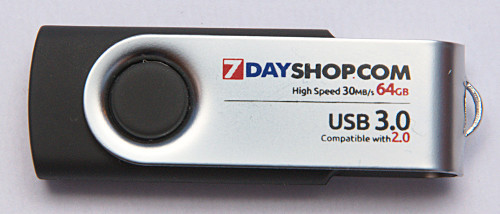
Front
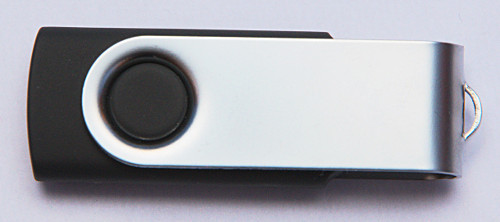
Reverse side
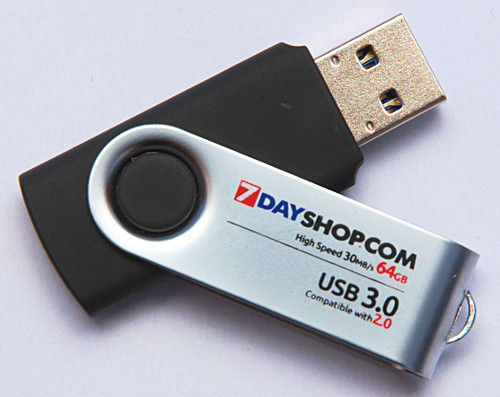
Opened up
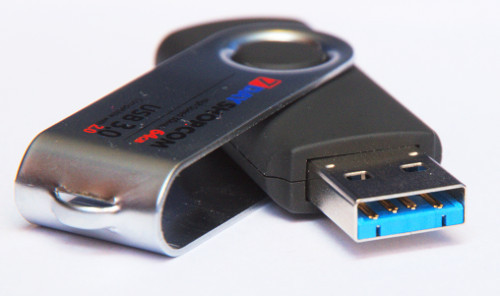
USB3 connector
The flash drive itself is fairly light and
compact, about the length of a door key. The twistable cap cover is also a
nice feature that avoids the issue of losing the cap and includes a loop to attach
to a ring of a keychain.
Operation mode indication
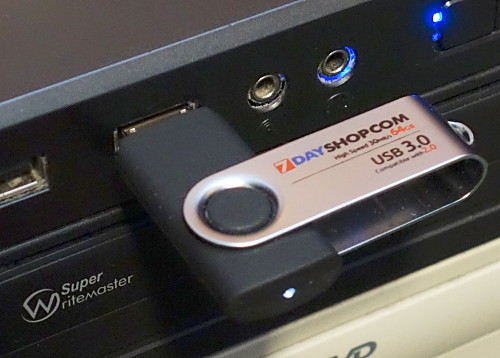
Like most flash drives, this one has an LED
that serves to indicate power and activity. When powered up, it flashes white
at the tail end to indicate activity and remains solidly lit when idle. The
twistable cover needs to be positioned off to the side to avoid covering up the
LED.
The following image shows it lit while
plugged in my desktop PC:
Product Specifications
The following are the specifications, as
provided on the 7DayShop website:
- Nice rubber feel
- Quality swivel action
- Red LED on Light
- Keyring attachable
- Write Speed Up To: 35MB/s
- Read Speed Up To: 80MB/s
- Backwards compatible with USB 2.0
- Please note: speeds on USB 2.0 will be
slower compared to USB 3.0 standards
Now let’s head to the next page where we
will look at our test PC and testing procedures…
Test Equipment
The following are the specifications of the
computer this product has been tested on.
Computer 1:
- Crucial 2GB x 2 kit 240pin DDR3 PC3-8500
- Kingston 4GB x 2 kit 240pin DDR3 PC3-8500
- Gigabyte S1156 Intel P55 motherboard - GA-P55-UD4
- Intel Core i5 Quad 750 2.66GHz 8MB cache
- Antec Three Hundred Black Case
- Sapphire HD4350 512MB PCIe DVI graphics card
- Samsung Black DVD+/-RW SH-S223B SATA
- Lite-On DVD+/-RW SOHW-1693S ATA
- LG HL-DT-ST BD-RE BH10LS30
- SanDisk Extreme 240GB SSD
- Samsung F3 1TB 7200RPM HDD
- Samsung F4EG 2TB 5400RPM HDD
- WD RE4-GP 2TB 5400RPM HDD
- Renesas PCIe x1 USB3 2-port (uPD720201)
- Corsair 450W ATX PSU
- Windows 7 64-bit Enterprise Edition SP1
Test applications
To test the performance of the flash drive,
we will be using the following test applications in this review:
- HD Tune Pro
- ATTO
- CrystalDiskMark x64
- (Various in-house batch file scripts)
Test procedures
Unlike low capacity USB flash drives where
most people leave the drive formatted in the default FAT/FAT32 file system,
when it comes to flash drives with 64GB or larger capacity, some users will
reformat the drive as exFAT or NTFS to be able to store files greater than
4GB. As we have noticed before, the choice of file system can affect the write
performance considerably due to the way Windows handles each file system.
This USB flash drive came preformatted in
the NTFS file system with a 32KB allocation unit size. To cover the other
popular file system exFAT, the NTFS 4KB default allocation unit size and a
larger 64KB allocation unit size, we will rerun each benchmark formatted as
follows:
- NTFS in USB3
- NTFS in USB2
- exFAT in USB3 (32KB allocation units)
- exFAT in USB2 (32KB allocation units)
- NTFS in USB3 (4KB allocation units)
- NTFS in USB3 (64KB allocation units)
Due to the variation in performance from
one USB controller to another, we will conduct all tests in this review using
the same USB3 port on the Renesas PCIe card for all USB3 tests and on the same USB2
port at the front of the review PC for all USB2 tests.
For the real-world testing, we will test
the following:
- Copy a large 1GB file from the RAM drive
to the flash drive. - Read the 1GB file.
- Copy a large 1GB folder consisting of
8,247 JPEG files in a hierarchy of 245 folders. - Read this entire folder’s content.
- Copy a single folder containing 187 MP3
files, totalling 987MB. - Read all the MP3s in this folder.
- Delete the complete photos folder.
We chose a RAM drive as the file copying
source to minimise the latency as much as possible by the read source. For the
read tests, the files are simply read by our script without being stored
anywhere. All timings are measured by script with accuracy to 1/100th
second. The USB flash drive was removed and reconnected prior to the read
tests and again prior to the delete tests to clear any cached data.
The purpose of the delete test is to show
how long it takes to delete a large folder, as this task is usually quite
tedious on a USB flash drive.
Original File System
Before we conduct any tests, we will first
take a look at the file system this drive came pre-formatted with:

As with any other removable drive,
manufacturers rate the capacity in multiplies of 1,000 bytes, so 64GB means 64,000,000,000
bytes. From the above screenshot, we can see that the drive is just above this
figure, but right next to this mark, we see 59.6GB. You may wonder, where’s
the other 4.2GB? Like Solid State Drives, USB flash drives reserve a small
amount of capacity for wear levelling as well as to provide spare capacity to
replace worn out sectors over the lifespan of the drive.
While most flash drives come formatted in
FAT32 or sometimes even exFAT for capacities greater than 32GB, interestingly
this is the first flash drive we have encountered that came preformatted in the
NTFS file system. Unlike flash drives that come preformatted in exFAT, this
flash drive is immediately usable in Windows XP without the need to install the
exFAT Windows update. The same goes with set-top media players, where many
support NTFS, but not exFAT. However, Linux and Mac users will need to format
this drive before use.
Unlike some flash drives that come with
utilities or encryption software, this flash drive was supplied completely
blank.
The following ‘CHKDSK’ screen gives some
more technical information about the file system, such as the allocation unit
size:

All NTFS tests are conducted with this
factory formatted file system. Only when we complete these tests do we format
the drive in another file system to carry out all the tests again under the
alternative file systems.
Initial hiccup
One issue we ran into when conducting our
real-world benchmarks is that the flash drive would not let us write files to
the root without Administrator permission. The following is an example of what
happens when we copy & paste a file to the flash drive:

While this will unlikely be an issue on a
home PC, most users are not allowed administrator rights on public PCs,
especially in Internet cafés, school computers and many workplace PCs.
The following gives an example of what
happens when we attempt to save a file to the flash drive in Microsoft Word:

As this flash drive came pre-formatted in
NTFS, the first thing we suspect is that something is wrong with the NTFS
security permissions that were applied:

As we can see in the drive’s security
settings, only administrators are given full control, while all other users are
given a combination of read, execute, create folders, append data and other
special permissions. From a look at the special permissions, these are a
repeat of the other permissions. The “CREATOR OWNER” entry has all ‘Allow’
permissions set. From what we can tell, only the original PC or user account
that created the files can later modify or delete them, unless the user has
administrator rights on the PC.
The easiest workaround is to either change
all the permissions on “Everyone” to ‘Allow’ or reformat the flash drive.
Now let’s head to the next page, where
we carry out some benchmarks…
HD Tune Pro
We start by running the HD Tune Pro benchmark,
shown here in USB3 mode:

Quite an impressive start for a budget USB3
flash drive, with a transfer rate just slightly below its 80MB/s rating. It’s
also nice to see a very consistent read across the drive’s capacity.
Now for the HD Tune Pro benchmark in legacy
USB2 mode:

Again, an impressive result, delivering
about the maximum throughput we have seen over USB2.
ATTO disk benchmark
ATTO has become a standard tool for measuring
the data throughput of hard drives, flash drives and memory cards. It measures
the performance of reading and writing, using different file sizes and block
sizes.
The following is with the original NTFS file
system, operating in USB3:

For 64KB transfers and larger, this flash
drive seems to have no problem meeting its rated read and write throughputs.
Now let’s see how this compares with when
the flash drive is formatted with NTFS and exFAT, as well as when connected by
USB2 and USB3:

ATTO – Read performance

ATTO – Write performance
For read performance, both file systems perform
equally well and give very consistent throughput for 64KB and larger
transfers. As for performance, the exFAT file system gives a slight
improvement in performance over the NTFS file system for larger transfers.
CrystalDiskMark 3.0
Crystal Disk Mark is quite a handy
benchmarking application, as it focuses on the file sizes that can cause a
problem on a system drive and external drives.
The following are the test results. For
the first two rows, USB3 results are on the left column and USB2 results are on
the right. The final two NTFS screenshots cover 4KB and 64KB allocation unit
sizes, both conducted in USB3 only:

As with the ATTO tests, the sequential read
and write throughputs clearly meet and slightly exceed the specifications. The
NTFS 4KB allocation unit size appears to be an exception for sequential
writing, where it barely manages 1/3rd the rated sequential write
rate, but still does well in all the other tests.
The 4K and 4K QD32 write results are some
of the best we’ve seen for a flash drive. Most flash drives we have seen only
handle 0.2MB/s for the 4K write tests and there are even some that are as low
as 0.01MB/s, such as the Transcend 64GB USB2 flash drive we reviewed over a
year ago. Fast 4K random write operations help speed up small write operations
such as updating file table records, writing small files and deleting multiple
files.
Interestingly, for 512KB random write
operations, this flash drive performs over 4 times better in NTFS in all 3
allocation unit sizes than in exFAT. This is actually a very important test,
as many files stored on USB flash drives are around this size. However, as
these are synthetic tests, we’ll find out what impact the file system has in
real-world file transfers on the next page.
Warm slowdown
While conducting the NTFS 4KB write tests,
including some real world tests on the following page, we noticed a significant
slowdown in write performance, where the sequential write speed is reduced to
about 14MB/s. This seemed to occur after roughly 10 minutes of writing,
especially after the small files write tests. At first we thought it was due
to its spare area being used up like what happens with an SSD, however, the
performance only seemed to recover once the drive was allowed to cool. For
example, if we dismounted it and plugged it back in several seconds later, the
write performance did not improve. However, if we dismounted it, left it
unplugged for 30 minutes and then plugged it back in, the write performance
would return back to full speed.
The following shows an ATTO benchmark
comparison of the flash drive, both NTFS formatted running in USB 2.0 mode,
with the write performance slowdown on the right:

As shown in the above bottom-left CrystalDiskMark
benchmark, the NTFS 4KB allocation unit appeared to be the worst for causing
this slowdown, to the point where we always got under 14MB/s in the sequential
write test.
After we conducted our tests for a given
file system, we unplugged the flash drive and allowed it to cool down prior to
testing the next file system.
Summary
The read and write transfer rates are
excellent for a budget flash drive, especially for small random IO read and
write operations. In fact, this is one of the quickest flash drives we have
seen for random 4KB and 512KB write operations, similar to a USB hard disk, so
we expect this to perform well writing small files as well as large bulky
files.
Based on file system performance with this flash
drive, those interested in storing a large number of small files such as photos
and pictures would be better off using the NTFS file system.
Real world tests
As with benchmarking SSDs it is pointless
conducting an endless amount of benchmarks on a flash drive. Real users may
conduct a few benchmarks when they first get their flash drive, but most users
simply want a drive that performs well in everyday use.
The benchmarks have so far shown us that
this flash drive provides good sequential throughput and small random read
transfers, as well as pretty good performance with small random write transfers.
Now let’s see how this drive performs in the real world.
Real world single file copy test
The most common task people use a high
capacity flash drive for is transferring bulky files from one place to
another. So in this test, we will measure how long it takes to transfer a 1GB
file to and from the flash drive.
We used a script to measure the timing,
with the source file stored on a RAM disk to prevent the read source becoming a
bottleneck. The flash drive was dismounted after each write test to clear the
cache prior to the read test. These tests were repeated to cover the various
file systems.
The following are the results:

As we can see from the graph, the choice of
file system and allocation unit size can have a drastic effect on its write
speed. When connected by USB3, exFAT gives a slight lead over NTFS, but when
connected to a legacy USB2 port, it writes data over twice as quick when
formatted in NTFS. The 4KB and 64KB allocation unit sizes also cause a
significant slow-down, when compared with the preformatted 32KB allocation unit
size.
Reading performance remains roughly the
same regardless of the file system, with the preformatted NTFS file system
giving a very slight lead over exFAT.
What is pretty clear is that no synthetic
test predicted this outcome, hence we insist on conducting real world tests in
our storage drive reviews.
Real world small files copy test
Not everyone uses a USB flash drive for
bulky files. In fact, some simply use it to back up their documents and
photos, many of which could range from a few Kilobytes to a few Megabytes per
file. So in this test, we time how long it takes to copy 8,247 photos in a
hierarchy of 245 folders totalling 1GB to and from the flash drive.
Like the previous test, these files are
stored on a RAM disk as the source and we used a script to measure the timing.
The flash drive was dismounted after each write test to clear the cache.
The following are the results:

Total time taken to write the file set

Total time taken to read the file set
For small files, the file system does not
have the drastic effect as writing bulky files. However, like the 1GB file
transfer test, NTFS performs significantly better than exFAT, especially with
the factory formatted NTFS file system with 32KB allocation units. There is
only a small improvement with USB3 over USB2 when writing small files.
As with the 1GB transfer test, read
performance is much the same regardless of the file system, again with NTFS
giving a slight lead over exFAT. Unlike the write tests, USB3 cuts the read
time in half when reading small files.
Real world MP3 files copy test
As most set top media players and many car
stereos can play MP3 files from USB, a very common use for a USB flash drive is
to carry MP3 files around. In fact, this drive should be large enough to store
several hundred CDs of music in the MP3 format.
Like the previous tests, these MP3 files
are stored on a RAM disk as the source and we used a script to measure the
timing. All MP3s were stored in the same folder. The flash drive was
dismounted after each write test to clear the cache.
The following are the results:

Total time taken to write the MP3 file set

Total time taken to read the MP3 file set
Like the small pictures test, the file
system does not have as significant effect on write performance as with the
single 1GB file transfer test. NTFS gives a small lead over exFAT when
operating in USB3 mode and both file systems perform about equal in USB2 mode.
USB3 provides about a third faster writing performance in comparison to USB2
for both NTFS and exFAT. The 4K and 64KB allocation unit sizes both cause a
significant slowdown, reducing performance below that of even USB2 with the
default 32KB allocation unit size.
There was no variation in read performance
of MP3 files between the file systems and allocation unit sizes. USB3 provides
over double the read-back performance for both file systems.
Real world file deletion test
One issue we noticed in the past when it
comes to flash drives and even external hard drives is the amount of time it
takes to delete a large folder from the drive, in some cases taking several
minutes.
So for this test, we simply timed the duration
it took to delete the hierarchy of 8,247 files and 245 folders from the flash
drive. The drive was dismounted and reattached before we ran this test to
clear the cache. The timing was measured by a script.

This flash drive performs very well when it
comes to deleting a large quantity of files, especially with the NTFS files
system where it takes half the time of exFAT regardless of the USB speed and
allocation unit size.
Summary
Like with the Transcend JetFlash review,
synthetic testing tells very little about how a flash drive will perform in the
real world. For example, CrystalDiskMark showed roughly equal sequential
transfer rates for both NTFS and exFAT in USB 2.0 mode, but with the 1GB file
transfer test, NTFS took under half the time to write this bulky file. Going
by the 512K write tests in CrystalDiskMark, NTFS was 4 times quicker in this
test, yet when it came to our small and MP3 files write tests, the NTFS file
system only performance about 10% quicker.
Overall, NTFS clearly performed the best
for this flash drive, especially when using the flash drive with a legacy USB
2.0 port. NTFS also has the advantage of being compatible with many media
players that don’t support the exFAT file system. As for allocation unit size,
we recommend using 32KB allocation units as the drive comes preformatted with.
By default, NTFS uses 4KB allocation units and as we’ve seen from our real
world tests, the 4K allocation unit size has a significant impact on write
performance, as does using a larger 64KB allocation unit size.
Let’s head on to the next page to
conclude our review …
Positive
- Excellent performance for its price, also
considerably cheaper than many USB2 64GB flash drives. - Excellent sequential read and write
speeds for a budget USB3 flash drive, meeting its specifications. - Good read performance of small files and
read operations. - Much better write performance of small
files than many branded USB 3.0 flash drives. - Reasonably compact, considering its large
64GB capacity. - Very good NTFS performance, especially
with a 32KB allocation unit size. - Consistent and fast read performance
regardless of the file system. - Preformatted in NTFS, works with Windows
XP even without the exFAT driver update. - No USB cap to loose.
Negative
- Significantly slower write performance
with exFAT file system, especially in legacy USB 2.0 mode. - Write performance falls to ~14MB/s when
warm, such as after several minutes of write operations. - Preformatted NTFS permissions disallow
storing files on the root folder (but a quick workaround is to format the
drive). - Needs to be formatted to use in Linux or
with a Mac. - No hardware based encryption support.
- Requires third party software to encrypt
or format in FAT32. - Available to purchase in UK / Ireland
only
Conclusion
For sequential reading and writing, this is
a very fast flash drive for its price. In fact, we are unaware of any other
64GB USB 3.0 flash drive in the UK or Ireland available for the price 7DayShop
is charging. Read performance is around 80MB/s regardless of the file system,
very close to that of a USB 3.0 portable hard disk. Sequential write
performance peaks about 37MB/s, delivering about 2GB per minute, far faster
than storing bulky files on a DVD.
When it comes to small files, read and
write performance are both excellent, very like what we would expect off a USB
hard disk than a flash drive. 1GB worth of MP3s takes just over a minute to
write and under 14 seconds to read in USB 3.0 mode, making it an ideal drive
for carrying a large quantity of music or photos on the move, such as music for
a car stereo with USB connectivity or backing up photos to each evening while
on holiday.
Unlike some previous drives we tested, the
exFAT file system results in a significant impact on write performance,
especially in USB 2.0 mode where it took double the time to write our 1GB test
file in comparison to the NTFS file system also in USB 2.0 mode. The choice of
allocation unit size also has a significant effect on write performance, where
NTFS’ default 4KB allocation unit size can knock a third off the write
performance. However, these issues only affect users who format the flash
drive in a different file system or with a different allocation unit size than
32KB.
When the drive is warm, sequential write
falls to just 14MB/s. This happens after several minutes of continuous writing
or if the flash drive is already warm. If the flash drive is already warm such
as carried in a pocket, its write performance may already be throttled before
any data is written.
To sum it up, this is what we would say for the 7DayShop
USB3 64GB swivel flash drive:
“The 7DayShop USB3 64GB is ideal for anyone
looking for a high performance flash drive on a budget capable of storing a vast
amount of data that can attach to a keychain.”

You can comment on this review below.
Thanks to:
|
|
EFD |
|
|
Alex Schepeljanski for |