|
|
Review: Corsair |

You can find various USB flash drives, ranging
from the older and much slower USB2 to the current USB3 that can offer anything
from acceptable read/write speeds to outrageous performance, and size won't be
an issue, as you can easily find the one that suits your needs. So why did Corsair
end up with the Voyager GTX? I can only guess that they needed to have a USB3
flash drive that would be able to produce top notch performance, meaning that they
wanted to have SSD like performance.
This is what the Corsair Voyager GTX claims
to do. The Corsair Voyager GTX is available in two capacities, 128GB and 256GB,
that should provide more than enough space to carry with you all the time, and
most importantly both drives will give outstanding read/write speeds.
You can find out more about Corsair simply
by visiting their website here. Now let's
start this review for the Corsair Voyager GTX by taking a look at the packaging.
A quick look at the Corsair Voyager GTX and its specifications
The packaging for the Corsair Voyager GTX
is very simple, and clean looking, with red being the dominant colour. On the
right side you will find all the information that you need about the Voyager
GTX.
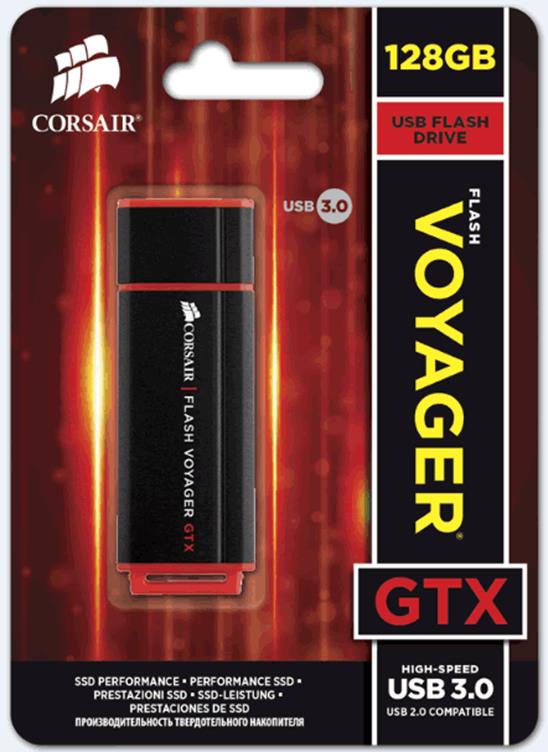
The
front side.
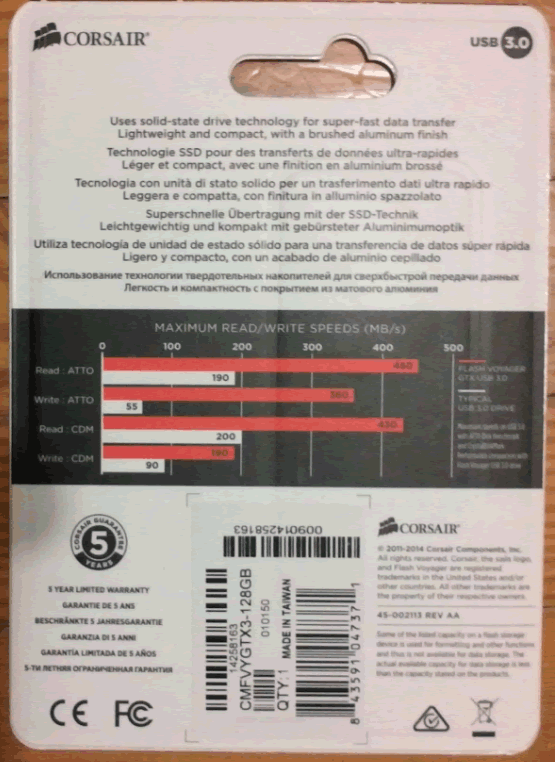
Here
is the rear.
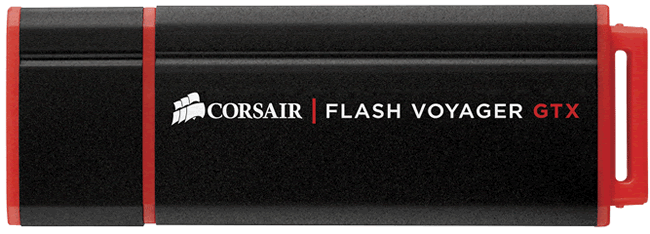
This
is what you will find on the top and the bottom of the Voyager GTX.
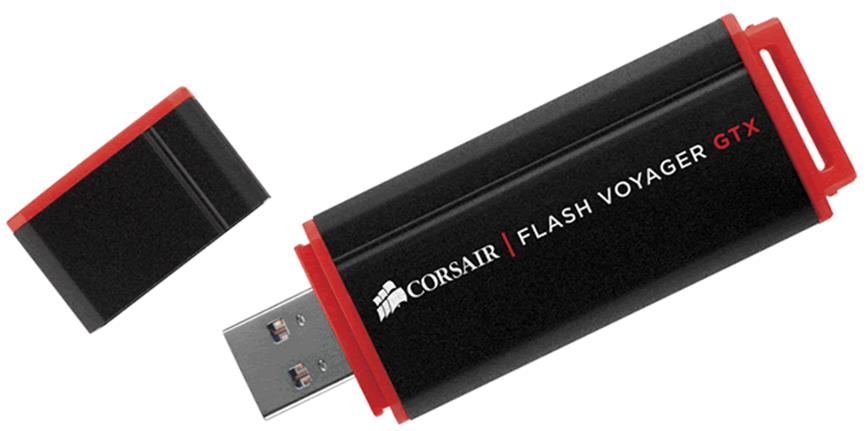
The
Corsair Voyager GTX opened.
Specifications
Let's take a look at the specifications of
the Corsair Voyager GTX as they appear on the official website.
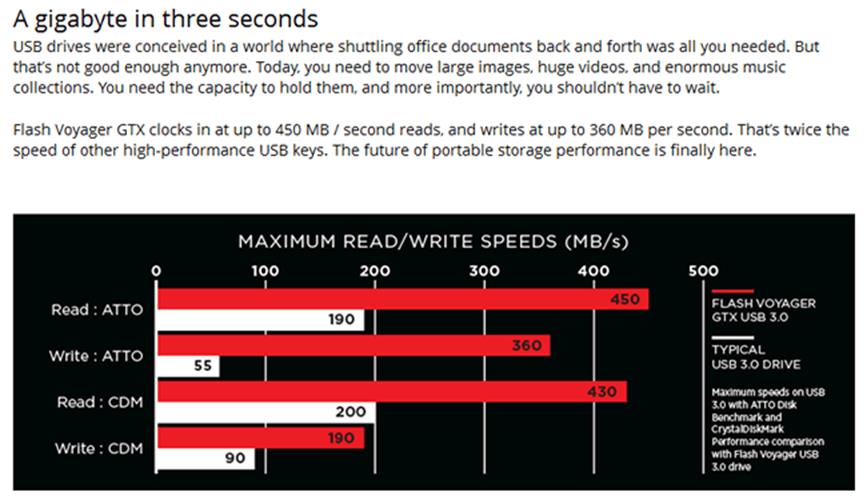
This was the most relevant information that
I could find at the time of writing this review, but you can always check the
products page on the Corsair website for further info.
CrystalDiskInfo
Here I present two screenshots from CrystalDiskInfo.
One with the drive connected in a Windows 7 installation, without UASP, and a
second with the drive connected in a Windows 8.1 installation. So let's take a
look.
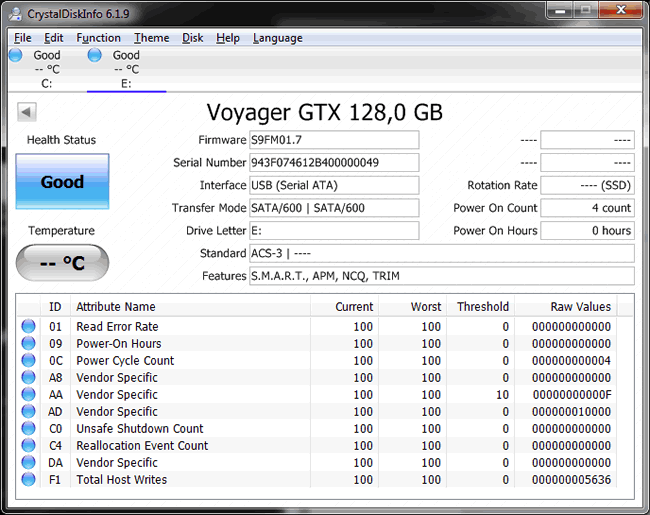
Starting with Windows 7 without UASP
support, here is how the Corsair Voyager GTX is identified.
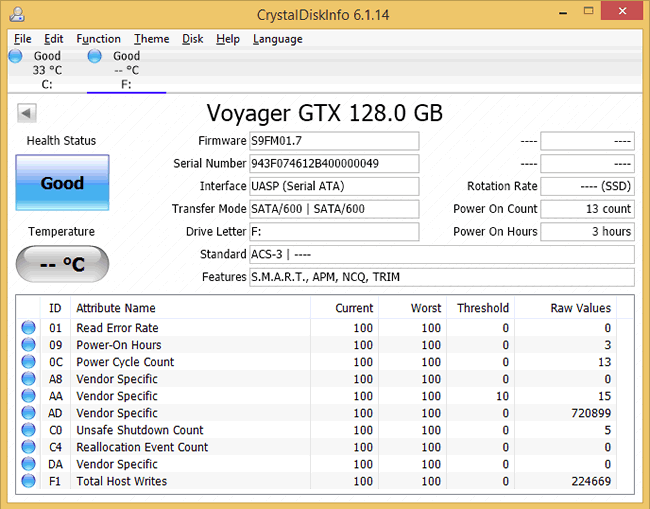
The Corsair voyager GTX in a Windows 8
install. As we can also see in both screenshots, CDI reports the Total Host
Writes as well.
Now let's start our tests with the NTFS
file-system...
Test system and test procedures
For this review I will be using a PC with
the following configuration.
PC
- MOTHERBOARD: ASRock extreme4 Z77
- CPU: Intel
2500K @ 4Ghz - CPU COOLER: Corsair A70
- RAM: 2x4GB
Kingston HyperX - VGA: Intel
3000HD - HDD1: Corsair
Nova 60GB (OS) - PSU: Corsair
CX 430Watt - OS:
Windows 8 x64
Testing methods
I will try to keep my testing methods as
simple as possible and repeatable on various systems. I will run two simple
benchmarks, ATTO and CrystalDiskMark, as both tools can give a
good impression of how the drive performs. I will only run test with the NTFS
file systems that most users will use on this USB3 device. There will also be
some real life tests, simple tasks such as copy/paste and also a compatibility test
with a list of various consumer devices that most people will use in or out of their
homes.
NTFS Tests
Starting my tests with ATTO, so let’s see
how the Corsair Voyager GTX performs with the NTFS file-system.
ATTO

The Voyager GTX simply pushes USB3 to a
world that was unseen before. The performance of the Voyager GTX easily
embarrasses a lot of older SSDs, with read speeds up to 460MB/Sec and
360MB/Sec, numbers that are out of reach for lot of USB3 flash drives.
CrystalDiskMark

As I said, SSD performance from a USB3
flash drive, the above picture shows how fast this drive is.

Again
I first present the read speeds,

and then
the write speeds.
Note: When you see the * the tests were
run in Windows 7 and without the UASP support, Windows 8 has built in support
for UASP and as we can see there is a significant improvement with UASP.
Conclusion
Outstanding read and write performance for
the Corsair Voyager GTX, especially when UASP is supported. The numbers can
very easily scare some older SSDs and at the same time Corsair Voyager GTX is
raising the standards when it comes to flash drives.
Let’s move to the next page for some
real world tests ...
Real world tests
Benchmarks are great, as they can give a
very good view of how the drive can perform when it’s pushed to the maximum.
Unfortunately they only tell part of the story, the rest you have to find out
when you're using the drive for everyday tasks.
I've therefore decided to perform three
simple tests that almost everyone does, so that I can get a better view of the
performance of the drive.
For this test I will be moving all the test
files from a RAM disk to the tested USB drive, and vice versa, below you can see
the results.
MP3
I will start my tests by performing a
simple copy of 1.36GB of MP3s. You can see the results for the Corsair Voyager
GTX flash drive in the graph below.

It was expected to see the Voyager GTX
among the fastest drives that I have tested and, when it comes to reading, the
result is insanely fast, 3.33 Seconds to copy 1.36Gb from the Voyager GTX to
the RAMDisk.
Pictures
For the next test I will copy 3377 assorted
picture files with a total size of 2.56GB, so let’s see how the Corsair Voyager
GTX performs.

Once again we see speeds that you would
normally consider as impossible for a USB3 flash drive, but the Voyager GTX
gives a result that is more suited to an SSD. Again the result is outstanding.
Movie
We'll finish this set of tests by copying
an MKV file and an SRT file. The two files have a total size of 3.46GB

I wanted to see a much higher write speed
here and 39.16 seconds isn't very fast, then again the read speed of 8.22
seconds is outstanding. This is a result that I didn't entirely like, but I can
live with it.
Small Text files
In one of my previous reviews I was asked by
a user to do a test with proper small files. So I went ahead and put 48.128
files in one folder and ran some tests with a few of the latest USB flash
drives that I reviewed in the past. I personally don’t feel that this kind of
abuse will happen on daily basis, but it's a good way to separate the men from
the boys.
First here is a screenshot to give you an
idea of the actual size of all these files and further below you can view the
results from this test.


This is the moment when the Corsair Voyager
GTX simply destroys all the other drives that I have tested, and lost to the
Lexar Triton by only 1.17 seconds. The word impressive simply isnt enough to
describe how I fell about the Corsair Voyager GTX.
Compatibility
This is a simple test, in which I will plug
the Corsair Voyager GTX flash drive into various devices, two PCs, a laptop, a
netbook, one mini Hi-Fi, a media player, and two TVs, to check the
compatibility.
Let’s see if the Corsair Voyager GTX 128GB has
any possible compatibility issues.

No surprises here as the Voyager GTX had
zero compatibility issues with my test equipment.
Performance with older systems
For those of you that are still using an
older machine, like I do on daily basis here, I will post the results of the Corsair
Voyager GTX when it's connected to an older PC that has no native Intel USB3
support. My Gigabyte P55A-UD4 motherboard uses an NEC chipset to provide two
USB3 ports, the OS is Windows 8.1, and the USB3 drives are the ones that come
with the operating system. So let's take a look on the performance of the Corsair
Voyager GTX on this old system.

It’s clear the Voyager GTX isn't going to
give its best performance with this system. The numbers are good, but nowhere
near as good as the ones that I got with the Z77 platform.

Again the performance is good but the truth
is that if you have an older setup, and have no immediate plans for update,
then the Corsair Voyager GTX isn't the USB3 drive that you need.
Anvils Benchmark (100% incompressible)
Below you will find a graph comparing the
performance of the Corsair Voyager GTX against all the other USB3 flash drives
that I have tested.

Once again the Corsair Voyager GTX is at the
top of the chart, it also occupies second place in Windows 7 even without the
help of UASP.
Let’s move to the next page for some
extra real world tests ...
Since the Corsair Voyager GTX has a
performance close to a value SSD I thought that it would be a good idea to run
some extra tests that I don't normally run on USB flash drives. Let's start by
running AS SSD.
AS SSD

We can see that the Voyager GTX continues
to have outstanding read performance. The write speed is low in this test, but
remember that this test is mainly used on SSDs.
IOMeter
With most of my SSD reviews I run IOMeter.
I don'twant go into that much detail, so here are the results for 4K random
read/write, 512K Seq read/write, and also the workstation test. All these tests
are run on Windows 7 and Windows 8.1 so let's see and compare the two results.
I didn't add an SSD to these results but you can always compare it with the Corsair
Force LX.
4K Random read

Here is the result for the 4K random read, and
as we can see Windows 8.1 has a clear advantage over Windows 7.
4K Random write

This was a surprise, the Corsair Voyager
GTX showed some serious slowdown in Windows 8.1 compared to Windows 7.
512K Seq & Workstation

Again the UASP support in Windows 8.1 makes
a big difference compared to Windows 7.
Dell Inspiron 15 3537
Closing this set of tests, I decided to try
the Corsair Voyager GTX on my Dell Inspiron and see how it performs.
ATTO

No issues for the Corsair Voyager GTX when
it's connected to my laptop. It managed to reach a max read speed of 460MB/Sec
and also a max write speed of 360Mb/Sec.
CrystalDiskMark

Here the numbers are a little bit lower,
but still the overall speed is excellent. So no matter where the Corsair
Voyager GTX is connected it is able to get the maximum.
Let’s move to the next page for the
conclusion ...
Conclusion.
Positive:
- Insane read/write speed with Windows 8.
- Very fast with Windows 7, even without
the UASP support. - Stylish and colourful
- Excellent build quality
- Outstanding performance in real world
use.
Negative:
- Nothing.
Summary:
Corsair did an excellent job with the
Voyager GTX, it clearly has the best performance for a flash drive, and in some
tests it's very close to Value SSDs. The five year warranty is also welcomed,
especially since many SSD drives come only with three years. But the numbers I
got in my tests tell only one part of the story. The rest of the story is real
world usage, and here the drive was able to reach the top and in some cases by
a long margin from the second place drive that I tested. The Corsair Voyager
GTX has a price of $129.99 on the Corsair website, although keep in mind that
by the time that this review will be published prices may change. I am sure though
that if you want the ultimate in speed, consistency, and build quality then price
is less of a concern.
Overall I will say this for my finishing
sentence:
“If you are currently looking for the
fastest USB3 flash drive available, then the Corsair Voyager GTX is the one you
need to get."
I give the Corsair Voyager GTX the outstanding
award.