 |
Review: WD Blue 3D 1TB SSD Reviewed by: J.Reynolds Provided by: Western Digital Firmware: X61130WD |
Introduction
Welcome to Myce’s review of the WD Blue 3D 1TB SATA SSD
(hereafter referred to as the WD Blue 3D).
Having published many Enterprise Storage reviews this is my
first review of a Client (or Consumer) grade SSD.
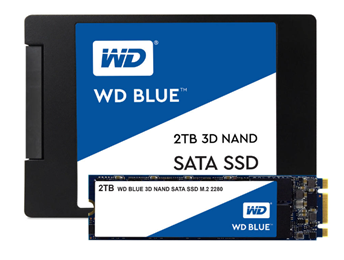
The WD Blue 3D is a state of the art SATA SSD using 64 layer
3D BiCS (‘Bit Cost Scalable’) TLC NAND. It is available in two form factors –
2.5” and M.2 2280.
On the face of it the WD Blue 3D offers excellent performance
at an excellent price – please read on to see what we find.
The WD Blue 3D uses the Marvell 88SS1074 Controller.
To enhance the performance of its TLC NAND the WD Blue 3D
uses what is known as an ‘SLC Write Cache’.
This is how OCZ (who pioneered the idea) describes an SLC
Write Cache –
Certain SSDs utilize a feature called SLC Write Cache to
enhance write performance. Using this method, a portion of the available
capacity is being treated as SLC (1bit-per-cell) NAND flash memory. When the
drive is performing a write just one bit, instead of three in case of TLC, is
being written thus improving the write speeds drastically. Once the SLC Write
Cache has been filled, it will be "flushed" to the rest of the drive
to free up the cache again. Under common desktop workloads, the user typically
does not experience this transition. However, under heavy workloads, there may
be a temporary drop in performance once the SLC Write Cache is filled and the
drive is still being written to. The drive's performance will recover once the
cache has been flushed.
We will look out for signs of the SLC Write Cache and its
impact on performance in our testing.
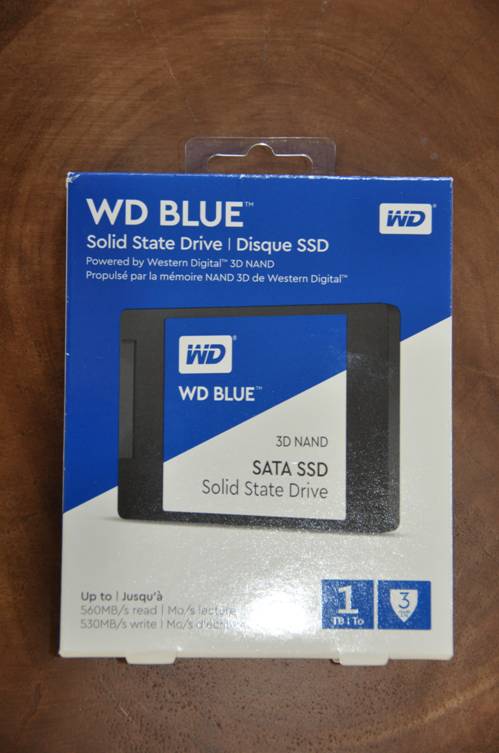
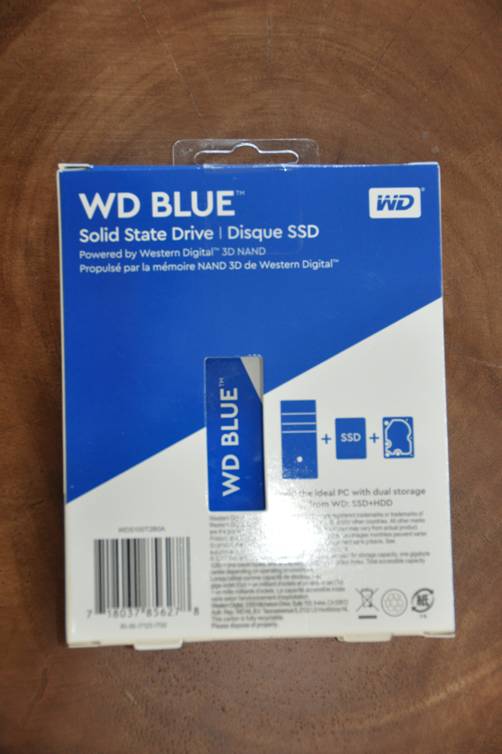
Packaging
Let’s start by having a look at the WD Blue 3D’s packaging –
Market Positioning and Specification
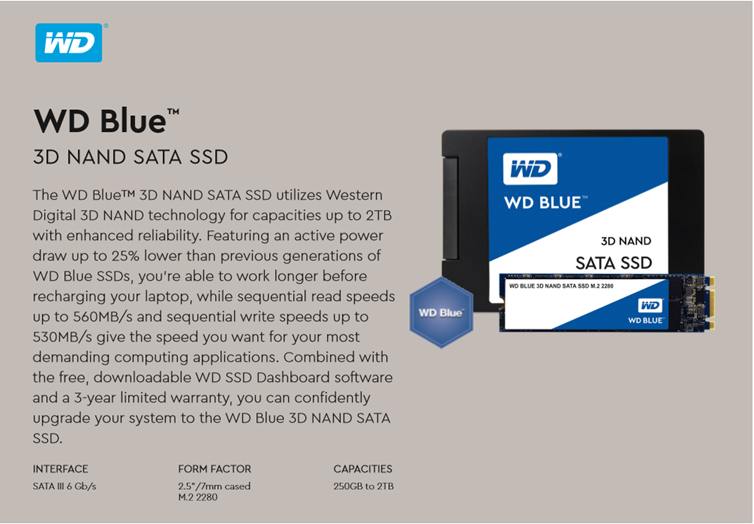
This is how WD positions the WD Blue 3D –
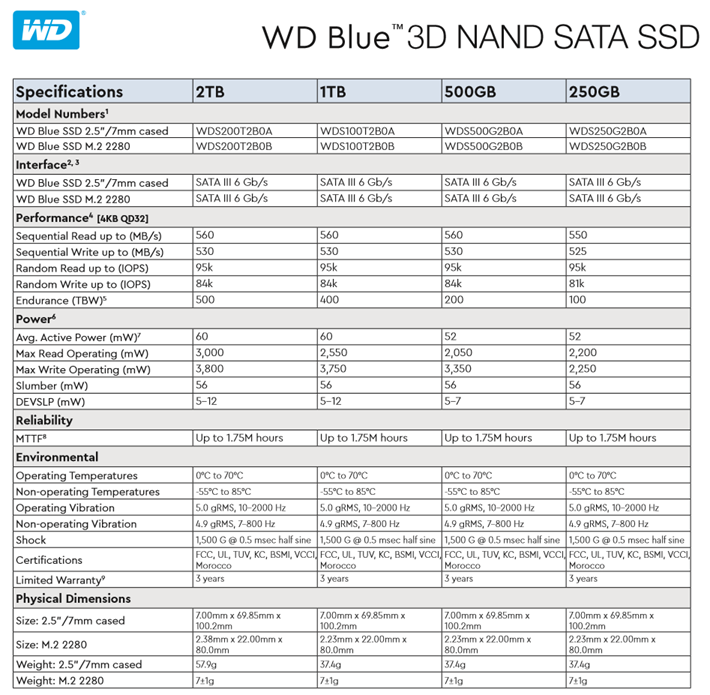
Here is WD’s specification for the WD Blue 3D –
Pictures
Software Supplied
WD provides the WD SSD Dashboard and a licence to use
Acronis True Image (which can, for example, be used to move the contents of an
old drive to a new SSD).
Here are some screenshots showing the functionality provided
by the WD SSD dashboard –
[masterslider id="11"]
Now let's head to the next page, to look at my approach
to testing Client SSDs.....
Testing Approach
When reviewing the performance of a Storage solution there
are three basic metrics to look at:
1.
IOPS – the number of Input/Output Operations per Second
2.
Bandwidth – the number of bytes transferred per second (usually measured
in Megabytes per second, ‘MB/s’)
3.
Latency – the amount of time each IO request will take to complete
(usually, in the context of Solid State Storage solutions, measured in
Microseconds, which are millionths of a second).
It is true to say that IOPS and Bandwidth had both been
growing rapidly before the advent of Solid State Storage, but Latency can only
be significantly decreased by eliminating mechanical devices, and thus Latency
is the single most important improvement that Solid State solutions deliver to
enhance performance.
Latency in a technical environment is synonymous with delay.
In the context of a Solid State solution it is the amount of time between an IO
request being made, and when the request is serviced.
Bandwidth, also commonly referred to as ‘Throughput’, is the
amount of data that can be transferred from a storage device to a host, in a
given amount of time. In the context of Solid State solutions it is typically
measured in Megabytes per second (MB/s).
A great Solid State solution offers an effective balance of
all three metrics. High IOPS and Bandwidth is simply not enough if Latency
(the delay in an IO operation) is too high.
Queue Depth is the average amount of IO requests
outstanding. If you are running an application and the Average Queue Depth is
one or higher and CPU utilisation is low, then the application’s performance is
most probably suffering from a ‘Storage Bottleneck’.
It is true to say that a typical PC user will very rarely
cause a modern SSD to see a Queue Depth greater than 1 or 2. So for Client SSDs
we need to primarily focus on performance at low Queue Depths.
Another important aspect to consider with an SSD is the
state of its NAND when an IO task begins. When an SSD is new, or immediately
following a purge (a Secure Erase for an SATA device) being performed, it is in
a Fresh out of Box (‘FOB’) state and in this state all of its Blocks of NAND
are clean and able to immediately accommodate the writing of new data.
Typically SSDs are supplied with a greater capacity of ‘Total NAND’ than their stated
‘User Capacity’ and the difference between them (Total NAND – User Capacity) is
known as an Over Provision (‘OP’) at the firmware level.
If an IO Task that involves writing new data can complete
without the supply of clean blocks being exhausted it will complete more
quickly than if blocks must first be cleaned on the fly before writes can be
accommodated. The number of free blocks available may also impact on performance
(think of it this way - the more free blocks there are the easier it is to find
one to write to). An SSD will continue to write to clean blocks until there
are no more available after which it must then free up blocks by completing an
Erase/Write cycle on the fly before it can write new data. Blocks that have
been written to are flagged as being able to be cleaned when either the logical
address they are associated with in an Operating System is written to again or
when a Trim instruction is sent by the OS to indicate that a range of logical
addresses (which map to physical blocks) no longer contain live data (for
example, in Windows, Trim instructions are sent to an SSD, when a file is
logically deleted, to indicate that all of the physical blocks which contained
the file no longer hold live data).
An SSD’s controller performs a process known as ‘Garbage
Collection’ which gathers together spaces that no longer hold live data so that
it can create clean blocks in preparation for accommodating the writing of new
live data. Blocks are contained within Pages and only complete Pages can be
erased in preparation to accommodate new writes, so one of the responsibilities
for Garbage Collection is to shuffle blocks out of partially filled pages so
that whole pages can then be cleaned. Garbage Collection can be performed as a
regular background task and on the fly. The effectiveness of an SSD’s Garbage
Collection has a significant impact on its long term performance. It is
important to note that a Trim command does not itself clean blocks and it will
always take a bit of time for Garbage Collection to follow up and actually
complete the cleaning process.
An SSD maintains a table, which holds the mapping of
its physical blocks to logical addresses. Effectively,
the OP is increased above that set at the firmware level whilst the drive’s
user capacity is not full of live data. In Windows a user can effectively
choose to underline their commitment to increasing the level of OP by not fully
allocating the drive’s user capacity to partitions.
When a drive is compelled to clean blocks on the fly to
accommodate new data it moves from an FOB state towards what is known as a ‘Steady
State’. A Steady State is achieved when performance is steady and no longer
changes significantly over time. Testing of Enterprise SSDs is always
performed when a drive is in a Steady State. It is fair to say that typically
a Client SSD will spend most of its time in an FOB state (or near to FOB state)
and it's in this state that our testing is performed using the Desktop PC.
Remember though that one can expect to see a performance drop when the drive
holds increasing amounts of live data, as the pool of free blocks (the effective
OP) becomes smaller.
Whilst most Client SSD users need not be overly concerned
about Steady State performance we do push an SSD to its limits as part of our
testing on the OakGate Test Platform.
So what performance characteristics make for an excellent
Client SSD?
Put simply, we look for a solution that provides both
excellent Sequential IO performance and excellent Random IO performance.
Excellent Sequential performance supports the rapid transfer of large amounts
of data from one place to another, such as when copying a movie, loading a game,
or running a backup. Excellent Random IO means that a drive will support the
rapid reading, writing, and updating of relatively small files that are
randomly placed on a drive (such as is required by the Windows Operating System),
the launching of applications, or by a database based application. Sequential
performance is most often measured in terms of MB/s (Megabytes per Second) and
Random IO is most often measured in terms of IOPS (IO Operations per Second).
Modern SSDs deliver low Latency and support tens of thousands of Random IOPS
and whilst very few PC users really need support for such a high level of IOPS
it does mean that every IO will be fast.
Manufacturers most frequently quote the headline maximum
Sequential Read and Write Bandwidth for a drive. They also regularly cite the
maximum IOPS level for 4K Random Reads and Writes. Operating Systems are known
to make extensive use of the 4K IO size and this is why strong 4K Random Read
and Write performance is considered important.
I use two test platforms for testing Client Storage
solutions –
Firstly, a Desktop PC, with the following specification: CPU
– Intel Core I7 6700K, Motherboard – Asus Maximus VIII Extreme (Z170), System
Drive – Intel 750 400GB, GPU – EVGA GeForce GTX970 FTW, RAM – 32GB Corsair
Dominator Platinum, Cooler – Corsair H110i GTX, Windows 10 using Intel RST
15.7.1.1015 and with C States disabled in the BIOS, as this ensures reasonable
consistency from storage benchmarks.
Secondly, an OakGate Storage Test Platform, which is
introduced in an article that you can view by clicking here.
The OakGate Test Platform can be thought as a professional, laboratory
instrument where the test environment is managed strictly and consistently so
that test results from multiple solutions can be compared with great confidence
and precision.
The Desktop PC is used to run a cross section of the most
respected and commonly used storage performance benchmark software, including
AS SSD, Anvil, Crystal Disk Mark, ATTO, and PCMark 8 Storage, together with a
number of real world file copies. Most of these benchmark programs are freely
and easily available for you to run on your own PC. There is a good case for reviewers
to test an SSD as a System Drive, as arguably this is the way in which most
people will use an SSD. However, I choose to test drives as a spare as I
believe this makes it far easier to provide a consistent basis for product
comparisons, which I feel is most important.
The OakGate Test Platform is used to provide an accurate
baseline for a drive’s performance in all of the key aspects of performance,
including Sequential Reads and Writes, Random Reads and Writes, and Random
Mixed Reads and Writes. The OakGate Test Platform is also used to investigate
how a drive behaves when it is pushed to its limits and to measure a drive’s
power consumption characteristics. (All testing on the OakGate Test Platform
is conducted with fully random data and is aligned to 4K boundaries)
In the presentation of test results I include comparisons
with other products I have tested in the same way on the same platforms.
As this is the first Client SSD Review I have published, to
get the comparisons underway, I include results for an Intel 750 400GB NVMe SSD
(which is my day to day boot drive) and a Toshiba MK5076GSX 500GB 5400RPM (that
came with my Dell XPS 17 laptop and which I now use in an external USB
enclosure for back up purposes). These two comparison drives are from
different ends of the performance spectrum, the Intel 750 being a high
performance NVMe SSD and the Toshiba MK5076GSX a relatively low performance
HDD. As I have not published them before, for reference purposes, I include the
detailed results for these comparison drives on Page 7 – Initial Comparison Products
Detailed Results.
Now let's head to the next page, to look at the results for
the Desktop PC Synthetic Benchmarks.....
Desktop PC – Synthetic Benchmarks
AS SSD
As its name suggests AS SSD was developed specifically to
measure the performance of SSDs. It measures Sequential Read and Write performance
with an IO Size of 16MB and a Queue Depth of 1. It measures Random 4K Read and
Write for a Queue Depth of 1 and for 64 Threads. 64 Threads generates a Queue
Depth of 64 (please note that SATA drives support a maximum Queue Depth of 32,
so they are at a disadvantage in this test to NVMe devices, which support queue
depths of 128 or more). The Access Time AS SSD reports is for 512Byte
sequential reads and writes.
The 4K random Reads and Writes performance is particularly
relevant to a drive’s ability to act as a Windows system drive. I use the
default test file size of 1GB.
AS SSD produces a score for Read Performance, Write
Performance and an Overall Score.
The scores are calculated as –
Overall score = (Seq Write x 0.15) + (Seq Read
x 0.1) + (4K Read * 2) + 4K Write + 4K-64Thrd Write + (4K-64Thrd Read * 1.5)
Read score = (Seq Read * 0.1) + 4K Read + 4K-64Thrd
Read
Write score = (Seq Write *0.1) + 4K Write + 4K-64Thrd
Write
For Client SSDs, I feel that there should be an
even greater loading given to the Queue Depth 1 4K Read and 4K Write results
but nevertheless AS SSD is a quick and useful benchmark. I always use a 1GB
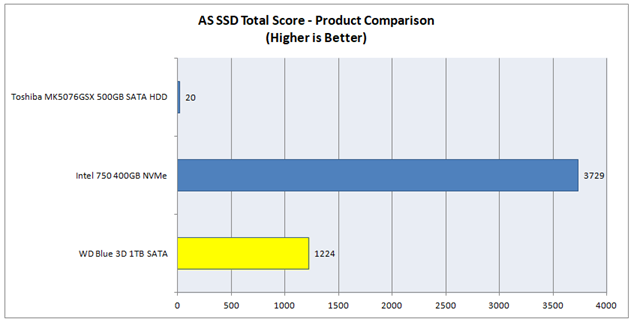
test file. We would expect a modern SATA SSD to achieve an overall score
of 1000+.
The latest version of AS SSD can be downloaded here.
Here is the AS SSD result for the WD Blue 3D -
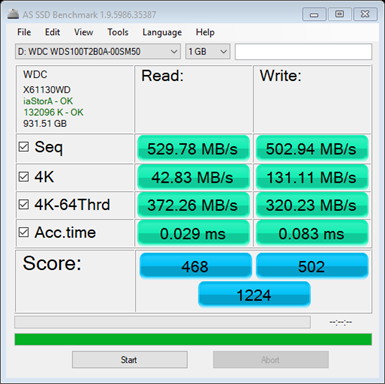
The 4K (QD 1) Read result of 42.83 is impressive for an SATA
drive.
Here is a comparison of the overall AS SSD score with the
other products I have tested -
Anvil’s Storage Utilities
Anvil’s Storage Utilities tests Sequential Reads and Writes
with an IO Size of 4MB, Random 4K Reads and Writes at Queue Depths of 1, 4 and
16 and Random 32K and 128K Writes.
The scores are calculated as –
Overall Score = Read Score + Write Score
Read Score = (Seq 4MB = MB/s x 1) + (4K = MB/s
x 4.5) + (4K QD4 = MB/s x 2.75) + (4K QD16 = MB/s x 1.75) + (32K = MB/s x 1) +
(128K = MB/s x 1.5)
Write Score = (Seq 4MB = MB/s x 1) + (4K =
MB/s x 4) + (4K QD4 = MB/s x 3) + (4K QD16 = MB/s x 3)
I always use a Test size of 1GB and 100%
Incompressible data.
The latest version of Anvil’s Storage
Utilities can be downloaded here.
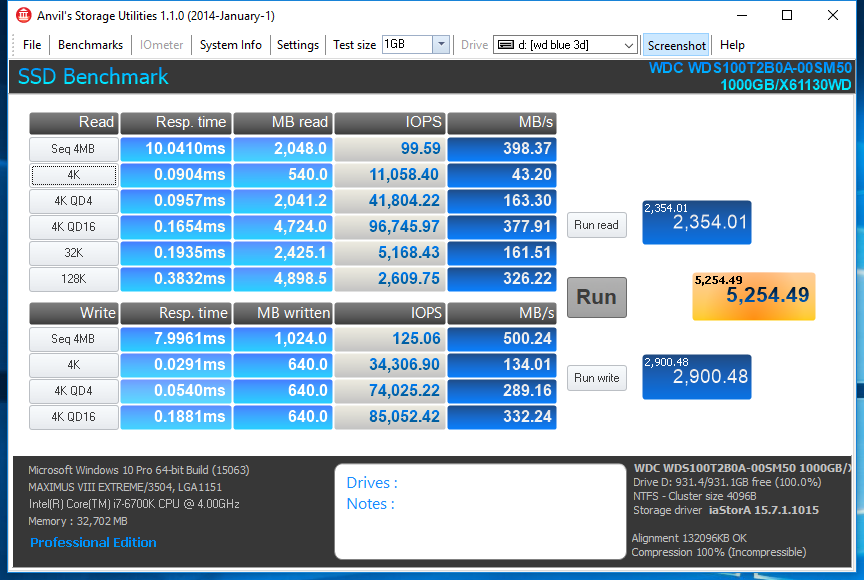
Here is the Anvil result for the WD Blue 3D -
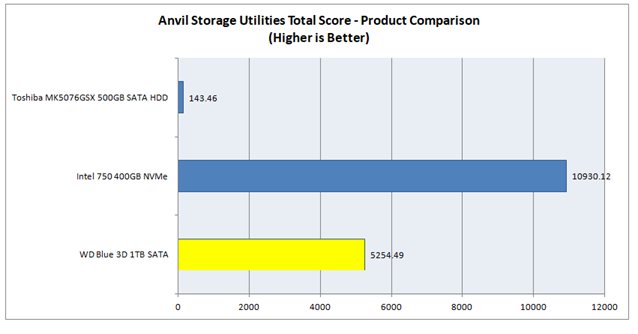
Here is a comparison of the Anvil Total score with the other
products I have tested -
Crystal Disk Mark
Crystal Disk Mark is a widely respected benchmark, which is
often used by manufacturers as a basis for publishing their ‘headline’
sequential read and write speeds. I always run the test with One Thread and a
Queue Depth of 32 (which generates a Queue Depth of 32, being the maximum Queue
Depth supported by SATA drives), a 1GB test file, Random data and 5 passes. The
benchmark performs sequential IO with an IO Size of 512K for the Seq Q32T1
test, sequential IO with an IO Size of 1MB for the Queue Depth 1 Seq test and
Random IO with an IO Size of 4K for the 4K (Queue Depth 1) and the 4K Q32T1
test.
Crystal Disk Mark can be downloaded here (I use the
standard edition).
Here is the CDM result for the WD Blue 3D -
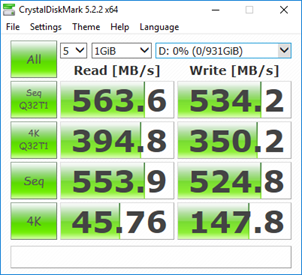
You can see that the Sequential Read and Write speeds as
specified by WD, of 560MB/s and 530MB/s respectively, have both been exceeded.
ATTO
The ATTO benchmark tests Sequential IO for a large range of
IO Sizes. I always run the test with the default Queue Depth of 4.
ATTO can be downloaded here.
Here is the ATTO result for the WD Blue 3D -
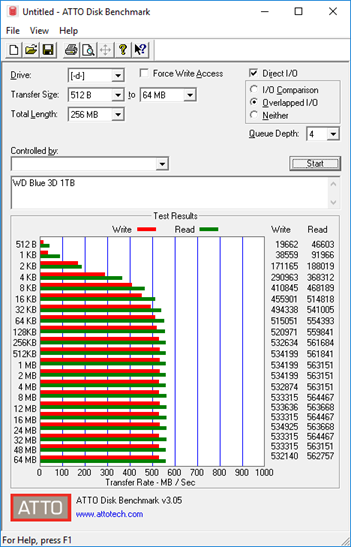
Again, you can see that the maximum Sequential Read and
Write speeds, as specified by WD, have both been exceeded.
Now let's head to the next page, to look at the results
for the Desktop PC Real World Benchmarks.....
Desktop PC – Real World Benchmark Tests
PCMark 8 Storage Benchmark 2.0
This is how Futuremark describes the PCmark 8 Storage
Benchmark –
PCMark 8 Storage benchmark is ideal for testing the
performance of SSDs, HDDs and hybrid drives.
Using traces recorded from Adobe Creative Suite,
Microsoft Office and a selection of popular games, PCMark 8 Storage highlights
real-world performance differences between storage devices. You do not need to
have these applications installed on your system to run the Storage benchmark.
The PCMark 8 Storage benchmark test contains the
following workload traces: Adobe Photoshop light, Adobe Photoshop heavy, Adobe
Illustrator, Adobe InDesign, Adobe After Effects, Microsoft Word, Microsoft
Excel, Microsoft PowerPoint, World of Warcraft and Battlefield 3
You can read a detailed description of each storage test and
how the overall score is calculated in the PCMark 8 Technical Guide by clicking
here.
The results from this benchmark are, I feel, a valuable
insight into how a drive will support real world applications.
I thank Futuremark for providing Myce with a license to use
PCMark 8 Pro.
Here is the result for the WD Blue 3D -
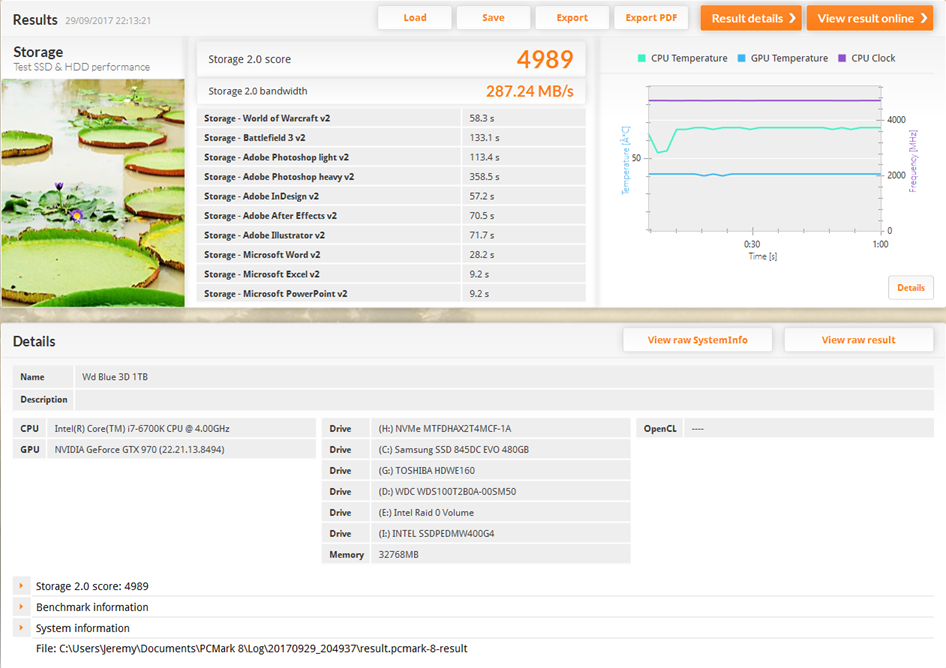
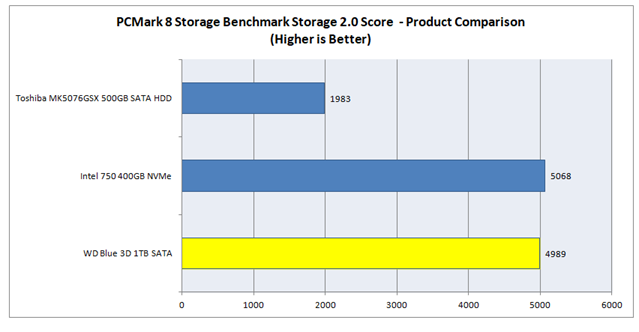
Here is a comparison of the overall score with the other
products I have tested -
File Copy Benchmarks
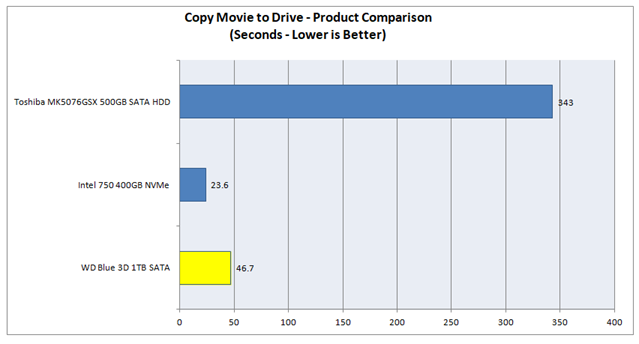
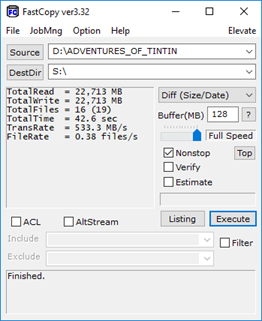
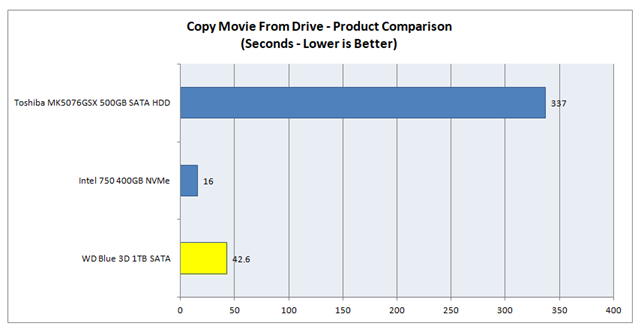
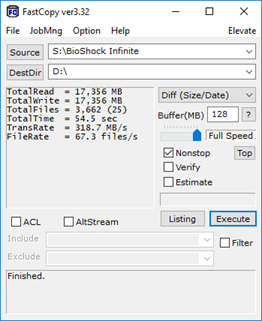
FastCopy is a useful program for recording how long copying
files to and from a drive takes. FastCopy can be downloaded here.
A Ram Disk (a virtual drive held in RAM) is used as the
source drive when a file is ‘copied to’ the test drive and is then used as the
destination when a file is ‘copied from’ the test drive. This ensures that the
test drive is on the critical path for the time taken.
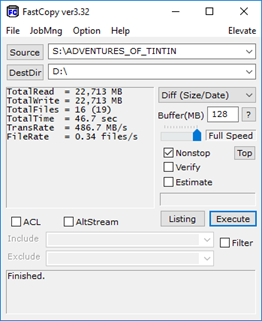
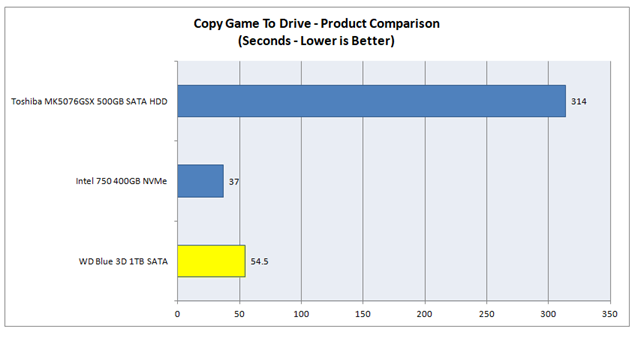
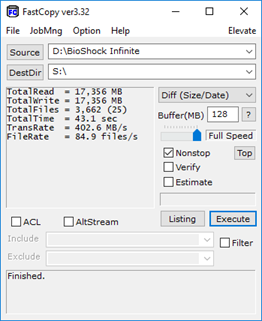
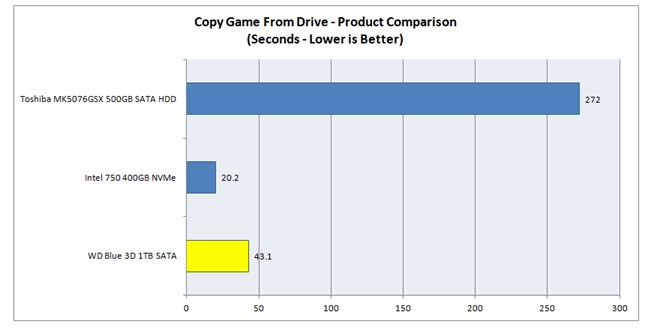
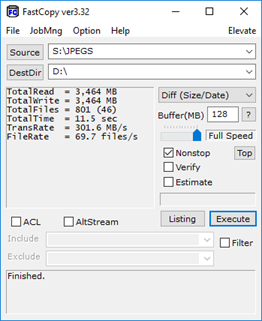
Here are the results -
Copy a Blu-ray Movie to the WD Blue 3D
Copy a Blu-ray Movie from the WD Blue 3D
Copy a Game to the WD Blue 3D
Copy a Game from the WD Blue 3D
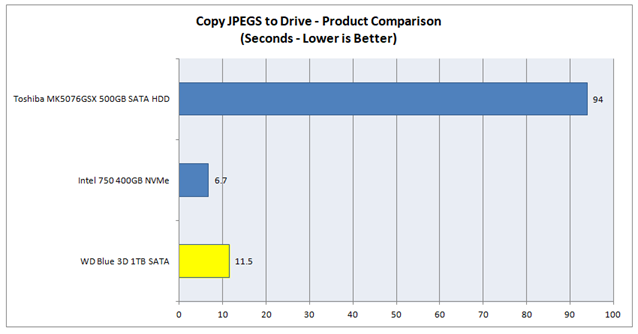
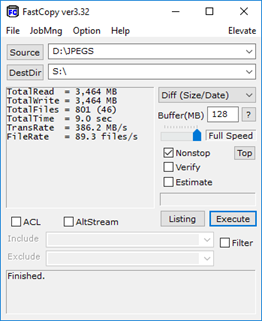
Copy a folder of JPEGs to the WD Blue 3D
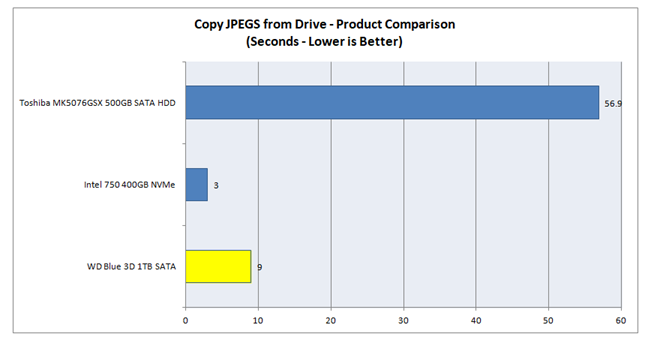
Copy a folder of JPEGs from the WD Blue 3D
Now let's head to the next page, to look at the results
for the OakGate FOB Tests.....
OakGate Platform - ‘Fresh out of Box’ Tests
These tests provide a highly consistent basis for comparing
solutions. The sequence of tests begins with a purge of the drive to ensure
that it starts in a FOB state.
The tests cover all of the essential IO performance
characteristics.
Sequential Writes
This test performs 20 seconds of Sequential Write IOs for
each combination of Queue Depths 1, 4 and 32 and IO Sizes of 4K, 128K and
1024K. IO traffic is limited to an IO Range of 1GB (which is equivalent to a
test file size of 1GB).
Here are the results for the WD Blue 3D –
[masterslider id="13"]
Here is a comparison of the 1024K, Queue Depth 32,
Sequential Write performance with the other products I have tested to date –
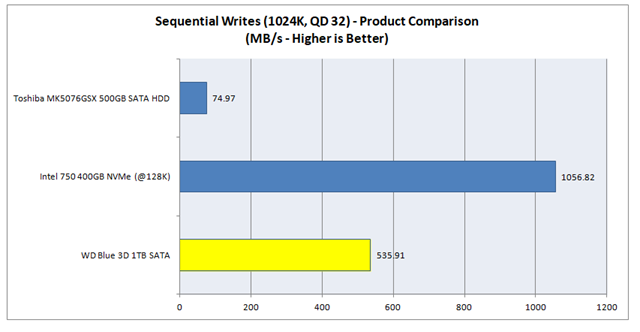
This is an excellent result which exceeds WD’s specification
of 530 MB/s.
Let’s also have a look at how the Sequential Writes Power
Consumption compares, but to do this fairly we must divide the average MB/s by
the average Milliwatts to get a value for the effective work done. Here is the
result –
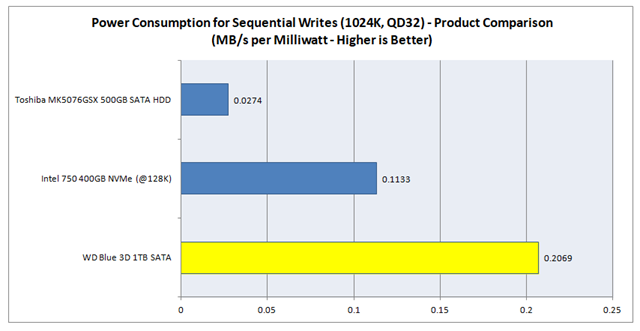
You can see that the WD Blue 1TB provides an excellent level
of power efficiency.
Sequential Reads
The test performs 20 seconds of Sequential Read IOs for each
combination of Queue Depths 1, 4, and 32, and IO Sizes of 4K, 128K, and 1024K.
IO traffic is limited to an IO Range of 1GB.
Here are the results for the WD Blue 3D –
[masterslider id="14"]
Here is a comparison of the 1024K, Queue Depth 32,
Sequential Read performance with the other products I have tested to date –
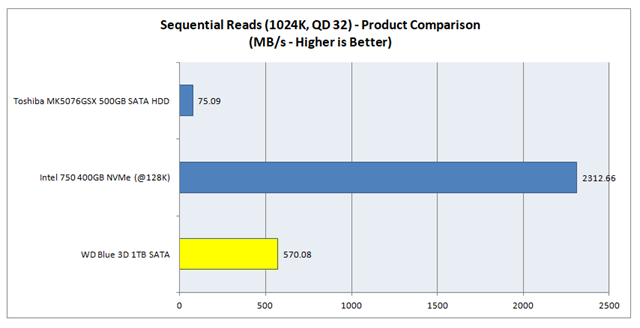
This is an excellent result for an SATA drive. The WD Blue
3D is pushing to the very limit of the SATA Bus bandwidth and it exceeds WD’s
specification of 560 MB/s.
Random Writes
The test performs 20 seconds of Random Write IOs for each
combination of Queue Depths 1, 4, and 32, and IO Sizes of 4K, 16K, and 32K. IO
traffic is limited to an IO Range of 1GB.
Here are the results for the WD Blue 3D –
[masterslider id="15"]
Here is a comparison of the 4K, Queue Depth 1, Random Write
performance with the other products I have tested to date –
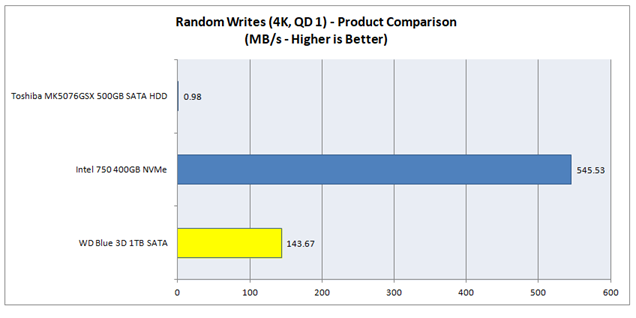
This is an excellent result for an SATA drive.
The 4K Random Write IOPS for an IO Size of 4 and Queue Depth
of 32 was 69,155, which is a long way short of WD’s specified value of 84,000
IOPS.
Let’s have a look at the Latency Distribution for the 4K, QD
1 performance –
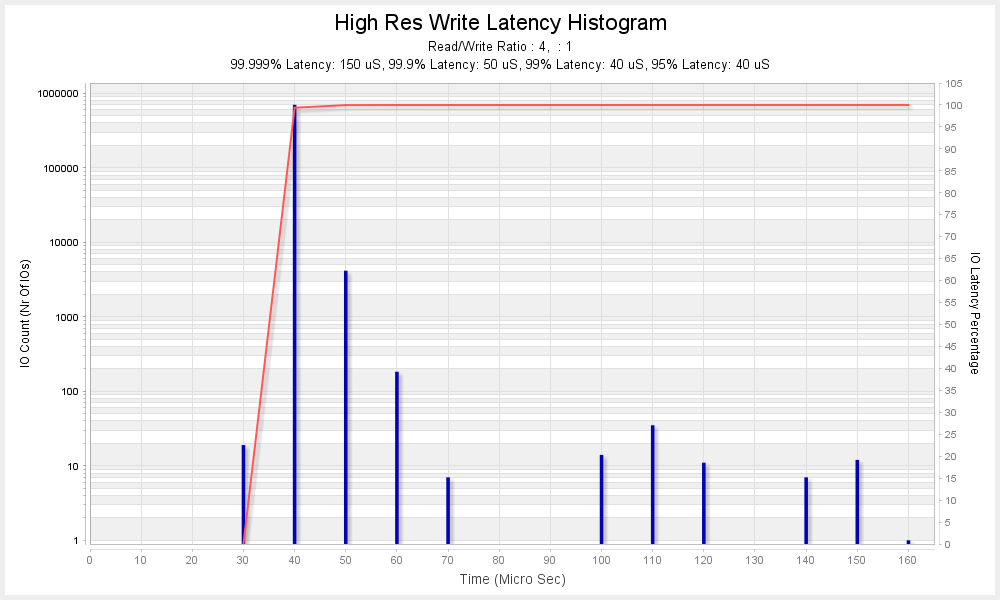
This graph shows the Latency for every IO that was performed
in the 20 seconds of traffic. It shows the Number of IOs (IO Count) that fell
within a particular period of Time (Microseconds). The red line plots the Time
for a % of the total IOs performed.
You can see that the WD Blue 3D achieves a high level of
consistency and that 99.9% of all IOs have a Latency of 50 Microseconds or
less.
Remember this test was run in an IO Range of 1GB and the WD
Blue 3D uses an SLC Write Cache. I don’t know how big the SLC Write Cache is
but I imagine it is most probably bigger than 1GB and, if so, then an IO Range
of 1GB would maximise the opportunity for Cache hits to occur (i.e. for a block
that is written to already be in the SLC Write Cache). So, I decided to rerun
this test with an IO Range of 64GB to see if performance would slow down, this
is the result –
Random Writes to an IO range of 64GB
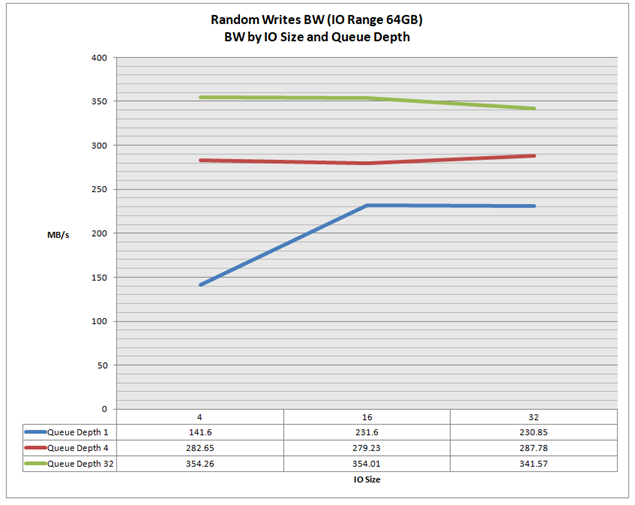
As you can see, there is a performance drop for an IO Size
of 4K and Queue Depth 32 Bandwidth has fallen from 382.95 MB/s to 354.26 MB/s.
Random Reads
The test performs 20 seconds of Random Write IOs for each
combination of Queue Depths 1, 4, and 32, and IO Sizes of 4K, 16K, and 32K. IO
traffic is limited to an IO Range of 1GB.
Here are the results for the WD Blue 3D –
[masterslider id="16"]
Here is a comparison of the 4K, Queue Depth 1, Random Read
performance with the other products I have tested to date –
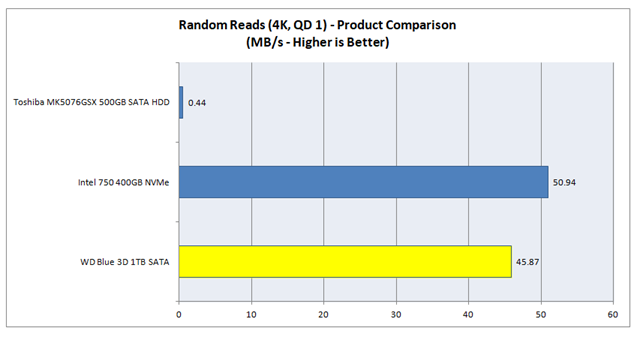
This is an excellent result for an SATA drive.
The 4K Random Read IOPS for an IO Size of 4 and Queue Depth
of 32 was 80,603, which is a long way short of WD’s specified value of 95,000
IOPS.
4K Random Mixed Reads/Writes
The test performs 20 seconds of 4K Random Mixed Reads/Writes
for each combination of Queue Depths 1, 4, and 32, and Read/Write ratios of
0/100, 30/70, 50/50, 70/30, and 100/0. IO traffic is limited to an IO Range of
1GB.
Here are the results for the WD Blue 3D –
[masterslider id="17"]
Here is a comparison of the 4K Mixed Random 50% Read/50%
Write, Queue Depth 1 performance with the other products I have tested to date
–
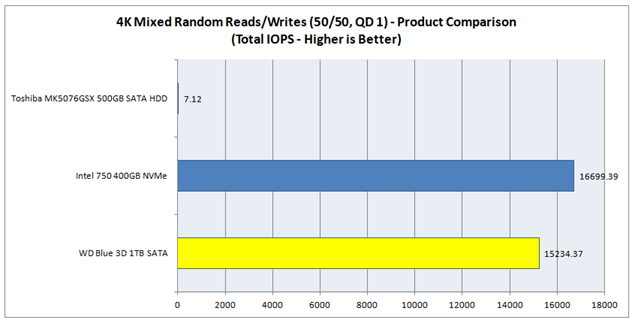
This is an excellent result.
Now let's head to the next page, to look at the results
for the Oakgate Steady State Tests.....
OakGate Test Platform - Steady State Tests
Sequential Writes to Steady State
This test starts with a purge (Secure Erase), so that the
drive is in a FOB state, and then performs 128K Sequential Writes until twice the
drive’s User Capacity has been written to.
Here is a graph showing the resulting Write Bandwidth over
time -
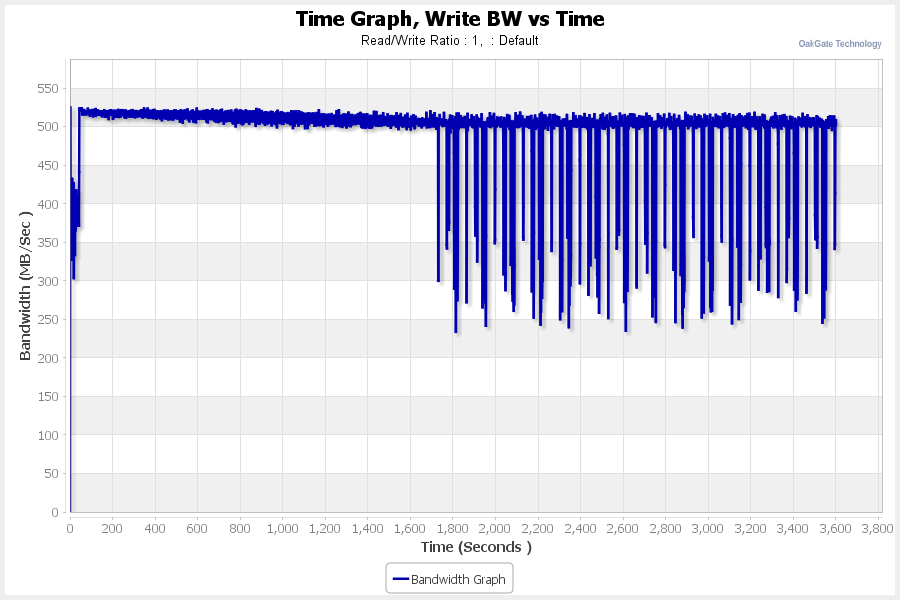
You can see that the performance level is consistent until
around 1,700 seconds when regular downward spikes in performance start to
occur. At this point all physical blocks have been written to and the drive’s
controller needs to clean blocks on the fly to accommodate the writing of new
data. The downward spikes are a classic sign of the firmware’s regular
invocation of Garbage Collection activity, which slows down performance
momentarily. However, it must be noted that the average write speed does not
slow down very much and the drops in performance would most probably not be
apparent to a user (not that it is at all likely that any normal user will ever
write this much data!).
4K Random Writes, FOB to Degraded (Steady State) to Recovered
This test is designed to fully degrade the drive’s
performance and then see how it recovers following a Trim and a period of Rest.
In this test I start with a purge
of the drive to take it to a FOB state.
- FOB Performance – 4K Random
Writes Bandwidth
I then test the FOB 4K Random
Write Performance at Queue Depths of 1 and 32, in an IO Range of 1GB, the
result was as follows –
- Sequential Writes to two times User Capacity
I then performed 128K Sequential Writes to the drive for
twice the drive’s user capacity (as in the previous Sequential Writes to Steady
State test).
- 4K Random Writes for 1 Hour
This was immediately followed by performing 4K Random Writes
to the drive for 1 hour. Here is a graph showing the resulting Bandwidth over
Time –
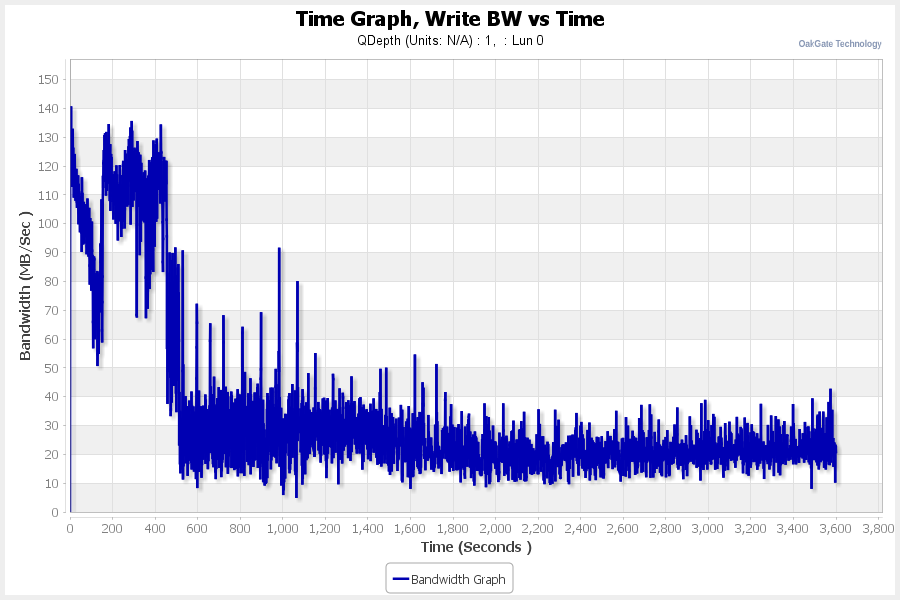
You can see that the Random 4K Write performance drops
significantly after around 500 seconds and the performance then settles and
heads towards a Steady State.
I then ask the Oakgate Test Unit to check if/when the 4K
Writes reach a Steady State, which is detected as follows -
The average IOPS performance for each of 5 consecutive
rounds of 20 seconds is calculated – the Round Values. The Allowed Range is
+/- 10% of the average of the Round Values. Steady State is achieved if all
Round Values fall within the Allowed Range and when the slope of the best
linear fit through the Round Values is <= 10% (for interest - this is how
the achievement of Steady State is verified according to the SNIA’s Performance
Test specifications)
- 4K Random Writes – Steady State Detection
Here is a graph of Bandwidth over Time for the Window in
which a Steady State condition was detected (the first 10 seconds is ignored) –
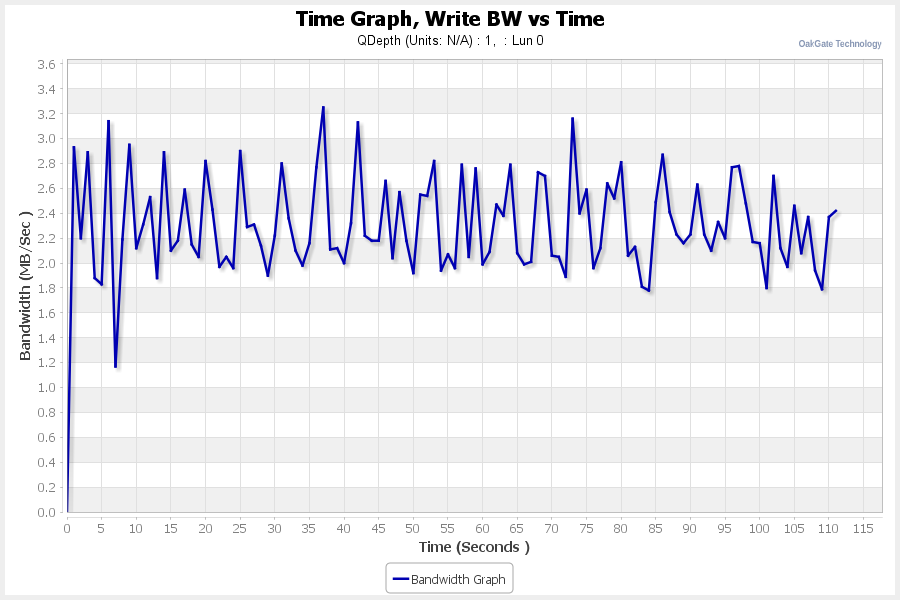
- Fully Degraded, 4K Random Write ‘Steady State’
Performance
I then immediately test the 4K Random Write Performance, in
an IO Range of 1GB (as we did in the initial FOB test), the result was as
follows -
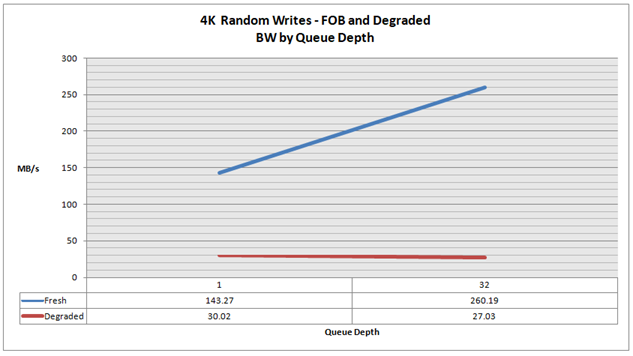
You can see that performance has dropped significantly
compared to the test performed in the FOB step. At this stage it is fair to
say that the drive’s performance is fully degraded and in a Steady State. It’s
as bad as it can get!
- Trim and Rest for 5m
I then liberally sent Sequential Trim commands to the drive
for a minute (to ensure that the drive’s entire range of logical blocks (= User
Capacity) was trimmed).
I then let the drive rest for 5 minutes before retesting 4K
Random Write performance again.
- ‘Recovered’ 4K Random Write Performance
The result was –
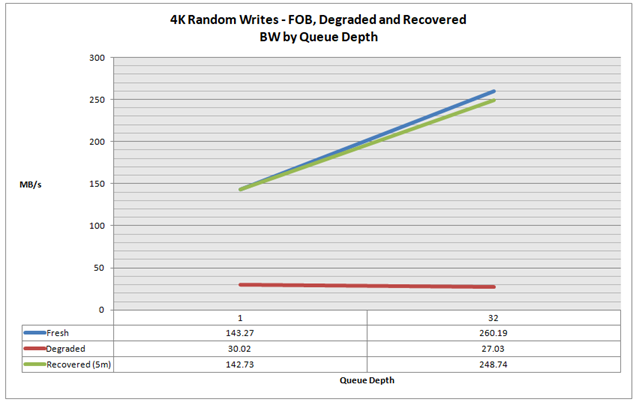
You can see that the drive has very nearly fully recovered
its FOB performance level following a Trim and a Rest for five minutes. Whilst
it is most unlikely that many users will ever degrade a drive to this extent,
it is reassuring to know that given half a chance performance the drive will recover
quickly.
Now let's head to the next page, to where the test
results for the initial Comparison drives included in this review can be
referenced...
Initial Comparison Products - Detailed Results
Intel 750 400GB NVMe SSD - Oakgate FOB Tests –
Sequential Writes
[masterslider id="18"]
Sequential Reads
[masterslider id="19"]
Random Writes
[masterslider id="45"]
Random Reads
[masterslider id="46"]
Mixed 4K Random Reads/Writes
[masterslider id="47"]
Intel 750 400GB - Desktop PC Synthetic Benchmarks
[masterslider id="48"]
Intel 750 400GB Desktop PC - Real World Benchmarks
[masterslider id="49"]
Toshiba MK5076GSX 500GB HDD - Oakgate FOB Tests –
Sequential Writes
[masterslider id="50"]
Sequential Reads
[masterslider id="51"]
Random Writes
[masterslider id="52"]
Random Reads
[masterslider id="53"]
Mixed 4K Random Reads/Writes
[masterslider id="54"]
Toshiba MK5076GSX 500GB HDD - Desktop PC Synthetic Benchmarks
[masterslider id="55"]
Toshiba MK5076GSX 500GB HDD - Desktop PC Real
World Benchmarks
[masterslider id="56"]
Now let's head to the next page, to look at the
Conclusions from this review.....
Conclusions
Throughout the testing performed in this review the gulf in
performance between an HDD and an SSD has been clear. I remember clearly the
first time I booted my PC from an SATA SSD; the difference in the
responsiveness of my system was a revelation. The truth is that the difference
in user experience between one modern SSD and another is much harder to
appreciate. This is particularly true amongst SATA SSDs where they are all
pushing the boundary of the performance level that can be achieved with a SATA
3 connection. When I upgraded from a SATA SSD to using a super fast NVMe SSD as
my boot drive, I must admit the difference did not immediately feel like a big
jump forwards and it took a while for me to really appreciate the overall level
of improvement.
So, does it matter which SATA SSD one chooses or are they
all the same? Well, I believe it still matters. For example, the WD Blue 3D
makes very effective use of an SLC Write Cache and even when writing a very
large file, there is only a momentary slow down whilst the cache pushes it
contents down to TLC NAND. However, some SSDs suffer a significant slow down once
the write cache has been filled once. So if you regularly write large files I
feel it is important you choose an SSD that has the right performance
characteristics - I know which I would choose.
With the cost effective use of 64 layer TLC 3D NAND, WD is
able to bring the WD Blue 3D to market at an excellent price point. I found
the WD Blue 3D 1TB available at scan.co.uk for GBP £303.98. So, relatively speaking,
the WD Blue 3D is inexpensive.
At the same time the WD Blue 3D delivers top notch
performance for an SATA drive even though it uses TLC NAND (and no doubt this
is, in a large part, thanks to its excellent use of an ‘SLC Write Cache’). So
what’s not to like?
The WD Blue 3D’s main competitor will probably be the
Samsung 850 EVO, which has sat at the top of value SSD league without tough
competition for a long time. I notice the price of the Samsung 850 EVO is
coming down and I suspect this is because of the newly found pressure from WD.
So, well done WD.
I am pleased to award the WD Blue 3D 1TB our rating of "Excellent"
and name it as an "Editor’s Choice".